

The DOI matches its Crossref record; 51 of the 53 references it cites were found in a registry or an index.
The International Study of Childhood Obesity, Lifestyle and the Environment (ISCOLE): design and methods
Open accessAbstract
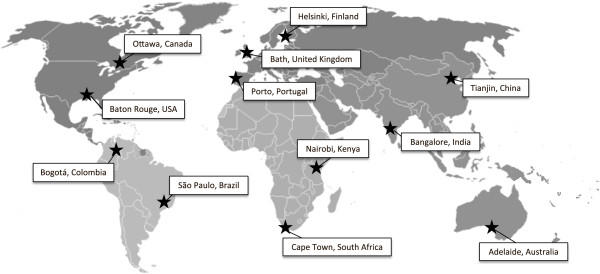
BACKGROUND: The primary aim of the International Study of Childhood Obesity, Lifestyle and the Environment (ISCOLE) was to determine the relationships between lifestyle behaviours and obesity in a multi-national study of children, and to investigate the influence of higher-order characteristics such as behavioural settings, and the physical, social and policy environments, on the observed relationships within and between countries. METHODS/DESIGN: The targeted sample included 6000 10-year old children from 12 countries in five major geographic regions of the world (Europe, Africa, the Americas, South-East Asia, and the Western Pacific). The protocol included procedures to collect data at the individual level (lifestyle, diet and physical activity questionnaires, accelerometry), family and neighborhood level (parental questionnaires), and the school environment (school administrator questionnaire and school audit tool). A standard study protocol was developed for implementation in all regions of the world. A rigorous system of training and certification of study personnel was developed and implemented, including web-based training modules and regional in-person training meetings. DISCUSSION: The results of this study will provide a robust examination of the correlates of adiposity and obesity in children, focusing on both sides of the energy balance equation. The results will also provide important new information that will inform the development of lifestyle, environmental, and policy interventions to address and prevent childhood obesity that may be culturally adapted for implementation around the world. ISCOLE represents a multi-national collaboration among all world regions, and represents a global effort to increase research understanding, capacity and infrastructure in childhood obesity.
Overview
The claims and statistics of this paper haven’t been checked yet.
Run the check — free, no account needed. It reads the open-access text and checks the sources it cites.
Integrity signals
Registry
Cites
Statistics
Figures
Verification
Claims the paper makes
The claims and statistics of this paper haven’t been checked yet.
Run the check — free, no account needed. It reads the open-access text and checks the sources it cites.
Claims other papers make about this one
Each is checked against this paper’s own text: does it say what the citing paper says it does?
In the citing paper
“We also used objective measurements for sleep and activity behaviors, a highly standardized measurement protocol, and a rigorous quality control program to ensure consistent data collection across all study sites (8).”
From Are children like werewolves? Full moon and its association with sleep and activity behaviors in an international sample of children (2016) · cites this paper as [8]
In the citing paper
“Based on an a priori power calculation analysis (8), the objective was to enroll a sex-balanced sample of at least 500 participants per site.”
From Are children like werewolves? Full moon and its association with sleep and activity behaviors in an international sample of children (2016) · cites this paper as [8]
In the citing paper
“A standard protocol was used to collect data across all sites, and all study personnel underwent rigorous training and certification to ensure the quality of collected data (8).”
From Are children like werewolves? Full moon and its association with sleep and activity behaviors in an international sample of children (2016) · cites this paper as [8]
In the citing paper
“A standard protocol was used to collect data across all sites, and all study personnel underwent rigorous training and certification before and during the data collection to ensure the quality of data collected [22].”
From Proportion of children meeting recommendations for 24-hour movement guidelines and associations with adiposity in a 12-country study (2016) · cites this paper as [22]
In the citing paper
“Body weight and height were measured according to standardized procedures by trained ISCOLE staff [22].”
From Proportion of children meeting recommendations for 24-hour movement guidelines and associations with adiposity in a 12-country study (2016) · cites this paper as [22]
In the citing paper
“In comparison to the studies mentioned above, the countries participating in ISCOLE have a much wider range of economic and social development levels [20, 22]”
From Proportion of children meeting recommendations for 24-hour movement guidelines and associations with adiposity in a 12-country study (2016) · cites this paper as [22]
Self-check
Percentages, sums and reported differences re-computed from the paper’s own numbers.
The self-check needs the paper’s full text.
Citations
Cites
Neighborhoods and Violent Crime: A Multilevel Study of Collective Efficacy
Sampson, R. J., Raudenbush, S. W., & Earls, F. (1997) · Science · doi:10.1126/science.277.5328.918 · Cited by 11,999
Obesity in children and young people: a crisis in public health
Lobstein, T., Baur, L., & Uauy, R. (2004) · Obesity Reviews · doi:10.1111/j.1467-789x.2004.00133.x · Cited by 3,801 · cited 1×
“The prevalence of childhood obesity remains high, and there are regional differences in both the level of obesity and rates of increase that have occurred over time [1,2].”
Growth, Maturation, and Physical Activity
Malina, R. M., Bouchard, C., & Bar‐Or, O. (2004) · Human Kinetics eBooks · doi:10.5040/9781492596837 · Cited by 3,383
An ecological approach to creating active living communities
Sallis, J. F., Cervero, R. B., Ascher, W., Henderson, K. A., Kraft, M. K., & Kerr, J. (2006) · Annual Review of Public Health · doi:10.1146/annurev.publhealth.27.021405.102100 · Cited by 3,296
Anthropometric Standardization Reference Manual
Lohman, T. J., Roache, A. F., & Martorell, R. (1992) · Medicine & Science in Sports & Exercise · doi:10.1249/00005768-199208000-00020 · Cited by 2,764
Creating Healthy Food and Eating Environments: Policy and Environmental Approaches
Story, M. T., Kaphingst, K. M., Robinson‐O’Brien, R., & Glanz, K. (2007) · Annual Review of Public Health · doi:10.1146/annurev.publhealth.29.020907.090926 · Cited by 2,387
An assessment of maturity from anthropometric measurements
Mirwald, R. L., Baxter-Jones, A. D. G., Bailey, D. A., & Beunen, G. P. (2002) · Medicine & Science in Sports & Exercise · doi:10.1097/00005768-200204000-00020 · Cited by 2,364
(2017) · The SHAFR Guide Online · doi:10.1163/2468-1733_shafr_sim010030025 · Cited by 2,357
National Health and Nutrition Examination Survey
Rothwell, C. J. (2009) · Springer eBooks · doi:10.1007/978-0-387-78665-0_6177 · Cited by 2,093
Currie, C. E., Zanotti, C., Morgan, A. M., Currie, D. B., de Looze, M. E., Roberts, C., Samdal, O., Smith, O. R. F., & Barnekow, V. (2012) · Cited by 1,591
Research works printed but not linked: 3
- World Health Organization: Waist Circumference and Waist-Hip Ratio: Report of a WHO Expert Consultation. Geneva, 8–11 December 2008. 2011, Geneva: World Health Organization
- Inequalities in Children’s Health: HBSC International Report from the 2005/2006 Survey. Edited by: Currie C, Gabhainn SN, Godeau E, Roberts C, Smith R, Currie D, Pickett W, Richter M, Morgan A, Barnekow V. 2008, Geneva: World Health Organization
- Joint Consortium for School Health: Healthy School Planner. 2012, Available at: http://www.healthyschoolplanner.uwaterloo.ca
Cited by
Sorted by citations
Items 101–200 of 357
Ferrari, G., Pires, C. A. M., Solé, D., Matsudo, V. K. R., Katzmarzyk, P. T., & Fisberg, M. (2018) · Jornal de Pediatria · doi:10.1016/j.jped.2017.12.003 · Cited by 35
Self-citationCorrelates of the Physical Activity Decline during Childhood
Pereira, S., Reyes, A., de Chaves, R. N., Santos, C., Vasconcelos, O., Tani, G., Katzmarzyk, P. T., Baxter-Jones, A. D. G., & Maia, J. A. R. (2022) · Medicine & Science in Sports & Exercise · doi:10.1249/mss.0000000000003013 · Cited by 37
Self-citationHarrington, D. M., Davies, M. J., Bodicoat, D. H., Charles, J. M., Chudasama, Y., Gorely, T., Khunti, K., Rowlands, A. V., Sherar, L. B., Edwards, R. T., et al. (2019) · Public Health Research · doi:10.3310/phr07050 · Cited by 32
Comparison of ActiGraph GT3X+ and Actical accelerometer data in 9–11-year-old Canadian children
Borghese, M. M., Tremblay, M. S., LeBlanc, A. G., Leduc, G., Boyer, C., & Chaput, J. (2016) · Journal of Sports Sciences · doi:10.1080/02640414.2016.1175653 · Cited by 29
Self-citationBig Data Warehouse for Healthcare-Sensitive Data Applications
Shahid, A., Nguyen, T.-A. N., & Kechadi, T. (2021) · Sensors · doi:10.3390/s21072353 · Cited by 31
Uys, M., Broyles, S. T., Draper, C. E., Hendricks, S., Rae, D. E., Naidoo, N., Katzmarzyk, P. T., & Lambert, E. V. (2016) · BMC Public Health · doi:10.1186/s12889-016-2860-0 · Cited by 30
Self-citationWilkie, H. J., Standage, M., Gillison, F., Cumming, S. P., & Katzmarzyk, P. T. (2018) · BMC Public Health · doi:10.1186/s12889-018-5382-0 · Cited by 31
Self-citationTudor-Locke, C. E., Mire, E. F., Barreira, T. V., Schuna, J. M., Chaput, J.-P., Fogelholm, M., Hu, G., Kurpad, A. V., Kuriyan, R., Lambert, E. V., et al. (2015) · International Journal of Obesity Supplements · doi:10.1038/ijosup.2015.19 · Cited by 28
Self-citationZakrzewski-Fruer, J. K., Gillison, F., Katzmarzyk, P. T., Mire, E. F., Broyles, S. T., Champagne, C. M., Chaput, J., Denstel, K. D., Fogelholm, M., Hu, G., et al. (2019) · BMC Public Health · doi:10.1186/s12889-019-6542-6 · Cited by 31
Self-citationThe Use of Accelerometers in Young Children: A Methodological Scoping Review
Breau, B., Coyle-Asbil, H. J., & Vallis, L. A. (2022) · Journal for the Measurement of Physical Behaviour · doi:10.1123/jmpb.2021-0049 · Cited by 26
Watson, A., Maher, C. A., Tomkinson, G. R., Golley, R. K., Fraysse, F., Dumuid, D., Lewthwaite, H., & Olds, T. (2019) · BMC Public Health · doi:10.1186/s12889-019-7671-7 · Cited by 28
Self-citationHammersley, M. L., Jones, R. A., & Okely, A. D. (2017) · Contemporary Clinical Trials · doi:10.1016/j.cct.2017.07.022 · Cited by 26
Whelan, J., Hayward, J., Nichols, M. S., Brown, A. D., Orellana, L., Brown, V., Becker, D., Bell, C., Swinburn, B. A., Peeters, A., et al. (2022) · BMJ Open · doi:10.1136/bmjopen-2021-057187 · Cited by 25
Outdoor time and dietary patterns in children around the world
Chaput, J., Tremblay, M. S., Katzmarzyk, P. T., Fogelholm, M., Mikkilä, V., Hu, G., Lambert, E. V., Maher, C. A., Maia, J. A. R., Olds, T., et al. (2018) · Journal of Public Health · doi:10.1093/pubmed/fdy071 · Cited by 28
Self-citationBorghese, M. M., Tremblay, M. S., Leduc, G., Boyer, C., Bélanger, P., LeBlanc, A. G., Francis, C. E., & Chaput, J. (2015) · Journal of Nutritional Science · doi:10.1017/jns.2014.72 · Cited by 23
Self-citationResults From Kenya’s 2016 Report Card on Physical Activity for Children and Youth
Onywera, V. O., Muthuri, S. K., Hayker, S., Wachira, L.-J. M., Kyallo, F., Mang’eni, R. O., Bukhala, P. W., & Mireri, C. O. (2016) · Journal of Physical Activity and Health · doi:10.1123/jpah.2016-0359 · Cited by 23
Self-citationGillison, F., Standage, M., Cumming, S. P., Zakrzewski-Fruer, J. K., Rouse, P. C., & Katzmarzyk, P. T. (2017) · Psychology of sport and exercise · doi:10.1016/j.psychsport.2017.07.004 · Cited by 23
Self-citationGonzález, S. A., Sarmiento, O. L., Lemoine, P. D., Larouche, R., Meisel, J. D., Tremblay, M. S., Vanegas, M. S. N., Broyles, S. T., Fogelholm, M., Holguin, G. A., et al. (2020) · International Journal of Environmental Research and Public Health · doi:10.3390/ijerph17113847 · Cited by 23
Self-citationPrevalence and factors associated with body mass index in children aged 9–11 years
Ferrari, G., Matsudo, V. K. R., Katzmarzyk, P. T., & Fisberg, M. (2017) · Jornal de Pediatria (Versão em Português) · doi:10.1016/j.jpedp.2017.05.003 · Cited by 23
Self-citationA model for presenting accelerometer paradata in large studies: ISCOLE
Tudor‐Locke, C., Mire, E. F., Dentro, K. N., Barreira, T. V., Schuna, J. M., Zhao, P. Z., Tremblay, M. S., Standage, M., Sarmiento, O. L., Onywera, V. O., et al. (2015) · International Journal of Behavioral Nutrition and Physical Activity · doi:10.1186/s12966-015-0213-5 · Cited by 23
Self-citationHarrison, F., van Sluijs, E. M. F., Corder, K. L., & Jones, A. (2016) · Health & Place · doi:10.1016/j.healthplace.2016.02.004 · Cited by 23
Development and Validation of the Adolescent Psychological Need Support in Exercise Questionnaire
Emm-Collison, L., Standage, M., & Gillison, F. (2016) · Journal of Sport and Exercise Psychology · doi:10.1123/jsep.2015-0220 · Cited by 24
Self-citationSullivan, S. M., Broyles, S. T., Barreira, T. V., Chaput, J., Fogelholm, M., Hu, G., Kuriyan, R., Kurpad, A. V., Lambert, E. V., Maher, C. A., et al. (2017) · Health & Place · doi:10.1016/j.healthplace.2017.05.013 · Cited by 24
Self-citationLi, N., Zhao, P. Z., Diao, C., Qiao, Y., Katzmarzyk, P. T., Chaput, J., Fogelholm, M., Kuriyan, R., Kurpad, A. V., Lambert, E. V., et al. (2019) · International Journal of Obesity · doi:10.1038/s41366-019-0329-9 · Cited by 23
Self-citationGonzález, S., Rubio, M. A., Triana, C., King, A., Banchoff, A., & Sarmiento, O. (2021) · Global Public Health · doi:10.1080/17441692.2020.1869285 · Cited by 18
Self-citationRouten, A. C., Biddle, S., Bodicoat, D. H., Cale, L., Clemes, S. A., Edwardson, C. L., Glazebrook, C., Harrington, D. M., Khunti, K. K., Pearson, N., et al. (2017) · BMJ Open · doi:10.1136/bmjopen-2017-019428 · Cited by 23
Collaborators, O. B. O. T. I. C. A. D. (., Atkin, A. J., Biddle, S., Broyles, S. T., Chinapaw, M. J. M., Ekelund, U., Esliger, D., Hansen, B. H., Kriemler, S., Puder, J. J., et al. (2017) · International Journal of Behavioral Nutrition and Physical Activity · doi:10.1186/s12966-017-0631-7 · Cited by 22
Self-citationToledo-Vargas, M., Perez-Contreras, P., Chandía-Poblete, D., & Aguilar-Farías, N. (2020) · Journal of Physical Activity and Health · doi:10.1123/jpah.2019-0672 · Cited by 22
Weaver, R. G., Tassitano, R. M., Tenório, M. C. M., Brazendale, K., & Beets, M. W. (2021) · Journal of Physical Activity and Health · doi:10.1123/jpah.2021-0254 · Cited by 22
Pan, C., Davis, R., Nichols, D., Hwang, S. H., & Hsieh, K. (2016) · Research in Developmental Disabilities · doi:10.1016/j.ridd.2016.02.018 · Cited by 21
Gillison, F., Cumming, S. P., Standage, M., Barnaby, C., & Katzmarzyk, P. T. (2017) · BMJ Open · doi:10.1136/bmjopen-2016-015769 · Cited by 21
Self-citationWeaver, R. G., Webster, C. A., Erwin, H. E., Beighle, A. E., Beets, M. W., Choukroun, H., & Kaysing, N. (2016) · Measurement in Physical Education and Exercise Science · doi:10.1080/1091367x.2016.1159208 · Cited by 21
Lewis, L. K., Maher, C. A., Katzmarzyk, P. T., & Olds, T. (2016) · Journal of School Health · doi:10.1111/josh.12357 · Cited by 20
Self-citationKatzmarzyk, P. T., Barreira, T. V., Broyles, S. T., Chaput, J.-P., Fogelholm, M., Hu, G., Kuriyan, R., Kurpad, A. V., Lambert, E. V., Maher, C. A., et al. (2015) · International Journal of Obesity Supplements · doi:10.1038/ijosup.2015.18 · Cited by 20
Self-citationEffects of a strategy for the promotion of physical activity in students from Bogotá
Gutiérrez-Martínez, L., Martínez, R. G., González, S. A., Bolívar, M. A., Valencia, O., & Sarmiento, O. L. (2018) · Revista de Saúde Pública · doi:10.11606/s1518-8787.2018052017173 · Cited by 20
Self-citationChaput, J.-P., Weippert, M., LeBlanc, A. G., Hjorth, M. F., Michaelsen, K. F., Katzmarzyk, P. T., Tremblay, M. S., Barreira, T. V., Broyles, S. T., Fogelholm, M., et al. (2016) · Frontiers in Pediatrics · doi:10.3389/fped.2016.00024 · Cited by 19
Self-citationPereira, S., Borges, A., Gomes, T. N., Santos, D., de Souza, M. C., dos Santos, F. K., de Chaves, R. N., Barreira, T. V., Hedeker, D., Katzmarzyk, P. T., et al. (2016) · Scandinavian Journal of Medicine and Science in Sports · doi:10.1111/sms.12671 · Cited by 20
Self-citationSigmund, E., Sigmundová, D., Baďura, P., & Voráčová, J. (2015) · Central European Journal of Public Health · doi:10.21101/cejph.a4181 · Cited by 19
Muthuri, S. K., Wachira, L.-J. M., Onywera, V. O., & Tremblay, M. S. (2014) · Annals of Human Biology · doi:10.3109/03014460.2014.932847 · Cited by 18
Self-citationBroyles, S. T., Drazba, K. T., Church, T. S., Chaput, J.-P., Fogelholm, M., Hu, G., Kuriyan, R., Kurpad, A. V., Lambert, E. V., Maher, C. A., et al. (2015) · International Journal of Obesity Supplements · doi:10.1038/ijosup.2015.17 · Cited by 18
Self-citationVariability and Stability in Daily Moderate-to-Vigorous Physical Activity among 10 Year Old Children
Pereira, S., Gomes, T. N., Borges, A., Santos, D., de Souza, M. C., dos Santos, F., de Chaves, R. N., Katzmarzyk, P. T., & Maia, J. A. R. (2015) · International Journal of Environmental Research and Public Health · doi:10.3390/ijerph120809248 · Cited by 18
Self-citationMosha, M., Msuya, S. E., Kasagama, E., Ayieko, P., Todd, J., & Filteau, S. (2021) · PLoS ONE · doi:10.1371/journal.pone.0249595 · Cited by 18
Olaya‐Contreras, P., Bastidas, M., & Arvidsson, D. (2014) · Journal of Physical Activity and Health · doi:10.1123/jpah.2014-0024 · Cited by 18
González, S. A., Sarmiento, O. L., Katzmarzyk, P. T., Chaput, J., Camargo, D. M., & Tremblay, M. S. (2021) · Journal of Physical Activity and Health · doi:10.1123/jpah.2020-0568 · Cited by 18
Self-citationAguilar-Farías, N., Martino-Fuentealba, P., & Chandía-Poblete, D. (2020) · Retos · doi:10.47197/retos.v37i37.71142 · Cited by 21
Gomes, T. N., Hedeker, D., dos Santos, F., de Souza, M. C., Santos, D., Pereira, S., Katzmarzyk, P. T., & Maia, J. A. R. (2017) · International Journal of Environmental Research and Public Health · doi:10.3390/ijerph14020148 · Cited by 18
Self-citationINDICADORES DE ESTILO DE VIDA E APTIDÃO CARDIORRESPIRATÓRIA DE ADOLESCENTES
de Victo, E. R., Ferrari, G., da Silva, J. P., Araújo, T. L., & Matsudo, V. K. R. (2017) · Revista Paulista de Pediatria · doi:10.1590/1984-0462/;2017;35;1;00016 · Cited by 16
Self-citationA History of Cow’s Milk Allergy Is Associated with Lower Vitamin D Status in Schoolchildren
Rosendahl, J., Fogelholm, M., Pelkonen, A. S., Mäkelä, M. J., Mäkitie, O., & Erkkola, M. (2017) · Hormone Research in Paediatrics · doi:10.1159/000478779 · Cited by 16
Self-citationReyes, A., de Chaves, R. N., Baxter-Jones, A. D. G., Vasconcelos, O., Tani, G., & Maia, J. A. R. (2018) · Annals of Human Biology · doi:10.1080/03014460.2018.1511828 · Cited by 21
Self-citationRicci, J. M., Clevenger, K. A., Sellers, S., Davenport, S., & Pfeiffer, K. A. (2020) · Sports Medicine and Health Science · doi:10.1016/j.smhs.2020.06.001 · Cited by 17
Toriola, O. O., Monyeki, M. A., & Toriola, A. L. (2015) · African Journal of Primary Health Care & Family Medicine · doi:10.4102/phcfm.v7i1.896 · Cited by 16
Sigmund, E., Baďura, P., Vokáčová, J., & Sigmundová, D. (2016) · International Journal of Environmental Research and Public Health · doi:10.3390/ijerph13070740 · Cited by 17
Qiao, Y., Zhang, T., Liu, H., Katzmarzyk, P. T., Chaput, J., Fogelholm, M., Johnson, W. D., Kuriyan, R., Kurpad, A. V., Lambert, E. V., et al. (2017) · Obesity · doi:10.1002/oby.21792 · Cited by 18
Self-citationCurtis, R., Olds, T., Fraysse, F., Dumuid, D., Hendrie, G. A., Esterman, A., Brown, W. J., Ferguson, T., Lagiseti, R., & Maher, C. A. (2021) · BMC Public Health · doi:10.1186/s12889-020-10054-3 · Cited by 15
Self-citationFerrari, G., Pires, C. A. M., Solé, D., Matsudo, V. K. R., Katzmarzyk, P. T., & Fisberg, M. (2019) · Jornal de Pediatria (Versão em Português) · doi:10.1016/j.jpedp.2017.12.014 · Cited by 16
Self-citationResults From Ghana’s 2016 Report Card on Physical Activity for Children and Youth
Ocansey, R. T.-A., Aryeetey, R., Sofo, S. S., Nazzar, A., Badasu, D. M., Pambo, P., Nyawornota, V. K., Nartey, J., & Sarkwa, R. (2016) · Journal of Physical Activity and Health · doi:10.1123/jpah.2016-0272 · Cited by 15
Chalkley, A. E., Routen, A. C., Harris, J., Cale, L., Gorely, T., & Sherar, L. B. (2018) · BMJ Open · doi:10.1136/bmjopen-2018-022176 · Cited by 16
Wood, B., Ruskin, G., & Sacks, G. (2020) · International Journal of Environmental Research and Public Health · doi:10.3390/ijerph17238996 · Cited by 16
de Souza, M. C., Eisenmann, J. C., Santos, D., de Chaves, R. N., Forjaz, C. L. M., & Maia, J. A. R. (2015) · International Journal of Obesity · doi:10.1038/ijo.2015.60 · Cited by 15
Self-citationOlds, T., Sanders, I., Maher, C. A., Fraysse, F., Bell, L., & Leslie, E. R. (2017) · Child Care Health and Development · doi:10.1111/cch.12497 · Cited by 15
Self-citationAre BMI and Sedentariness Correlated? A Multilevel Study in Children
Gomes, T. N., Katzmarzyk, P. T., dos Santos, F., de Chaves, R. N., Santos, D., Pereira, S., Champagne, C. M., Hedeker, D., & Maia, J. A. R. (2015) · Nutrients · doi:10.3390/nu7075258 · Cited by 14
Self-citation(2015) · Advances in Pediatric Research · doi:10.12715/apr.2015.2.23 · Cited by 14
Estimating sleep efficiency in 10- to- 13-year-olds using a waist-worn accelerometer
Borghese, M., Lin, Y., Chaput, J., & Janssen, I. (2017) · Sleep Health · doi:10.1016/j.sleh.2017.09.006 · Cited by 15
Self-citationNo evidence for an epidemiological transition in sleep patterns among children: a 12-country study
Manyanga, T., Barnes, J. D., Tremblay, M. S., Katzmarzyk, P. T., Broyles, S. T., Barreira, T. V., Fogelholm, M., Hu, G., Maher, C. A., Maia, J. A. R., et al. (2017) · Sleep Health · doi:10.1016/j.sleh.2017.10.010 · Cited by 14
Self-citationPearce, K. L., Golley, R. K., Lewis, L. K., Cassidy, L., Olds, T., & Maher, C. A. (2018) · Journal of School Health · doi:10.1111/josh.12631 · Cited by 15
Self-citationMartinez‐Ospina, A., Sudfeld, C. R., González, S. A., & Sarmiento, O. L. (2019) · Journal of School Health · doi:10.1111/josh.12729 · Cited by 14
Self-citationValidity of a Novel Algorithm to Detect Bedtime, Wake Time, and Sleep Time in Adults
Leister, K. R., Garay, J., & Barreira, T. V. (2022) · Journal for the Measurement of Physical Behaviour · doi:10.1123/jmpb.2021-0027 · Cited by 15
Self-citationSales, D. R. L., da Silva, J. P., Bergamo, R. R., de Oliveira, L. C., Ferrari, G., & Matsudo, V. K. R. (2023) · Scientific Reports · doi:10.1038/s41598-023-33732-9 · Cited by 21
Self-citationResults from Kenya’s 2014 Report Card on the Physical Activity and Body Weight of Children and Youth
Wachira, L.-J. M., Muthuri, S. K., Tremblay, M. S., & Onywera, V. O. (2014) · Journal of Physical Activity and Health · doi:10.1123/jpah.11.s1.s69 · Cited by 14
Self-citationManyanga, T., Barnes, J. D., Chaput, J., Dubois, L., Katzmarzyk, P. T., Mire, E. F., Prista, A., & Tremblay, M. S. (2020) · PLoS ONE · doi:10.1371/journal.pone.0228592 · Cited by 14
Self-citationKidokoro, T., Fuku, N., Yanagiya, T., Takeshita, T., Takaragawa, M., Annear, M. J., Tian, X., Waiganjo, L. B., Bogonko, L. F., Isika, J. K., et al. (2020) · International Journal of Environmental Research and Public Health · doi:10.3390/ijerph17124254 · Cited by 12
Yuan, X., Liu, Z., Zhu, J., Yu, P., Deng, Y., Chen, X., Li, N., Li, S., Yang, S., Li, J., et al. (2020) · BMC Pregnancy and Childbirth · doi:10.1186/s12884-020-03100-w · Cited by 16
Amornsriwatanakul, A., Lester, L., Rosenberg, M., & Bull, F. (2021) · PLoS ONE · doi:10.1371/journal.pone.0245906 · Cited by 13
Evaluation of the Little Rock Green Schoolyard initiative: a quasi-experimental study protocol
Barenie, M. J., Howie, E. K., Weber, K. A., & Thomsen, M. R. (2023) · BMC Public Health · doi:10.1186/s12889-023-15891-6 · Cited by 14
Are participant characteristics from ISCOLE study sites comparable to the rest of their country?
LeBlanc, A. G., Katzmarzyk, P. T., Barreira, T. V., Broyles, S. T., Chaput, J.-P., Church, T., Fogelholm, M., Harrington, D. M., Hu, G., Kuriyan, R., et al. (2015) · International Journal of Obesity Supplements · doi:10.1038/ijosup.2015.13 · Cited by 12
Self-citationLane, H., Calvert, H. G., Deitch, R., Harris, R. L., Babatunde, O. T., Turner, L. R., Hager, E. R., & Pitts, S. J. (2020) · Health & Place · doi:10.1016/j.healthplace.2020.102388 · Cited by 12
Crooks, N., Alston, L., Nichols, M., Bolton, K., Allender, S., Fraser, P., Le, H., Bliss, J., Rennie, C., Orellana, L., et al. (2021) · International Journal of Behavioral Nutrition and Physical Activity · doi:10.1186/s12966-021-01151-6 · Cited by 11
Epidemiological Influences and Requirements of Global Childhood Obesity Research
Klingelhöfer, D., Braun, M., Quarcoo, D., Brüggmann, D., & Groneberg, D. A. (2021) · Obesity Facts · doi:10.1159/000516777 · Cited by 12
Hernández-Martín, A., García‐Unanue, J., Martínez‐Rodríguez, A., Manzano-Carrasco, S., Felipe, J. L., Carvalho, M. J., Gallardo, L., & Sánchez‐Sánchez, J. (2021) · Nutrients · doi:10.3390/nu13082562 · Cited by 12
Body mass index reference curves for Tunisian children
Ghouili, H., Khalifa, W. B., Ouerghi, N., Zouaoui, M., Dridi, A., Gmada, N., & Bouassida, A. (2018) · Archives de Pédiatrie · doi:10.1016/j.arcped.2018.09.005 · Cited by 12
Pereira, S., Reyes, A., dos Santos, M. A. M., Santos, C., Gomes, T. N., Tani, G., Vasconcelos, O., Barreira, T. V., Katzmarzyk, P. T., & Maia, J. A. R. (2018) · Jornal de Pediatria · doi:10.1016/j.jped.2018.10.013 · Cited by 15
Self-citationEpidemiological Transition in Physical Activity and Sedentary Time in Children
Barreira, T. V., Broyles, S. T., Tudor‐Locke, C., Chaput, J., Fogelholm, M., Hu, G., Kuriyan, R., Lambert, E. V., Maher, C. A., Maia, J. A. R., et al. (2019) · Journal of Physical Activity and Health · doi:10.1123/jpah.2018-0546 · Cited by 12
Self-citationDukhi, N., Sartorius, B. K. D., & Taylor, M. (2020) · BMC Public Health · doi:10.1186/s12889-020-8272-1 · Cited by 12
Nakabazzi, B., Wachira, L.-J. M., Oyeyemi, A. L., Ssenyonga, R., & Onywera, V. O. (2020) · PLoS ONE · doi:10.1371/journal.pone.0235211 · Cited by 13
Self-citationBernhardsson, S., Boman, C., Lundqvist, S., Arvidsson, D., Börjesson, M., Larsson, M. E. H., Lundh, H., Melin, K., Nilsén, P., & Lauruschkus, K. (2022) · Pilot and Feasibility Studies · doi:10.1186/s40814-022-01075-3 · Cited by 20
Boberska, M., Horodyska, K., Kruk, M., Knoll, N., Hohl, D. H., Keller, J., & Łuszczyńska, A. (2019) · British Journal of Health Psychology · doi:10.1111/bjhp.12354 · Cited by 12
Praxedes, P., Maia, J., Santos, C., Garbeloto, F., Hedeker, D., Barreira, T., Garganta, R., Farias, C., Tani, G., Chaput, J., et al. (2024) · American Journal of Human Biology · doi:10.1002/ajhb.24108 · Cited by 14
Self-citationWatson, A., Dumuid, D., & Olds, T. (2020) · Health Education & Behavior · doi:10.1177/1090198120952041 · Cited by 11
Self-citationPereira, S., Katzmarzyk, P. T., Hedeker, D., Barreira, T. V., Garganta, R., Farias, C. F. G., Garbeloto, F., Tani, G., Chaput, J., Stodden, D. F., et al. (2023) · American Journal of Human Biology · doi:10.1002/ajhb.23968 · Cited by 17
Self-citationUnique contributions of ISCOLE to the advancement of accelerometry in large studies
Tudor‐Locke, C., Barreira, T. V., Schuna, J. M., & Katzmarzyk, P. T. (2015) · International Journal of Obesity Supplements · doi:10.1038/ijosup.2015.20 · Cited by 11
Self-citationGuerra, A. M., Montes, F., Useche, A. F., Jaramillo, A. M., González, S. A., Meisel, J. D., Obando, C., Cardozo, V., Hunter, R. F., & Sarmiento, O. L. (2020) · International Journal of Environmental Research and Public Health · doi:10.3390/ijerph17165796 · Cited by 11
Self-citationdos Santos, M., Ferrari, G., Drenowatz, C. J., Estivaleti, J. M., de Victo, E. R., de Oliveira, L. C., & Matsudo, V. K. R. (2022) · BMC Pediatrics · doi:10.1186/s12887-022-03641-3 · Cited by 9
Self-citationAbadi, M. R. H., Kwaghbo, N., Onyeso, O. K., Sadia, F., Castro, J. K. B., Silva, D. A. S., Yan, Y., Shen, Y., Hamřík, Z., Sarmiento, O. L., et al. (2025) · Sports Medicine · doi:10.1007/s40279-025-02270-x · Cited by 10
Self-citationResults From Zimbabwe’s 2016 Report Card on Physical Activity for Children and Youth
Manyanga, T., Makaza, D., Mahachi, C. B., Mlalazi, T. F., Masocha, V., Makoni, P., Tapera, E., Khumalo, B., Rutsate, S. H., & Tremblay, M. S. (2016) · Journal of Physical Activity and Health · doi:10.1123/jpah.2016-0304 · Cited by 10
Self-citationMiatke, A., Maher, C. A., Fraysse, F., Dumuid, D., & Olds, T. (2021) · BMC Public Health · doi:10.1186/s12889-021-11420-5 · Cited by 10
Self-citationCanadian children's independent mobility during the COVID-19 pandemic: A national survey
Larouche, R., Bélanger, M. F., BRUSSONI, M. J., Faulkner, G., Gunnell, K. E., & Tremblay, M. S. (2023) · Health & Place · doi:10.1016/j.healthplace.2023.103019 · Cited by 10
Self-citationSalvo, D., Varela, A. R., & Jáuregui, A. (2022) · Journal of Physical Activity and Health · doi:10.1123/jpah.2022-0374 · Cited by 9
Larouche, R., Abadi, M. R. H., Aubert, S., Bhawra, J., Brazo‐Sayavera, J., Carson, V., Colley, R. C., Nyström, C. D., Esliger, D., Harper-Brown, R., et al. (2024) · BMJ Open · doi:10.1136/bmjopen-2023-082275 · Cited by 13
Self-citationEckermann, S. D., & Willan, A. R. (2021) · Journal of Public Health · doi:10.1007/s10389-021-01649-0 · Cited by 9
Mosha, M., Paulo, H. A., Msuya, S. E., Grosskurth, H., & Filteau, S. (2022) · BMC Nutrition · doi:10.1186/s40795-022-00529-4 · Cited by 9
Metadata
- Authors
- Katzmarzyk, P. T., Barreira, T. V., Broyles, S. T., Champagne, C. M., Chaput, J.-P., Fogelholm, M., Hu, G., Johnson, W. D., Kuriyan, R., Kurpad, A., Lambert, E. V., Maher, C., Maia, J., Matsudo, V., Olds, T., Onywera, V., Sarmiento, O. L., Standage, M., Tremblay, M. S., Tudor-Locke, C., Zhao, P., & Church, T. S.
- Affiliations
- Pennington Biomedical Research Center (US)
- Children's Hospital of Eastern Ontario (CA)
- University of Helsinki (FI)
- St. John's Research Institute (IN)
- University of Cape Town (ZA)
- University of South Australia (AU)
- Universidade do Porto (PT)
- Centro de Estudos do Laboratório de Aptidão Física de São Caetano do Sul (BR)
- Kenyatta University (KE)
- Universidad de Los Andes (CO)
- University of Bath (GB)
- Tianjin Women's and Children's Health Center (CN)
- Corresponding author
- Katzmarzyk, Peter T
- ORCID
- Katzmarzyk, Peter T
- Barreira, Tiago V
- Broyles, Stephanie T
- Champagne, Catherine M
- Chaput, Jean-Philippe
- Fogelholm, Mikael
- Hu, Gang
- Johnson, William D
- Kuriyan, Rebecca
- Kurpad, Anura
- Lambert, Estelle V
- Maher, Carol
- Maia, José
- Matsudo, Victor
- Olds, Tim
- Onywera, Vincent
- Sarmiento, Olga L
- Standage, Martyn
- Tremblay, Mark S
- Tudor-Locke, Catrine
- Church, Timothy S
- Venue
- BMC Public Health
- Published
- 2013-09-30
- Volume
- 13
- Issue
- 1
- Pages
- 900-900
- ISSN
- 1471-2458 (ISSN-L)
- PMC
- PMC3849927
- OpenAlex
- W2163068346
- Cited by
- 357
- References
- 53
- Citations by year
- 2026: 7 · 2025: 9 · 2024: 16 · 2023: 27 · 2022: 16 · 2021: 38 · 2020: 36 · 2019: 25 · 2018: 36 · 2017: 38 · 2016: 36 · 2015: 47 · 2014: 25 · 2013: 1
- FWCI
- 37.15
- Type
- journal article
- Language
- en
- Open access
- gold
- doi.org
- Licence
- Locations
- BMC Public Health (publishedVersion, cc-by)
- Europe PMC (PubMed Central) (publishedVersion, cc-by)
- PubMed Central (publishedVersion, cc-by)
- PubMed (publishedVersion)
- The University of Bath Online Publications Store (The University of Bath) (submittedVersion, cc-by)
- Pure (University of Bath) (submittedVersion, cc-by)
- Työväentutkimus Vuosikirja (submittedVersion)
- Kenyatta University Institutional Repository (Kenyatta University) (submittedVersion)
- uO Research (University of Ottawa) (submittedVersion, public-domain)
- UniSA Research Outputs Repository (University of South Australia) (submittedVersion, other-oa)
- Greater South Information System
- Funders
- Coca-Cola Foundation
- Wake Forest University
- University of South Australia
- Topics
- Health Sciences › Medicine › Public Health, Environmental and Occupational Health › Obesity, Physical Activity, Diet
- Health Sciences › Medicine › Public Health, Environmental and Occupational Health › Physical Activity and Health
- Health Sciences › Medicine › Public Health, Environmental and Occupational Health › Obesity and Health Practices
- Keywords
- childhood obesity, lifestyle habits, energy balance, physical activity, diet, accelerometry, school environment, neighborhood environment, parental influence, environmental policy, cross-national comparison, multinational study, obesity prevention
- MeSH terms
- Anthropometry, Child, Cross-Sectional Studies, Female, Health Promotion, Humans, International Cooperation, Life Style, Male, Research Design, Schools, Social Environment, Pediatric Obesity
About these checks
Registry, retraction, Cites and statistics results are computed, not judged, with one exception: a printed reference that no index lists is read once by a model before it counts as a citation error. Claims are extracted by a model and kept only when their quote appears verbatim in the text; each cited source is then checked, with a model’s help, for whether it says what the claim relies on. Those verdicts can be wrong — read the claim’s quote and the cited source before relying on one.
Statistics and arithmetic are recomputed, not judged.
Confidence bands are shown only for fields calibrated on our annotated test set. None is calibrated yet, so no band is shown.
What counts as a claim ›How we measure confidence ›How we check this ›
Are you an author, or do you see a problem with this page? Request a review
