

Exploration of pathways related to the decline in female circumcision in Egypt
Open accessThe DOI matches its Crossref record; 17 of the 19 references it cites were found in a registry or an index.
Abstract
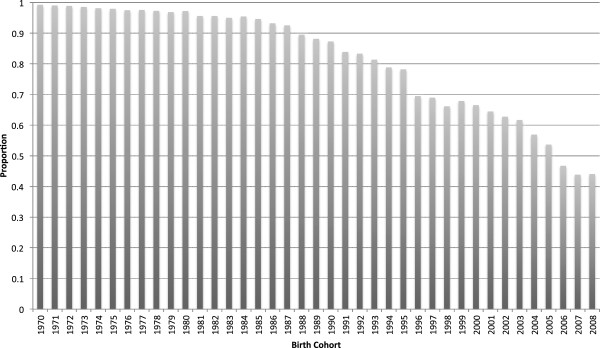
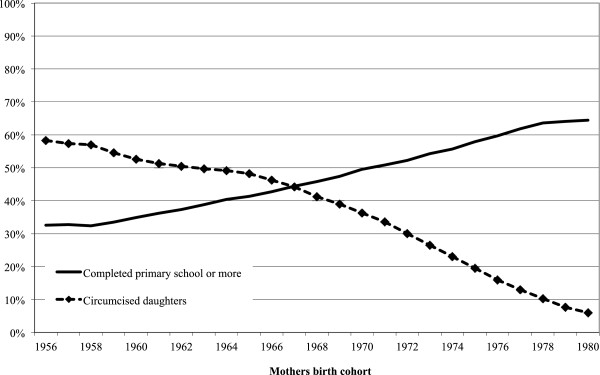
BACKGROUND: There has been a large decline in female genital circumcision (FGC) in Egypt in recent decades. Understanding how this change has occurred so rapidly has been an area of particular interest to policymakers and public health officials alike who seek to further discourage the practice elsewhere. METHODS: We document the trends in this decline in the newest cohorts of young girls and explore the influences of three pathways--socioeconomic development, social media messages, and women's empowerment--for explaining the observed trends. Using the 2005 and 2008 Egypt Demographic and Health Surveys, we estimate several logistic regression models to (1) examine individual and household determinants of circumcision, (2) assess the contributions of different pathways through which these changes may have occurred, and (3) assess the robustness of different pathways when unobserved community differences are taken into account. RESULTS: Across all communities, socioeconomic status, social media messages, and women's empowerment all have significant independent effects on the risk of circumcision. However, after accounting for unobserved differences across communities, only mother's education and household wealth significantly predict circumcision outcomes. Additional analyses of maternal education suggest that increases in women's education may be causally related to the reduction in FGC prevalence. CONCLUSIONS: Women's empowerment and social media appear to be more important in explaining differences across communities; within communities, socioeconomic status is a key driver of girls' circumcision risk. Further investigation of community-level women's educational attainment for mothers suggests that investments made in female education a generation ago may have had echo effects on girls' FGC risk a generation later.
Overview
The claims and statistics of this paper haven’t been checked yet.
Free: it reads the open-access text and checks the first 5 claims that cite a source we can check. Create a free account to check every claim.
Integrity signals
Registry
Cites
Statistics
Figures
Verification
Claims the paper makes
The claims and statistics of this paper haven’t been checked yet.
Free: it reads the open-access text and checks the first 5 claims that cite a source we can check. Create a free account to check every claim.
Claims other papers make about this one
Each is checked against this paper’s own text: does it say what the citing paper says it does?
The cited source says what the claim attributes to it.
In the citing paper
“In the wake of sharp criticism, this policy was changed, but a loophole allowing for “medically necessary circumcision” was not closed until 2007 [ 38 ].”
From Medicalized Female Genital Mutilation/Cutting: Contentious Practices and Persistent Debates (2018) · cites this paper as [38]
Self-check
Percentages, sums and reported differences re-computed from the paper’s own numbers.
The self-check needs the paper’s full text.
Citations
Cites
Specification Tests in Econometrics
Hausman, J. A. (1978) · Econometrica · doi:10.2307/1913827 · Cited by 18,820 · cited 1×
“000 [19]).”
(2013) · Reproductive Health Matters · doi:10.1016/s0968-8080(13)42747-7 · Cited by 410
Female "circumcision" in Africa: culture, controversy, and change
(2001) · Choice Reviews Online · doi:10.5860/choice.38-3970 · Cited by 369
Female Genital Surgeries: The Known, the Unknown, and the Unknowable
Obermeyer, C. M. (1999) · Medical Anthropology Quarterly · doi:10.1525/maq.1999.13.1.79 · Cited by 214 · cited 1×
“Although anthropologists have highlighted some differences in the significance of the practice across regions [1], FGC has been recognized as an entrenched cultural practice across the northern sub-Saharan region and along the Nile Valley, where it is thought to have originated.”
BackgroundFemale Circumcision in Egypt: Social Implications, Current Research, and Prospects for Change
Assaad, M. B. (1980) · Studies in Family Planning · doi:10.2307/1965892 · Cited by 160 · cited 3×
“[3,12,20]), a new round of studies is needed to understand the rapidly changing context in which circumcision preferences and practices are also changing, particularly with respect to gender roles, religion, and concepts of modernity.”
BackgroundFemale genital cutting in the demographic and health surveys: a critical and comparative analysis
Yoder, P. S., Abderrahim, N., & Zhuzhuni, A. (2004) · Cited by 154
Estimates of Female Genital Mutilation/Cutting in 27 African Countries and Yemen
Yoder, P. S., Wang, S., & Johansen, R. E. B. (2013) · Studies in Family Planning · doi:10.1111/j.1728-4465.2013.00352.x · Cited by 122 · cited 1×
“Understanding how FGC has declined internationally and in Egypt in particular is an area of active research [13].”
BackgroundPrevalence of female genital cutting among Egyptian girls
Tag-Eldin, M. A., Gadallah, M. A., Al-Tayeb, M. N., Abdel-Aty, M., Mansour, E., & Sallem, M. (2008) · Bulletin of the World Health Organization · doi:10.2471/blt.07.042093 · Cited by 122 · cited 4×
“Tag-Eldin and colleagues also provide descriptive evidence from a nationally representative sample of schoolgirls that development and modernization may also be important drivers of declining FGC [5].”
BackgroundResultInfluentialThe decline of female circumcision in Egypt: evidence and interpretation
El-Gibaly, O., Ibrahim, B., Mensch, B. S., & Clark, W. H. (2002) · Social Science & Medicine · doi:10.1016/s0277-9536(01)00020-x · Cited by 121 · cited 4×
“While there is some evidence that FGCspecific social media messages have influenced changes in popular attitudes [15], the evidence linking changes in girls’ circumcision risk to the 1994 ICPD event itself is only suggestive [4].”
BackgroundInfluentialJohansen, R. E. B., Diop, N. J., Laverack, G., & Leye, E. (2013) · Obstetrics and Gynecology International · doi:10.1155/2013/348248 · Cited by 108 · cited 1×
“Internationally, research has focused on studying the myriad of strategies that have been used to increase knowledge on the health risks associated with circumcision through social media messages, conversion of circumcision practitioners’ beliefs, public statements against the practice, and the imposition of laws bann…”
Background
Research works printed but not linked: 2
- The Population Council Survey of young people in Egypt: final report 2011 Cairo http://www.popcouncil.org/pdfs/2010PGY_SYPEFinalReport.pdf
- Hauslohner A Egypt strengthens ban on female genital cutting, Reuters: online edn 2007 Thomson Reuters: Cairo, Egypt
Cited by
Female genital mutilation/cutting in Africa
Odukogbe, A.-T. A., Afolabi, B. B., Bello, O. O., & Adeyanju, A. S. (2017) · Translational Andrology and Urology · doi:10.21037/tau.2016.12.01 · Cited by 135
“messages in the social media account for the decline in the practice of FGM/C (67).”
BackgroundA state-of-the-art synthesis on female genital mutilation/cutting: What do we know now?
Shell-Duncan, B., Naik, R., & Feldman-Jacobs, C. (2016) · doi:10.31899/rh8.1002 · Cited by 80
Mengistu, T. S., Lakew, Y., & Deribe, K. (2016) · PLoS ONE · doi:10.1371/journal.pone.0145329 · Cited by 77
Medicalized Female Genital Mutilation/Cutting: Contentious Practices and Persistent Debates
Kimani, S., & Shell-Duncan, B. (2018) · Current Sexual Health Reports · doi:10.1007/s11930-018-0140-y · Cited by 65
Female Genital Mutilation. Overview and Current Knowledge
Andro, A., Lesclingand, M., Grieve, M., & Reeve, P. (2016) · Population (English Edition) · doi:10.3917/popu.1602.0224 · Cited by 108
Rossem, R. V., Meekers, D., & Gage, A. J. (2015) · BMC Public Health · doi:10.1186/s12889-015-2203-6 · Cited by 67
“The results discussed above support earlier findings that female opposition to FGM is most pronounced among well-educated women [5, 6, 9, 33, 43, 45, 46, 53].”
ResultGajaa, M., Wakgari, N., Kebede, Y., & Gezie, L. D. (2016) · BMC Women s Health · doi:10.1186/s12905-016-0322-6 · Cited by 43
“This study finding is comparable with several studies conducted [25–28].”
ResultGrose, R. G., Hayford, S. R., Cheong, Y. F., Garver, S., Kandala, N., & Yount, K. M. (2019) · Journal of Health and Social Behavior · doi:10.1177/0022146518821870 · Cited by 60
Matanda, D. J., Eekert, N. V., Croce‐Galis, M., Gay, J., Middelburg, A., & Hardee, K. (2023) · PLOS Global Public Health · doi:10.1371/journal.pgph.0001855 · Cited by 67
Abdelshahid, A., & Campbell, C. (2014) · Journal of Community & Applied Social Psychology · doi:10.1002/casp.2195 · Cited by 48
Female Genital Mutilation in Sudan
Elduma, A. H. (2018) · Open Access Macedonian Journal of Medical Sciences · doi:10.3889/oamjms.2018.099 · Cited by 34
“So, this finding conforms with other studies reported from both Ethiopia and Egypt where the low education level is related to a high rate of FGM [19][20].”
ResultKandala, N., Nnanatu, C. C., Atilola, G. O., Komba, P. N., Mavatikua, L., Moore, Z., Mackie, G. L., & Shell‐Duncan, B. (2019) · International Journal of Environmental Research and Public Health · doi:10.3390/ijerph16214155 · Cited by 35
Rossem, R. V., Meekers, D., & Gage, A. J. (2016) · International Journal for Equity in Health · doi:10.1186/s12939-016-0324-x · Cited by 25
“A number of other studies have found that highly educated and urban women are more likely believe that FGM should be discontinued [30], and that wealthier women and better educated women are less likely to intend to have their daughters cut [8, 31, 32].”
BackgroundResultTrends in medicalisation of female genital mutilation/cutting: What do the data reveal?
Shell‐Duncan, B., Njue, C., & Moore, Z. (2018) · doi:10.31899/rh6.1038 · Cited by 30
“A “loophole”, however, allowed for “medically necessary circumcision,” (Modrek & Liu, 2013) and was not closed until 2007 by a Ministerial Decree prohibiting doctors, nursing staff, or others from performing FGM/C, whether in governmental or non-governmental hospitals.”
BackgroundSocial norm coordination and readiness to change female genital cutting: Evidence from Senegambia
Wander, K., & Shell‐Duncan, B. (2020) · SSM - Population Health · doi:10.1016/j.ssmph.2020.100593 · Cited by 19
Intergenerational Transmission of Female Genital Cutting: Community and Marriage Dynamics
Boyle, E. H., & Svec, J. (2019) · Journal of Marriage and the Family · doi:10.1111/jomf.12560 · Cited by 19
“In support of the theory, studies of FGC consistently find that women with more human capital are more likely to oppose FGC (Boyle, McMorris, & Gomez, 2002; Hayford, 2005; Modrek & Liu, 2013; Williams & Sobieszczyk, 1997).”
ResultUnprogrammed abandonment of female genital mutilation/cutting
Engelsma, B., Mackie, G. L., & Merrell, B. (2020) · World Development · doi:10.1016/j.worlddev.2019.104845 · Cited by 15
Rossem, R. V., & Meekers, D. (2020) · BMC Women s Health · doi:10.1186/s12905-020-00954-2 · Cited by 17
“Discussion The literature on FGM in Egypt suggests that the prevalence of FGM is declining and that an increasing proportion of girls no longer get cut [10, 32, 37, 47, 49, 55, 60, 61].”
BackgroundGlover, J., Liebling, H., Goodman, S., & Barrett, H. R. (2018) · Journal of international women's studies · Cited by 48
Female genital mutilation/cutting in sudan and subsequent pelvic floor dysfunction
Birge, Ö., Serin, A. N., & Bakır, M. S. (2021) · BMC Women s Health · doi:10.1186/s12905-021-01576-y · Cited by 11
“As shown in many studies we found that non-employed and noneducated women were more likely to have undergone FGM/C so the significance of women’s education to eradicate the practice of FGM/C is obvious [3, 7, 14, 24, 25].”
ResultShabila, N. P. (2021) · BMC Women s Health · doi:10.1186/s12905-021-01282-9 · Cited by 11
“Similar to the current study, another study from Egypt suggested that increases in women’s education might be causally related to reducing the prevalence of FGM [31].”
ResultEekert, N. V., Leye, E., & de Velde, S. M. V. (2018) · International Perspectives on Sexual and Reproductive Health · doi:10.1363/44e6618 · Cited by 12
Religion, family structure, and the perpetuation of female genital cutting in Egypt
Blaydes, L., & Izama, M. P. (2020) · Journal of Demographic Economics · doi:10.1017/dem.2020.15 · Cited by 11
“In addition, high levels of exposure to FGC-related media messaging may also be associated with reduced support for FGC (Modrek and Liu 2013).”
BackgroundResultInfluentialAlemu, A. A. (2021) · International Journal of Women s Health · doi:10.2147/ijwh.s287643 · Cited by 8
Estimating excess mortality due to female genital mutilation
Ghosh, A., Flowe, H. D., & Rockey, J. C. (2023) · Scientific Reports · doi:10.1038/s41598-023-38276-6 · Cited by 9
Shell‐Duncan, B., Naik, R., & Feldman-Jacobs, C. (2016) · Cited by 8
Ending the medicalization of female genital mutilation/cutting in Egypt
Ghattass, S., Abdel-Tawab, N. G., & Hussein, S. (2016) · doi:10.31899/rh8.1000 · Cited by 8
Tesema, G. A., Agegnehu, C. D., Teshale, A. B., Alem, A. Z., Liyew, A. M., Yeshaw, Y., & Kebede, S. A. (2020) · BMC Public Health · doi:10.1186/s12889-020-08882-4 · Cited by 6
The effect of female circumcision on maternal and neonatal outcomes after childbirth: a cohort study
Rabiepour, S., & Ahmadi, Z. S. (2023) · BMC Pregnancy and Childbirth · doi:10.1186/s12884-022-05316-4 · Cited by 12
“This finding is consistent with Ethiopia and Egypt’s reports about this health problem [20, 21], which indicated the outbreak of females’ circumcision is associated with lower educational background among families.”
ResultMostafa, A., Gaballah, S. A., & Amin, G. E. E.-D. (2020) · Reproductive Health · doi:10.1186/s12978-020-00941-8 · Cited by 3
Zaky, H. H. M., Armanious, D. M., & Kalliny, M. A. (2024) · BMC Women s Health · doi:10.1186/s12905-023-02863-6 · Cited by 2
“Modrek and Liu [18] mentioned that female circumcision has a significant impact on women’s empowerment, as socio-economic status is the main driver of girls’ circumcision risk.”
BackgroundAdolescents’ Sexual and Reproductive Health in the Arab World
Wahba, M. (2021) · Springer eBooks · doi:10.1007/978-3-030-36811-1_100 · Cited by 2
Katz, I., Sanders, R., Carvalho, M. N., Friedman, H. S., Legesse, B., Winfrey, W. L., & Diop, N. (2021) · PLoS ONE · doi:10.1371/journal.pone.0244946 · Cited by 4
“The intervention-based reductions are in addition to the reductions in incidence associated with historic trends due to previous interventions, as well as education and other social and economic dynamics, which are estimated to avert an additional 46 million cases of FGM by 2050 (historic trends and the interventions…”
BackgroundKandala, N., Komba, P. N., Nnanatu, C. C., Atilola, G. O., Mavatikua, L., Moore, Z., & Matanda, D. J. (2020) · doi:10.31899/rh11.1041 · Cited by 5
Ontological Analysis of the Research on the Use of Social Media for Health Behavior Change
Thirumalai, M., & Ramaprasad, A. (2015) · Hawaii International Conference on System Sciences (HICSS) · doi:10.1109/hicss.2015.103 · Cited by 2
Salama, I. I., Sami, S. M., Salama, S. I., Elmosalami, D. M., Saleh, R. M., Said, Z. N. A., Shaaban, F. A., Mohsen, A. M. A., Rabah, T. M., Elshaarawy, G. A., et al. (2021) · Open Access Macedonian Journal of Medical Sciences · doi:10.3889/oamjms.2021.5827 · Cited by 1
“It is performed for females in certain countries for cultural considerations [4] and inhibiting sexual feelings [5].”
BackgroundThe effect of training in pregnant women on beliefs and intention to do FGM
Mojahed, S., Shekari, M., Bokaie, M., & Dehghani, A. (2021) · Journal Of Advanced Pharmacy Education And Research · doi:10.51847/wm4e80chde · Cited by 1
Zsabokorszky, Z., de Velde, S. M. V., Michielsen, K., & Eekert, N. V. (2023) · Frontiers in Sociology · doi:10.3389/fsoc.2023.1183989 · Cited by 1
“, 2017), progressive views on sexuality, such as men prefer to marry uncut women, and that FGM/C can reduce sexual desire (Afifi and Von Bothmer, 2007), and higher level of female empowerment (Afifi, 2009; Modrek and Liu, 2013; Van Rossem et al., 2015).”
BackgroundAdolescents’ Sexual and Reproductive Health in the Arab World
Wahba, M. (2019) · Springer eBooks · doi:10.1007/978-3-319-74365-3_100-1 · Cited by 1
Schubert, K. A. (2016) · Wiley eBooks · doi:10.1002/9781119085621.wbefs203 · Cited by 1
The Persistence of Female Genital Cutting in West Africa
Novak, L. (2017) · University of Minnesota Digital Conservancy (University of Minnesota)
Alia Mohammed, K., Ali, S., Mohammed, K., Abbasa Ahmed, M., & Ahmed, M. (2020) · Annals of Gynecology and Obstetrics · doi:10.36959/468/474 · Cited by 1
Female Genital Mutilation/Cutting is continued problem
Rohym, H. H., Mahmoud, H. S., & Salah, A. (2023) · The Egyptian Journal of Forensic Sciences and Applied Toxicology · doi:10.21608/ejfsat.2023.186230.1286
Novo estudo revela que mutilação genital feminina é a principal causa de morte de meninas na África
Flowe, H. D., Rockey, J. C., & Ghosh, A. (2025) · doi:10.64628/ade.dkrwqjg7f
Mostafa, A., Gaballah, S. A., & Amin, G. E. (2020) · Figshare · doi:10.6084/m9.figshare.12463094
Khalifa, S. (2023) · theses.fr (ABES) · doi:10.70675/3025a1abz927dz4329z9f8fz8ee7733f6714
Metadata
- Authors
- Modrek, S., & Liu, J. X.
- Affiliations
- Stanford Medicine (US)
- University of California, San Francisco (US)
- Corresponding author
- Modrek, Sepideh
- Venue
- BMC Public Health
- Published
- 2013-10-03
- Volume
- 13
- Issue
- 1
- Pages
- 921-921
- ISSN
- 1471-2458 (ISSN-L)
- PMC
- PMC3835453
- OpenAlex
- W2155747472
- Cited by
- 47
- References
- 19
- Citations by year
- 2025: 1 · 2024: 1 · 2023: 6 · 2021: 8 · 2020: 9 · 2019: 4 · 2018: 5 · 2017: 2 · 2016: 8 · 2015: 2 · 2014: 1
- FWCI
- 3.74
- Type
- journal article
- Language
- en
- Open access
- gold
- doi.org
- Licence
- Locations
- BMC Public Health (publishedVersion, cc-by)
- Europe PMC (PubMed Central) (publishedVersion, cc-by)
- PubMed Central (publishedVersion, cc-by)
- PubMed (publishedVersion)
- eScholarship (California Digital Library) (submittedVersion)
- Funders
- National Institutes of Health
- National Institute on Aging (T32AG000244)
- Topics
- Health Sciences › Medicine › Public Health, Environmental and Occupational Health › Female Genital Mutilation/Cutting Issues
- Health Sciences › Medicine › Surgery › Genital Health and Disease
- Social Sciences › Gender Studies › Demographic Trends and Gender Preferences
- Keywords
- female genital mutilation, socioeconomic status, social media posts, women's empowerment, maternal education, household wealth, echo effect, community-level determinants, Egypt
- MeSH terms
- Adolescent, Adult, Egypt, Female, Health Surveys, Humans, Middle Aged, Power, Psychological, Socioeconomic Factors, Women, Circumcision, Female, Young Adult, Social Media
About these checks
Registry, retraction, Cites and statistics results are computed, not judged, with one exception: a printed reference that no index lists is read once by a model before it counts as a citation error. Claims are extracted by a model and kept only when their quote appears verbatim in the text; each cited source is then checked, with a model’s help, for whether it says what the claim relies on. Those verdicts can be wrong — read the claim’s quote and the cited source before relying on one.
Statistics and arithmetic are recomputed, not judged.
Confidence bands are shown only for fields calibrated on our annotated test set. None is calibrated yet, so no band is shown.
What counts as a claim ›How we measure confidence ›How we check this ›
Are you an author, or do you see a problem with this page? Request a review
Data sources
Bibliographic data: Semantic Scholar, OpenAlex, Crossref.
Contains information from the Semantic Scholar Academic Graph Datasets, made available under the ODC Attribution License (ODC-BY 1.0).
Semantic Scholar’s data is described in: Kinney, R., et al. (2023). The Semantic Scholar Open Data Platform. arXiv:2301.10140.
