

The DOI matches its Crossref record; 42 of the 45 references it cites were found in a registry or an index.
A cross-sectional, population-based study measuring comorbidity among people living with HIV in Ontario
Open accessAbstract
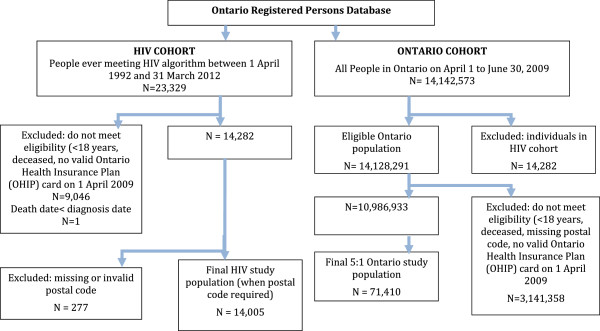
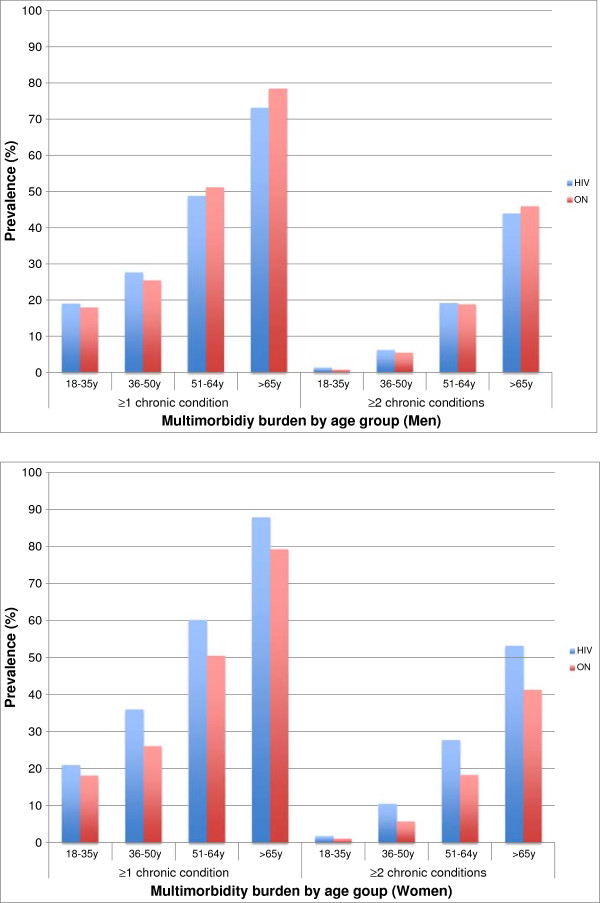
BACKGROUND: As people diagnosed with HIV and receiving combination antiretroviral therapy are now living longer, they are likely to acquire chronic conditions related to normal ageing and the effects of HIV and its treatment. Comordidities for people with HIV have not previously been described from a representative population perspective. METHODS: We used linked health administrative data from Ontario, Canada. We applied a validated algorithm to identify people with HIV among all residents aged 18 years or older between April 1, 1992 and March 31, 2009. We randomly selected 5 Ontario adults who were not identified with HIV for each person with HIV for comparison. Previously validated case definitions were used to identify persons with mental health disorders and any of the following physical chronic diseases: diabetes, congestive heart failure, acute myocardial infarction, stroke, hypertension, asthma, chronic obstructive lung disease, peripheral vascular disease and end-stage renal failure. We examined multimorbidity prevalence as the presence of at least two physical chronic conditions, or as combined physical-mental health multimorbidity. Direct age-sex standardized rates were calculated for both cohorts for comparison. RESULTS: 34.4% (95% confidence interval (CI) 33.6% to 35.2%) of people with HIV had at least one other physical condition. Prevalence was especially high for mental health conditions (38.6%), hypertension (14.9%) and asthma (12.7%). After accounting for age and sex differences, people with HIV had significantly higher prevalence of all chronic conditions except myocardial infarction and hypertension, as well as substantially higher multimorbidity (prevalence ratio 1.30, 95% CI 1.18 to 1.44) and combined physical-mental health multimorbidity (1.79, 95% CI 1.65 to 1.94). Prevalence of multimorbidity among people with HIV increased with age. The difference in prevalence of multimorbidity between the two cohorts was more pronounced among women. CONCLUSION: People living with HIV in Ontario, especially women, had higher prevalence of comorbidity and multimorbidity than the general population. Quantifying this morbidity at the population level can help inform healthcare delivery requirements for this complex population.
Overview
The claims and statistics of this paper haven’t been checked yet.
Run the check — free, no account needed. It reads the open-access text and checks the sources it cites.
Integrity signals
Registry
Cites
Statistics
Figures
Verification
Claims the paper makes
The claims and statistics of this paper haven’t been checked yet.
Run the check — free, no account needed. It reads the open-access text and checks the sources it cites.
Claims other papers make about this one
Each is checked against this paper’s own text: does it say what the citing paper says it does?
The source backs part of the claim, not all of it — or backs it for a different population, condition or comparison.
In the citing paper
“Οι ψυχικές διαταραχές, πιο συγκεκριμένα, παραμένουν έως και σήμερα οι συχνότερες συννοσηρότητες στη λοίμωξη HIV, με ποσοστά επίπτωσης που έχουν εκτιμηθεί έως και στο 50%, πολύ υψηλότερα σε σχέση με τον γενικό πληθυσμό και με ομάδες ανθρώπων που πάσχουν από άλλα χρόνια νοσήματα. 7-9”
From Clinical presentation and requests for support of people with HIV/AIDS seeking counselling and psychotherapy in Greece (2019) · cites this paper as [8]
Experimental — accuracy not yet measuredThe source backs part of the claim, not all of it — or backs it for a different population, condition or comparison.
In the citing paper
“Σε συμφωνία με την προηγούμενη βιβλιογραφία γύρω από τις ψυχιατρικές εκδηλώσεις στη λοίμωξη HIV, 7-10 στο δείγμα της παρούσας έρευνας βρέθηκε ότι η συχνότητα των αγχωδών διαταραχών, της κατάθλιψης, της προβληματικής χρήσης αλκοόλ και άλλων ψυχοτρόπων ουσιών και της αυτοκτονικής συμπεριφοράς είναι ιδιαίτερα υψηλή μεταξύ των ανθρώπων που ζουν με HIV.”
From Clinical presentation and requests for support of people with HIV/AIDS seeking counselling and psychotherapy in Greece (2019) · cites this paper as [8]
Experimental — accuracy not yet measured
Self-check
Percentages, sums and reported differences re-computed from the paper’s own numbers.
The self-check needs the paper’s full text.
Citations
Cites
Barnett, K., Mercer, S. W., Norbury, M., Watt, G., Wyke, S., & Guthrie, B. (2012) · The Lancet · doi:10.1016/s0140-6736(12)60240-2 · Cited by 6,972
Statistical Methods in Cancer Research. Volume II – The Design and Analysis of Cohort Studies
Juul, S. (1989) · Scandinavian Journal of Social Medicine · doi:10.1177/140349488901700214 · Cited by 3,602
Statistical methods in cancer research. Volume II--The design and analysis of cohort studies.
Breslow, N. E., & Day, N. E. (1987) · PubMed · Cited by 1,684
Guaraldi, G., Orlando, G., Zona, S., Menozzi, M., Carli, F., Garlassi, E., Berti, A., Rossi, E., Roverato, A., & Palella, F. (2011) · Clinical Infectious Diseases · doi:10.1093/cid/cir627 · Cited by 1,331
Hux, J. E., Ivis, F. J., Flintoft, V. F., & Bica, A. (2002) · Diabetes Care · doi:10.2337/diacare.25.3.512 · Cited by 1,290
Aberg, J. A., Kaplan, J. E., Libman, H., Emmanuel, P. J., Anderson, J., Stone, V. E., Oleske, J. M., Currier, J. S., & Gallant, J. E. (2009) · Clinical Infectious Diseases · doi:10.1086/605292 · Cited by 831
Huntley, A. L., Johnson, R., Purdy, S., Valderas, J. M., & Salisbury, C. (2012) · The Annals of Family Medicine · doi:10.1370/afm.1363 · Cited by 619
Morbidity and Aging in HIV-Infected Persons: The Swiss HIV Cohort Study
Hasse, B. K., Ledergerber, B., Furrer, H., Battegay, M., Hirschel, B. J., Cavassini, M. L., Bertisch, B., Bernasconi, E., Weber, R. K., & Study, T. S. H. C. (2011) · Clinical Infectious Diseases · doi:10.1093/cid/cir626 · Cited by 608
Chronic Illness Management: What Is the Role of Primary Care?
Rothman, A. A., & Wagner, E. H. (2003) · Annals of Internal Medicine · doi:10.7326/0003-4819-138-3-200302040-00034 · Cited by 566
Accuracy of administrative databases in identifying patients with hypertension.
Tu, K., Campbell, N. R. C., Chen, Z., Cauch‐Dudek, K., & McAlister, F. A. (2007) · PubMed Central · Cited by 553
Research works printed but not linked: 7
- Dahrouge S, Devline RA, Hogg B, Russell G, Coyle D, Fergusson D: The economic impact of improvements in primary healthcare performance. 2012, Ottawa: Canadian Health Services Research Foundation
- Matheson FI, Dunn JR, Smith KLW, Moineddin R, Glazier RH: Canadian marginalization index user guide. 2012, Toronto, ON: Canadian Journal of Public Health
- Kralj B: Measuring “rurality” for purposes of health care planning: an empirical measure for Ontario. Ont Med Rev. 2000, 67: 33-52.
- Canadian Institue for Health Information: Making sense of health indicators: statisical considerations. 2010, Ottawa, ON: CIHI
- Broemeling A, Watson D, Black C: Chronic conditions and co-morbidity among residents of British Columbia. 2005, Vancouver, BC, Canada: Centre for Health Services and Policy Research
- Public Health Agency of Canada: HIV/AIDS epi update: national HIV prevalence and incidence estimates in Canada for 2008. 2010, Ottawa, Ontario, Canada: Surveillance and Risk Assessment Division, Centre for Communicable Diseases and Infection Control
- Glazier RH, Zagorski BM, Rayner J: Comparison of primary care models in Ontario by demographics, case mix and emergency department use, 2008/09 to 2009/10. ICES investigative report. 2012, Toronto, Ontario: ICES Investigative Report. Toronto: Institute for Clinical Evaluative Sciences; 2012
Cited by
Sorted by citations
Mental health and HIV/AIDS: the need for an integrated response
Remien, R. H., Stirratt, M. J., Nguyen, N., Robbins, R. N., Pala, A. N., & Mellins, C. A. (2019) · AIDS · doi:10.1097/qad.0000000000002227 · Cited by 727
Bigna, J. J., Kenne, A. M., Asangbeh, S. L., & Sibetcheu, A. T. (2017) · The Lancet Global Health · doi:10.1016/s2214-109x(17)30451-5 · Cited by 182
Multimorbidity Among Persons Living with Human Immunodeficiency Virus in the United States
Wong, C., Gange, S. J., Moore, R. D., Justice, A. C., Buchacz, K. A., Abraham, A. G., Rebeiro, P. F., Koethe, J. R., Martin, J. N., Horberg, M. A., et al. (2017) · Clinical Infectious Diseases · doi:10.1093/cid/cix998 · Cited by 186
The challenge of HIV treatment in an era of polypharmacy
Back, D. J., & Marzolini, C. (2020) · Journal of the International AIDS Society · doi:10.1002/jia2.25449 · Cited by 181
Mental Health in Women Living With HIV: The Unique and Unmet Needs
Waldron, E. M., Burnett‐Zeigler, I., Wee, V., Ng, Y. K. W., Koenig, L. J., Pederson, A. B., Tomaszewski, E. P., & Miller, E. S. (2021) · Journal of the International Association of Providers of AIDS Care (JIAPAC) · doi:10.1177/2325958220985665 · Cited by 174
Metadata
- Authors
- Kendall, C. E., Wong, J., Taljaard, M., Glazier, R. H., Hogg, W., Younger, J., & Manuel, D. G.
- Affiliations
- Bruyère (CA)
- McGill University (CA)
- University of Ottawa (CA)
- University of Toronto (CA)
- Ottawa Hospital Research Institute (CA)
- Corresponding author
- Kendall, Claire E
- Venue
- BMC Public Health
- Published
- 2014-02-13
- Volume
- 14
- Issue
- 1
- Pages
- 161-161
- ISSN
- 1471-2458 (ISSN-L)
- PMC
- PMC3933292
- OpenAlex
- W2144007968
- Cited by
- 213
- References
- 45
- Citations by year
- 2026: 8 · 2025: 13 · 2024: 11 · 2023: 20 · 2022: 24 · 2021: 27 · 2020: 22 · 2019: 26 · 2018: 16 · 2017: 14 · 2016: 15 · 2015: 10 · 2014: 6
- FWCI
- 16.06
- Type
- journal article
- Language
- en
- Open access
- gold
- doi.org
- Licence
- Locations
- BMC Public Health (publishedVersion, cc-by)
- Europe PMC (PubMed Central) (publishedVersion, cc-by)
- PubMed Central (publishedVersion, cc-by)
- PubMed (publishedVersion)
- uO Research (University of Ottawa) (submittedVersion, public-domain)
- TSpace (University of Toronto) (submittedVersion)
- Funders
- University of Ottawa
- Ottawa Hospital Research Institute
- Public Health Agency of Canada
- Institute for Clinical Evaluative Sciences
- Ontario Ministry of Health and Long-Term Care
- University of Toronto
- Canadian Institutes of Health Research
- Topics
- Health Sciences › Medicine › Infectious Diseases › HIV-related health complications and treatments
- Health Sciences › Medicine › Infectious Diseases › HIV/AIDS Research and Interventions
- Health Sciences › Medicine › Epidemiology › Chronic Disease Management Strategies
- Keywords
- HIV, multimorbidity, comorbidities, chronic disease, mental illness, hypertension, asthma, diabetes mellitus, women living with HIV, age differences, Ontario
- MeSH terms
- Adolescent, Adult, Aged, Aging, Chronic Disease, Cross-Sectional Studies, Diabetes Mellitus, Type 2, Female, Heart Failure, Humans, Hypertension, Kidney Failure, Chronic, Male, Middle Aged, Ontario, Retrospective Studies, Sex Factors, Cohort Studies, HIV Infections, Comorbidity, Prevalence
About these checks
Registry, retraction, Cites and statistics results are computed, not judged, with one exception: a printed reference that no index lists is read once by a model before it counts as a citation error. Claims are extracted by a model and kept only when their quote appears verbatim in the text; each cited source is then checked, with a model’s help, for whether it says what the claim relies on. Those verdicts can be wrong — read the claim’s quote and the cited source before relying on one.
Statistics and arithmetic are recomputed, not judged.
Confidence bands are shown only for fields calibrated on our annotated test set. None is calibrated yet, so no band is shown.
What counts as a claim ›How we measure confidence ›How we check this ›
Are you an author, or do you see a problem with this page? Request a review
