

The DOI matches its Crossref record; 30 of the 30 references it cites were found in a registry or an index.
Epidemiology of frequent attenders: a 3-year historic cohort study comparing attendance, morbidity and prescriptions of one-year and persistent frequent attenders
Open accessAbstract
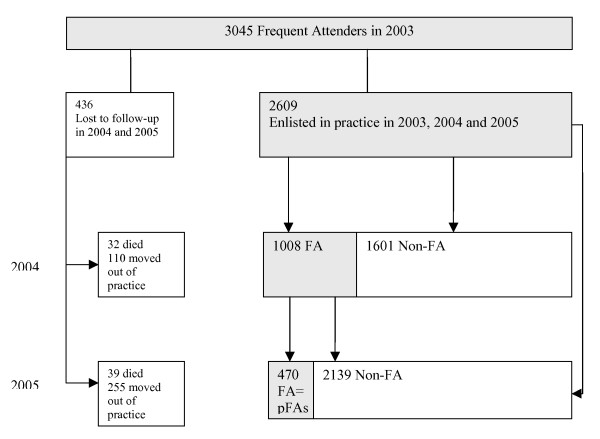
BACKGROUND: General Practitioners spend a disproportionate amount of time on frequent attenders. So far, trials on the effect of interventions on frequent attenders have shown negative results. However, these trials were conducted in short-term frequent attenders. It would be more reasonable to target intervention at persistent frequent attenders. Typical characteristics of persistent frequent attenders, as opposed to 1-year frequent attenders and non-frequent attenders, may generate hypotheses regarding modifiable factors on which new randomized trials may be designed. METHODS: We used the data of all 28,860 adult patients from 5 primary healthcare centers. Frequent attenders were patients whose attendance rate ranked in the (age and sex adjusted) top 10 percent during 1 year (1-year frequent attenders) or 3 years (persistent frequent attenders). All other patients on the register over the 3-year period were referred to as non-frequent attenders. The lists of medical problems coded by the GP using the International Classification of Primary Care (ICPC) were used to assess morbidity.First, we determined which proportion of 1-year frequent attenders was still a frequent attender during the next two consecutive years and calculated the GPs' workload for these patients. Second, we compared morbidity and number of prescriptions for non-frequent attenders, 1-year frequent attenders and persistent frequent attenders. RESULTS: Of all 1-year frequent attenders, 15.4% became a persistent frequent attender equal to 1.6% of all patients. The 1-year frequent attenders (3,045; 10.6%) were responsible for 39% of the face-to-face consultations; the 470 patients who would become persistent frequent attenders (1.6%) were responsible for 8% of all consultations in 2003. Persistent frequent attenders presented more social problems, more psychiatric problems and medically unexplained physical symptoms, but also more chronic somatic diseases (especially diabetes). They received more prescriptions for psychotropic medication. CONCLUSION: One out of every seven 1-year-frequent attenders (15.4%) becomes a persistent frequent attender. Compared with non-frequent attenders, and 1-year frequent attenders, persistent frequent attenders consume more health care and are diagnosed not only with more somatic diseases but especially more social problems, psychiatric problems and medically unexplained physical symptoms.
Overview
The claims and statistics of this paper haven’t been checked yet.
Run the check — free, no account needed. It reads the open-access text and checks the sources it cites.
Integrity signals
Registry
Cites
Statistics
Figures
Verification
Claims the paper makes
The claims and statistics of this paper haven’t been checked yet.
Run the check — free, no account needed. It reads the open-access text and checks the sources it cites.
Claims other papers make about this one
Each is checked against this paper’s own text: does it say what the citing paper says it does?
The cited source says what the claim attributes to it.
In the citing paper
“Defined in this way, most frequent attenders return to normal consultation rates within 12months. 12”
From Cognitive behaviour therapy for long-term frequent attenders in primary care: A feasibility case series and treatment development study (2016) · cites this paper as [12]
The cited source says what the claim attributes to it.
In the citing paper
“Even then the threshold was not high enough to apply the clinical differentiation suggested, 12 and did not report change in service use.”
From Cognitive behaviour therapy for long-term frequent attenders in primary care: A feasibility case series and treatment development study (2016) · cites this paper as [12]
Self-check
Percentages, sums and reported differences re-computed from the paper’s own numbers.
The self-check needs the paper’s full text.
Citations
Cites
A structural approach to selection bias
Hernán, M. A., Hernández-Díaz, S., & Robins, J. M. (2004) · Epidemiology · doi:10.1097/01.ede.0000135174.63482.43 · Cited by 2,844
International Classification of Primary Care
Bentsen, B. G. (1986) · Scandinavian Journal of Primary Health Care · doi:10.3109/02813438609013970 · Cited by 900
(2021) · Croatian Medical Journal · doi:10.3325/cmj · Cited by 403
Systematic review of scope and quality of electronic patient record data in primary care
Thiru, K., Hassey, A., & Sullivan, F. (2003) · BMJ · doi:10.1136/bmj.326.7398.1070 · Cited by 342
Randomized Trial of a Depression Management Program in High Utilizers of Medical Care
Katzelnick, D. J. (2000) · Archives of Family Medicine · doi:10.1001/archfami.9.4.345 · Cited by 331
Hansagi, H., Olsson, M., Sjöberg, S., Tomson, Y., & Göransson, S. (2001) · Annals of Emergency Medicine · doi:10.1067/mem.2001.111762 · Cited by 318
Vedsted, P., & Christensen, M. B. (2004) · Public Health · doi:10.1016/j.puhe.2004.03.007 · Cited by 247
Frequent attenders with medically unexplained symptoms: service use and costs in secondary care
Reid, S., Wessely, S. C., Crayford, T. J. B., & Hotopf, M. H. (2002) · The British Journal of Psychiatry · doi:10.1192/bjp.180.3.248 · Cited by 223
Persistent presentation of medically unexplained symptoms in general practice
Verhaak, P. F. M. (2006) · Family Practice · doi:10.1093/fampra/cml016 · Cited by 211
Cost-effectiveness of Systematic Depression Treatment for High Utilizers of General Medical Care
Simon, G. E., Manning, W. G., Katzelnick, D. J., Pearson, S. D., Henk, H. J., & Helstad, C. P. (2001) · Archives of General Psychiatry · doi:10.1001/archpsyc.58.2.181 · Cited by 199
Research works printed but not linked: 1
- Carney TA, Guy S, Jeffrey G: Frequent attenders in general practice: a retrospective 20-year follow-up study. Br J Gen Pract. 2001, 51: 567-569.
Cited by
Sorted by citations
Items 101–138 of 138
Hanssen, D. J. C., van Driel, D. T. J. W., Hilderink, P. H., Benraad, C. E. M., Naarding, P., Hartman, T. O., Lucassen, P. L., & Voshaar, R. C. O. (2020) · European Psychiatry · doi:10.1192/j.eurpsy.2020.51 · Cited by 4
Smits, F., Brouwer, H. J., & ter Riet, G. (2010) · British Journal of General Practice · doi:10.3399/bjgp10x484002 · Cited by 4
Self-citationvan den Bussche, H., Niemann, D., Kaduszkiewicz, H., Schäfer, I., Koller, D., Hansen, H., Scherer, M., Glaeske, G., & Schön, G. (2013) · Zeitschrift für Evidenz Fortbildung und Qualität im Gesundheitswesen · doi:10.1016/j.zefq.2013.09.001 · Cited by 3
Santalahti, A., Luutonen, S. H., Vahlberg, T. J., Moen, H., Salanterä, S., & Rautava, P. T. (2021) · Journal of Primary Care & Community Health · doi:10.1177/21501327211024417 · Cited by 3
The effects of physical activity prescription on mental health: Evidence from primary care
Hernández-Pizarro, H. M., & Maynou, L. (2024) · Economics & Human Biology · doi:10.1016/j.ehb.2024.101432 · Cited by 3
Rifel, J., & Selič, P. (2019) · Materia Socio Medica · doi:10.5455/msm.2019.31.93-98 · Cited by 4
Hirsikangas, S., Kanste, O. I., Korpelainen, J. T., & Kyngäs, H. A. (2017) · Journal of Nursing Education and Practice · doi:10.5430/jnep.v7n9p98 · Cited by 3
A Patient-Centered Approach to a Rural General Practice in Distress and the Search for a Solution
Young, V., Mehl‐Madrona, L., & Mainguy, B. (2018) · The Permanente Journal · doi:10.7812/tpp/17-099 · Cited by 3
Non-attending patients in general practice
Smits, F., & ter Riet, G. (2017) · The Lancet Public Health · doi:10.1016/s2468-2667(17)30215-3 · Cited by 3
Self-citationReducing patients’ rate of frequent attendance through a training intervention for physicians
Ramos, A. B. M. A., Pujol, R., & Palma, C. (2024) · BMC Medical Education · doi:10.1186/s12909-024-05748-w · Cited by 2
Norton, J. L., Engberink, A. O., Gandubert, C., Macgregor, A., David, M. M., MANN, A. H., Ritchie, K. A., Ancelin, M., & Capdevielle, D. (2018) · Journal of Psychosomatic Research · doi:10.1016/j.jpsychores.2018.04.001 · Cited by 2
Behaviour in therapeutic medical care: evidence from general practitioners in Austria
Müller, M., Meyer, H. J., & Stummer, H. (2010) · Journal of Public Health · doi:10.1007/s10389-010-0363-5 · Cited by 2
Alahuhta, M. A., & Niemelä, E. (2017) · Sosiaalilääketieteellinen Aikakauslehti · doi:10.23990/sa.60620 · Cited by 4
Häufigkeit somatoformer Syndrome in der Allgemeinmedizin
Jank, R., Liegl, G., Boeckle, M., Vockner, B., & Pieh, C. (2017) · Zeitschrift für psychosomatische Medizin und Psychotherapie · doi:10.13109/zptm.2017.63.2.202 · Cited by 2
Urgencias psiquiátricas infanto-juveniles: ¿Quiénes son los hiperfrecuentadores?
Sagué-Vilavella, V., Anmella, G., Pons-Cabrera, M. T., Gómez, S. M., Vallejo, M. V., Soler-Catà, V., Roigé, E. S., & Méndez, I. (2020) · Revista de Psiquiatría Infanto-Juvenil · doi:10.31766/revpsij.v37n3a2 · Cited by 2
Non-attending patients in general practice
Ellis, D. A., McQueenie, R., McConnachie, A., Wilson, P., & Williamson, A. E. (2018) · The Lancet Public Health · doi:10.1016/s2468-2667(18)30020-3 · Cited by 2
Heavy use of oral health services
Nihtilä, A. (2014) · Työväentutkimus Vuosikirja · Cited by 2
Hald, A. N., Fallesen, P., Eriksson, F., & Hald, G. M. (2025) · Journal of Medical Internet Research · doi:10.2196/69387 · Cited by 1
Medidas organizativas y práctica asistencial. Una perspectiva desde los centros de salud
García, L. C. R., Santos, J. F., González, J. J. M., Navarro, G. M., Álvarez, G. G., & Salazar, M. T. A. (2011) · Atención Primaria · doi:10.1016/j.aprim.2010.07.010 · Cited by 1
Development and validation of a prediction score to assess the risk of depression in primary care
Lapi, F., Castellini, G., Ricca, V., Cricelli, I., Marconi, E., & Cricelli, C. A. (2024) · Journal of Affective Disorders · doi:10.1016/j.jad.2024.03.160 · Cited by 1
Frequente bezoekers: hoe vaak, wie en waarom?
Smits, F. (2015) · Huisarts en Wetenschap · doi:10.1007/s12445-015-0193-3 · Cited by 1
Self-citationFrequent Attenders with Chronic Respiratory Diseases in Primary Care Settings
Kurpas, D., Szwamel, K., & Mroczek, B. (2016) · Advances in experimental medicine and biology · doi:10.1007/5584_2016_63 · Cited by 1
Pymont, C., McNamee, P., & Butterworth, P. (2018) · Health Policy · doi:10.1016/j.healthpol.2018.03.014 · Cited by 1
Reho, T., Atkins, S. A., Korhonen, M., Siukola, A., Sumanen, M. P. T., Viljamaa, M., Uitti, J., & Sauni, R. (2022) · BMJ Open · doi:10.1136/bmjopen-2021-052740 · Cited by 1
Somatoforme Störungen – somatoforme Belastungsstörung und verwandte Störungen
Kapfhammer, H. (2016) · Springer eBooks · doi:10.1007/978-3-642-45028-0_74-1 · Cited by 2
The Outcome of Late‐Life Depressive Disorders
Stek, M. L. (2010) · Wiley eBooks · doi:10.1002/9780470669600.ch80 · Cited by 1
Langdurig frequent bezoek aan de huisarts moeilijk te voorspellen
Smits, F., Brouwer, H. J., van Weert, H. C. P. M., Schene, A. H., & ter Riet, G. (2009) · Huisarts en Wetenschap · doi:10.1007/bf03085578
Self-citationCaracterização do perfil dos grandes utilizadores de uma Unidade de Saúde Familiar
Magalhães, A. R., Penetra, J., Pereira, C., Carvalho, R., Neto, M. G., & Santiago, L. M. (2016) · Revista ADSO · doi:10.35323/revadso.46201654
'Is it me, my aging body, or the doctor?' Medically unexplained symptoms in later life
Hanssen, D. J. C. (2017) · Radboud Repository (Radboud University)
Wallem, A., Martinez, A. I., Vickers, L., Singleton, M. D., & Moga, D. C. (2021) · Exploratory Research in Clinical and Social Pharmacy · doi:10.1016/j.rcsop.2021.100058
P.450 Overvisted... and overmedicated? regular medication regimen in psychiatric frequent attenders
Sagué‐Vilavella, M., Anmella, G., Madero, S., Giménez, A., Pinzón-Espinosa, J., Pons-Cabrera, M. T., Vázquez, M., Soler, V. G., Pintor, L., Méndez, I., et al. (2019) · European Neuropsychopharmacology · doi:10.1016/j.euroneuro.2019.09.462
(2012) · Elsevier eBooks · doi:10.1016/b978-0-323-08373-7.00028-5
Somatische Belastungsstörung und verwandte Störungen
Hennemann, S., Böhme, K., & Witthöft, M. (2023) · Springer eBooks · doi:10.1007/978-3-662-65816-1_9
THE DIGITAL CONNECTION BETWEEN HEALTHCARE AND SOCIAL WELLBEING ORGANISATIONS
Koelman, L., Poppel, H. V., Latten, G., Gilberts, J., Meziane, N., & Meijs, J. J. (2023) · Journal of Social Intervention Theory and Practice · doi:10.54431/jsi.726
Fjellborg, K., Cervin, C., Witthöft, M., Köteles, F. G., & Nordin, S. (2025) · Journal of Psychosomatic Research · doi:10.1016/j.jpsychores.2025.112505
Löfgren, M., Nordeman, L., Ariai, N., Björkelund, C., Rembeck, G. I., Svenningsson, I., Törnbom, K., & Hange, D. (2026) · Scandinavian Journal of Primary Health Care · doi:10.1080/02813432.2026.2638516
Nygård, K., Hartzell, J., Kauppila, T., Teronen, E., Rahkonen, O., Leskelä, R., Lallukka, T. M., & Heikkinen, A. M. (2026) · Scandinavian Journal of Primary Health Care · doi:10.1080/02813432.2026.2633757
Metadata
- Authors
- Smits, F. T., Brouwer, H. J., ter Riet, G., & van Weert, H. C.
- Affiliations
- Amsterdam UMC Location University of Amsterdam (NL)
- Corresponding author
- Smits, Frans ThM
- ORCID
- Smits, Frans ThM
- Venue
- BMC Public Health
- Published
- 2009-01-24
- Volume
- 9
- Issue
- 1
- Pages
- 36-36
- ISSN
- 1471-2458 (ISSN-L)
- PMC
- PMC2649070
- OpenAlex
- W1976363983
- Cited by
- 139
- References
- 30
- Citations by year
- 2026: 2 · 2025: 2 · 2024: 5 · 2023: 8 · 2022: 3 · 2021: 10 · 2020: 12 · 2019: 15 · 2018: 12 · 2017: 10 · 2016: 17 · 2015: 8 · 2014: 5 · 2013: 10 · 2012: 6
- FWCI
- 11.44
- Type
- journal article
- Language
- en
- Open access
- gold
- doi.org
- Licence
- Locations
- BMC Public Health (publishedVersion, cc-by)
- Europe PMC (PubMed Central) (publishedVersion, cc-by)
- PubMed Central (publishedVersion, cc-by)
- PubMed (publishedVersion)
- UvA-DARE (University of Amsterdam) (publishedVersion, cc-by)
- Zurich Open Repository and Archive (University of Zurich) (acceptedVersion, cc-by)
- Data Archiving and Networked Services (DANS) (submittedVersion)
- UvA-DARE (University of Amsterdam) (submittedVersion, cc-by)
- DOAJ (DOAJ: Directory of Open Access Journals) (submittedVersion)
- Pure Amsterdam UMC (submittedVersion)
- Zurich Open Repository and Archive (University of Zurich) (submittedVersion, cc-by)
- Data Archiving and Networked Services (DANS) (submittedVersion, other-oa)
- Zurich Open Repository and Archive (University of Zurich)
- Funders
- Universiteit van Amsterdam
- Topics
- Health Sciences › Medicine › Family Practice › Primary Care and Health Outcomes
- Health Sciences › Medicine › Epidemiology › Chronic Disease Management Strategies
- Health Sciences › Medicine › Emergency Medicine › Emergency and Acute Care Studies
- Keywords
- frequent attenders, general practitioner workload, morbidity, prescribing patterns, psychotropic drugs, medically unexplained physical symptoms, mental illness, social problems, chronic somatic diseases, diabetes mellitus, primary care utilization, International Classification of Primary Care
- MeSH terms
- Adolescent, Adult, Age Factors, Drug Utilization, Family Practice, Female, Health Services Misuse, Humans, Male, Middle Aged, Morbidity, Netherlands, Office Visits, Physician-Patient Relations, Probability, Sensitivity and Specificity, Sex Factors, Cohort Studies, Incidence, Survival Analysis, Health Care Surveys, Prescriptions, Young Adult
About these checks
Registry, retraction, Cites and statistics results are computed, not judged, with one exception: a printed reference that no index lists is read once by a model before it counts as a citation error. Claims are extracted by a model and kept only when their quote appears verbatim in the text; each cited source is then checked, with a model’s help, for whether it says what the claim relies on. Those verdicts can be wrong — read the claim’s quote and the cited source before relying on one.
Statistics and arithmetic are recomputed, not judged.
Confidence bands are shown only for fields calibrated on our annotated test set. None is calibrated yet, so no band is shown.
What counts as a claim ›How we measure confidence ›How we check this ›
Are you an author, or do you see a problem with this page? Request a review
