

Contrasting effects of preexisting hyperglycemia and higher body size on hospital mortality in critically ill patients: a prospective cohort study
Open accessThe DOI matches its Crossref record; 38 of the 38 references it cites were found in a registry or an index.
Abstract
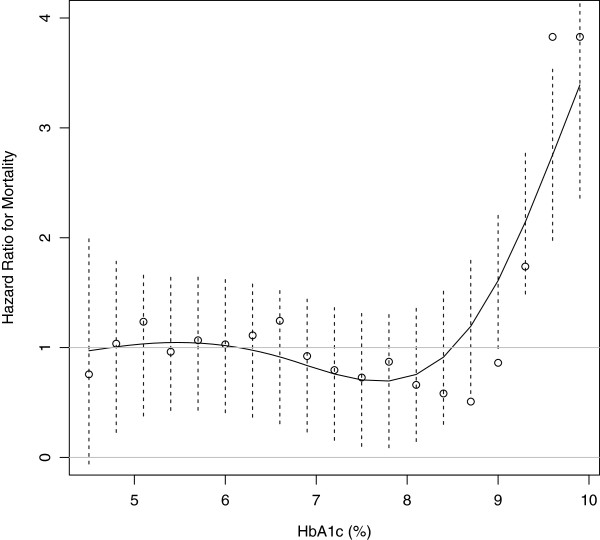
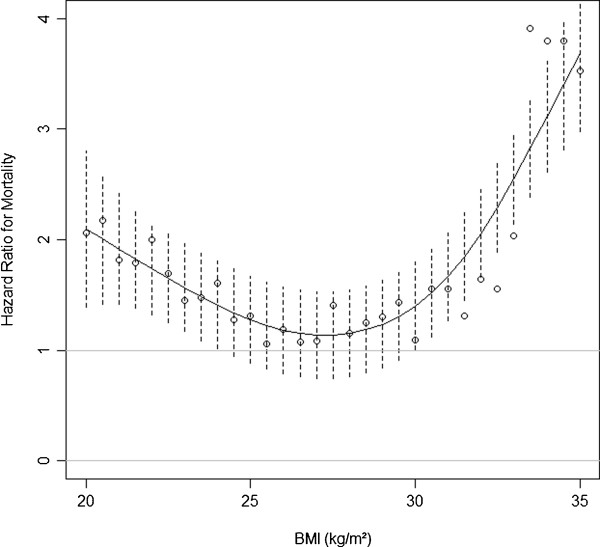
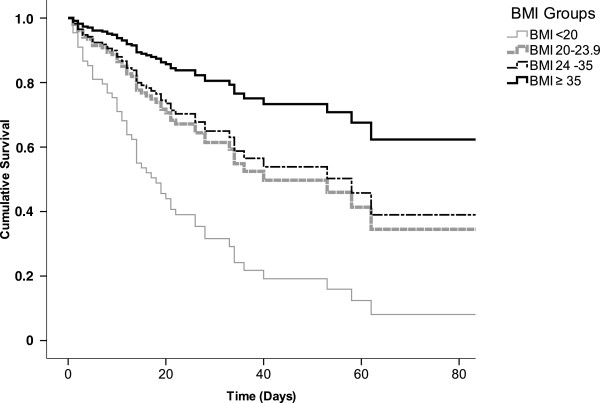
BACKGROUND: Obesity and diabetes mellitus are well-defined risk factors for cardiovascular mortality. The impact of antecedent hyperglycemia and body size on mortality in critical ill patients in intensive care units (ICUs) may vary across their range of values. Therefore, we prospectively analyzed the relationship between in-hospital mortality and preexisting hyperglycemia and body size in critically ill ICU patients to understand how mortality varied among normal, overweight, and obese patients and those with low, intermediate, and high glycated hemoglobin (HbA1c) levels. METHODS: Medical history, weight, height, physiologic variables, and HbA1c were obtained during the first 24 h for patients who were consecutively admitted to the high complexity ICU of Hospital de Clínicas de Porto Alegre, Brazil, from April to August 2011. The relationships between mortality and obesity and antecedent hyperglycemia were prospectively analyzed by cubic spline analysis and a Cox proportional hazards model. RESULTS: The study comprised 199 patients. The overall hospital mortality rate was 43.2% during a median 16 (8-28) days of follow-up. There was a progressive risk of in-hospital mortality with higher HbA1c levels, with the relationship becoming significant at HbA1c >9.3% compared with lower levels (hazard ratio 1.74; 95% confidence interval with Bonferroni correction 1.49-2.80). In contrast, mean body mass index (BMI) was higher in survivors than in nonsurvivors (27.2 kg/m2 ± 7.3 vs. 24.7 kg/m2 ± 5.0 P = 0.031, respectively). Cubic spline analysis showed that these relationships differed nonlinearly through the spectrum of BMI values. In a Cox proportional hazards model adjusted for Acute Physiology and Chronic Health Evaluation II score and HbA1c, the risk of in-hospital mortality progressively decreased with increasing BMI (BMI <20 vs. 20-23.9 kg/m2, P = 0.032; BMI <20 vs. 24-34.9 kg/m2, P = 0.010; BMI <20 vs. ≥35 kg/m2, P = 0.032). CONCLUSIONS: Our findings suggest that significant hyperglycemia prior to ICU admission is a risk factor for in-hospital mortality. Conversely, increasing BMI may confer an advantageous effect against mortality in critical illness independently of previous glycemic control.
Overview
The claims and statistics of this paper haven’t been checked yet.
Free: it reads the open-access text and checks the first 5 claims that cite a source we can check. Create a free account to check every claim.
Integrity signals
Registry
Cites
Statistics
Figures
Verification
Claims the paper makes
The claims and statistics of this paper haven’t been checked yet.
Free: it reads the open-access text and checks the first 5 claims that cite a source we can check. Create a free account to check every claim.
Claims other papers make about this one
Each is checked against this paper’s own text: does it say what the citing paper says it does?
The check wasn’t confident either way, so it gives no verdict — never disputed.
In the citing paper
“Our meta-analysis including three studies (342, 343, 344) showed a decrease in length of stay (RR -0.47, CI -7.57, -1.71, p=0.002), a trend for decrease in mortality (RR 0.69, CI 0. 39, 1.23, p=0.21), but no difference in incidence of pneumonia when early EN was administered.”
From ESPEN guideline on clinical nutrition in the intensive care unit. (2019) · cites this paper as [343]
Experimental — accuracy not yet measuredThe check wasn’t confident either way, so it gives no verdict — never disputed.
In the citing paper
“Justo Meirelles at al. (343), in moderate traumatic brain injury, compared EN to PN after resuscitation and did not show any significant outcome difference.”
From ESPEN guideline on clinical nutrition in the intensive care unit. (2019) · cites this paper as [343]
Experimental — accuracy not yet measured
Self-check
Percentages, sums and reported differences re-computed from the paper’s own numbers.
The self-check needs the paper’s full text.
Citations
Cites
Diagnosis and Classification of Diabetes Mellitus
American Diabetes Association (2011) · Diabetes Care · doi:10.2337/dc11-s062 · Cited by 13,988
APACHE II: A severity of disease classification system
KNAUS, W. A., DRAPER, E. A., WAGNER, D. P., & ZIMMERMAN, J. E. (1985) · Critical Care Medicine · doi:10.1097/00003246-198510000-00009 · Cited by 13,664
APACHE II-A Severity of Disease Classification System: Reply
Knaus, W. A., Draper, E. A., Wagner, D. P., & Zimmerman, J. E. (1986) · Critical Care Medicine · doi:10.1097/00003246-198608000-00028 · Cited by 13,376
Vincent, J. L., Moreno, R., Takala, J., Willatts, S., De Mendonça, A., Bruining, H., Reinhart, C. K., Suter, P. M., & Thijs, L. G. (1996) · Intensive Care Medicine · doi:10.1007/bf01709751 · Cited by 11,674
(1998) · PsycEXTRA Dataset · doi:10.1037/e565682010-001 · Cited by 9,472
APACHE II: a severity of disease classification system.
Knaus, W. A., Draper, E. S., Wagner, D. P., & Zimmerman, J. E. (1985) · PubMed · Cited by 6,034
Prevalence of obesity, diabetes, and obesity-related health risk factors, 2001
Mokdad, A. H., Ford, E. S., Bowman, B. A., Dietz, W. H., Vinicor, F., Bales, V. S., & Marks, J. S. (2003) · JAMA · doi:10.1001/jama.289.1.76 · Cited by 5,866
The global obesity pandemic: shaped by global drivers and local environments
Swinburn, B. A., Sacks, G., Hall, K. D., McPherson, K., Finegood, D. T., Moodie, M. L., & Gortmaker, S. L. (2011) · The Lancet · doi:10.1016/s0140-6736(11)60813-1 · Cited by 4,888 · cited 3×
“Background Diabetes mellitus (DM) and obesity are well-defined risk factors for cardiovascular disease and mortality [1,2].”
Background(1998) · PubMed · Cited by 2,737
Effect of obesity on intensive care morbidity and mortality: A meta-analysis*
Akinnusi, M. E., Pineda, L. A., & El Solh, A. A. (2008) · Critical Care Medicine · doi:10.1097/01.ccm.0000297885.60037.6e · Cited by 489
Blood glucose concentration and outcome of critical illness: The impact of diabetes*
Egi, M., Bellomo, R., Stachowski, E., French, C. J., Hart, G. K., Hegarty, C., & Bailey, M. (2008) · Critical Care Medicine · doi:10.1097/ccm.0b013e318181039a · Cited by 399
(2006) · Technical Report Series 936 · doi:10.2471/trs.06.930 · Cited by 347
Qaseem, A., Humphrey, L. L., Chou, R., Snow, V., Shekelle, P., & for the Clinical Guidelines Committee of the American College of Physicians* (2011) · Annals of Internal Medicine · doi:10.7326/0003-4819-154-4-201102150-00007 · Cited by 334
The impact of obesity on outcomes after critical illness: a meta-analysis
Hogue, C. W., Stearns, J. D., Colantuoni, E., Robinson, K. A., Stierer, T., Mitter, N., Pronovost, P. J., & Needham, D. M. (2009) · Intensive Care Medicine · doi:10.1007/s00134-009-1424-5 · Cited by 329
Impact of Body Mass Index on Outcomes Following Critical Care
Tremblay, A., & Bandi, V. (2003) · Chest · doi:10.1378/chest.123.4.1202 · Cited by 318 · cited 3×
“Our findings confirm those of other studies that suggest an inverse relationship between body size and mortality in critically ill patients [15,16,30,31].”
BackgroundResultO’Brien, J. M., Phillips, G. S., Ali, N. A., Lucarelli, M., Marsh, C. B., & Lemeshow, S. (2006) · Critical Care Medicine · doi:10.1097/01.ccm.0000202207.87891.fc · Cited by 314
Consensus Statement on the Worldwide Standardization of the Hemoglobin A1C Measurement
Consensus Committee (2007) · Diabetes Care · doi:10.2337/dc07-9925 · Cited by 303
Bercault, N., Boulain, T., Kuteifan, K., Wolf, M., Runge, I., & Fleury, J.-C. (2004) · Critical Care Medicine · doi:10.1097/01.ccm.0000119422.93413.08 · Cited by 284
Gaining more flexibility in Cox proportional hazards regression models with cubic spline functions
Heinzl, H., & Kaider, A. (1997) · Computer Methods and Programs in Biomedicine · doi:10.1016/s0169-2607(97)00043-6 · Cited by 283
Obesity and Mortality in Critically Ill Adults: A Systematic Review and Meta‐analysis
Oliveros, H., & Villamor, E. (2008) · Obesity · doi:10.1038/oby.2007.102 · Cited by 261
Egi, M., Bellomo, R., Stachowski, E., French, C. J., Hart, G. K., Taori, G., Hegarty, C., & Bailey, M. (2011) · Critical Care Medicine · doi:10.1097/ccm.0b013e3181feb5ea · Cited by 232
Impact of admission hyperglycemia on hospital mortality in various intensive care unit populations*
Whitcomb, B. W., Pradhan, E. K., Pittas, A. G., Roghmann, M.-C., & Perencevich, E. N. (2005) · Critical Care Medicine · doi:10.1097/01.ccm.0000189741.44071.25 · Cited by 224
Kavanagh, B. P., & McCowen, K. C. (2010) · New England Journal of Medicine · doi:10.1056/nejmcp1001115 · Cited by 205 · cited 1×
“As DM is usually asymptomatic in its early stages, many patients may not be aware of this condition on ICU admission [29].”
BackgroundInfluence of Overweight on ICU Mortality
Goulenok, C., Monchi, M., Chiche, J.-D., Mira, J.-P., Dhainaut, J.-F., & Cariou, A. (2004) · Chest · doi:10.1378/chest.125.4.1441 · Cited by 175
Extreme Obesity and Outcomes in Critically Ill Patients
Martino, J. L., Stapleton, R. D., Wang, M., Day, A. G., Cahill, N. E., Dixon, A. E., Suratt, B. T., & Heyland, D. K. (2011) · Chest · doi:10.1378/chest.10-3023 · Cited by 173
Finding Optimal Cutpoints for Continuous Covariates with Binary and Time-to-Event Outcomes
Williams, B. A., Mandrekar, J. N., Mandrekar, S. J., Seiler, S., & Furth, A. F. (2006) · Cited by 172
The Effect of Body Mass Index on Patient Outcomes in a Medical ICU
Ray, D. E., Matchett, S., Baker, K. M., Wasser, T., & Young, M. (2005) · CHEST Journal · doi:10.1378/chest.127.6.2125 · Cited by 165
Relationship of Baseline Glucose Homeostasis to Hyperglycemia During Medical Critical Illness
Cely, C. M., Arora, P., Quartin, A. A., Kett, D. H., & Schein, R. M. H. (2004) · CHEST Journal · doi:10.1378/chest.126.3.879 · Cited by 132
Peake, S., Moran, J. L., Ghelani, D. R., Lloyd, A. J., & Walker, M. J. (2006) · Critical Care Medicine · doi:10.1097/01.ccm.0000248726.75699.b1 · Cited by 124
Diabetes mellitus does not adversely affect outcomes from a critical illness*
Graham, B. B., Keniston, A., Gajic, O., Trillo Alvarez, C. A., Medvedev, S., & Douglas, I. S. (2010) · Critical Care Medicine · doi:10.1097/ccm.0b013e3181b9eaa5 · Cited by 123
Nychka, D. W., Furrer, R., Paige, J., & Sain, S. R. (2016) · Cited by 118
Abhyankar, S., Leishear, K., Callaghan, F. M., Demner‐Fushman, D., & McDonald, C. J. (2012) · Critical Care · doi:10.1186/cc11903 · Cited by 115
The impact of cormorbid conditions on critical illness
Esper, A. M., & Martin, G. S. (2011) · Critical Care Medicine · doi:10.1097/ccm.0b013e318236f27e · Cited by 98
Brief inhalation of low-dose carbon monoxide protects rodents and swine from postoperative ileus*
Moore, B. A., Overhaus, M., Whitcomb, J., Ifedigbo, E., Choi, A. M. K., Otterbein, L. E., & Bauer, A. J. (2005) · Critical Care Medicine · doi:10.1097/01.ccm.0000166349.76514.40 · Cited by 74
HbA1c is outcome predictor in diabetic patients with sepsis
Gornik, I., Gornik, O., & Gašparović, V. (2006) · Diabetes Research and Clinical Practice · doi:10.1016/j.diabres.2006.10.017 · Cited by 53
Slynkova, K., Mannino, D. M., Martin, G. S., Morehead, R. S., & Doherty, D. E. (2006) · Critical Care · doi:10.1186/cc5051 · Cited by 52
Complicações macrovasculares do diabetes melito: peculiaridades clínicas, de diagnóstico e manejo
Triches, C. B., Schaan, B. D., Gross, J. L., & de Azevedo, M. J. (2009) · Arquivos Brasileiros de Endocrinologia & Metabologia · doi:10.1590/s0004-27302009000600002 · Cited by 49
Self-citationO’Brien, J. M., Ali, N. A., Lucarelli, M., Marsh, C. B., Lemeshow, S. A., & Phillips, G. S. (2005) · Critical Care Medicine · doi:10.1097/00003246-200512002-00300 · Cited by 11
Cited by
ESPEN guideline on clinical nutrition in the intensive care unit.
Singer, P., Blaser, A. R., Berger, M. M., Alhazzani, W., Calder, P. C., Casaer, M. P., Hiesmayr, M., Mayer, K., Montejo, J. C., Pichard, C., et al. (2019) · Clinical Nutrition · doi:10.1016/j.clnu.2018.08.037 · Cited by 2,904
ESPEN practical and partially revised guideline: Clinical nutrition in the intensive care unit
Singer, P., Blaser, A. R., Berger, M. M., Calder, P. C., Casaer, M., Hiesmayr, M., Mayer, K., Montejo-Gonzalez, J. C., Pichard, C., Preiser, J.-C., et al. (2023) · Clinical Nutrition · doi:10.1016/j.clnu.2023.07.011 · Cited by 793
“Additional metabolic derangements such as decreased glucose tolerance, altered lipid metabolism, lack of micronutrients and decreased gut motility will need speci fi c attention [135].”
BackgroundAlobaid, A. S., Hites, M., Lipman, J., Taccone, F. S., & Roberts, J. A. (2016) · International Journal of Antimicrobial Agents · doi:10.1016/j.ijantimicag.2016.01.009 · Cited by 148
Bellaver, P., Schaeffer, A. F., Dullius, D. P., Viana, M. V., Leitão, C. B., & Rech, T. H. (2019) · Scientific Reports · doi:10.1038/s41598-019-55080-3 · Cited by 78
Self-citationvan Vught, L. A., Holman, R., de Jonge, E., de Keizer, N. F., & van der Poll, T. (2017) · Critical Care Medicine · doi:10.1097/ccm.0000000000002590 · Cited by 71
Metadata
- Authors
- Viana, M. V., Moraes, R. B., Fabbrin, A. R., Santos, M. F., Torman, V. B. L., Vieira, S. R., Gross, J. L., Canani, L. H., & Gerchman, F.
- Affiliations
- Universidade Federal do Rio Grande do Sul (BR)
- Corresponding author
- Viana, Marina Verçoza
- ORCID
- Venue
- BMC Endocrine Disorders
- Published
- 2014-06-17
- Volume
- 14
- Issue
- 1
- Pages
- 50-50
- ISSN
- 1472-6823 (ISSN-L)
- PMC
- PMC4072488
- OpenAlex
- W2001928187
- Cited by
- 19
- References
- 38
- Citations by year
- 2024: 1 · 2023: 3 · 2022: 3 · 2021: 1 · 2019: 4 · 2018: 1 · 2017: 2 · 2016: 4
- FWCI
- 1.61
- Type
- journal article
- Language
- en
- Open access
- gold
- doi.org
- Licence
- Locations
- BMC Endocrine Disorders (publishedVersion, cc-by)
- Europe PMC (PubMed Central) (publishedVersion, cc-by)
- PubMed Central (publishedVersion, cc-by)
- PubMed (publishedVersion)
- Americanae (AECID Library) (submittedVersion, other-oa)
- LA Referencia (Red Federada de Repositorios Institucionales de Publicaciones Científicas) (submittedVersion, cc-by-nc-sa)
- Funders
- Hospital de Clínicas de Porto Alegre
- Fundação de Amparo à Pesquisa do Estado do Rio Grande do Sul
- Fundação Instituto de Pesquisas Econômicas
- Topics
- Health Sciences › Medicine › Endocrinology, Diabetes and Metabolism › Hyperglycemia and glycemic control in critically ill and hospitalized patients
- Health Sciences › Medicine › Critical Care and Intensive Care Medicine › Intensive Care Unit Cognitive Disorders
- Health Sciences › Medicine › Endocrinology, Diabetes and Metabolism › Diabetes, Cardiovascular Risks, and Lipoproteins
- Keywords
- critical illness, in-hospital mortality, body size, obesity, body mass index, HbA1c, diabetes mellitus, critically ill patients, intensive care unit, nonlinear dose-response relationship, mortality risk factors, APACHE II score, body composition
- MeSH terms
- Blood Glucose, Brazil, Female, Follow-Up Studies, Hospitalization, Humans, Hyperglycemia, Intensive Care Units, Male, Middle Aged, Obesity, Prognosis, Prospective Studies, Risk Factors, Body Mass Index, Critical Illness, Hospital Mortality, Body Size
About these checks
Registry, retraction, Cites and statistics results are computed, not judged, with one exception: a printed reference that no index lists is read once by a model before it counts as a citation error. Claims are extracted by a model and kept only when their quote appears verbatim in the text; each cited source is then checked, with a model’s help, for whether it says what the claim relies on. Those verdicts can be wrong — read the claim’s quote and the cited source before relying on one.
Statistics and arithmetic are recomputed, not judged.
Confidence bands are shown only for fields calibrated on our annotated test set. None is calibrated yet, so no band is shown.
What counts as a claim ›How we measure confidence ›How we check this ›
Are you an author, or do you see a problem with this page? Request a review
Data sources
Bibliographic data: Semantic Scholar, OpenAlex, Crossref.
Contains information from the Semantic Scholar Academic Graph Datasets, made available under the ODC Attribution License (ODC-BY 1.0).
Semantic Scholar’s data is described in: Kinney, R., et al. (2023). The Semantic Scholar Open Data Platform. arXiv:2301.10140.
