

Thymidine phosphorylase expression is associated with time to progression in patients with metastatic colorectal cancer
Open accessThe DOI matches its Crossref record; 36 of the 36 references it cites were found in a registry or an index.
Abstract
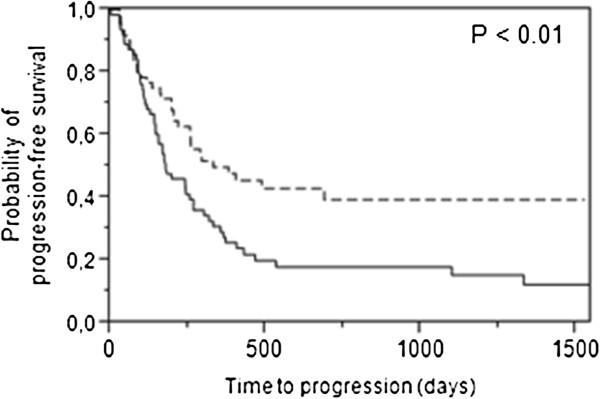
BACKGROUND: 5-Fluorouracil (5-FU) is the cornerstone of chemotherapeutic treatment for patients with colorectal cancer. The enzyme thymidine phosphorylase (TP) catalyzes the conversion of 5-FU to its active metabolite, 5-fluoro-2'-deoxyuridine. TP is expressed in tumour epithelial cells and stromal cells, particularly in tumour-associated macrophages. These macrophages may affect sensitivity to chemotherapy. Previously, we identified TP as a predictive factor in microdissected tumour samples of patients with advanced colorectal cancer. In the present study, we analysed TP expression in tissues and associated stromal cells from patients with advanced colorectal cancer and associated TP levels to tumour response and time-to-event variables during first-line chemotherapy treatment. We also investigated the association between serum TP levels at the time of surgery and gene expression in primary tumour tissues. METHODS: This study included 125 patients with metastatic colorectal cancer treated with first-line 5-FU-based chemotherapy. To quantify TP gene expression levels in tumour tissues, real-time polymerase chain reaction was performed using the 7500 Fast Real-Time PCR system (Applied Biosystems, Foster City, CA, USA). TP protein concentration in matched serum samples was determined using an enzyme-linked immunosorbent assay system (USCN Life Science Inc.). RESULTS: The tumour response rate was 31%, and 30% of patients exhibited stable disease. No associations between TP expression level and age or gender were observed. Levels of TP mRNA in mucosa and tumours were positively correlated (r = 0.41, p < 0.01). No correlation between TP expression and tumour response rate was observed. Time to progression was significantly longer in patients with high TP expression (p < 0.01). Serum TP protein levels were not associated with tumour response or time-to-event variables and did not correlate with gene expression in tumour tissues. CONCLUSIONS: High TP gene expression in non-microdissected tumour tissues of patients with advanced colorectal cancer correlates with longer time to progression, which could be related to treatment. These results are in contrast to previous studies where microdissected tumour cells were analysed and may be due to the presence of adjacent stromal cells. Serum TP protein expression does not correlate to TP gene expression in tissues of patients with advanced colorectal cancer.
Overview
The claims and statistics of this paper haven’t been checked yet.
Free: it reads the open-access text and checks the first 5 claims that cite a source we can check. Create a free account to check every claim.
Integrity signals
Registry
Cites
Statistics
Figures
Verification
Claims the paper makes
The claims and statistics of this paper haven’t been checked yet.
Free: it reads the open-access text and checks the first 5 claims that cite a source we can check. Create a free account to check every claim.
Claims other papers make about this one
Each is checked against this paper’s own text: does it say what the citing paper says it does?
In the citing paper
“the progression-free survival of patients with higher expression of TP is significantly prolonged [11].”
From Drug Resistance in Colorectal Cancer: From Mechanism to Clinic (2022) · cites this paper as [11]
In the citing paper
“Although another study has shown that there is no correlation between the level of TP expression and tumor response rate”
From Drug Resistance in Colorectal Cancer: From Mechanism to Clinic (2022) · cites this paper as [11]
Self-check
Percentages, sums and reported differences re-computed from the paper’s own numbers.
The self-check needs the paper’s full text.
Citations
Cites
PROTEIN MEASUREMENT WITH THE FOLIN PHENOL REAGENT
Lowry, O., Rosebrough, N., Farr, A. L., & Randall, R. (1951) · Journal of Biological Chemistry · doi:10.1016/s0021-9258(19)52451-6 · Cited by 317,331 · cited 1×
“[23].”
Reporting results of cancer treatment
Miller, A. B., Hoogstraten, B., Staquet, M., & Winkler, A. (1981) · Cancer · doi:10.1002/1097-0142(19810101)47:1<207::aid-cncr2820470134>3.0.co;2-6 · Cited by 7,793 · cited 1×
“Treatment response was evaluated according to criteria outlined by the World Health Organization [21].”
MethodMiwa, M., Ura, M., Nishida, M., Sawada, N., Ishikawa, T., Mori, K., Shimma, N., Umeda, I., & Ishitsuka, H. (1998) · European Journal of Cancer · doi:10.1016/s0959-8049(98)00058-6 · Cited by 1,240 · cited 1×
“P revious studies have shown that TP levels are higher in tumour compared with normal tissue s in a wide range of solid tumours [2-5].”
Background(2011) · Hepatogastroenterology · doi:10.5754/hge11470 · Cited by 646
Takebayashi, Y., Akiyama, S.-I., Akiba, S., Yamada, K., Miyadera, K., Sumizawa, T., Yamada, Y., Murata, F., & Aikou, T. (1996) · JNCI Journal of the National Cancer Institute · doi:10.1093/jnci/88.16.1110 · Cited by 363 · cited 3×
“TP and its catalytic product, 2-deoxy-D-ribose-1-phosphate act as angiogenic factors via induction of endothelial cell migration and tube formation [6-9].”
BackgroundAnti‐tumour strategies aiming to target tumour‐associated macrophages
Tang, X., Mo, C., Wang, Y., Wei, D., & Xiao, H. (2013) · Immunology · doi:10.1111/imm.12023 · Cited by 278 · cited 2×
“These specific macrophages play an importa nt role in the tumour microenvironment and may affect sensitivity to chemotherapy [16].”
BackgroundMetzger, R., Danenberg, K. D., Leichman, C. G., Salonga, D. S., Schwartz, E. L., Wadler, S., Lenz, H., Groshen, S. G., Leichman, L., & Danenberg, P. V. (1998) · PubMed · Cited by 259
The dual role of thymidine phosphorylase in cancer development and chemotherapy
Bronckaers, A., Gago, F., Balzarini, J., & Liekens, S. (2009) · Medicinal Research Reviews · doi:10.1002/med.20159 · Cited by 206 · cited 2×
“In hypoxic environments, TP may also impart resistance to apoptosis [1,10].”
BackgroundThe activity and expression of thymidine phosphorylase in human solid tumours
Takebayashi, Y., Yamada, K., Miyadera, K., Sumizawa, T., Furukawa, T., Kinoshita, F., Aoki, D., Okumura, H., Yamada, Y., Akiyama, S.-I., et al. (1996) · European Journal of Cancer · doi:10.1016/0959-8049(96)00061-5 · Cited by 181 · cited 1×
“Previous studies have shown that TP levels are higher in tumour compared with normal tissues in a wide range of solid tumours [2-5].”
BackgroundExpression of Macrophage Antigens by Tumor Cells
Shabo, I., & Svanvik, J. (2011) · Advances in experimental medicine and biology · doi:10.1007/978-94-007-0782-5_7 · Cited by 117 · cited 1×
“TP is predominantly expressed in the tumour stroma by macrophages [9,27] and TAMs play an important role in the tumour microenvironment [16,28].”
BackgroundPrevention of Hypoxia-Induced Apoptosis by the Angiogenic Factor Thymidine Phosphorylase
Kitazono, M., Takebayashi, Y., Ishitsuka, K., Takao, S., Tani, A., Furukawa, T., Miyadera, K., Yamada, Y., Aikou, T., & Akiyama, S. (1998) · Biochemical and Biophysical Research Communications · doi:10.1006/bbrc.1998.9852 · Cited by 111 · cited 1×
“In hypoxic environments, TP may also impart resistance to apoptosis [1,10].”
BackgroundThymidine Phosphorylase Mediates the Sensitivity of Human Colon Carcinoma Cells to 5-Fluorouracil
Schwartz, E. L., Baptiste, N., Wadler, S., & Makower, D. (1995) · Journal of Biological Chemistry · doi:10.1074/jbc.270.32.19073 · Cited by 107 · cited 1×
“Schwartz et al, demonstrated that human colon carcinoma cells transfected with TP cDNA exhibited higher sensitivity to 5-FU compared with parental wild-ty pe cells, and this phenomenon has also been shown in other cell lines [29-31].”
BackgroundCiaparrone, M., Quirino, M., Schinzari, G., Zannoni, G. F., Corsi, D. C., Vecchio, F. M., Cassano, A., Torre, G. L., & Barone, C. A. (2006) · Oncology · doi:10.1159/000098110 · Cited by 97 · cited 1×
“High levels of TP in tumour tissues and/or serum may be indicati ve of poor prognosis, however, it may also be advantageous in the chemotherapeutic setting when 5-FU-based drugs are used [9, 24-26].”
BackgroundMatsuura, T., Kuratate, I., Teramachi, K., Osaki, M., Fukuda, Y., & Ito, H. (1999) · PubMed · doi:10.11501/3174649 · Cited by 85
Hong, R.-L., & Tseng, Y.-L. (2001) · Cancer · doi:10.1002/1097-0142(20010501)91:9<1826::aid-cncr1203>3.0.co;2-j · Cited by 80
Pauly, J. L., Schuller, M. G., Zelcer, A. A., Kirss, T. A., Gore, S. S., & Germain, M. J. (1977) · JNCI Journal of the National Cancer Institute · doi:10.1093/jnci/58.6.1587 · Cited by 79
Sengupta, S., Sellers, L. A., Matheson, H. B., & Fan, T. D. (2003) · British Journal of Pharmacology · doi:10.1038/sj.bjp.0705216 · Cited by 78 · cited 1×
“TP and its catalytic product, 2-deoxy-D-ribose-1-phosphate act as angiogenic factors via induction of endothelial cell migration and tube formation [6-9].”
BackgroundMatsumura, M., Chiba, Y., Lu, C., Amaya, H., Shimomatsuya, T., Horiuchi, T., Muraoka, R., & Tanigawa, N. (1998) · Cancer Letters · doi:10.1016/s0304-3835(98)00051-2 · Cited by 57 · cited 2×
“TP and its catalytic product, 2-deoxy-D-ribose-1-phosphate act as angiogenic factors via induction of endothelial cell migration and tube formation [6-9].”
BackgroundKato, Y., Matsukawa, S., Muraoka, R., & Tanigawa, N. (1997) · British Journal of Cancer · doi:10.1038/bjc.1997.88 · Cited by 46 · cited 1×
“, demonstrated that human colon carcinoma cells transfected with TP cDNA exhibited higher sensitivity to 5-FU compared with parental wild-type cells, and this phenomenon has also been shown in other cell lines [29-31].”
BackgroundShimada, H., Takeda, A., Shiratori, T., Nabeya, Y., Okazumi, S., Matsubara, H., Funami, Y., Hayashi, H., Gunji, Y., Kobayashi, S. S., et al. (2002) · Cancer · doi:10.1002/cncr.10418 · Cited by 44 · cited 2×
“Furthermore, high serum TP (sTP) in patients with oesophageal and uterine cervical cancer appears to be related to poor prognosis and inferior response to chemotherapy [18,19].”
BackgroundUchida, K., Danenberg, P. V., Danenberg, K. D., & Grem, J. L. (2008) · BMC Cancer · doi:10.1186/1471-2407-8-386 · Cited by 43
Kuramochi, H., Hayashi, K., Uchida, K., Miyakura, S., Shimizu, D., Vallböhmer, D., Park, S.-J., Danenberg, K. D., Takasaki, K., & Danenberg, P. V. (2006) · International Journal of Cancer · doi:10.1002/ijc.21692 · Cited by 39
Gustavsson, B. G., Kaiser, C. J., Carlsson, G. U., Wettergren, Y., Odin, E., Lindskog, E. B., Niyikiza, C., & Ma, D. (2008) · International Journal of Cancer · doi:10.1002/ijc.23852 · Cited by 38 · cited 2×
“This finding was in keeping with the observations of other independent reports [12-15].”
BackgroundResultSelf-citationAmatori, F., Paolo, A. D., Tacca, M. D., Fontanini, G., Vannozzi, F., Boldrini, L., Bocci, G., Lastella, M., & Danesi, R. (2006) · Pharmacogenetics and Genomics · doi:10.1097/01.fpc.0000230410.07899.bc · Cited by 37 · cited 1×
“Previous studies have shown that TP levels are higher in tumour compared with normal tissues in a wide range of solid tumours [2-5].”
BackgroundYanagisawa, Y., Maruta, F., Iinuma, N., Ishizone, S., Koide, N., Nakayama, J., & Miyagawa, S. (2006) · Scandinavian Journal of Gastroenterology · doi:10.1080/00365520600994418 · Cited by 31 · cited 1×
“, observed no association between tTP gene expression and clinical response in a cohort of 16 patients analysed in the palliative setting [32].”
BackgroundSchwartz, M. L., BRUCE, J. S., Shneidman, P. S., & Schlaepfer, W. W. (1995) · Journal of Biological Chemistry · doi:10.1074/jbc.270.44.26364 · Cited by 31
Fujimoto, J., Sakaguchi, H., Aoki, I., & Tamaya, T. (2000) · PubMed · Cited by 27
Sadahiro, S., Suzuki, T., Tanaka, A., Okada, K., Nagase, H., & Uchida, J. (2012) · Cancer Chemotherapy and Pharmacology · doi:10.1007/s00280-012-1909-8 · Cited by 23 · cited 2×
“This finding was in keeping with the observations of other independent reports [12-15].”
BackgroundResultKumamoto, K., Kuwabara, K., Tajima, Y., Amano, K., Hatano, S., Ohsawa, T., Okada, N., Ishibashi, K., Haga, N., & Ishida, H. (2012) · Oncology Letters · doi:10.3892/ol.2012.598 · Cited by 23 · cited 3×
“Several studies indicate a positive correlation between TP expression in primary tumours and both synchronous and metachronous liver metastases, supporting the use of TP as a predictive factor for 5-FU-based chemotherapy in the palliative setting [13,33,34].”
BackgroundResultTsuji, T., Sawai, T., Yamashita, H., Takeshita, H., Nakagoe, T., Shindou, H., Fukuoka, H., Yoshinaga, M., Hidaka, S., Yasutake, T., et al. (2003) · European Journal of Surgical Oncology · doi:10.1016/j.ejso.2003.11.019 · Cited by 16 · cited 1×
“TP is predominantly expressed in the tumour str ma by macrophages [9, 27] and TAMs play an important role in the tumour microenviroment [16, 28].”
BackgroundMimori, K., Matsuyama, A., Yoshinaga, K., Yamashita, K., Masuda, T., Inoue, H., Ueo, H., & Mori, M. (2002) · Oncology · doi:10.1159/000065064 · Cited by 15 · cited 2×
“, who showed that TP mRNA detected by in situ reverse-transcriptase PCR was comparable with TP enzyme activity detected by high-performance liquid chromatography and enzyme assays [11].”
BackgroundMethodAkiyama (2010) · International Journal of Oncology · doi:10.3892/ijo_00000602 · Cited by 13 · cited 1×
“, demonstrated that human colon carcinoma cells transfected with TP cDNA exhibited higher sensitivity to 5-FU compared with parental wild-type cells, and this phenomenon has also been shown in other cell lines [29-31].”
BackgroundNozawa, T., Enomoto, T., Koshida, Y., Sato, Y., & Kuranami, M. (2004) · Diseases of the Colon & Rectum · doi:10.1007/s10350-004-0712-y · Cited by 12 · cited 2×
“TP expression is observed in tumour epithelial cells and stromal cells, particularly in tum o r-associated macrophages (TAMs) [4, 8, 11].”
BackgroundChanges in thymidine phosphorylase gene expression related to treatment of rectal cancer.
Derwinger, K., Lindskog, E. B., Palmqvist, E., & Wettergren, Y. (2013) · PubMed · Cited by 11
Self-citationThymidine Phosphorylase Gene Expression in Stage III Colorectal Cancer
Lindskog, E. B., Wettergren, Y., Odin, E., Gustavsson, B. G., & Derwinger, K. (2012) · Clinical Medicine Insights Oncology · doi:10.4137/cmo.s10226 · Cited by 10
Self-citationHaraguchi, M., Komuta, K., Ueda, T., Akashi, A., Minami, S., Furui, J., & Kanematsu, T. (2008) · PubMed · Cited by 6
Cited by
5-fluorouracil and other fluoropyrimidines in colorectal cancer: Past, present and future
Vodenkova, S., Buchler, T., Cervena, K., Veskrnova, V., Vodicka, P., & Vymetalkova, V. (2020) · Pharmacology & Therapeutics · doi:10.1016/j.pharmthera.2019.107447 · Cited by 956
Pharmacologic resistance in colorectal cancer: a review
Hammond, W. A., Swaika, A., & Mody, K. (2016) · Therapeutic Advances in Medical Oncology · doi:10.1177/1758834015614530 · Cited by 519
“A more recent study analyzed tumor tissue from mCRC by RT-PCR and found longer time to progression with high TP expression [Lindskog et al. 2014].”
BackgroundDrug Resistance in Colorectal Cancer: From Mechanism to Clinic
Wang, Q., Shen, X., Chen, G., & Du, J. (2022) · Cancers · doi:10.3390/cancers14122928 · Cited by 160
Bitar, S. A., El-Sabban, M. E., Doughan, S., & Abou-Kheir, W. G. (2023) · World Journal of Gastroenterology · doi:10.3748/wjg.v29.i9.1395 · Cited by 74
Albadari, N. G., Xie, Y., & Li, W. (2024) · Frontiers in Pharmacology · doi:10.3389/fphar.2023.1340401 · Cited by 38
Metadata
- Authors
- Lindskog, E. B., Derwinger, K., Gustavsson, B., Falk, P., & Wettergren, Y.
- Affiliations
- University of Gothenburg (SE)
- Corresponding author
- Lindskog, Elinor Bexe
- Venue
- BMC Clinical Pathology
- Published
- 2014-06-10
- Volume
- 14
- Issue
- 1
- Pages
- 25-25
- ISSN
- 1472-6890 (ISSN-L)
- PMC
- PMC4058433
- OpenAlex
- W2075758937
- Cited by
- 22
- References
- 36
- Citations by year
- 2024: 1 · 2023: 2 · 2022: 5 · 2021: 2 · 2019: 3 · 2018: 2 · 2017: 1 · 2016: 2 · 2015: 3 · 2014: 1
- FWCI
- 1.13
- Type
- journal article
- Language
- en
- Open access
- hybrid
- doi.org
- Licence
- Locations
- BMC Clinical Pathology (publishedVersion, cc-by)
- Europe PMC (PubMed Central) (publishedVersion, cc-by)
- PubMed Central (publishedVersion, cc-by)
- PubMed (publishedVersion)
- Funders
- Anna-Lisa och Bror Björnssons Stiftelse
- Cancerfonden
- Stiftelsen Assar Gabrielssons Fond
- Göteborgs Läkaresällskap
- Sahlgrenska Universitetssjukhuset
- Topics
- Health Sciences › Medicine › Oncology › Colorectal Cancer Treatments and Studies
- Life Sciences › Pharmacology, Toxicology and Pharmaceutics › Pharmacology › Pharmacogenetics and Drug Metabolism
- Life Sciences › Biochemistry, Genetics and Molecular Biology › Molecular Biology › Cancer therapeutics and mechanisms
- Keywords
- thymidine phosphorylase, metastatic colorectal cancer, 5-fluorouracil, time to progression, tumor stroma, tumour-associated macrophages, chemotherapy response, predictive biomarkers, first-line chemotherapy
About these checks
Registry, retraction, Cites and statistics results are computed, not judged, with one exception: a printed reference that no index lists is read once by a model before it counts as a citation error. Claims are extracted by a model and kept only when their quote appears verbatim in the text; each cited source is then checked, with a model’s help, for whether it says what the claim relies on. Those verdicts can be wrong — read the claim’s quote and the cited source before relying on one.
Statistics and arithmetic are recomputed, not judged.
Confidence bands are shown only for fields calibrated on our annotated test set. None is calibrated yet, so no band is shown.
What counts as a claim ›How we measure confidence ›How we check this ›
Are you an author, or do you see a problem with this page? Request a review
Data sources
Bibliographic data: Semantic Scholar, OpenAlex, Crossref.
Contains information from the Semantic Scholar Academic Graph Datasets, made available under the ODC Attribution License (ODC-BY 1.0).
Semantic Scholar’s data is described in: Kinney, R., et al. (2023). The Semantic Scholar Open Data Platform. arXiv:2301.10140.
