

Effect of exenatide on the pharmacokinetics of a combination oral contraceptive in healthy women: an open-label, randomised, crossover trial
Open accessThe DOI matches its Crossref record; 24 of the 24 references it cites were found in a registry or an index.
Abstract
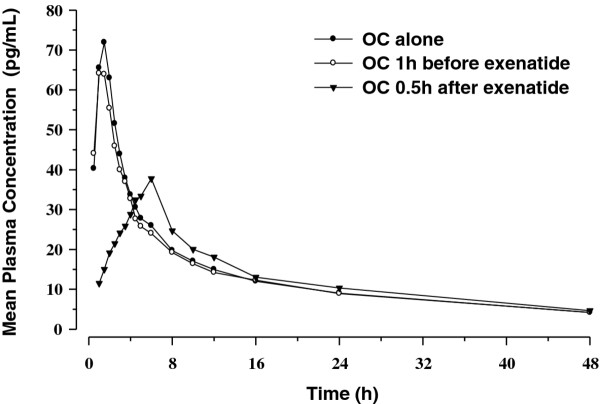
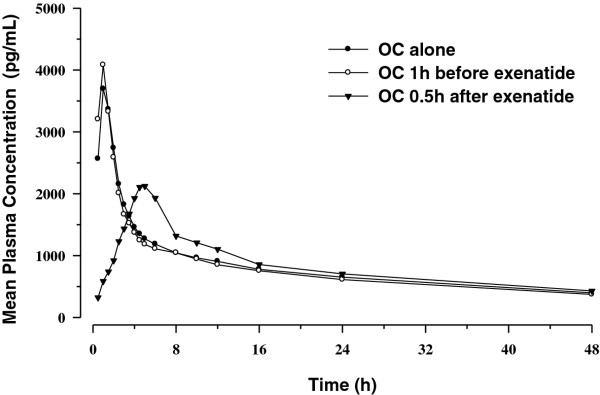
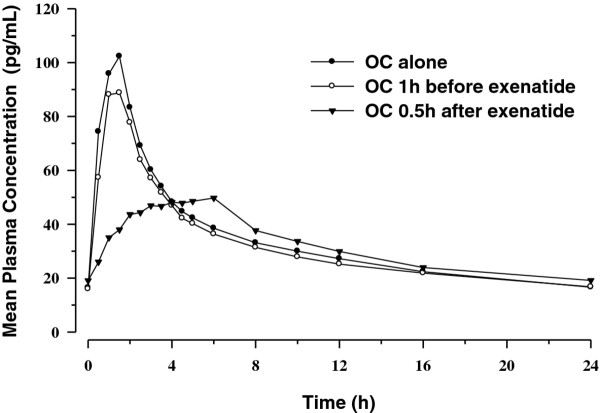
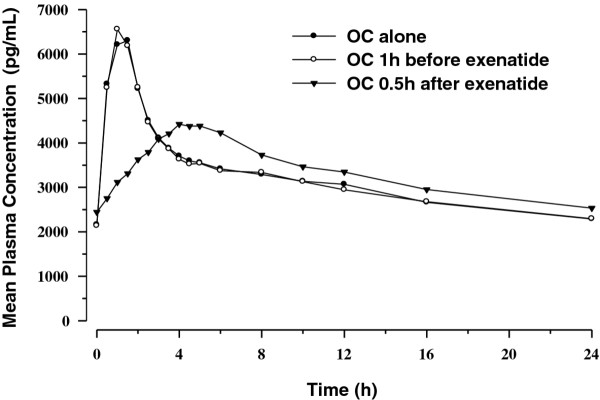
BACKGROUND: Consistent with its effect on gastric emptying, exenatide, an injectable treatment for type 2 diabetes, may slow the absorption rate of concomitantly administered oral drugs resulting in a decrease in maximum concentration (Cmax). This study evaluated the drug interaction potential of exenatide when administered adjunctively with oral contraceptives, given their potential concomitant use. METHODS: This trial evaluated the effect of exenatide co-administration on single- and multiple-dose pharmacokinetics of a combination oral contraceptive (ethinyl estradiol [EE] 30 μg, levonorgestrel [LV] 150 μg [Microgynon 30®]). Thirty-two healthy female subjects participated in an open-label, randomised, crossover trial with 3 treatment periods (oral contraceptive alone, 1 hour before exenatide, 30 minutes after exenatide). Subjects received a single dose of oral contraceptive on Day 8 of each period and QD doses on Days 10 through 28. During treatment periods of concomitant usage, exenatide was administered subcutaneously prior to morning and evening meals at 5 μg BID from Days 1 through 4 and at 10 μg BID from Days 5 through 22. Single- (Day 8) and multiple-dose (Day 22) pharmacokinetic profiles were assessed for each treatment period. RESULTS: Exenatide did not alter the bioavailability nor decrease daily trough concentrations for either oral contraceptive component. No substantive changes in oral contraceptive pharmacokinetics occurred when oral contraceptive was administered 1 hour before exenatide. Single-dose oral contraceptive administration 30 minutes after exenatide resulted in mean (90% CI) Cmax reductions of 46% (42-51%) and 41% (35-47%) for EE and LV, respectively. Repeated daily oral contraceptive administration 30 minutes after exenatide resulted in Cmax reductions of 45% (40-50%) and 27% (21-33%) for EE and LV, respectively. Peak oral contraceptive concentrations were delayed approximately 3 to 4 hours. Mild-to-moderate nausea and vomiting were the most common adverse events observed during the trial. CONCLUSIONS: The observed reduction in Cmax is likely of limited importance given the unaltered oral contraceptive bioavailability and trough concentrations; however, for oral medications that are dependent on threshold concentrations for efficacy, such as contraceptives and antibiotics, patients should be advised to take those drugs at least 1 hour before exenatide injection. TRIAL REGISTRATION: ClinicalTrials.gov: NCT00254800.
Overview
The claims and statistics of this paper haven’t been checked yet.
Free: it reads the open-access text and checks the first 5 claims that cite a source we can check. Create a free account to check every claim.
Integrity signals
Registry
Cites
Statistics
Figures
Verification
Claims the paper makes
The claims and statistics of this paper haven’t been checked yet.
Free: it reads the open-access text and checks the first 5 claims that cite a source we can check. Create a free account to check every claim.
Self-check
Percentages, sums and reported differences re-computed from the paper’s own numbers.
The self-check needs the paper’s full text.
Citations
Cites
Cook, R. J., Dickens, B. M., & Fathalla, M. F. (2003) · Reproductive Health and Human Rights · doi:10.1093/acprof:oso/9780199241323.003.0025 · Cited by 10,769
Ethical principles for medical research involving human subjects
(2003) · Manual for Research Ethics Committees · doi:10.1017/cbo9780511550089.027 · Cited by 2,585
Available, N. (2000) · JAMA · doi:10.1001/jama.284.23.3043 · Cited by 2,344
DeFronzo, R. A., Ratner, R. E., Han, J., Kim, D. D., Fineman, M. S., & Baron, A. D. (2005) · Diabetes Care · doi:10.2337/diacare.28.5.1092 · Cited by 1,559 · cited 1×
“Despite this potential effect of food on Cmax, OCs are generally recommended to be taken without regard to food [19], suggesting that PK changes observed in this study are not likely to be clinically relevant.”
BackgroundBuse, J. B., Henry, R. R., Han, J., Kim, D. D., Fineman, M. S., Baron, A. D., & for the Exenatide-113 Clinical Study Group (2004) · Diabetes Care · doi:10.2337/diacare.27.11.2628 · Cited by 1,346
Kendall, D. M., Riddle, M. C., Rosenstock, J., Zhuang, D., Kim, D. D., Fineman, M. S., & Baron, A. D. (2005) · Diabetes Care · doi:10.2337/diacare.28.5.1083 · Cited by 1,177 · cited 1×
“This study used 4-day dose initiation at 5 μg BID, rather than 4 weeks as recommended for exenatide dosing [20], and Table 2 Levonorgestrel Single- and Multiple-dose Pharmacokinetics: Comparison of Mean Pharmacokinetic Parameters Across Treatments”
MethodKlonoff, D. C., Buse, J. B., Nielsen, L. L., Guan, X., Bowlus, C. L., Holcombe, J. H., Wintle, M. E., & Maggs, D. G. (2008) · Current Medical Research and Opinion · doi:10.1185/030079908x253870 · Cited by 699 · cited 2×
“More specifically, the high incidence of nausea and vomiting observed in the present drug-drug interaction study has not been observed in large clinical trials of exenatide-treated patients with type 2 diabetes [21-24].”
BackgroundResultVerdich, C., Flint, A., Gutzwiller, J.-P., Näslund, E., Beglinger, C., Hellström, P. M., Long, S. J., Morgan, L. M., Holst, J. J., & Astrup, A. (2001) · The Journal of Clinical Endocrinology & Metabolism · doi:10.1210/jcem.86.9.7877 · Cited by 600 · cited 1×
“There is evidence that this treatment also reduces appetite [6] and energy intake [7].”
BackgroundKolterman, O. G., Buse, J. B., Fineman, M. S., Gaines, E., Heintz, S., Bicsak, T. A., Taylor, K., Kim, D., Aisporna, M., Wang, Y., et al. (2003) · The Journal of Clinical Endocrinology & Metabolism · doi:10.1210/jc.2002-021545 · Cited by 552 · cited 1×
“Exenatide has been shown to reduce fasting and postprandial glucose by the combined contribution of glucose-dependent insulin secretion, suppression of glucagon secretion, and slowing of gastric emptying [3-5].”
BackgroundExendin-4 reduces fasting and postprandial glucose and decreases energy intake in healthy volunteers
Edwards, C. M. B., Stanley, S. A., Davis, R., Brynes, A. E., Frost, G. S., Seal, L. J., Ghatei, M. A., & Bloom, S. R. (2001) · American Journal of Physiology-Endocrinology and Metabolism · doi:10.1152/ajpendo.2001.281.1.e155 · Cited by 464 · cited 1×
“There is evidence that this treatment also reduces appetite [6] and energy intake [7].”
Background
Research works printed but not linked: 1
- Reddy S, Park S, Fineman M, Jay L, Carter M, Reynolds L, Sanburn N, Kothare PA: Clinical pharmacokinetics of exenatide in patients with type 2 diabetes [abstract]. AAPS J 2005, 7:M1285.
Cited by
Kapitza, C., Nosek, L., Jensen, L., Hartvig, H., Jensen, C. B., & Flint, A. (2015) · The Journal of Clinical Pharmacology · doi:10.1002/jcph.443 · Cited by 175
“The slight delay of tmax for both ethinylestradiol and levonorgestrel during the semaglutide steady-state period is consistent with the minor delay in the rate of gastric emptying reported with other GLP-1 receptor agonists.(16,18,25,26) In this study, drug-drug interactions were performed at steady state for both sem…”
BackgroundResultMin, J. S., Jo, S. J., Lee, S., Kim, D. Y., Kim, D. H., Lee, C. B., & Bae, S. K. (2025) · Drug Design Development and Therapy · doi:10.2147/dddt.s506957 · Cited by 133
“148,167 Similarly, alterations in the pharmacokinetics after 1.8 mg liraglutide and 1.5 mg dulaglutide administration have also been shown to have minimal clinical significance.”
InfluentialCalvarysky, B., Dotan, I., Shepshelovich, D., Leader, A., & Cohen, T. D. (2024) · Drug Safety · doi:10.1007/s40264-023-01392-3 · Cited by 97
“Pharmacokinetic studies with exenatide [21], lixisenatide [36], liraglutide [17], albiglutide [14], dulaglutide [15] and semaglutide [18] given concomitantly with COCs are presented in Table 3.”
BackgroundSkelley, J. W., Swearengin, K., York, A. L., & Glover, L. H. (2024) · Journal of the American Pharmacists Association · doi:10.1016/j.japh.2023.10.037 · Cited by 66
McCormack, P. L. (2014) · Drugs · doi:10.1007/s40265-013-0172-6 · Cited by 68
“Concomitant exenatide has been shown to affect the pharmacokinetics of oral contraceptive (ethinyl estradiol plus levonorgestrel) [45], digoxin [46], lisinopril [11], warfarin [47], paracetamol [48] and lovastatin [11], but the alterations were not sufficient to warrant adjustment of the dosages of these drugs.”
BackgroundClinical Pharmacology of Albiglutide, a GLP-1 Receptor Agonist
Young, M. A., Wald, J. A., Matthews, J. E., Scott, R., Hodge, R. J., Zhi, H., & Reinhardt, R. R. (2014) · Postgraduate Medicine · doi:10.3810/pgm.2014.11.2836 · Cited by 41
Misreporting of contraceptive hormone use in clinical research participants
Achilles, S. L., Mhlanga, F., Musara, P., Poloyac, S. M., Chirenje, Z. M., & Hillier, S. L. (2017) · Contraception · doi:10.1016/j.contraception.2017.09.013 · Cited by 38
Malm-Erjefält, M., Ekblom, M., Vouis, J., Zdravkovic, M., & Lennernäs, H. (2015) · Molecular Pharmaceutics · doi:10.1021/acs.molpharmaceut.5b00278 · Cited by 36
de la Peña, A., Cui, X., Geiser, J., & Loghin, C. (2017) · Clinical Pharmacokinetics · doi:10.1007/s40262-017-0531-7 · Cited by 31
“Large intersubject variability of the concentration data is characteristic of oral contraceptives, and ethinylestradiol AUCs can vary by almost a factor of 4 [32].”
BackgroundHeger-Mahn, D., Pabst, G., Dienel, A., Schläfke, S., & Klipping, C. (2014) · Drugs in R&D · doi:10.1007/s40268-014-0065-5 · Cited by 29
“The drug is widely used in combination oral contraceptive interaction studies [18, 19] and was packed in the original marketed package, which carried an additional label presenting the information required for use in a clinical trial.”
MethodNon-insulin anti-diabetic drugs: An update on pharmacological interactions
Ruscica, M., Baldessin, L., Boccia, D., Racagni, G., & Mitro, N. (2016) · Pharmacological Research · doi:10.1016/j.phrs.2016.11.005 · Cited by 32
Perspectives on variability in pharmacokinetics of an oral contraceptive product
Jusko, W. J. (2016) · Contraception · doi:10.1016/j.contraception.2016.07.019 · Cited by 21
Pharmacokinetic drug evaluation of exenatide for the treatment of type 2 diabetes
Molina‐Vega, M., Muñoz‐Garach, A., & Tinahones, F. J. (2017) · Expert Opinion on Drug Metabolism & Toxicology · doi:10.1080/17425255.2018.1420160 · Cited by 16
Thapaliya, K., Sweeting, A., Black, K. I., Poprzeczny, A. J., Mazza, D., & Grzeskowiak, L. E. (2025) · The Medical Journal of Australia · doi:10.5694/mja2.70026 · Cited by 17
“31 Further, GLP-1 receptor agonists may reduce the effectiveness of oral contraception by altering drug absorption, 32 but the clinical significance of this interaction was questioned in a recent systematic review.”
Effect of GLP1 Agonists on Reproduction
Couldwell, M., Tidwell, A. J., & Taylor, A. E. (2025) · The Journal of Clinical Endocrinology & Metabolism · doi:10.1210/clinem/dgaf401 · Cited by 16
Pharmacologically relevant drug interactions of Glucagon-like peptide-1 receptor agonists
Maideen, N. M. P. (2019) · Journal of Analytical & Pharmaceutical Research · doi:10.15406/japlr.2019.08.00311 · Cited by 14
Urakami, T., Habu, M., Okuno, M., Suzuki, J., Takahashi, S., & Yorifuji, T. (2014) · Journal of Pediatric Endocrinology and Metabolism · doi:10.1515/jpem-2014-0211 · Cited by 12
Fujita, Y., Kitamura, T., Otsuki, M., Tamada, D., Tabuchi, Y., Kozawa, J., Yasuda, T., Okita, K., Imagawa, A., Kaneto, H., et al. (2012) · Diabetes Care · doi:10.2337/dc12-1499 · Cited by 8
“Similar results were reported with digoxin, warfarin, lovastatin, lisinopril, and acetaminophen (2,3).”
BackgroundResultGinstman, C., Kallner, H. K., Fagerberg-Silwer, J., Carlsson, B., Ärlemalm, A., Böttiger, Y., & Brynhildsen, J. (2020) · Obesity Surgery · doi:10.1007/s11695-020-04447-x · Cited by 10
Glucagon-like peptide and its receptor agonists for the treatment of rheumatic diseases
Chamchoum, E., Katrib, N., Nassif, N., Ratel, Y., & Rida, M. A. (2025) · World Journal of Experimental Medicine · doi:10.5493/wjem.v15.i3.107020 · Cited by 7
Nagai, Y., Mukai, K., Otsuki, M., Kimura, T., Kozawa, J., Nishizawa, H., Maeda, N., Matsuoka, T., Iwahashi, H., Imagawa, A., et al. (2018) · Internal Medicine · doi:10.2169/internalmedicine.1585-18 · Cited by 7
“It has been reported that the administration of GLP-1 RAs resulted in the slow absorption of oral drugs due to delayed gastric emptying (7-13).”
BackgroundEffect of Ticagrelor, a Cytochrome P450 3A4 Inhibitor, on the Pharmacokinetics of Tadalafil in Rats
Na, Y., Byeon, J., Huh, H. W., Kim, M., Shin, Y. G., Lee, H.-K., & Cho, C. (2019) · Pharmaceutics · doi:10.3390/pharmaceutics11070354 · Cited by 7
“25, where no pre-specified pharmacological effect was observed [37].”
BackgroundPosada, M. M., Schneck, K. B., Morse, B. L., Rougée, L. R. A., Tham, L. S., Rehmel, J., Thompson, B., Stamatis, S. D., Hall, S. D., & Dickinson, G. L. (2025) · CPT Pharmacometrics & Systems Pharmacology · doi:10.1002/psp4.70101 · Cited by 4
Contraception and Diabetes Mellitus
Panou, T., Gouveri, E., Gerede, A., Tsikouras, P. N., Papazoglou, D., & Παπάνας, Ν. (2025) · Experimental and Clinical Endocrinology & Diabetes · doi:10.1055/a-2561-9460 · Cited by 4
“After re - peated daily administration along with exenatide, the mean Cmax was reduced by 45 % for ethinylestradiol and by 27 % for levonorg - estrel [14].”
Zbârcea, C. E., Marineci, C., Valeanu, A., Chiriţă, C., & Șeremet, O. C. (2026) · Diabetology · doi:10.3390/diabetology7060108 · Cited by 3
“However, for drugs whose efficacy depends on rapid absorption, such as oral contra-ceptives, it is preferable to administer them at least one hour before exenatide, to avoid a possible delay or reduction in therapeutic response [138].”
Maslin, K., Shawe, J., Blowers, S., Ceulemans, M., Hart, K. H., Schoenmakers, S., Rottenstreich, A., Hopper, H., Jensterle, M., Flynn, A. C., et al. (2026) · Obesity Reviews · doi:10.1111/obr.70203 · Cited by 4
Pharmacologically relevant drug interactions of Glucagon-like peptide-1 receptor agonists
Maideen, N. M. P. (2019) · Journal of Analytical & Pharmaceutical Research · doi:10.15406/japlr.2019.08.00310 · Cited by 7
Medication Interactions with Contraceptives
Perry, R., Stone, R. H., & Haider, S. (2014) · Springer eBooks · doi:10.1007/978-1-4939-1233-9_20 · Cited by 2
Zhang, Z., Xu, L., Zhang, Z., Ding, H., Rayburn, E. R., & Li, H. (2018) · Expert Opinion on Drug Safety · doi:10.1080/14740338.2018.1544617 · Cited by 2
Contraception in women with obesity with special reference to gastric bypass surgery
Ginstman, C. (2019) · Linköping University medical dissertations · doi:10.3384/diss.diva-156643 · Cited by 1
Pittrof, R., Filippi, V., Somé, D. A., Compaoré, G., & Méda, N. (2012) · Contraception · doi:10.1016/j.contraception.2012.11.003
Interações medicamentosas envolvendo contracetivos hormonais
Martins, S. A. (2013) · Portuguese National Funding Agency for Science, Research and Technology (RCAAP Project by FCT)
Zajdenverg, L., Santos, V. M., Rodrigues, A. C. M., Previdelli, L. K., & Negrato, C. A. (2026) · Diabetology & Metabolic Syndrome · doi:10.1186/s13098-026-02235-8
“…was the only agent associated with changes in maximum plasma concentration (Cmax), an effect attributed to the methodological design of the study by Kothare et al. (2012) [42], in which the OHC was administered 30 min after exenatide injection, coinciding with peak delay in gastric emptying.”
GLP-1 Receptor Agonists and Reproductive Health
Porterfield, F., Mulligan, J., Salim, K., Olubowale, O. O., & Stanford, F. C. (2026) · Endocrinology and Metabolism Clinics of North America · doi:10.1016/j.ecl.2026.07.003 · Cited by 1
Impactos dos agonistas do receptor de GLP-1 na eficácia dos anticoncepcionais hormonais orais
Bortolato, G. M. T., Farche, K. S. N., Sousa, G. A. S., Andrade, J. K. D. S., & de Moraes, A. J. (2026) · Revista Master Ensino Pesquisa e Extensão · doi:10.47224/revistamaster.v11i21.851
Incretinotherapy for obesity and hormonal contraception: working in one play
Orazov, M. R. (2026) · Obstetrics and gynecology News Opinions Training · doi:10.33029/2303-9698-2026-14-3-134-139
Araújo, M. D. S. D. S., Flexa, B. N. D. S., da Hora, R. C., Martins, G. T., da Fonseca, V. M., da Luz, R. D. S., do Nascimento, G., da Silva, J. I. F., da Silva, M. F. B., de Oliveira, M. D., et al. (2026) · Aposta · doi:10.23900/ra.v24i121.2228
Metadata
- Authors
- Kothare, P. A., Seger, M. E., Northrup, J., Mace, K., Mitchell, M. I., & Linnebjerg, H.
- Affiliations
- Eli Lilly (United States) (US)
- Eli Lilly (United Kingdom) (GB)
- Corresponding author
- Kothare, Prajakti A
- ORCID
- Linnebjerg, Helle
- Venue
- BMC Clinical Pharmacology
- Published
- 2012-03-19
- Volume
- 12
- Issue
- 1
- Pages
- 8-8
- ISSN
- 1472-6904 (ISSN-L)
- PMC
- PMC3378442
- OpenAlex
- W2059979713
- Cited by
- 35
- References
- 24
- Citations by year
- 2026: 5 · 2025: 6 · 2024: 1 · 2023: 1 · 2020: 1 · 2019: 4 · 2018: 2 · 2017: 3 · 2016: 2 · 2015: 1 · 2014: 6 · 2013: 1 · 2012: 2
- FWCI
- 3.62
- Type
- journal article
- Language
- en
- Open access
- hybrid
- doi.org
- Licence
- Locations
- BMC Clinical Pharmacology (publishedVersion, cc-by)
- Europe PMC (PubMed Central) (publishedVersion, cc-by)
- PubMed Central (publishedVersion, cc-by)
- PubMed (publishedVersion)
- Topics
- Life Sciences › Pharmacology, Toxicology and Pharmaceutics › Pharmacology › Pharmacogenetics and Drug Metabolism
- Health Sciences › Medicine › Public Health, Environmental and Occupational Health › Reproductive Health and Contraception
- Health Sciences › Medicine › Endocrinology, Diabetes and Metabolism › Diabetes Treatment and Management
- Keywords
- exenatide, combined oral contraceptives, drug interactions, pharmacokinetics, ethinyl estradiol, levonorgestrel, gastric emptying, bioavailability, type 2 diabetes, nausea and vomiting, women of reproductive age, timing of drug administration
- MeSH terms
- Exenatide, Adult, Contraceptives, Oral, Combined, Drug Interactions, Ethinyl Estradiol, Female, Humans, Hypoglycemic Agents, Peptides, Venoms, Levonorgestrel, Cross-Over Studies, Young Adult
About these checks
Registry, retraction, Cites and statistics results are computed, not judged, with one exception: a printed reference that no index lists is read once by a model before it counts as a citation error. Claims are extracted by a model and kept only when their quote appears verbatim in the text; each cited source is then checked, with a model’s help, for whether it says what the claim relies on. Those verdicts can be wrong — read the claim’s quote and the cited source before relying on one.
Statistics and arithmetic are recomputed, not judged.
Confidence bands are shown only for fields calibrated on our annotated test set. None is calibrated yet, so no band is shown.
What counts as a claim ›How we measure confidence ›How we check this ›
Are you an author, or do you see a problem with this page? Request a review
Data sources
Bibliographic data: Semantic Scholar, OpenAlex, Crossref.
Contains information from the Semantic Scholar Academic Graph Datasets, made available under the ODC Attribution License (ODC-BY 1.0).
Semantic Scholar’s data is described in: Kinney, R., et al. (2023). The Semantic Scholar Open Data Platform. arXiv:2301.10140.
