

The DOI matches its Crossref record; 119 of the 122 references it cites were found in a registry or an index.
A Systematic Review of Healthcare Applications for Smartphones
Open accessAbstract
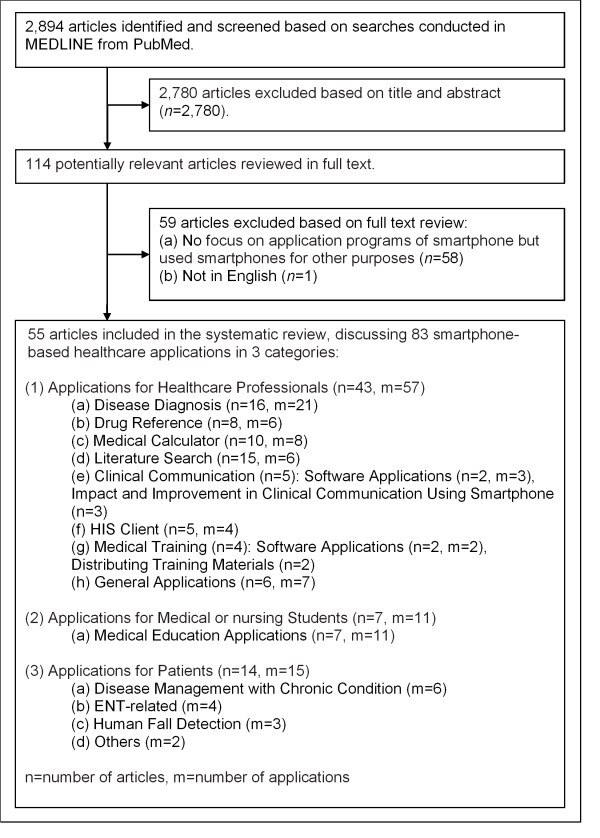
Background: Advanced mobile communications and portable computation are now combined in handheld devices called “smartphones”, which are also capable of running third-party software. The number of smartphone users is growing rapidly, including among healthcare professionals. The purpose of this study was to classify smartphone-based healthcare technologies as discussed in academic literature according to their functionalities, and summarize articles in each category. Methods: In April 2011, MEDLINE was searched to identify articles that discussed the design, development, evaluation, or use of smartphone-based software for healthcare professionals, medical or nursing students, or patients. A total of 55 articles discussing 83 applications were selected for this study from 2,894 articles initially obtained from the MEDLINE searches. Results: A total of 83 applications were documented: 57 applications for healthcare professionals focusing on disease diagnosis (21), drug reference (6), medical calculators (8), literature search (6), clinical communication (3), Hospital Information System (HIS) client applications (4), medical training (2) and general healthcare applications (7); 11 applications for medical or nursing students focusing on medical education; and 15 applications for patients focusing on disease management with chronic illness (6), ENT-related (4), fall-related (3), and two other conditions (2). The disease diagnosis, drug reference, and medical calculator applications were reported as most useful by healthcare professionals and medical or nursing students. Conclusions: Many medical applications for smartphones have been developed and widely used by health professionals and patients. The use of smartphones is getting more attention in healthcare day by day. Medical applications make smartphones useful tools in the practice of evidence-based medicine at the point of care, in addition to their use in mobile clinical communication. Also, smartphones can play a very important role in patient education, disease self-management, and remote monitoring of patients.
Overview
The claims and statistics of this paper haven’t been checked yet.
Run the check — free, no account needed. It reads the open-access text and checks the sources it cites.
Integrity signals
Registry
Cites
Statistics
Figures
Verification
Claims the paper makes
The claims and statistics of this paper haven’t been checked yet.
Run the check — free, no account needed. It reads the open-access text and checks the sources it cites.
Claims other papers make about this one
Each is checked against this paper’s own text: does it say what the citing paper says it does?
The source backs part of the claim, not all of it — or backs it for a different population, condition or comparison.
In the citing paper
“Generally, health care apps have been exhaustively discussed and reviewed in the literature [58]; however, the number of papers that focus on reviewing and evaluating tinnitus-related smartphone apps is underwhelming.”
From Smartphone and mobile health apps for tinnitus: Systematic identification, analysis, and assessment (2020) · cites this paper as [58]
Experimental — accuracy not yet measured
Self-check
Percentages, sums and reported differences re-computed from the paper’s own numbers.
The self-check needs the paper’s full text.
Citations
Cites
Preferred Reporting Items for Systematic Reviews and Meta-Analyses: the PRISMA statement
Moher, D., Liberati, A., Tetzlaff, J., Altman, D. G., & for the PRISMA Group (2009) · BMJ · doi:10.1136/bmj.b2535 · Cited by 83,823
Preferred reporting items for systematic reviews and meta-analyses: the PRISMA Statement.
(2009) · PubMed Central · Cited by 44,859
Studies in Health Technology and Informatics
Aphinyanaphongs, Y., & Aliferis, C. (2007) · Cited by 1,247
Text messaging as a tool for behavior change in disease prevention and management
Cole-Lewis, H., & Kershaw, T. (2010) · Epidemiologic Reviews · doi:10.1093/epirev/mxq004 · Cited by 1,190
Boulos, M. N. K., Wheeler, S., Tavares, C., & Jones, R. B. (2011) · BioMedical Engineering OnLine · doi:10.1186/1475-925x-10-24 · Cited by 1,123
Healthcare via Cell Phones: A Systematic Review
Krishna, S., Boren, S. A., & Balas, E. A. (2009) · Telemedicine and e-Health · doi:10.1089/tmj.2008.0099 · Cited by 882
Adolphe Quetelet (1796 1874) the average man and indices of obesity
Eknoyan, G. (2007) · Nephrology Dialysis Transplantation · doi:10.1093/ndt/gfm517 · Cited by 746
Recent advances: Consumer health informatics
Eysenbach, G. (2000) · BMJ · doi:10.1136/bmj.320.7251.1713 · Cited by 670
Liang, X., Wang, Q., Yang, X., Cao, J., Chen, J., Mo, X., Huang, J., Wang, L., & Gu, D. (2011) · Diabetic Medicine · doi:10.1111/j.1464-5491.2010.03180.x · Cited by 515
Wireless World: Social and Interactional Aspects of the Mobile Age
Brown, B. A. T., & Green, N. H. (2001) · Cited by 367
Research works printed but not linked: 10
- US Mobile Year in Review. [http://www2.comscore.com/l/1552/ileYearinReview2010Webinar-pdf/QOZR3]
- Knowledge on call: Physicians increasingly are discovering smartphones serve a purpose beyond being a convenient communication gadget. [http://www.ama-assn.org/amednews/2009/01/05/plus/bisa0105.pdf]
- M B: Proceedings of Ume°a’s 14th Student Conference in Computing Science. Opportunities and Challenges when Applying Mobile Technology in Health Care. 2010, UME°A, SWEDEN: UME°A UNIVERSITY, 1-12.
- Sarasohn-Kahn J: How Smartphones Are Changing Health Care for Consumers and Providers. 2010, Oakland, CA: California HealthCare Foundation,http://posterous.com/getfile/files.posterous.com/mobihealth/Pqvz1Ff7GcGuEwfNYj1WFMiuBfqUe0h2NY7fqAisAPu0okpu0fmuCGAytEI0/HowSmartPhonesChngHealthcare.pdf,
- Zhang T, Wang J, Liu P, Hou J: Fall detection by embedding an accelerometer in cellphone and using KFD algorithm. International Journal of Computer Science and Network Security: IJCSNS. 2006, 6: 277-284.
- de Buenaga M, Gachet D, Maña MJ, de la Villa M, Mata J: SIGIR 2008 Workshop on Mobile Information Retrieval. Clustering and Summarizing Medical Documents to Improve Mobile Retrieval. 2008, Singapore, 54-57.
- Mayo Clinic Proceedings. Tri JL, Severson RP, Hyberger LK, Hayes DL. 2007, Mayo Clinic, 282-285. 82nd · DOI
- Bertman J: Tech 101: a new generation of smartphones. MDNG Neurology. 2009, 11: 26-
- Hoyt RE, Cruz RW: Chapter 11: Mobile Technology. In Medical Informatics. Practical Guide for Healthcare and Information Technology Professionals. Edited by: Hoyt RE. 2010, Lulu Enterprises Inc, 199-217. 4th
- Introducing the T-Mobile G2 with Google — the First Smartphone Delivering 4G Speeds on T-Mobile’s Super-Fast HSPA+ Network. [http://www.htc.com/us/press/introducing-the-t-mobile-g2-with-google--the-first-smartphone-delivering-4g-speeds-on-t-mobiles-super-fast-hspa-network/19]
Cited by
Sorted by citations
The Internet of Things for Health Care: A Comprehensive Survey
Islam, S. M. R., Kwak, D., Kabir, M. H., Hossain, M., & Kwak, K.-S. (2015) · IEEE Access · doi:10.1109/access.2015.2437951 · Cited by 3,199
Mobile devices and apps for health care professionals: uses and benefits.
Ventola, C. L. (2014) · PubMed Central · doi:10.57945/manara.23966214 · Cited by 847
Analyzing older users’ home telehealth services acceptance behavior—applying an Extended UTAUT model
Cimperman, M., Brenčić, M. M., & Trkman, P. (2016) · International Journal of Medical Informatics · doi:10.1016/j.ijmedinf.2016.03.002 · Cited by 634
Who uses mobile phone health apps and does use matter? A secondary data analytics approach
Carroll, J. K., Moorhead, A., Bond, R., LeBlanc, W. G., Petrella, R. J., & Fiscella, K. (2017) · Journal of Medical Internet Research · doi:10.2196/jmir.5604 · Cited by 540
Burke, L. E., Ma, J., Azar, K. M. J., Bennett, G. G., Peterson, E. D., Zheng, Y., Riley, W., Stephens, J., Shah, S. H., Suffoletto, B., et al. (2015) · Circulation · doi:10.1161/cir.0000000000000232 · Cited by 516
Metadata
- Authors
- Mosa, A. S. M., Yoo, I., & Sheets, L.
- Affiliations
- University of Missouri (US)
- Corresponding author
- Yoo, Illhoi
- Venue
- BMC Medical Informatics and Decision Making
- Published
- 2012-07-10
- Volume
- 12
- Issue
- 1
- Pages
- 67-67
- ISSN
- 1472-6947 (ISSN-L)
- PMC
- PMC3534499
- OpenAlex
- W2168217134
- Cited by
- 1,184
- References
- 122
- Citations by year
- 2026: 23 · 2025: 55 · 2024: 69 · 2023: 75 · 2022: 88 · 2021: 102 · 2020: 108 · 2019: 92 · 2018: 110 · 2017: 132 · 2016: 122 · 2015: 95 · 2014: 69 · 2013: 41 · 2012: 3
- FWCI
- 10.12
- Type
- journal article
- Language
- en
- Open access
- gold
- doi.org
- Licence
- Locations
- BMC Medical Informatics and Decision Making (publishedVersion, cc-by)
- Europe PMC (PubMed Central) (publishedVersion, cc-by)
- PubMed Central (publishedVersion, cc-by)
- PubMed (publishedVersion)
- DOAJ (DOAJ: Directory of Open Access Journals) (submittedVersion, cc-by-sa)
- Funders
- U.S. Food and Drug Administration
- Topics
- Health Sciences › Health Professions › General Health Professions › Mobile Health and mHealth Applications
- Physical Sciences › Computer Science › Information Systems › Mobile Learning in Education
- Physical Sciences › Computer Science › Information Systems › Mobile and Web Applications
- Keywords
- mobile application, mobile health, healthcare workers, medical students, nursing students, disease diagnosis, drug reference, medical calculators, clinical communication, hospital information systems, medical education, patient self-management, chronic disease, patient education, remote patient monitoring, evidence-based medicine
- MeSH terms
- Medical Informatics Applications, Cell Phone
About these checks
Registry, retraction, Cites and statistics results are computed, not judged, with one exception: a printed reference that no index lists is read once by a model before it counts as a citation error. Claims are extracted by a model and kept only when their quote appears verbatim in the text; each cited source is then checked, with a model’s help, for whether it says what the claim relies on. Those verdicts can be wrong — read the claim’s quote and the cited source before relying on one.
Statistics and arithmetic are recomputed, not judged.
Confidence bands are shown only for fields calibrated on our annotated test set. None is calibrated yet, so no band is shown.
What counts as a claim ›How we measure confidence ›How we check this ›
Are you an author, or do you see a problem with this page? Request a review
