

A cross-sectional survey assessing the acceptability and feasibility of self-report electronic data collection about health risks from patients attending an Aboriginal Community Controlled Health Service
Open accessThe DOI matches its Crossref record; 30 of the 30 references it cites were found in a registry or an index.
Abstract
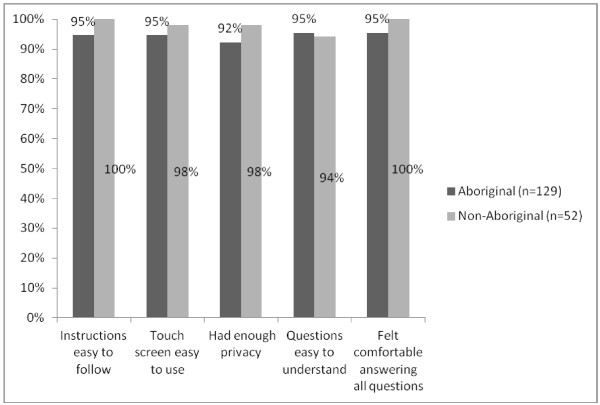
BACKGROUND: Aboriginal Australians experience significantly worse health and a higher burden of chronic disease than non-Aboriginal Australians. Electronic self-report data collection is a systematic means of collecting data about health risk factors which could help to overcome screening barriers and assist in the provision of preventive health care. Yet this approach has not been tested in an Aboriginal health care setting. Therefore, the aim of this study was to examine the acceptability and feasibility of a health risk questionnaire administered on a touch screen laptop computer for patients attending an Aboriginal Community Controlled Health Service (ACCHS). METHODS: In 2012, consecutive adult patients attending an ACCHS in rural New South Wales, Australia, were asked to complete a health risk survey on a touch screen computer. Health risk factors assessed in the questionnaire included smoking status, body mass index, and level of physical activity. The questionnaire included visual cues to improve accuracy and minimise literacy barriers and was completed while participants were waiting for their appointment. RESULTS: A total of 188 participants completed the questionnaire, with a consent rate of 71%. The mean time taken to complete the questionnaire was less than 12 minutes. Over 90% of participants agreed that: the questionnaire instructions were easy to follow; the touch screen computer was easy to use; they had enough privacy; the questions were easy to understand; they felt comfortable answering all the questions. CONCLUSIONS: Results indicate that the use of a touch screen questionnaire to collect information from patients about health risk factors affecting Aboriginal Australians is feasible and acceptable in the ACCHS setting. This approach has potential to improve identification and management of at-risk individuals, therein providing significant opportunities to reduce the burden of disease among Aboriginal Australians.
Overview
The claims and statistics of this paper haven’t been checked yet.
Free: it reads the open-access text and checks the first 5 claims that cite a source we can check. Create a free account to check every claim.
Integrity signals
Registry
Cites
Statistics
Figures
Verification
Claims the paper makes
The claims and statistics of this paper haven’t been checked yet.
Free: it reads the open-access text and checks the first 5 claims that cite a source we can check. Create a free account to check every claim.
Claims other papers make about this one
Each is checked against this paper’s own text: does it say what the citing paper says it does?
In the citing paper
“Locally produced eHealth strategies that use culturally appropriate graphics and videos, limited text, and Aboriginal and Torres Strait Islander voices reportedly have the best chance of successful implementation [20,21].”
From Acceptability of Mental Health Apps for Aboriginal and Torres Strait Islander Australians: A Qualitative Study (2016) · cites this paper as [21]
In the citing paper
“This accords with the findings of others and strengthens the evidence for collaborative development of eHealth tools [20,21].”
From Acceptability of Mental Health Apps for Aboriginal and Torres Strait Islander Australians: A Qualitative Study (2016) · cites this paper as [21]
Self-check
Percentages, sums and reported differences re-computed from the paper’s own numbers.
The self-check needs the paper’s full text.
Citations
Cites
Vos, T., Barker, B., Begg, S., Stanley, L., & Lopez, A. D. (2009) · International Journal of Epidemiology · doi:10.1093/ije/dyn240 · Cited by 593
Velikova, G., Wright, E. P., Smith, A. B., Cull, A., Gould, A., Forman, D., Perren, T., Stead, M., Brown, J., & Selby, P. J. (1999) · Journal of Clinical Oncology · doi:10.1200/jco.1999.17.3.998 · Cited by 339 · cited 1×
“Electronic data collection is preferred by patients [22,23], reduces missing values compared to paper and pencil methods [24], allows tailoring of questions to minimise patient burden, and has the potential for automatic entry of data into medical records [23,25].”
BackgroundThe burden of disease and injury in Aboriginal and Torres Strait Islander peoples 2003
Vos, T., López, A. D., Stanley, L., & Barker, B. M. (2007) · Cited by 194
The health status of indigenous peoples and others
Ring, I., & Brown, N. (2003) · BMJ · doi:10.1136/bmj.327.7412.404 · Cited by 163 · cited 1×
“Background As for other Indigenous populations worldwide [1], Aboriginal and Torres Strait Islander Australians experience significantly poorer health and younger mortality than other Australians [2,3].”
Researching Aboriginal health: experience from a study of urban young people's health and well-being
Holmes, W. R., Stewart, P., Garrow, A., Anderson, I. P. S., & Thorpe, L. (2002) · Social Science & Medicine · doi:10.1016/s0277-9536(01)00095-8 · Cited by 105 · cited 2×
“One study utilised a laptop questionnaire to collect risk and resilience data [23], and another touch activated hand held computer devices to collect data about condom use [28], from Aboriginal youth.”
BackgroundAboriginal and Torres Strait Islander Health Performance Framework 2008 report: detailed analyses
Gourley, M., Stace-Winkles, N., & Al-Yaman, F. M. (2009) · Cited by 94
Islam, M. M., Topp, L., Conigrave, K. M., van Beek, I., Maher, L., White, A., Rodgers, C., & Day, C. A. (2012) · AIDS Care · doi:10.1080/09540121.2012.663886 · Cited by 82 · cited 1×
“However, the use of a touch screen with graphics and multimedia options such as those used in audio computer-assisted self-interviewing methods [36], or the multimedia Queensland ‘HITnet’ program for Indigenous communities [37,38] could help to overcome these barriers.”
MethodSelf-citationPeiris, D., Patel, A. A., Cass, A., Howard, M. P., Tchan, M., Brady, J. P., Vries, J. D., Rickards, B. A., Yarnold, D., Hayman, N. E., et al. (2009) · The Medical Journal of Australia · doi:10.5694/j.1326-5377.2009.tb02811.x · Cited by 78 · cited 2×
“However, reliance on medical records to identify at-risk patients may be limited by the accuracy and completeness of such records [14-16].”
BackgroundA review of tobacco interventions for Indigenous Australians
Ivers, R. G. (2003) · Australian and New Zealand Journal of Public Health · doi:10.1111/j.1467-842x.2003.tb00398.x · Cited by 71 · cited 1×
“For example, many Aboriginal health workers are themselves smokers, and may feel uncomfortable assessing the smoking status of their patients and providing cessation advice [19,20].”
BackgroundEdwards, S. L., Slattery, M. L., Murtaugh, M. A., Edwards, R. L., Bryner, J., Pearson, M., Rogers, A., Edwards, A. M., & Tom-Orme, L. (2007) · American Journal of Epidemiology · doi:10.1093/aje/kwm019 · Cited by 65
Australia's National Bowel Cancer Screening Program: does it work for Indigenous Australians?
Christou, A., Katzenellenbogen, J. M., & Thompson, S. (2010) · BMC Public Health · doi:10.1186/1471-2458-10-373 · Cited by 60 · cited 1×
“Cancer screening rates are also known to be low [9,10].”
BackgroundBreast and cervical cancer in indigenous women-overcoming barriers to early detection.
Reath, J., & Carey, M. (2008) · PubMed · Cited by 51
Self-citationA single question reliably identifies physically inactive women in primary care.
Rose, S. B., Elley, C. R., LAWTON, B. A., & Ac, D. (2008) · PubMed · Cited by 49
GILLIGAN, C., SANSON‐FISHER, R., EADES, S., WENITONG, M., PANARETTO, K., & D'ESTE, C. (2010) · Drug and Alcohol Review · doi:10.1111/j.1465-3362.2009.00078.x · Cited by 45 · cited 1×
“Although validated measures were used wherever possible [33-35], many show only moderate sensitivity and specificity (such as short measures of physical activity and diet) and the validity of most measures for use in the Aboriginal population has not been specifically established.”
MethodSelf-citationQuantity-Frequency and Diary Measures of Alcohol Consumption for Elderly Drinkers
Werch, C. E. (1989) · International Journal of the Addictions · doi:10.3109/10826088909047316 · Cited by 45
National Aboriginal and Torres Strait Islander Social Survey, 2008
(2009) · PsycEXTRA Dataset · doi:10.1037/e543652012-001 · Cited by 44
Aiello, E. J., Taplin, S. H., Reid, R. D., Hobbs, M., Seger, D., Kamel, H., Tufano, J., & Ballard-Barbash, R. R. (2005) · Journal of Clinical Epidemiology · doi:10.1016/j.jclinepi.2005.07.007 · Cited by 42
The harmful use of alcohol amongst Indigenous Australians
Wilson, A. J., Stearne, A., Gray, D. A., & Saggers, S. (2010) · Cited by 41
Yoong, S. L., Carey, M. L., Sanson‐Fisher, R., Russell, G. M., Mazza, D., Makeham, M., Paul, C. L., Inder, K., & D’Este, C. A. (2012) · BMJ Open · doi:10.1136/bmjopen-2012-001405 · Cited by 37 · cited 1×
“Electronic data collection is preferred by patients [22,23], reduces missing values compared to paper and pencil methods [24], allows tailoring of questions to minimise patient burden, and has the potential for automatic entry of data into medical records [23,25].”
BackgroundSelf-citationPanaretto, K. S., Coutts, J., Johnson, L. M., Morgan, A., Leon, D., & Hayman, N. E. (2010) · Australian and New Zealand Journal of Public Health · doi:10.1111/j.1753-6405.2010.00471.x · Cited by 36 · cited 4×
“However, reliance on medical records to identify at-risk patients may be limited by the accuracy and completeness of such records [14-16].”
BackgroundInfluentialSafer sex and condom use: a convenience sample of Aboriginal young people in New South Wales
Bryant, J., Ward, J. S., Worth, H., Hull, P., Solar, S., & Bailey, S. (2011) · Sexual Health · doi:10.1071/sh10138 · Cited by 29 · cited 1×
“One study utilised a laptop questionnaire to collect risk and resilience data [23], and another touch activated hand held computer devices to collect data about condom use [28], from Aboriginal youth.”
BackgroundBailie, R. S., Si, D., Connors, C. M., Kwedza, R., O’Donoghue, L., Kennedy, C. M., Cox, R. J., Liddle, H. E., Hains, J., Dowden, M., et al. (2011) · BMC Health Services Research · doi:10.1186/1472-6963-11-139 · Cited by 29 · cited 3×
“Such inconsistencies in detecting or recording data for at-risk patients may be due to the time required for screening, and privacy or sensitivity concerns [17,18].”
BackgroundThompson, M., Robertson, J. A., & CLOUGH, A. R. (2010) · Australian and New Zealand Journal of Public Health · doi:10.1111/j.1753-6405.2010.00632.x · Cited by 27 · cited 1×
“For example, many Aboriginal health workers are themselves smokers, and may feel uncomfortable assessing the smoking status of their patients and providing cessation advice [19,20].”
BackgroundStewart, J. M., Sanson‐Fisher, R., Eades, S., & FITZGERALD, M. (2012) · Drug and Alcohol Review · doi:10.1111/j.1465-3362.2012.00455.x · Cited by 18 · cited 1×
“The need to prioritise across a complex array of health and other problems facing many Aboriginal patients is a further challenge to achieving regular assessment of modifiable health risks and the provision of preventive health care [14,21].”
BackgroundSelf-citationBridging the Information Gap: IT and Health in Indigenous Populations
Hunter, E., Travers, H., & McCulloch, B. (2003) · Australasian Psychiatry · doi:10.1046/j.1038-5282.2003.02011.x · Cited by 13 · cited 2×
“Of note was the importance of including non text-based information and culturally appropriate graphics to promote acceptability in this population [29].”
BackgroundMultimedia Computerized Smoking Awareness Education for Low-Literacy Hispanics
ANDERSEN, S., Andersen, P., & Youngblood, N. E. (2010) · CIN Computers Informatics Nursing · doi:10.1097/ncn.0b013e3181f9dd81 · Cited by 12
Closing the gap depends on ACCHSs
Couzos, S., & Thiele, D. D. (2009) · The Medical Journal of Australia · doi:10.5694/j.1326-5377.2009.tb02554.x · Cited by 12 · cited 1×
“Approximately 50% of the Aboriginal population of Australia access ACCHSs for their health care [13], making ACCHSs an appropriate setting in which to address the risk status of Aboriginal Australians.”
BackgroundLaurence, C., Burgess, T. A., Beilby, J., Symon, B. G., & Wilkinson, D. (2004) · Australian and New Zealand Journal of Public Health · doi:10.1111/j.1467-842x.2004.tb00436.x · Cited by 10 · cited 1×
“However, reliance on medical records to identify at-risk patients may be limited by the accuracy and completeness of such records [14-16].”
BackgroundHunter, E. M., Travers, H. J., Pelham, S., Gibson, J., Hermawan, G., & Austin, C. (2009) · Australasian Psychiatry · doi:10.1080/10398560902948456 · Cited by 9 · cited 1×
“However, the use of a touch screen with graphics and multimedia options such as those used in audio computer-assisted self-interviewing methods [36], or the multimedia Queensland ‘HITnet’ program for Indigenous communities [37,38] could help to overcome these barriers.”
MethodMultimedia Computerized Smoking Awareness Education for Low-Literacy Hispanics
ANDERSEN, S., Andersen, P., & Youngblood, N. E. (2011) · CIN Computers Informatics Nursing · doi:10.1097/ncn.0b013e318215543f · Cited by 3 · cited 1×
“A touch screen kiosk providing smoking cessation information was also successful in engaging a sample of low-literacy, underserved, Mexican-American primary care patients [27].”
Background
Research works printed but not linked: 1
- Harris M The Role of Primary Health Care in Preventing the Onset of Chronic Disease, with a Particular Focus on the Lifestyle Risk Factors of Obesity, Tobacco and Alcohol Commissioned Paper for the National Preventive Health Taskforce 2009 [ http://www.preventativehealth.org.au/internet/preventativehealth/publishing.nsf/Content/0FBE203C1C547A82CA257529000231BF/$File/commpaper-primary-hlth-care-harris.pdf]
Cited by
Povey, J., Mills, P. P. J. R., Dingwall, K. M., Lowell, A., Singer, J., Rotumah, D., Bennett-Levy, J., & Nagel, T. (2016) · Journal of Medical Internet Research · doi:10.2196/jmir.5314 · Cited by 121
“Locally produced eHealth strategies that use culturally appropriate graphics and videos, limited text, and Aboriginal and Torres Strait Islander voices reportedly have the best chance of successful implementation [20,21].”
The Role of eHealth in Optimizing Preventive Care in the Primary Care Setting
Carey, M. L., Noble, N., Mansfield, E. L., Waller, A. E., Henskens, F. A., & Sanson‐Fisher, R. (2015) · Journal of Medical Internet Research · doi:10.2196/jmir.3817 · Cited by 57
“High rates of acceptability ranging from 88% to over 90% have also been confirmed in community settings serving socioeconomically disadvantaged clients [72,73].”
Self-citationOlder Aboriginal Australians’ Health Concerns and Preferences for Healthy Ageing Programs
Wettasinghe, P. M., Allan, W., Garvey, G., Timbery, A., Hoskins, S., Veinovic, M., Daylight, G., Mack, H. A., Minogue, C., Broe, G. A., et al. (2020) · International Journal of Environmental Research and Public Health · doi:10.3390/ijerph17207390 · Cited by 56
“This aligns with the findings of others and reinforces the evidence for the co-design of e-Health tools [30,31].”
ResultLee, K. S., Conigrave, J. H., Ansari, M. A., Wilson, S., Perry, J., Zheng, C., Freeburn, B., Room, R., Callinan, S., Hayman, N. E., et al. (2019) · Journal of Ethnicity in Substance Abuse · doi:10.1080/15332640.2019.1579144 · Cited by 33
Self-citationIncreasing advance personal planning: the need for action at the community level
Waller, A. E., Sanson‐Fisher, R., Ries, N. M., & Bryant, J. (2018) · BMC Public Health · doi:10.1186/s12889-018-5523-5 · Cited by 31
Self-citation
Metadata
- Authors
- Noble, N. E., Paul, C. L., Carey, M. L., Sanson-Fisher, R. W., Blunden, S. V., Stewart, J. M., & Conigrave, K. M.
- Affiliations
- University of Newcastle Australia (AU)
- The University of Sydney (AU)
- Corresponding author
- Noble, Natasha E
- Venue
- BMC Medical Informatics and Decision Making
- Published
- 2014-04-16
- Volume
- 14
- Issue
- 1
- Pages
- 34-34
- ISSN
- 1472-6947 (ISSN-L)
- PMC
- PMC4005463
- OpenAlex
- W2055886596
- Cited by
- 22
- References
- 30
- Citations by year
- 2024: 4 · 2022: 1 · 2021: 2 · 2020: 1 · 2019: 3 · 2018: 2 · 2017: 1 · 2016: 4 · 2015: 3 · 2014: 1
- FWCI
- 9.78
- Type
- journal article
- Language
- en
- Open access
- gold
- doi.org
- Licence
- cc-by
- creativecommons.org/licenses/by/2.0 (tdm)
- Locations
- BMC Medical Informatics and Decision Making (publishedVersion, cc-by)
- Europe PMC (PubMed Central) (publishedVersion, cc-by)
- PubMed Central (publishedVersion, cc-by)
- PubMed (publishedVersion)
- Figshare (submittedVersion, cc-by)
- NOVA (University of Newcastle Australia) (submittedVersion, cc-by)
- Funders
- Hunter Medical Research Institute
- Cancer Council NSW
- Topics
- Social Sciences › Sociology and Political Science › Survey Methodology and Nonresponse
- Social Sciences › Health › Indigenous Health, Education, and Rights
- Health Sciences › Health Professions › Health Information Management › Electronic Health Records Systems
- Keywords
- health risk factors, Aboriginal Australians, Aboriginal Community Controlled Health Services, acceptability, feasibility, smoking status, body mass index, physical activity, literacy barriers, preventive medicine, chronic disease burden
- MeSH terms
- Adult, Community Health Services, Cross-Sectional Studies, Data Collection, Feasibility Studies, Female, Health Services Research, Humans, Informed Consent, Male, Mass Screening, Middle Aged, New South Wales, Risk Factors, Rural Population, User-Computer Interface, Risk Assessment, Native Hawaiian or Other Pacific Islander, Self Report
About these checks
Registry, retraction, Cites and statistics results are computed, not judged, with one exception: a printed reference that no index lists is read once by a model before it counts as a citation error. Claims are extracted by a model and kept only when their quote appears verbatim in the text; each cited source is then checked, with a model’s help, for whether it says what the claim relies on. Those verdicts can be wrong — read the claim’s quote and the cited source before relying on one.
Statistics and arithmetic are recomputed, not judged.
Confidence bands are shown only for fields calibrated on our annotated test set. None is calibrated yet, so no band is shown.
What counts as a claim ›How we measure confidence ›How we check this ›
Are you an author, or do you see a problem with this page? Request a review
Data sources
Bibliographic data: Semantic Scholar, OpenAlex, Crossref.
Contains information from the Semantic Scholar Academic Graph Datasets, made available under the ODC Attribution License (ODC-BY 1.0).
Semantic Scholar’s data is described in: Kinney, R., et al. (2023). The Semantic Scholar Open Data Platform. arXiv:2301.10140.
