

The DOI matches its Crossref record; 40 of the 40 references it cites were found in a registry or an index.
A systematic review of speech recognition technology in health care
Open accessAbstract
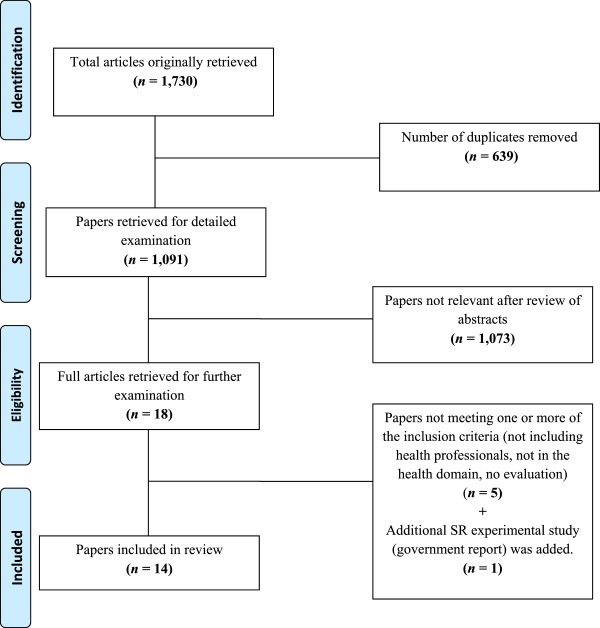
BACKGROUND: To undertake a systematic review of existing literature relating to speech recognition technology and its application within health care. METHODS: A systematic review of existing literature from 2000 was undertaken. Inclusion criteria were: all papers that referred to speech recognition (SR) in health care settings, used by health professionals (allied health, medicine, nursing, technical or support staff), with an evaluation or patient or staff outcomes. Experimental and non-experimental designs were considered. Six databases (Ebscohost including CINAHL, EMBASE, MEDLINE including the Cochrane Database of Systematic Reviews, OVID Technologies, PreMED-LINE, PsycINFO) were searched by a qualified health librarian trained in systematic review searches initially capturing 1,730 references. Fourteen studies met the inclusion criteria and were retained. RESULTS: The heterogeneity of the studies made comparative analysis and synthesis of the data challenging resulting in a narrative presentation of the results. SR, although not as accurate as human transcription, does deliver reduced turnaround times for reporting and cost-effective reporting, although equivocal evidence of improved workflow processes. CONCLUSIONS: SR systems have substantial benefits and should be considered in light of the cost and selection of the SR system, training requirements, length of the transcription task, potential use of macros and templates, the presence of accented voices or experienced and in-experienced typists, and workflow patterns.
Overview
The claims and statistics of this paper haven’t been checked yet.
Run the check — free, no account needed. It reads the open-access text and checks the sources it cites.
Integrity signals
Registry
Cites
Statistics
Figures
Verification
Claims the paper makes
The claims and statistics of this paper haven’t been checked yet.
Run the check — free, no account needed. It reads the open-access text and checks the sources it cites.
Claims other papers make about this one
Each is checked against this paper’s own text: does it say what the citing paper says it does?
The cited source says what the claim attributes to it.
In the citing paper
“Strategies to reduce documentation burden, including team documentation, 9-13 automatic speech recognition technologies, 14 and 2021 E&M coding changes 15 have been implemented with variable impact.16”
From Ambient artificial intelligence scribes: utilization and impact on documentation time (2025) · cites this paper as [14]
Self-check
Percentages, sums and reported differences re-computed from the paper’s own numbers.
The self-check needs the paper’s full text.
Citations
Cites
Chaudhry, B., Wang, J., Wu, S., Maglione, M., Mojica, W., Roth, E., Morton, S. C., & Shekelle, P. G. (2006) · Annals of Internal Medicine · doi:10.7326/0003-4819-144-10-200605160-00125 · Cited by 3,159
Minimum prediction residual principle applied to speech recognition
Itakura, F. (1975) · IEEE Transactions on Acoustics Speech and Signal Processing · doi:10.1109/tassp.1975.1162641 · Cited by 1,620
Buntin, M. B., Burke, M. F., Hoaglin, M. C., & Blumenthal, D. (2011) · Health Affairs · doi:10.1377/hlthaff.2011.0178 · Cited by 1,311
Pluye, P., Gagnon, M.-P., Griffiths, F., & Johnson-Lafleur, J. (2009) · International Journal of Nursing Studies · doi:10.1016/j.ijnurstu.2009.01.009 · Cited by 1,119
Information Systems Development: Methodologies, Techniques and Tools
Avison, D., & Fitzgerald, G. (1995) · McGraw-Hill Ltd., UK eBooks · Cited by 1,053
New directions in eHealth communication: Opportunities and challenges
Kreps, G. L., & Neuhauser, L. (2010) · Patient Education and Counseling · doi:10.1016/j.pec.2010.01.013 · Cited by 546
Health Information Technology: An Updated Systematic Review With a Focus on Meaningful Use
Jones, S. S., Rudin, R. S., Perry, T., & Shekelle, P. G. (2014) · Annals of Internal Medicine · doi:10.7326/m13-1531 · Cited by 475
Costs And Benefits Of Health Information Technology: New Trends From The Literature
Goldzweig, C. L., Towfigh, A., Maglione, M., & Shekelle, P. (2009) · Health Affairs · doi:10.1377/hlthaff.28.2.w282 · Cited by 375
Jamal, A., McKenzie, K., & Clark, M. (2009) · Health Information Management Journal · doi:10.1177/183335830903800305 · Cited by 222
Pakhomov, S., Buntrock, J. D., & Chute, C. G. (2006) · Journal of the American Medical Informatics Association · doi:10.1197/jamia.m2077 · Cited by 161
Research works printed but not linked: 1
- Northern Sydney Local Health District: Manly Emergency Department Voice Recognition Evaluation. 2012, Manly: Northern Sydney Local Health District and NSW Health
Cited by
Sorted by citations
Velupillai, S. U., Suominen, H., Liakata, M., Roberts, A., Shah, A. D., Morley, K. I., Osborn, D., Hayes, J., Stewart, R. J., Downs, J. M., et al. (2018) · Journal of Biomedical Informatics · doi:10.1016/j.jbi.2018.10.005 · Cited by 261
Self-citationSpeech Technology for Healthcare: Opportunities, Challenges, and State of the Art
Latif, S., Qadir, J., Qayyum, A., Usama, M., & Younis, M. S. (2020) · IEEE Reviews in Biomedical Engineering · doi:10.1109/rbme.2020.3006860 · Cited by 189
Ambient artificial intelligence scribes: utilization and impact on documentation time
Ma, S. P., Liang, A. S., Shah, S. J., Smith, M., Jeong, Y., Devon-Sand, A., Crowell, T., Delahaie, C., Hsia, C., Lin, S., et al. (2025) · Journal of the American Medical Informatics Association · doi:10.1093/jamia/ocae304 · Cited by 155
Javaid, M., Haleem, A., & Singh, R. P. (2024) · Informatics and Health · doi:10.1016/j.infoh.2024.05.001 · Cited by 135
Risks and benefits of speech recognition for clinical documentation: a systematic review
Hodgson, T., & Coiera, E. W. (2015) · Journal of the American Medical Informatics Association · doi:10.1093/jamia/ocv152 · Cited by 113
Metadata
- Authors
- Johnson, M., Lapkin, S., Long, V., Sanchez, P., Suominen, H., Basilakis, J., & Dawson, L.
- Affiliations
- Ingham Institute (AU)
- Western Sydney University (AU)
- Australian National University (AU)
- University of Wollongong (AU)
- Corresponding author
- Johnson, Maree
- Venue
- BMC Medical Informatics and Decision Making
- Published
- 2014-10-28
- Volume
- 14
- Issue
- 1
- Pages
- 94-94
- ISSN
- 1472-6947 (ISSN-L)
- PMC
- PMC4283090
- OpenAlex
- W2046499381
- Cited by
- 141
- References
- 40
- Citations by year
- 2026: 13 · 2025: 17 · 2024: 16 · 2023: 23 · 2022: 18 · 2021: 8 · 2020: 11 · 2019: 7 · 2018: 16 · 2017: 4 · 2016: 2 · 2015: 6
- FWCI
- 0.61
- Type
- journal article
- Language
- en
- Open access
- gold
- doi.org
- Licence
- Locations
- BMC Medical Informatics and Decision Making (publishedVersion, cc-by)
- Europe PMC (PubMed Central) (publishedVersion, cc-by)
- PubMed Central (publishedVersion, cc-by)
- PubMed (publishedVersion)
- Research Bank (Australian Catholic University) (submittedVersion)
- Research Online (University of Wollongong) (submittedVersion)
- Figshare (submittedVersion)
- ANU Open Research (Australian National University) (submittedVersion, cc-by)
- Funders
- ACT Government
- Australian Government
- Australian National University
- University of New South Wales
- University of Sydney
- University of Western Sydney
- Monash University
- University of Melbourne
- Griffith University
- Queensland University of Technology
- University of Queensland
- Australian Research Council
- Topics
- Health Sciences › Health Professions › Health Information Management › Electronic Health Records Systems
- Physical Sciences › Computer Science › Artificial Intelligence › Speech Recognition and Synthesis
- Health Sciences › Nursing › Research and Theory › Nursing Diagnosis and Documentation
- Keywords
- speech recognition, clinical documentation, transcription, cost-effectiveness, speech recognition accuracy, voice recognition
- MeSH terms
- Health Services, Humans, Speech Recognition Software
About these checks
Registry, retraction, Cites and statistics results are computed, not judged, with one exception: a printed reference that no index lists is read once by a model before it counts as a citation error. Claims are extracted by a model and kept only when their quote appears verbatim in the text; each cited source is then checked, with a model’s help, for whether it says what the claim relies on. Those verdicts can be wrong — read the claim’s quote and the cited source before relying on one.
Statistics and arithmetic are recomputed, not judged.
Confidence bands are shown only for fields calibrated on our annotated test set. None is calibrated yet, so no band is shown.
What counts as a claim ›How we measure confidence ›How we check this ›
Are you an author, or do you see a problem with this page? Request a review
