

Automated de-identification of free-text medical records
Open accessThe DOI matches its Crossref record; 30 of the 30 references it cites were found in a registry or an index.
Abstract
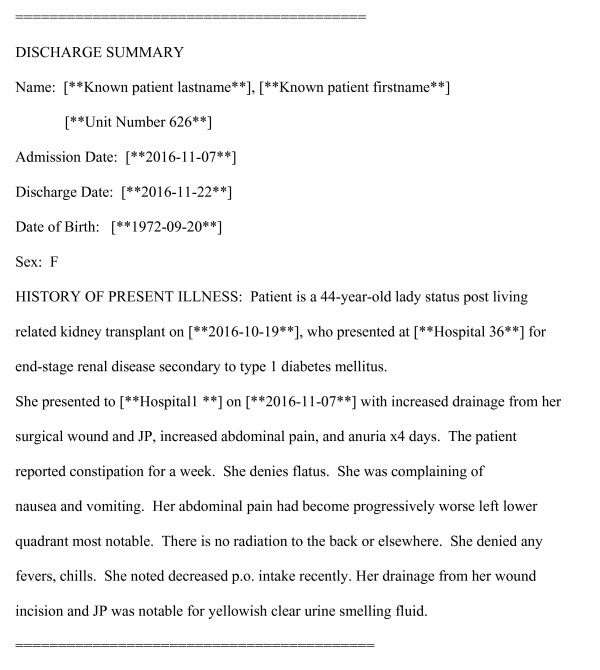
Background: Text-based patient medical records are a vital resource in medical research. In order to preserve patient confidentiality, however, the U.S. Health Insurance Portability and Accountability Act (HIPAA) requires that protected health information (PHI) be removed from medical records before they can be disseminated. Manual de-identification of large medical record databases is prohibitively expensive, time-consuming and prone to error, necessitating automatic methods for large-scale, automated de-identification. Methods: We describe an automated Perl-based de-identification software package that is generally usable on most free-text medical records, e.g., nursing notes, discharge summaries, X-ray reports, etc. The software uses lexical look-up tables, regular expressions, and simple heuristics to locate both HIPAA PHI, and an extended PHI set that includes doctors' names and years of dates. To develop the de-identification approach, we assembled a gold standard corpus of re-identified nursing notes with real PHI replaced by realistic surrogate information. This corpus consists of 2,434 nursing notes containing 334,000 words and a total of 1,779 instances of PHI taken from 163 randomly selected patient records. This gold standard corpus was used to refine the algorithm and measure its sensitivity. To test the algorithm on data not used in its development, we constructed a second test corpus of 1,836 nursing notes containing 296,400 words. The algorithm's false negative rate was evaluated using this test corpus. Results: Performance evaluation of the de-identification software on the development corpus yielded an overall recall of 0.967, precision value of 0.749, and fallout value of approximately 0.002. On the test corpus, a total of 90 instances of false negatives were found, or 27 per 100,000 word count, with an estimated recall of 0.943. Only one full date and one age over 89 were missed. No patient names were missed in either corpus. Conclusion: We have developed a pattern-matching de-identification system based on dictionary look-ups, regular expressions, and heuristics. Evaluation based on two different sets of nursing notes collected from a U.S. hospital suggests that, in terms of recall, the software out-performs a single human de-identifier (0.81) and performs at least as well as a consensus of two human de-identifiers (0.94). The system is currently tuned to de-identify PHI in nursing notes and discharge summaries but is sufficiently generalized and can be customized to handle text files of any format. Although the accuracy of the algorithm is high, it is probably insufficient to be used to publicly disseminate medical data. The open-source de-identification software and the gold standard re-identified corpus of medical records have therefore been made available to researchers via the PhysioNet website to encourage improvements in the algorithm.
Overview
The claims and statistics of this paper haven’t been checked yet.
Free: it reads the open-access text and checks the first 5 claims that cite a source we can check. Create a free account to check every claim.
Integrity signals
Registry
Cites
Statistics
Figures
Verification
Claims the paper makes
The claims and statistics of this paper haven’t been checked yet.
Free: it reads the open-access text and checks the first 5 claims that cite a source we can check. Create a free account to check every claim.
Claims other papers make about this one
Each is checked against this paper’s own text: does it say what the citing paper says it does?
The cited source says what the claim attributes to it.
In the citing paper
“Finally, we combined two published algorithms for removing PHI from free-text17,18.”
From MIMIC-IV, a freely accessible electronic health record dataset (2023) · cites this paper as [17]
Self-check
Percentages, sums and reported differences re-computed from the paper’s own numbers.
The self-check needs the paper’s full text.
Citations
Cites
Goldberger, A. L., Amaral, L. A. N., Glass, L., Hausdorff, J. M., Ivanov, P. C., Mark, R. G., Mietus, J. E., Moody, G. B., Peng, C.-K., & Stanley, H. E. (2000) · Circulation · doi:10.1161/01.cir.101.23.e215 · Cited by 14,809
Self-citationThe Unified Medical Language System
Humphreys, B. L., McCray, A. T., & Lindberg, D. A. B. (1993) · Methods of Information in Medicine · doi:10.1055/s-0038-1634945 · Cited by 1,182
Proceedings of the AMIA Symposium
Schulz, S., Daumke, P., Smith, B., & Hahn, U. (2005) · Cited by 606
Evaluating the State-of-the-Art in Automatic De-identification
Uzuner, O., Luo, Y., & Szolovits, P. (2007) · Journal of the American Medical Informatics Association · doi:10.1197/jamia.m2444 · Cited by 452 · cited 2×
“A very recent development has been a competition run at the first Workshop on Challenges in Natural Language Processing for Clinical Data to de-identify discharge summary free-text data [27].”
Self-citationStandards for privacy of individually identifiable health information. Final rule.
(2002) · PubMed · Cited by 405
Saeed, M., Lieu, C., Raber, G., & Mark, R. G. (2003) · Computers in Cardiology · doi:10.1109/cic.2002.1166854 · Cited by 271
Self-citationReplacing Personally-Identifying Information in Medical Records, the Scrub System
Sweeney, L. (2018) · PubMed · doi:10.1184/r1/6625565 · Cited by 251
Federal Policy for the Protection of Human Subjects. Final rule.
(1991) · PubMed · Cited by 237
Hypertrophic Obstructive Cardiomyopathy
Nishimura, R. A., & Holmes, D. R. (2004) · New England Journal of Medicine · doi:10.1056/nejmcp030779 · Cited by 236
Guaranteeing anonymity when sharing medical data, the Datafly system
Sweeney, L. (2018) · PubMed · doi:10.1184/r1/6622412 · Cited by 235
Research works printed but not linked: 2
- Miller R Boitnott JK Moore GW Web-Based Free-Text Query System for Surgical Pathology Reports with Automatic Case Deidentification Arch Pathol Lab Med 2001 125 1011
- Berman JJ Ruby Programming for Medicine and Biology 2008 11 Jones & Bartlett Publishers, Sudbury, MA 157 163
Cited by
Items 401–500 of 543
FATHIANPOUR, T., Cem, S. E. N., Lecturer/Researcher, F., & Ibrahim Sani, M. E. R. T. (2024) · Management of Sustainable Development · doi:10.54989/msd-2024-0021 · Cited by 1
Zhang, A., Sun, Z., Yin, L., Li, S., Liang, Y., Li, C., Du, J., & Sun, Y. (2024) · IEEE Smart World Congress (SWC) · doi:10.1109/swc62898.2024.00352 · Cited by 1
Schmeelk, S., Patra, B. G., Wu, J., Liu, H., Florez-Arango, J. F., & Dogo, M. S. (2025) · Lecture notes in networks and systems · doi:10.1007/978-3-031-92611-2_16 · Cited by 1
Protected Health Information Recognition in Medical Images Using YOLO, OCR, and LLM
Kłopotek-Główczewski, J., Górecki, A., & Mazur-Milecka, M. (2025) · Conference on Human System Interactions · doi:10.1109/hsi66212.2025.11142431 · Cited by 1
Helstad, G., Lison, P., Bjørnstad-Tuveng, E., & Nytrøen, K. (2025) · Health Information Management Journal · doi:10.1177/18333583251389095 · Cited by 1
“Although multiple methods exist for the de-identification of digital PHRs (Dernoncourt et al., 2017; Liu et al., 2023; Neamatullah et al., 2008), these are generally targeted at digital-born PHRs instead of digitised PHRs.”
Wu, G., & Yang, F. (2025) · Hospitals · doi:10.3390/hospitals2040029 · Cited by 1
We must publish material from our sessions, so how do we do it safely?
Tuckett, D. (2025) · The International Journal of Psychoanalysis · doi:10.1080/00207578.2025.2585390 · Cited by 1
“…relevant literature (e.g. Brennan, Afroz, and Greenstadt 2012; Caliskan, Bryson, and Narayanan 2017; Dernoncourt et al. 2017; Meystre et al. 2010; Narayanan and Shmatikov 2008; Neamatullah et al. 2008), reporting work by computer scientists designed to specify and explore the risks of such efforts.”
Cocchieri, A., Frisoni, G., Zangrillo, F., Ragazzi, L., Galindo, M. M., Tagliavini, G., & Moro, G. (2026) · Expert Systems with Applications · doi:10.1016/j.eswa.2026.131725 · Cited by 2
Reproducible synthetic clinical letters for seizure frequency information extraction
Gan, Y., Barlow, S. H., Holgate, B., Davies, J., Teo, J., Winston, J. S., & Richardson, M. P. (2026) · Journal of Biomedical Informatics · doi:10.1016/j.jbi.2026.105105 · Cited by 1
Multi-Token Completion for Text Anonymization
Madaan, P., Ramesh, K., Bauer, L., Peris, C., & Field, A. (2026) · Conference of the European Chapter of the Association for Computational Linguistics · doi:10.18653/v1/2026.eacl-long.276 · Cited by 1
Recognition of Sensitive Personal Data in Doctor-Patient Speech
Feng, B., Cheng, Y.-C., Lin, W.-P., Chang, Y.-H., Doan, V. T., & Hsieh, K. (2026) · Communications in computer and information science · doi:10.1007/978-981-92-2282-7_6 · Cited by 1
Improving Clinical Note De-identification via Post-NER Verification and Candidate Expansion
Zhou, Z., Zhang, R., Jiao, Z., Baird, G. L., & Çetintemel, U. (2026) · IEEE/ACM Conference on Connected Health: Applications, Systems and Engineering Technologies · doi:10.1109/chase69719.2026.00072 · Cited by 1
De-identification of free-text medical records in health information exchange
Zhou, T., Li, P., & Li, J. (2013) · Advances in intelligent systems research/Advances in Intelligent Systems Research · doi:10.2991/ccis-13.2013.56 · Cited by 1
“37%, and is higher than one single man’s identified ratio which is 81%[11], and the efficiency and cost is far away better than artificial work.”
BackgroundChang, K.-P., Wang, J., Chang, C., & Chu, Y.-W. (2020) · BioMed Research International · doi:10.1155/2020/2654815 · Cited by 1
“[26] to eliminate violation of privacy and ethical concerns.”
BackgroundImproving Patient Cohort Identification using Neural Word Embedding with Structured Analysis
Islam, M. J., Rahman, J., & Islam, M. K. B. (2019) · International Conference on Electrical, Computer & Telecommunication Engineering (ICECTE) · doi:10.1109/icecte48615.2019.9303568 · Cited by 1
Ethics and security in text mining of patient records in Bulgarian: the EVTIMA solution
Nikolova, I., Dimitrov, H., & Tcharaktchiev, D. (2010) · International Conference on Computer Systems and Technologies (CompSysTech) · doi:10.1145/1839379.1839472 · Cited by 1
“The current algorithm for anonymisation performs with 97% recall which is comparable to the results available for English described in [5], which focuses on a larger variety of texts but recognition of smaller number of personalisation details.”
BackgroundResultNatural Language Processing of Medical Reports
Taira, R. K. (2009) · Springer eBooks · doi:10.1007/978-1-4419-0385-3_6 · Cited by 1
Vikström, A., Moosavi, S. R., Moen, H., Salakoski, T., & Salanterä, S. (2016) · Communications in computer and information science · doi:10.1007/978-3-319-44672-1_5 · Cited by 1
AfLaT 2010: proceedings of the second workshop on African language technology (AfLaT 2010)
Pauw, G. D., Groenewald, H., & de Schryver, G.-M. (2010) · Ghent University Academic Bibliography (Ghent University) · Cited by 1
Data Sharing and Data Security
Berman, J. J. (2018) · Elsevier eBooks · doi:10.1016/b978-0-12-815609-4.00018-2 · Cited by 1
The FACTS of Technology-Assisted Sensitivity Review
McDonald, G., Macdonald, C., & Ounis, I. (2019) · ENLIGHTEN (Jurnal Bimbingan dan Konseling Islam) · doi:10.48550/arxiv.1907.02956 · Cited by 1
“Early examples of automatic anonymisation or redaction of documents used dictionaries (or medical knowledge bases) to term-match known sensitive terms and regular expressions to identify repeated patterns such as postal codes and dates of birth [11, 18, 25].”
BackgroundHina, S., Asif, R., & Ali, S. A. (2020) · Mehran University Research Journal of Engineering and Technology · doi:10.22581/muet1982.2003.16 · Cited by 1
“In another investigation, scientists have additionally utilized standards, query tables and customary articulations to de-identify PHIs in medicinal reports [21, 22].”
BackgroundAn Embedding-based Medical Note De-identification Approach with Minimal Annotation
Zhou, H., & Ruan, D. (2020) · IEEE International Conference on Bioinformatics and Bioengineering (BIBE) · doi:10.1109/bibe50027.2020.00050 · Cited by 1
Payne, N. (2022) · IEEE International Conference on Big Data (BigData) · doi:10.1109/bigdata55660.2022.10020387 · Cited by 1
A de-identifier for electronic medical records based on a heterogeneous feature set
Tafvizi, A. (2011) · Cited by 1
Non-confidential Clinical Prediction with Summarized Data
Rouzbahman, M. (2016) · TSpace (University of Toronto) · Cited by 1
Norgeot, B. (2019) · eScholarship (California Digital Library) · Cited by 1
Voice personalization and speaker de-identification in speech processing systems
Iglesias, M., & del Carmen, M. (2019) · Investigo Institutional repository of UVigo (Universidade de Vigo) · Cited by 1
Identification des informations sensibles dans des sources de données hétérogènes
Zacharie, S. S. (2019) · Archipel (Université du Québec à Montréal) · Cited by 1
Dietrich, G. (2019) · Online Publication Service of Würzburg University (Würzburg University) · doi:10.25972/opus-18464 · Cited by 1
Privacy-preserving data publishing using deep learning techniques
Ahmed, T. (2021) · Mspace (University of Manitoba) · Cited by 1
AspirinSum: an Aspect-based utility-preserved de-identification Summarization frameworkPreprint
Li, Y.-L. (2024) · arXiv (Cornell University) · doi:10.48550/arxiv.2406.13947 · Cited by 1
Kuo, R. Y. L., Soltan, A. A. S., O’Hanlon, C., Hasanic, A., Clifton, D. A., Collins, G. S., Furniss, D., & Eyre, D. W. (2024) · Research Square · doi:10.21203/rs.3.rs-4870585/v1 · Cited by 1
Stronger Re-identification Attacks through Reasoning and AggregationPreprint
Charpentier, L. G. G., & Lison, P. (2025) · arXiv (Cornell University) · doi:10.48550/arxiv.2510.09184 · Cited by 1
Automatic privacy and utility evaluation of anonymized documents via deep learning
Manzanares-Salor, B. (2023) · UPCommons institutional repository (Universitat Politècnica de Catalunya) · Cited by 1
Automatic Anonymization of Clinical Text: a study on emerging techniques and evaluation methods
Ribeiro, R. A. P. (2023) · Portuguese National Funding Agency for Science, Research and Technology (RCAAP Project by FCT) · Cited by 1
Secure and efficient computation on biomedical data in a distributed environment
Sadat, M. N. (2018) · Mspace (University of Manitoba) · Cited by 1
Information extraction with neural networks
Lee, J. Y. (2017) · DSpace@MIT (Massachusetts Institute of Technology) · Cited by 1
Privacy-Preserving Generation of Textual Healthcare Data
Faequa, T. (2021) · doi:10.82465/6645 · Cited by 1
HIPAAway: developing software for de-identification and exploring bias in name detection
Lim, S. (2023) · DSpace@MIT (Massachusetts Institute of Technology) · Cited by 1
Zhou, Z., Vanacore, K., Ahtisham, B., Lee, J., Pietrzak, D., Hedley, D., Dias, J., Shaw, C., Schäfer, R., & Kizilcec, R. F. (2026) · arXiv (Cornell University) · doi:10.48550/arxiv.2602.16571 · Cited by 1
A Causal Language Modeling Detour Improves Encoder Continued PretrainingPreprint
Touchent, R., & de la Clergerie, É. V. (2026) · arXiv (Cornell University) · doi:10.48550/arxiv.2605.12438 · Cited by 1
SurrogateShield: Beyond Redaction for High-Utility, Privacy-Preserving LLM InteractionsPreprint
Jathanna, S. V. (2026) · arXiv (Cornell University) · doi:10.48550/arxiv.2606.29567 · Cited by 1
Semantic tagging of medical narratives using SNOMED CT
Hina, S. (2013) · White Rose eTheses Online (University of Leeds, The University of Sheffield, University of York)
Complementary Methods for De-identifying Sensitive Data with a focus on Clinical Discourse
Kokkinakis, D. (2010) · Procesamiento del lenguaje natural
Anonymisation semi-automatique de corpus d'interactions éléments pour une méthode interactive
Reffay, C., Blondel, F.-M., Allaire, S., & Giguet, E. (2012) · HAL
Privacy protection methods for documents and risk evaluation for microdata
Abril, D. (2015) · TDX (Tesis Doctorals en Xarxa)
SECURED HEALTH MONITORING SYSTEM IN MOBILE CLOUD COMPUTING
Mamatha, J. (2014)
Conditional pseudonymity in vehicular ad hoc networks
Schaub, F. (2008) · OPen Access Repositorium der Universität Ulm (OPARU) (Ulm University) · doi:10.18725/oparu-1733
“De-identification or data sanitation algorithms [58, 110], therefore utilize heuristics and data aggregation to achieve adequate privacy while preserving as much detailed information as possible.”
Castellanos, A. (2016) · FIU - Digital Commons (Florida International University) · doi:10.25148/etd.fidc000777
“Using sentence processing heuristics can help in situations where individuals’ names can coincide with dictionary words by either removing them or labeling them as “ambiguous” for manual processing (Neamatullah et al., 2008).”
BackgroundLa protection de la vie privée au temps de la biosécurité
Déziel, P.-L. (2015) · doi:10.71781/1868
Awareness Survey of Anonymisation of Protected Health Information in Pakistan
Usman, M., Hina, S., Mahmood, W., & Usman, H. (2017) · International Journal of Advanced Computer Science and Applications · doi:10.14569/ijacsa.2017.080545
“In order to secure patient‟s health information researchers have developed automatic systems to secure data for research purposes (Neamatullah, 2008).”
BackgroundHernández, R. R. (2017) · LA Referencia (Red Federada de Repositorios Institucionales de Publicaciones Científicas)
Apport de la modélisation ontologique pour le partage des connaissances en psychiatrie
Richard, M. (2017) · theses.fr (ABES) · doi:10.70675/942d4206z3937z4e55zbea8z9b5410639a7b
Bootstrapping for electronic health record anonymization with minimal supervision
Herrera, S. M. (2017) · LA Referencia (Red Federada de Repositorios Institucionales de Publicaciones Científicas)
Bayesian Fusion of Continuous-Valued Labels in Biomedical Applications
Zhu, T. (2016) · Oxford University Research Archive (ORA) (University of Oxford) · doi:10.13140/rg.2.2.12486.11841
Machine learning approach for improving decision support in ICU
Siddiquee, M. B., Fuad, M. J., & Azmain, M. F. (2018) · BRAC University Institutional Repository (BRAC University)
A framework for the application of pseudonymization for primary and secondary use of health data
Heurix, J. (2016) · reposiTUm (TU Wien) · doi:10.34726/hss.2016.37624
Review for "A Pilot Study For Fragment Identification Using 2D NMR and Deep Learning"
(2021) · Publons reviews and discussion · doi:10.1002/mrc.5212/v2/review1
A Web Anonymizer Platform for Datasets with Personal Information
Ferreira, C. D. S. (2017) · Portuguese National Funding Agency for Science, Research and Technology (RCAAP Project by FCT) · doi:10.34626/s7cv-sp41
Decision letter for "A Pilot Study For Fragment Identification Using 2D NMR and Deep Learning"
(2021) · Publons reviews and discussion · doi:10.1002/mrc.5212/v2/decision1
Towards a Free Text Dataset for Hiding Quasi-Identifiers
Cai, D., Qian, L., Xu, D., & Huang, Z. (2021) · International Conference on Algorithms, Computing and Artificial Intelligence (ACAI) · doi:10.1145/3508546.3508635
Framework Design and Case Study for Privacy-Preserving Medical Data Publishing
Niu, Y., Yang, J., & Wang, Q. (2015) · IGI Global eBooks · doi:10.4018/978-1-4666-8111-8.ch053
(2015) · Computer Fraud & Security · doi:10.1016/s1361-3723(15)30099-3
Decision letter for "A Pilot Study For Fragment Identification Using 2D NMR and Deep Learning"
(2021) · Publons reviews and discussion · doi:10.1002/mrc.5212/v1/decision1
Review for "A Pilot Study For Fragment Identification Using 2D NMR and Deep Learning"
(2021) · Publons reviews and discussion · doi:10.1002/mrc.5212/v1/review2
Semi-automated De-identification of German Content Sensitive Reports for Big Data Analytics
Seuß, H., Dankerl, P., Ihle, M., Grandjean, A., Hammon, R., Kaestle, N., Fasching, P. A., Maier, C., Christoph, J., Sedlmayr, M., et al. (2017) · RöFo - Fortschritte auf dem Gebiet der Röntgenstrahlen und der bildgebenden Verfahren · doi:10.1055/s-0035-1567202
Using Resynthesized Natural Data to Probe Algorithmic Bias: A Study in De-Identification ToolsPreprint
Heider, P. M. (2023) · Research Square · doi:10.21203/rs.3.rs-3360291/v1
Natural language processing (NLP) for clinical information extraction and healthcare research
Fonferko‐Shadrach, B. (2023) · Cronfa (Swansea University) · doi:10.23889/suthesis.65061
Evaluation and Enhancement of Large Language Models for In-Patient Diagnostic SupportPreprint
Yuan, Y. (2025) · Research Square · doi:10.21203/rs.3.rs-5599195/v1
Sriram, R., Sundaram, S. S., & Sophie, S. L. (2025) · IAES International Journal of Robotics and Automation (IJRA) · doi:10.11591/ijra.v14i2.pp273-280
Tian, X.-T., Zheng, M., Zhuo, S.-Q., & Zheng, B. (2025) · Clinics · doi:10.1016/j.clinsp.2025.100728
“14 All clinical studies followed the STROBE statement.”
Scalable Pipelines for Integrating Structured and Unstructured Clinical Data
Abhijeet, F. S. (2025) · INTERNATIONAL JOURNAL OF RESEARCH AND ANALYTICAL REVIEWS · doi:10.56975/ijrar.v12i3.320668
Protecting De-identified Documents from Search-based Linkage Attacks
Lison, P., & Anderson, M. (2026) · Natural Legal Language Processing Workshop (NLLP) · doi:10.18653/2026.nllp-1.47
Azzouzi, M. E., Coatrieux, G., Bellafqira, R., Denis Delamarre, D., Riou, C., Oubenali, N., Cabon, S., Marc Cuggia, A., & Bouzillé, G. (2024) · Figshare · doi:10.6084/m9.figshare.25237268
Ανωνυμοποίηση μεγάλων δεδομένων
Dimakopoulos, N. (2022) · DSpace - NTUA (National Technical University of Athens) · doi:10.26240/heal.ntua.23773
Azzouzi, M. E., Coatrieux, G., Bellafqira, R., Denis Delamarre, D., Riou, C., Oubenali, N., Cabon, S., Marc Cuggia, A., & Bouzillé, G. (2024) · Figshare · doi:10.6084/m9.figshare.25237407
Berrada, S., Hall, S., McCollor, V., & Tippets, C. (2017) · cIRcle (University of British Columbia) · doi:10.14288/1.0361535
Uma interface para análise exploratória da base de dados MIMIC-III
Tomás, N. M. O. (2022) · Portuguese National Funding Agency for Science, Research and Technology (RCAAP Project by FCT) · doi:10.34626/f6wk-7s95
Azzouzi, M. E., Coatrieux, G., Bellafqira, R., Denis Delamarre, D., Riou, C., Oubenali, N., Cabon, S., Marc Cuggia, A., & Bouzillé, G. (2024) · Figshare · doi:10.6084/m9.figshare.26681680
Monitoring with MLOps for Clinical Decision Support
Ekblom, A. (2024) · Lund University Publications Student Papers (Lund University)
Het modelleren van termvariatie in klinische patiëntendossiers
Grön, L. (2019) · Lirias
Proceedings of the Workshop on NLP and Pseudonymisation
(2019) · DSpace repository (University of Tartu)
Identifying Outcomes of Care from Medical Records to Improve Doctor-Patient Communication
Polsley, S. C. (2017) · OakTrust (Texas A&M University Libraries)
A Patient-Centered Digital Scribe
Wang, J., & Kautz, H. A. (2021) · UR Research (University of Rochester)
Automated de-identification and unstructured textual electronic medical record data in Manitoba
McDermott, K. (2022) · Mspace (University of Manitoba)
Choi, Y. (2020) · e-scholar@UOIT (University of Ontario Institute of Technology)
Johnson, O. (2013) · JISC Information Environment Repository (Jisc)
De-identifier for electronic medical records
Tafvizi, A. (2011) · DSpace@MIT (Massachusetts Institute of Technology)
JEDA: Query-Free Clinical Order Search from Ambient DialoguesPreprint
Singh, P., Barrett, C., Srivasta, S., Saikia, A., Bulu, İ., Gadde, S., & Kenthapadi, K. (2025) · arXiv (Cornell University) · doi:10.48550/arxiv.2510.14169
Identifying Personal Information in Textual Data
Kayem, A. V. D. M. (2025) · Advances in information security · doi:10.1007/978-3-031-93906-8_7
ジア, ジ., Jia, J., & 賈, ジ. (2025) · Institutional Repositories DataBase (IRDB)
de Noronha, G. F. (2022) · LA Referencia (Red Federada de Repositorios Institucionales de Publicaciones Científicas)
Imanov, O. Y. L., Yilmaz, T., Tugrul, A. T., Zaman, M. N., Gunalp, O., Erisken, D., Dulger, S. B., Turhan, R. I., Ozdemir, I., Kulali, D. U., et al. (2026) · arXiv (Cornell University) · doi:10.48550/arxiv.2601.19191
Rethinking Clinical De-identification
Abdalla, M. S. A. (2022) · TSpace (University of Toronto)
Protection contre des photos en zone non autorisée
Feroui, N. (2023) · Dépôt Institutionnel de lUniversité de Tlemcen
Privacy-Preserving Responsible AI Framework for Patient-Facing Generative Healthcare Systems
Bussari, S., Kalyansundaram, T., & Sheri, U. R. (2025) · International Conference on Computer and Applications (ICCA) · doi:10.1109/icca66035.2025.11430778
End-to-end approach to unveil saliencies from massive signal data sets
Dernoncourt, F. (2014) · DSpace@MIT (Massachusetts Institute of Technology)
Metadata
- Authors
- Neamatullah, I., Douglass, M. M., Lehman, L.-W. H., Reisner, A., Villarroel, M., Long, W. J., Szolovits, P., Moody, G. B., Mark, R. G., & Clifford, G. D.
- Affiliations
- Massachusetts Institute of Technology (US)
- Harvard–MIT Division of Health Sciences and Technology (US)
- MIT Computer Science and Artificial Intelligence Laboratory (US)
- Corresponding author
- Lehman, Li-wei H
- Clifford, Gari D
- ORCID
- Venue
- BMC Medical Informatics and Decision Making
- Published
- 2008-07-24
- Volume
- 8
- Issue
- 1
- Pages
- 32-32
- ISSN
- 1472-6947 (ISSN-L)
- PMC
- PMC2526997
- OpenAlex
- W1995228216
- Cited by
- 413
- References
- 30
- Citations by year
- 2026: 25 · 2025: 26 · 2024: 27 · 2023: 30 · 2022: 24 · 2021: 32 · 2020: 32 · 2019: 21 · 2018: 23 · 2017: 27 · 2016: 23 · 2015: 26 · 2014: 21 · 2013: 15 · 2012: 25
- FWCI
- 18.99
- Type
- journal article
- Language
- en
- Open access
- gold
- doi.org
- Licence
- Locations
- BMC Medical Informatics and Decision Making (publishedVersion, cc-by)
- PubMed Central (publishedVersion, cc-by)
- PubMed (publishedVersion)
- Digital Access to Scholarship at Harvard (DASH) (Harvard University) (submittedVersion, cc-by)
- DOAJ (DOAJ: Directory of Open Access Journals) (submittedVersion)
- DSpace@MIT (Massachusetts Institute of Technology) (submittedVersion, cc-by-nc)
- Funders
- National Institutes of Health
- National Institute of Biomedical Imaging and Bioengineering (R01EB001659, R01-EB017205, EB001659)
- Topics
- Physical Sciences › Computer Science › Artificial Intelligence › Privacy-Preserving Technologies in Data
- Health Sciences › Health Professions › Health Information Management › Thoreau and American Literature
- Health Sciences › Health Professions › Health Information Management › Electronic Health Records Systems
- Keywords
- protected health information, HIPAA, nursing notes, discharge summaries, pattern matching, regular expressions, re-identification, patient confidentiality, gold standard corpus, false negative rate, natural language processing
- MeSH terms
- Algorithms, Confidentiality, Dictionaries as Topic, Humans, Medical Records, Natural Language Processing, Patient Discharge, Programming Languages, Software, United States, Health Insurance Portability and Accountability Act
About these checks
Registry, retraction, Cites and statistics results are computed, not judged, with one exception: a printed reference that no index lists is read once by a model before it counts as a citation error. Claims are extracted by a model and kept only when their quote appears verbatim in the text; each cited source is then checked, with a model’s help, for whether it says what the claim relies on. Those verdicts can be wrong — read the claim’s quote and the cited source before relying on one.
Statistics and arithmetic are recomputed, not judged.
Confidence bands are shown only for fields calibrated on our annotated test set. None is calibrated yet, so no band is shown.
What counts as a claim ›How we measure confidence ›How we check this ›
Are you an author, or do you see a problem with this page? Request a review
Data sources
Bibliographic data: Semantic Scholar, OpenAlex, Crossref.
Contains information from the Semantic Scholar Academic Graph Datasets, made available under the ODC Attribution License (ODC-BY 1.0).
Semantic Scholar’s data is described in: Kinney, R., et al. (2023). The Semantic Scholar Open Data Platform. arXiv:2301.10140.
