

The SAIL databank: linking multiple health and social care datasets
Open accessThe DOI matches its Crossref record; 14 of the 14 references it cites were found in a registry or an index.
Abstract
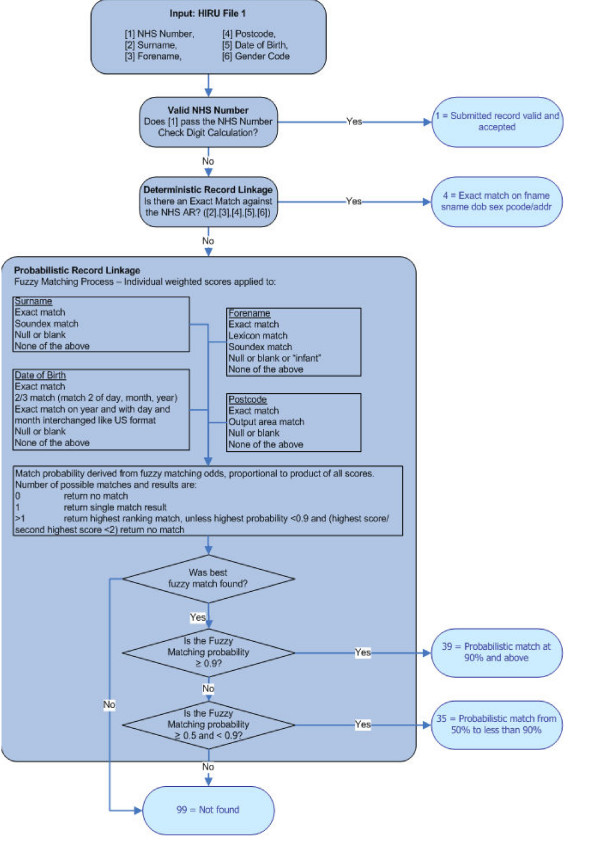
BACKGROUND: Vast amounts of data are collected about patients and service users in the course of health and social care service delivery. Electronic data systems for patient records have the potential to revolutionise service delivery and research. But in order to achieve this, it is essential that the ability to link the data at the individual record level be retained whilst adhering to the principles of information governance. The SAIL (Secure Anonymised Information Linkage) databank has been established using disparate datasets, and over 500 million records from multiple health and social care service providers have been loaded to date, with further growth in progress. METHODS: Having established the infrastructure of the databank, the aim of this work was to develop and implement an accurate matching process to enable the assignment of a unique Anonymous Linking Field (ALF) to person-based records to make the databank ready for record-linkage research studies. An SQL-based matching algorithm (MACRAL, Matching Algorithm for Consistent Results in Anonymised Linkage) was developed for this purpose. Firstly the suitability of using a valid NHS number as the basis of a unique identifier was assessed using MACRAL. Secondly, MACRAL was applied in turn to match primary care, secondary care and social services datasets to the NHS Administrative Register (NHSAR), to assess the efficacy of this process, and the optimum matching technique. RESULTS: The validation of using the NHS number yielded specificity values > 99.8% and sensitivity values > 94.6% using probabilistic record linkage (PRL) at the 50% threshold, and error rates were < 0.2%. A range of techniques for matching datasets to the NHSAR were applied and the optimum technique resulted in sensitivity values of: 99.9% for a GP dataset from primary care, 99.3% for a PEDW dataset from secondary care and 95.2% for the PARIS database from social care. CONCLUSION: With the infrastructure that has been put in place, the reliable matching process that has been developed enables an ALF to be consistently allocated to records in the databank. The SAIL databank represents a research-ready platform for record-linkage studies.
Overview
The claims and statistics of this paper haven’t been checked yet.
Free: it reads the open-access text and checks the first 5 claims that cite a source we can check. Create a free account to check every claim.
Integrity signals
Registry
Cites
Statistics
Figures
Verification
Claims the paper makes
The claims and statistics of this paper haven’t been checked yet.
Free: it reads the open-access text and checks the first 5 claims that cite a source we can check. Create a free account to check every claim.
Claims other papers make about this one
Each is checked against this paper’s own text: does it say what the citing paper says it does?
The cited source says what the claim attributes to it.
In the citing paper
“The SAIL databank enables the anonymised matching of individuals across these different datasets using a person level anonymised linkage field (ALF).26”
Self-check
Percentages, sums and reported differences re-computed from the paper’s own numbers.
The self-check needs the paper’s full text.
Citations
Cites
The SAIL Databank: building a national architecture for e-health research and evaluation
Ford, D. V., Jones, K. H., Verplancke, J.-P., Lyons, R. A., John, G., Brown, G., Brooks, C. J., Thompson, S., Bodger, O., Couch, T., et al. (2009) · BMC Health Services Research · doi:10.1186/1472-6963-9-157 · Cited by 559
Self-citationMéray, N., Reitsma, J. B., Ravelli, A. C. J., & Bonsel, G. J. (2007) · Journal of Clinical Epidemiology · doi:10.1016/j.jclinepi.2006.11.021 · Cited by 254 · cited 1×
“Because of this, PRL tends to have a higher sensitivity, but a lower specificity than DRL [ 12 ].”
Probabilistic record linkage and a method to calculate the positive predictive value
Blakely, T., & Salmond, C. (2002) · International Journal of Epidemiology · doi:10.1093/ije/31.6.1246 · Cited by 221 · cited 1×
“In these cases probabilistic record linkage (PRL) methods are used, taking account of the probabilities of agreement and disagreement between a range of matching variables [10,11].”
Finding approximate matches in large lexicons
Zobel, J., & Dart, P. W. (1995) · Software Practice and Experience · doi:10.1002/spe.4380250307 · Cited by 165
Campbell, K. M., Deck, D., & Krupski, A. (2008) · Health Informatics Journal · doi:10.1177/1460458208088855 · Cited by 156 · cited 1×
“The results also compare well with record linkage software packages, such as Link Plus and The Link King [21].”
(1995) · Journal of Clinical Epidemiology · doi:10.1016/0895-4356(95)00530-7 · Cited by 136
High-quality clinical databases: breaking down barriers
Black, N. A. (1999) · The Lancet · doi:10.1016/s0140-6736(99)00108-7 · Cited by 122 · cited 1×
“These routinely-collected data have enormous potential in health-related research, quality improvement, service planning and enhanced clinical decision-making [2], and such information could revolutionise health research if longitudinal individual health records can be developed from existing systems or through new de…”
Analysis of identifier performance using a deterministic linkage algorithm.
Grannis, S. J., Overhage, J. M., & McDonald, C. J. (2002) · PubMed · Cited by 113
Analysis of a probabilistic record linkage technique without human review.
Grannis, S. J., Overhage, J. M., Hui, S. L., & McDonald, C. J. (2003) · PubMed · Cited by 112
New approach to grouping newborn/neonatal patients
Homan, C., Mitchell, S., & Bartoli, H. (2007) · BMC Health Services Research · doi:10.1186/1472-6963-7-s1-a9 · Cited by 39
Research works printed but not linked: 4
- World Health Organization (WHO): Building foundations for e-health: progress of member states. Geneva. 2006
- UK Clinical Research Collaboration (UKCRC): Clinical Research in the UK: Towards a single system that reliably delivers distinctive quality and rapid access at reasonable cost (The McKinsey Report). 2005, [ http://www.ukcrc.org/publications/reports.aspx ]
- UKCRC: UKCRC Progress Report (2004 – 2006). 2006, [ http://www.ukcrc.org/publications/reports.aspx ]
- Goldacre MJ: The value of linked data for policy development, strategic planning, clinical practice and public health – an international perspective. Symposium on Health Data Linkage. Edited by: Glover J. 2003, Adelaide University: Public Health Information Development Unit
Cited by
Items 401–500 of 638
Gao, J., Akbari, A., Ahmed, H., Davies, A., Yeoman, A. D., & Pembroke, T. (2025) · BMJ Open · doi:10.1136/bmjopen-2024-093335 · Cited by 6
Cohort Profile: Growing Up in Wales: The Environments for Healthy Living study
Morgan, K., Khanom, A., Hill, R. A., Lyons, R. A., & Brophy, S. T. (2015) · International Journal of Epidemiology · doi:10.1093/ije/dyv178 · Cited by 4
“In Wales, de-identified electronic records are stored at the Secure Anonymised Information Linkage (SAIL) databank which was previously developed within the Health Information Research Unit (HIRU) at Swansea University.12,13 The SAIL databank enables record linkage of a wide range of pseudonymized, person-based data f…”
InfluentialSelf-citationA best practice framework to measure spatial variation in alcohol availability
Fry, R. J., Orford, S., Rodgers, S., Morgan, J. S., & Fone, D. L. (2018) · Environment and Planning B Urban Analytics and City Science · doi:10.1177/2399808318773761 · Cited by 6
“Furthermore, using anonymised linked data methods such as those found in the SAIL databank (Ford et al., 2009; Jones et al., 2014; Lyons et al., 2009; Rodgers et al., 2009), hyperlocal AOD measures can be linked to individual households to examine the impacts of AOD on health and other societal problems such as crime…”
MethodInfluentialGriffiths, L. J., Cortina‐Borja, M., Bandyopadhyay, A., Tingay, K. S., Stavola, B. L. D., Bedford, H. E., Akbari, A., Firman, N., Lyons, R. A., & Dezateux, C. A. (2019) · Pediatric Obesity · doi:10.1111/ijpo.12505 · Cited by 3
Self-citationHurt, L. S., Wright, M., Demmler, J. C., VanDerVoort, J., Morris, S. J., Brook, F., Tucker, D., Chapman, M., Francis, N. A., Daniel, R., et al. (2019) · PLoS Medicine · doi:10.1371/journal.pmed.1002859 · Cited by 5
Kansu, B., Pickrell, W. O., Lacey, A., Edwards, F., Samolia, G., Rees, M. I., Elwes, R. D. C., Hatfield, R., Gray, W., & Hamandi, K. (2020) · Epilepsy & Behavior · doi:10.1016/j.yebeh.2020.107196 · Cited by 4
Hill, T., Crooks, C. J., West, J., & Morling, J. R. (2022) · BMJ Open Gastroenterology · doi:10.1136/bmjgast-2022-000885 · Cited by 4
“Test data were excluded if there were multiple tests on the same day and the difference between them was outside the IQR for all the data, or the result contained missing, non-integer or extreme, implausible values (online supplemental figure S1).”
Walton, S., Cortina‐Borja, M., Dezateux, C. A., Griffiths, L. J., Tingay, K. S., Akbari, A., Bandyopadhyay, A., Lyons, R. A., Roberts, R. J., & Bedford, H. E. (2022) · Vaccine · doi:10.1016/j.vaccine.2022.06.080 · Cited by 4
Self-citationGriffiths, R., Herbert, L., Akbari, A., Bailey, R., Hollinghurst, J., Pugh, R. J., Szakmány, T., Torabi, F., & Lyons, R. A. (2022) · International Journal for Population Data Science · doi:10.23889/ijpds.v7i1.1724 · Cited by 3
Self-citationThe virtual flow cytometer: A new learning experience and environment for undergraduate teaching
Francis, N., Ruckley, D., & Wilkinson, T. S. (2022) · Frontiers in Education · doi:10.3389/feduc.2022.903732 · Cited by 6
“Alternative resources are either too simplistic, too focused, or targeted at researchers and, therefore, too technical for undergraduate students, such as the numerous resources that exist for the in silico analysis of “big data” including genome analysis and antibody epitope mapping (Lyons et al., 2009; Soria-Guerra…”
BackgroundReeve, N. F., Best, V., Gillespie, D., Hughes, K., Lugg-Widger, F. V., Cannings-John, R. L., Torabi, F., Wootton, M., Akbari, A., & Ahmed, H. (2022) · BMJ Open · doi:10.1136/bmjopen-2022-064586 · Cited by 4
Ramchand, S., Tsang, G., Cole, D., & Xie, X. (2022) · IEEE-EMBS International Conference on Biomedical and Health Informatics (BHI ...) · doi:10.1109/bhi56158.2022.9926906 · Cited by 5
“Data were obtained from the Secure Anonymised Information Linkage databank [13], which contains Electronic Health Records (EHR) of 80% of the Welsh primary care data.”
MethodCowley, L., Hodgson, K., Song, J., Whiffen, T., Tan, J. O. A., John, A. M., Bandyopadhyay, A., & Davies, A. R. (2023) · BMJ Open · doi:10.1136/bmjopen-2022-067882 · Cited by 4
Hughes, K., Cannings-John, R. L., Jones, H., Lugg-Widger, F. V., Lau, M., Paranjothy, S., Francis, N. A., Hay, A. D., Butler, C., Angel, L., et al. (2023) · British Journal of General Practice · doi:10.3399/bjgp.2023.0174 · Cited by 4
England, T., Walsh, B. M., Brailsford, S., Fogg, C., de Lusignan, S., Fraser, S. D., Roderick, P. J., Harris, S., Barkham, A., Patel, H. P., et al. (2025) · Health Systems · doi:10.1080/20476965.2025.2459364 · Cited by 4
Huang, Y., Radenković, D., Pérez, K., Nadeau, K. C., Verdin, E. M., & Furman, D. (2021) · Journal of Medical Internet Research · doi:10.2196/25696 · Cited by 6
“Cohort The COVID-19 Symptom Tracker is a smartphone app to which individuals from the United Kingdom and United States can submit their symptoms daily [19-22].”
BackgroundEmmerson, C., Hollinghurst, J., North, L., Fry, R. J., Akbari, A., Humphreys, C., Gravenor, M. B., & Lyons, R. A. (2022) · Age and Ageing · doi:10.1093/ageing/afac250 · Cited by 5
Self-citationDeterminants and Outcome of Acute Upper Gastrointestinal Bleeding in Yemen
Al-Dholea, M. H. H. H., Al-Makdad, A. M., & Al-Haimi, M. A. M. (2014) · Journal of Gastrointestinal & Digestive System · doi:10.4172/2161-069x.1000235 · Cited by 4
Trefán, L., Akbari, A., Morgan, J. S., Farewell, D. M., Fone, D. L., Lyons, R. A., Jones, H., & Moore, S. (2021) · International Journal for Population Data Science · doi:10.23889/ijpds.v6i1.1373 · Cited by 6
“The Secure Anonymised Information Linkage (SAIL) Databank held within the Population Data Science department at Swansea University, contains health, social and education data on over three million residents of Wales, UK [24, 25].”
MethodSelf-citationHollinghurst, J., Hollinghurst, R., North, L., Mizen, A., Akbari, A., Long, S. J., Lyons, R. A., & Fry, R. J. (2022) · Age and Ageing · doi:10.1093/ageing/afac084 · Cited by 4
Self-citationO’Hare, K., Chitsabesan, P., Ford, T. J., Gallagher, L., John, A. M., McNicholas, F., Minnis, H., Thapar, A., & Kelleher, I. (2025) · The British Journal of Psychiatry · doi:10.1192/bjp.2025.10480 · Cited by 5
Fonferko‐Shadrach, B., Lacey, A., Strafford, H., Jones, C., Baker, M. D., Powell, R., Akbari, A., Lyons, R. A., Ford, D. V., Thompson, S., et al. (2023) · Epilepsia · doi:10.1111/epi.17766 · Cited by 3
Self-citationTorabi, F., Orton, C., Squires, E., Heys, S., Hier, R., Lyons, R. A., & Thompson, S. (2023) · International Journal for Population Data Science · doi:10.23889/ijpds.v8i4.2164 · Cited by 8
Self-citationFactors associated with low school readiness, a linked health and education data study in Wales, UK
Bandyopadhyay, A., Marchant, E., Jones, H., Parker, M., Evans, J., & Brophy, S. T. (2023) · PLoS ONE · doi:10.1371/journal.pone.0273596 · Cited by 4
“The data linkage was done using an encrypted key known as Anonymised Linking Fields (ALF) in the Secure Anonymised Information Linkage (SAIL) Databank [24,25].”
MethodJalalinajafabadi, F., Bailey, R., Lyons, J., Akbari, A., Dhafari, T. B., Azadbakht, N., Rafferty, J., Watkins, A. J., Martin, G. P., Bowes, J., et al. (2024) · BMJ Open · doi:10.1136/bmjopen-2023-079169 · Cited by 6
Self-citationFormal school exclusions over the educational lifecourse in Wales
Tseliou, F., Taylor, C., & Power, S. (2024) · Oxford Review of Education · doi:10.1080/03054985.2024.2379918 · Cited by 3
Snooks, H. A., Akbari, A., Bethell, L., Carson‐Stevens, A., Dale, J. R., Dixon, L., Edwards, A., Emery, H., John, A. M., John, G., et al. (2025) · Public Health · doi:10.1016/j.puhe.2025.105736 · Cited by 3
Self-citationCumulative residential greenness and childhood body mass index
Davies, J., Griffiths, L. J., Pouliou, T., Bailey, R., Fry, R. J., Lyons, R. A., Stratton, G., & Mizen, A. (2025) · Environmental Epidemiology · doi:10.1097/ee9.0000000000000421 · Cited by 3
Self-citationGriffiths, R., Schlüter, D. K., Akbari, A., Cosgriff, R., Tucker, D., & Taylor-Robinson, D. C. (2020) · International Journal for Population Data Science · doi:10.23889/ijpds.v5i1.1346 · Cited by 4
“In Wales, the Secure Anonymised Information Linkage (SAIL) Databank is the national repository of anonymised, person based, linkable data [4,5].”
BackgroundBroadhurst, K., Cusworth, L., Harwin, J., Alrouh, B., Bedston, S., Trinder, L., Jones, K. H., Ford, D. V., & Griffiths, L. J. (2021) · Journal of Social Welfare and Family Law · doi:10.1080/09649069.2021.1953856 · Cited by 7
Self-citationJohnson, R. D., North, L., Alrouh, B., John, A. M., Jones, K. H., Akbari, A., Smart, J., Thompson, S., Hargreaves, C., Doebler, S., et al. (2022) · International Journal for Population Data Science · doi:10.23889/ijpds.v7i1.1723 · Cited by 3
Self-citationCardinal, R. N., Moore, A., Burchell, M., & Lewis, J. R. (2023) · BMC Medical Informatics and Decision Making · doi:10.1186/s12911-023-02176-6 · Cited by 7
Lyons, J., Nafilyan, V., Akbari, A., Bedston, S., Harrison, E. M., Hayward, A. C., Hippisley‐Cox, J., Kee, F., Khunti, K., Rahman, S., et al. (2023) · PLoS ONE · doi:10.1371/journal.pone.0285979 · Cited by 4
“This study used routinely collected anonymised, individual-level, population-scale health and demographic data held in the Secure Anonymised Information Linkage (SAIL) Databank to create a retrospective population-based individual-level linked e-cohort [18,19].”
MethodSelf-citationAlsallakh, M. A., Adeloye, D., Vasileiou, E., Sivakumaran, S., Akbari, A., Lyons, R. A., Robertson, C., Rudan, I., Davies, G. A., & Sheikh, A. (2024) · JMIR Public Health and Surveillance · doi:10.2196/43173 · Cited by 4
Self-citationOpatola, A. V., Seaborne, M., Kennedy, J. I., Hughes, D. A., Laing, H., Owen, R. K., Tuthill, D. P., Bracchi, R., & Brophy, S. T. (2024) · BMJ Paediatrics Open · doi:10.1136/bmjpo-2024-002831 · Cited by 3
Risk of Dementia After Electroconvulsive Therapy: A Cohort Study on the Population of Wales
Kirov, G., Simmonds, E., Kaster, T. S., & Escott‐Price, V. (2025) · Acta Psychiatrica Scandinavica · doi:10.1111/acps.70005 · Cited by 3
Mizen, A., Lyons, J., Doherty, R. M., Berridge, D. M., Wilkinson, P., Milojevic, A., Carruthers, D. J., Akbari, A., LAKE, I. R., Davies, G. A., et al. (2018) · International Journal for Population Data Science · doi:10.23889/ijpds.v3i1.412 · Cited by 4
“The matching process is documented in detail elsewhere (34).”
BackgroundRobards, J., Berrington, A. M., & Hinde, A. (2013) · Longitudinal and Life Course Studies · doi:10.14301/llcs.v4i3.244 · Cited by 3
“Within longitudinal and life course research, it is becoming more common to combine data from different sources to produce complex data sets (Ford et al., 2009; Lyons et al., 2009).”
BackgroundBrooks, C. J., Tang, T. S., Ford, D. V., Lyons, R. A., Price, D. E., Bain, S. C., & Stephens, J. W. (2009) · Primary care diabetes · doi:10.1016/j.pcd.2009.06.001 · Cited by 3
Self-citationAhmed, N., John, A. M., Islam, S., Jones, R. N., Anderson, P., Davies, C., Khanom, A., Harris, S. R. S., & Huxley, P. J. (2016) · BMJ Open · doi:10.1136/bmjopen-2016-012043 · Cited by 3
Does deprivation affect the demand for NHS Direct? Observational study of routine data from Wales
Peconi, J., Macey, S. M., Rodgers, S., Russell, I. T., Snooks, H. A., & Watkins, A. J. (2019) · BMJ Open · doi:10.1136/bmjopen-2019-029203 · Cited by 3
Hurt, L. S., Uzun, O., Morris, S. J., Bethel, J., Evans, A., Seaborne, M., Daniel, R., Brophy, S. T., & Paranjothy, S. (2023) · Children · doi:10.3390/children10071233 · Cited by 3
“The SAIL Databank uses small number suppression to ensure that no individuals can be re-identified from data presented in publications.”
MethodInfluentialSzakmány, T., Hollinghurst, J., Pugh, R. J., Akbari, A., Griffiths, R., Bailey, R., & Lyons, R. A. (2021) · Research Square · doi:10.21203/rs.3.rs-450880/v1 · Cited by 3
Self-citationRepresenting Multimorbid Disease Progressions Using Directed HypergraphsPreprint
Burke, J., Akbari, A., Bailey, R., Fasusi, K., Lyons, R. A., Pearson, J., Rafferty, J., & Schofield, D. (2023) · SSRN Electronic Journal · doi:10.1101/2023.08.31.23294903 · Cited by 7
“The Secure Anonymised Information Linkage (SAIL) Databank provides access to anonymised individual-level, population-scale, linked EHR data sources for the purpose of research, powered by its secure e-research platform (SERP) [4, 5, 6].”
Self-citationSwann, O. V., Lone, N., Harrison, E. M., Tomlinson, L. A., Walker, A. J., Seaborne, M., Pollock, L., Farrell, J. J., Hall, P. S., Seth, S., et al. (2022) · BMJ Open · doi:10.1136/bmjopen-2022-063271 · Cited by 2
Self-citationDental antibiotics and referrals in general medical practice: Wales 1974–2017
Currie, C. C., Stone, S. J., Brocklehurst, P. R., Thompson, W., Durham, J., & Pearce, M. S. (2023) · Journal of Dentistry · doi:10.1016/j.jdent.2023.104446 · Cited by 3
Pouliou, T., Pedrick-Case, R., Bailey, R., Rawlings, A., Mizen, A., Davies, J., Stratton, G., Lyons, R. A., Beck, B., Christian, H. E., et al. (2024) · Journal of Transport & Health · doi:10.1016/j.jth.2024.101855 · Cited by 3
Self-citationDale, C. E., Takhar, R., Fan, Y. Y., Torabi, F., Katsoulis, M., Kim, S., Lambarth, A. T., Tomlinson, C., Wilkinson, T., Mueller, T., et al. (2024) · BMJ Medicine · doi:10.1136/bmjmed-2023-000760 · Cited by 4
Beslay, M., Beau, A., Messina, D., Bénevent, J., Ballardini, E., Barrachina‐Bonet, L., Cavero‐Carbonell, C., Coldea, A., García‐Villodre, L., Geldhof, A. B., et al. (2025) · European Journal of Epidemiology · doi:10.1007/s10654-025-01243-8 · Cited by 2
“In Wales (UK), data are linked in the SAIL databank [ 14, 15 ]; for this study, hospital admissions data (national coverage) was linked with primary care data, including all prescrip - tions issued in primary care.”
Lowthian, E., Bedston, S., Lee, A., Akbari, A., Griffiths, L. J., Crick, T., & Forrester, D. (2025) · Oxford Review of Education · doi:10.1080/03054985.2025.2540036 · Cited by 3
Childs, M. J., Aldridge, S. J., Daniels, H., Davies, G. I., Best, V., Abbasizanjani, H., Lyons, R. A., Akbari, A., & Torabi, F. (2025) · BMJ Open · doi:10.1136/bmjopen-2025-103724 · Cited by 2
Self-citationLacey, A., Jones, C., Weir, C. J., Stephen, J., Pickrell, W. O., & Chin, R. (2025) · Seizure · doi:10.1016/j.seizure.2025.11.009 · Cited by 2
Schlüter, D. K., Griffiths, R., Akbari, A., & Taylor-Robinson, D. C. (2022) · International Journal for Population Data Science · doi:10.23889/ijpds.v7i1.1725 · Cited by 2
“Study design, setting, participants and data sources We undertook a population-scale data linkage study of all children born in Wales between 2000 and 2015 using the Secure Anonymised Information Linkage (SAIL) Databank [7, 8, 11, 12].”
InfluentialBaghdadi, F., Evans, B. A., Goodacre, S. W., John, P. A., Hettiarachchi, T., John, A. M., Lyons, R. A., Porter, A. M., Safari, S., Siriwardena, A. N., et al. (2023) · BMJ Open · doi:10.1136/bmjopen-2022-069596 · Cited by 2
“We will link this data using a study-specific Identity to patient-identifiable data held in separate files—the ‘split file’ method 44 —and uploaded to NHS Digital or eDRIS by each site.”
Self-citationTodd, O. M., Johnson, O., Wilkinson, C., Hollinghurst, J., Dondo, T. B., Yadegarfar, M. E., Sheppard, J. P., McManus, R. J., Gale, C. P., & Clegg, A. P. (2023) · Age and Ageing · doi:10.1093/ageing/afad077 · Cited by 2
Battle, C. E., Hutchings, H. A., Rafferty, J., Toghill, H., Akbari, A., & Watkins, A. J. (2023) · The Journal of Trauma: Injury, Infection, and Critical Care · doi:10.1097/ta.0000000000004086 · Cited by 2
Rafferty, J., Lee, A., Lyons, R. A., Akbari, A., Peek, N. B., Jalalinajafabadi, F., Dhafari, T. B., Lyons, J., Watkins, A. J., & Bailey, R. (2023) · PLoS ONE · doi:10.1371/journal.pone.0295300 · Cited by 3
Self-citationLugg-Widger, F. V., Sydenham, M., Oatley, R., & Scourfield, J. (2024) · The British Journal of Social Work · doi:10.1093/bjsw/bcae151 · Cited by 4
Byfield, D. C., Stacey, B. S., Evans, H., Farr, I. W., Yandle, L., Roberts, L., Filipponi, T., & Bailey, D. M. (2024) · Physiological Reports · doi:10.14814/phy2.70101 · Cited by 1
“Data from the NSWD were obtained via the Secure Anonymised Information Linkage (SAIL) Databank (Ford et al., 2009; Jones et al., 2019; Lyons et al., 2009), a secure repository containing an-onymised health and administrative data about the population of Wales.”
Owen, R. K., Bailey, R., Daniels, H., McBride, A., Akbari, A., Curnow, E., Cooper, A., Joseph‐Williams, N., Edwards, A., Parry, M., et al. (2025) · The Lancet Regional Health - Europe · doi:10.1016/j.lanepe.2025.101479 · Cited by 3
Cooksey, R., Underwood, J., Brophy, S. T., Atkinson, M., Kennedy, J. I., & Choy, E. (2022) · Rheumatology · doi:10.1093/rheumatology/keac283 · Cited by 2
“Data can then be recombined using the unique ALF while protecting anonymity [20, 21] which has been used to respond to the COVID-19 pandemic in Wales, previously [22].”
Bandyopadhyay, A., Brophy, S. T., Akbari, A., Demmler, J. C., Kennedy, J. I., Paranjothy, S., Lyons, R. A., & Moore, S. (2022) · International Journal for Population Data Science · doi:10.23889/ijpds.v7i1.1717 · Cited by 4
“Linkage was completed using an encrypted person-based identifier known as the anonymised linkage field (ALF), generated by the Digital Health and Care Wales (DHCW) [33, 34].”
Self-citationBrooks, C. J., Lyons, R. A., Jones, K. H., Hutton, A. J., Walker, R. S., Evans, K. A., Lloyd, K. R., & Ford, D. V. (2010) · Pharmacoepidemiology and Drug Safety · doi:10.1002/pds.2012 · Cited by 2
Self-citationWhiffen, T., Akbari, A., Paget, T., Lowe, S., & Lyons, R. A. (2020) · International Journal for Population Data Science · doi:10.23889/ijpds.v5i1.1151 · Cited by 2
Self-citationMorgan, K., Zhou, S., Hill, R. A., Lyons, R. A., Paranjothy, S., & Brophy, S. T. (2021) · International Journal of Environmental Research and Public Health · doi:10.3390/ijerph181910265 · Cited by 3
“With the consent, prenatal records, postnatal notes and routine electronic medical records were accessed via the Secured Anonymised Information Linkage Databank [14].”
MethodSelf-citationHollinghurst, J., North, L., Szakmány, T., Pugh, R. J., Davies, G. A., Sivakumaran, S., Jarvis, R., Rolles, M. J., Pickrell, W. O., Akbari, A., et al. (2022) · Journal of the Royal Society of Medicine · doi:10.1177/01410768221107119 · Cited by 2
“Further details of the matching procedure have been reported previously.(17) Chi-square tests indicated no significant difference in the proportions of positive tests between those with and without linked demographic data (Table S3b).”
BackgroundSelf-citationMoretti, G., Vinci, B., Zito, S., Caputo, A., Attanasio, F., & Vainieri, M. (2023) · PLoS ONE · doi:10.1371/journal.pone.0291628 · Cited by 2
Griffiths, L. J., Rafferty, J., Fry, R. J., Daniels, H., Dezateux, C. A., Firman, N., Pouliou, T., Stratton, G., Mizen, A., Lyons, R. A., et al. (2024) · PLoS ONE · doi:10.1371/journal.pone.0300221 · Cited by 2
“For each data source within the SAIL Databank, personal identifiable data has been removed and replaced with an anonymised linkage field (ALF) for each person to enable linkage of records from various sources (the anonymisation and linkage methodology is described elsewhere) [12–14].”
Self-citationAbakasanga, E., Kousovista, R., Cosma, G., Jun, G. T., Kiani, R., & Gangadharan, S. K. (2024) · Lecture notes in computer science · doi:10.1007/978-3-031-67285-9_1 · Cited by 2
Record linkage in health data: a simulation study
Ariel, A., Bakker, B., de Groot, M., van Grootheest, G., van der Laan, J., Smit, J., & Verkerk, B. (2015) · Data Archiving and Networked Services (DANS) · Cited by 2
Hurt, L. S., Ashfield-Watt, P. A. L., Townson, J. K., Heslop, L., Copeland, L., Atkinson, M., Horton, J., & Paranjothy, S. (2019) · bioRxiv (Cold Spring Harbor Laboratory) · doi:10.1101/613547 · Cited by 2
“Using routinely-available healthcare data through record linkage (11, 12).”
BackgroundMethodSallakh, M. A. A. (2018) · Cronfa (Swansea University) · doi:10.23889/suthesis.48569 · Cited by 5
Zhou, S., Lyons, R. A., Brophy, S. T., & Gravenor, M. B. (2013) · PLoS ONE · doi:10.1371/annotation/3724e791-2df4-4c75-8d60-4327fe0eb6d0 · Cited by 2
Self-citationMhereeg, M., Jones, H. E., Kennedy, J. I., Seaborne, M., Parker, M., Kennedy, N., Beeson, S., Akbari, A., Zuccolo, L., Davies, A. R., et al. (2022) · medRxiv · doi:10.21203/rs.3.rs-1831644/v1 · Cited by 2
Ford, E. M., Parfitt, H., McCheyne, I., Kiss, I. Z., & Sellers, R. (2022) · medRxiv · doi:10.1101/2022.11.14.22282285 · Cited by 6
The Impact of a Centralised Pancreatic Cancer Service: a Case Study of Wales, UK
Mowbray, N. G., Griffiths, R., Akbari, A., Hutchings, H. A., Jenkins, G. J. S., & Al-Sarireh, B. A. (2021) · Journal of Gastrointestinal Surgery · doi:10.1007/s11605-020-04612-8 · Cited by 1
Crowther, J., Butterly, E. W., Hannigan, L. J., Guthrie, B., Wild, S. H., Mair, F. S., Hanlon, P., Chadwick, F., & McAllister, D. (2023) · Journal of Multimorbidity and Comorbidity · doi:10.1177/26335565231213571 · Cited by 1
Bauer, B. S., Azcoaga-Lorenzo, A., Agrawal, U., Fagbamigbe, A. F., & McCowan, C. (2024) · PLoS ONE · doi:10.1371/journal.pone.0298871 · Cited by 2
Abdeldayem, W., Davies, J., & Griffiths, L. J. (2024) · International Journal for Population Data Science · doi:10.23889/ijpds.v9i1.2374 · Cited by 1
“[12–14] Several data sources were linked and used in this study: The National Community Child Health Database (NCCHD) compiles data from Child Health System databases which are held by National Health Service (NHS) organisations and includes data on birth registrations, child health examinations…”
Why social work needs to embrace data linkage research
Hodges, H. R., Griffiths, L. J., Cowley, L., Childs, M. J., & Scourfield, J. (2024) · Journal of Children s Services · doi:10.1108/jcs-12-2023-0063 · Cited by 1
Kousovista, R., Cosma, G., Abakasanga, E., Akbari, A., Zaccardi, F., Jun, G. T., Kiani, R., & Gangadharan, S. K. (2025) · Frontiers in Digital Health · doi:10.3389/fdgth.2025.1528882 · Cited by 3
Humphreys, I., Watkins, A. J., Akbari, A., Griffiths, R., Gabe‐Walters, M., Thomas, M., Pike, C., Williams, A., Dobbs, T., Gibson, J. A. G., et al. (2025) · International Wound Journal · doi:10.1111/iwj.70331 · Cited by 1
What Linked Data Can Tell Us About the Increasing Numbers of Children Entering Public Care
Warner, N., Forrester, D., Scourfield, J., Cannings-John, R. L., & John, A. M. (2025) · Child & Family Social Work · doi:10.1111/cfs.70026 · Cited by 3
Guran, A., Siris, A., Tam, G. K. L., Chess, J. A., & Xie, X. (2025) · Lecture notes in computer science · doi:10.1007/978-3-032-00656-1_2 · Cited by 1
Rouquette, O. Y., DelPozo‐Baños, M., Lee, S. C., & John, A. M. (2025) · BJPsych Open · doi:10.1192/bjo.2025.10827 · Cited by 1
Bedendo, A., Jarvis, S. W., Hain, R. D., & Fraser, L. (2025) · Archives of Disease in Childhood · doi:10.1136/archdischild-2025-329153 · Cited by 1
White, C., Summers, R., John, A. M., Osborn, D., Lloyd, K. R., Akbari, A., Gravenor, M. B., Halcox, J., & Ellins, E. A. (2025) · European Journal of Preventive Cardiology · doi:10.1093/eurjpc/zwaf658 · Cited by 1
DelPozo‐Baños, M., Atkinson, M. D., Lee, S. C., & John, A. M. (2025) · BJPsych Open · doi:10.1192/bjo.2025.10898 · Cited by 1
Talukder, A., Kougianou, I., O’Hare, K., Healy, C., & Kelleher, I. (2025) · BMJ Mental Health · doi:10.1136/bmjment-2025-302146 · Cited by 1
Jones, L. A., Barber, C., Clements-Brod, N., Davies, J., DelPozo‐Baños, M., Hughes, A., Iveson, M. H., Jain, D., John, A. M., Maguire, A., et al. (2026) · Frontiers in Psychiatry · doi:10.3389/fpsyt.2026.1760116 · Cited by 1
Wilson, N., O’Hare, K., Minnis, H., Fleming, M., Kelleher, I., & Gajwani, R. (2026) · Nature Mental Health · doi:10.1038/s44220-026-00653-1 · Cited by 1
Baragilly, M., Topham, A., Gallier, S., & Sapey, E. (2026) · Digital Health · doi:10.1177/20552076261440981 · Cited by 1
The role of information system in multiple sclerosis management.
Ajami, S., Ahmadi, G., & Etemadifar, M. (2014) · PubMed Central · Cited by 6
Torabi, F., Harris, D. E., Bodger, O. G., Akbari, A., Lyons, R. A., Gravenor, M. B., & Halcox, J. (2022) · European Heart Journal Open · doi:10.1093/ehjopen/oeac066 · Cited by 1
Self-citationHayes, J., Rafferty, J., Cheung, W., Akbari, A., Thomas, R., Bain, S. C., Topliss, C., & Stephens, J. W. (2023) · Diabetes Epidemiology and Management · doi:10.1016/j.deman.2023.100144 · Cited by 1
The coding of telephone consultations in UK primary care databases: are we picking up all the calls?
Atkinson, M. D., Cooksey, R., Jones, J., & Brophy, S. T. (2023) · BMC Research Notes · doi:10.1186/s13104-023-06325-y · Cited by 1
“Other primary care research databases as for example the SAIL databank [6, 7], only include the Read codes, dates and values from the contributing clinical databases.”
MethodImmunisation status of children receiving care and support in Wales: a national data linkage study
Bailey, G. A., Lee, A. M., Bedford, H. E., Perry, M., Holland, S., Walton, S., & Griffiths, L. J. (2023) · Frontiers in Public Health · doi:10.3389/fpubh.2023.1231264 · Cited by 1
Han, J., Rolles, M. J., Torabi, F., Griffiths, R., Bedston, S., Akbari, A., Burnett, B., Lyons, J., Greene, G., Thomas, R., et al. (2023) · Supportive Care in Cancer · doi:10.1007/s00520-023-07944-8 · Cited by 1
“Anonymised individual-level, population-scale linkable data sources were used within the Secure Anonymised Information Linkage (SAIL) Databank, a Secure Data Environment containing national-level data on the population of Wales [26, 27].”
MethodSelf-citationIdentifying Clusters on Multiple Long-Term Conditions for Adults with Learning Disabilities
Abakasanga, E., Kousovista, R., Cosma, G., Jun, G. T., Kiani, R., & Gangadharan, S. K. (2024) · Lecture notes in computer science · doi:10.1007/978-3-031-67278-1_4 · Cited by 1
Parsons, S. N., Kosnes, L., Anderson, P., Harris, S. R. S., Thatcher, R., Harrington, B., Davies, J., Fitzsimmons, D. F., & Luzio, S. D. (2024) · BMC Public Health · doi:10.1186/s12889-024-19946-0
“The anonymised programme user data (AWDPP minimum dataset) was made available by Public Health Wales via the SAIL (Secure Anonymised Information Linkage) Databank [15] and from the AWDPP Service User Database collated by the programme delivery team (HCSWs and local dietetic leads).”
Metadata
- Authors
- Lyons, R. A., Jones, K. H., John, G., Brooks, C. J., Verplancke, J.-P., Ford, D. V., Brown, G., & Leake, K.
- Affiliations
- Swansea University (GB)
- Corresponding author
- Lyons, Ronan A
- Venue
- BMC Medical Informatics and Decision Making
- Published
- 2009-01-16
- Volume
- 9
- Issue
- 1
- Pages
- 3-3
- ISSN
- 1472-6947 (ISSN-L)
- PMC
- PMC2648953
- OpenAlex
- W2060363472
- Cited by
- 638
- References
- 14
- Citations by year
- 2026: 30 · 2025: 52 · 2024: 60 · 2023: 69 · 2022: 80 · 2021: 68 · 2020: 60 · 2019: 41 · 2018: 30 · 2017: 15 · 2016: 24 · 2015: 19 · 2014: 24 · 2013: 23 · 2012: 23
- FWCI
- 18.94
- Type
- journal article
- Language
- en
- Open access
- gold
- doi.org
- Licence
- cc-by
- creativecommons.org/licenses/by/2.0 (tdm)
- Locations
- BMC Medical Informatics and Decision Making (publishedVersion, cc-by)
- PubMed Central (publishedVersion, cc-by)
- PubMed (publishedVersion)
- DOAJ (DOAJ: Directory of Open Access Journals) (submittedVersion)
- Funders
- Economic and Social Research Council (ES/G007543/1)
- Topics
- Physical Sciences › Computer Science › Information Systems › Data Quality and Management
- Health Sciences › Health Professions › Health Information Management › Medical Coding and Health Information
- Health Sciences › Health Professions › Health Information Management › Electronic Health Records Systems
- Keywords
- SAIL Databank, data linkage, probabilistic record linkage, NHS number, primary care records, information governance, data anonymization
- MeSH terms
- Algorithms, United Kingdom, Medical Record Linkage, State Medicine, Information Management, Databases as Topic
About these checks
Registry, retraction, Cites and statistics results are computed, not judged, with one exception: a printed reference that no index lists is read once by a model before it counts as a citation error. Claims are extracted by a model and kept only when their quote appears verbatim in the text; each cited source is then checked, with a model’s help, for whether it says what the claim relies on. Those verdicts can be wrong — read the claim’s quote and the cited source before relying on one.
Statistics and arithmetic are recomputed, not judged.
Confidence bands are shown only for fields calibrated on our annotated test set. None is calibrated yet, so no band is shown.
What counts as a claim ›How we measure confidence ›How we check this ›
Are you an author, or do you see a problem with this page? Request a review
Data sources
Bibliographic data: Semantic Scholar, OpenAlex, Crossref.
Contains information from the Semantic Scholar Academic Graph Datasets, made available under the ODC Attribution License (ODC-BY 1.0).
Semantic Scholar’s data is described in: Kinney, R., et al. (2023). The Semantic Scholar Open Data Platform. arXiv:2301.10140.
