

Failure mode and effects analysis outputs: are they valid?
Open accessThe DOI matches its Crossref record; 27 of the 29 references it cites were found in a registry or an index.
Abstract
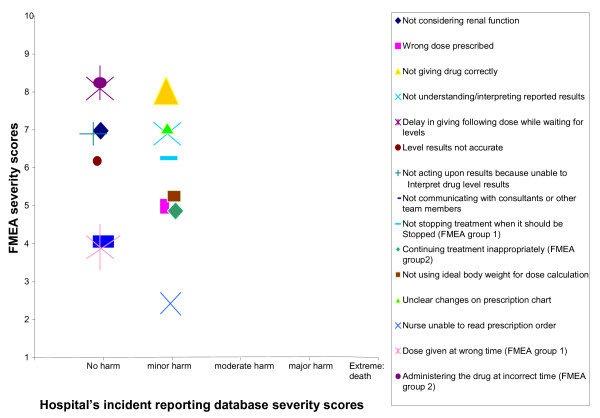
BACKGROUND: Failure Mode and Effects Analysis (FMEA) is a prospective risk assessment tool that has been widely used within the aerospace and automotive industries and has been utilised within healthcare since the early 1990s. The aim of this study was to explore the validity of FMEA outputs within a hospital setting in the United Kingdom. METHODS: Two multidisciplinary teams each conducted an FMEA for the use of vancomycin and gentamicin. Four different validity tests were conducted: Face validity: by comparing the FMEA participants' mapped processes with observational work. Content validity: by presenting the FMEA findings to other healthcare professionals. Criterion validity: by comparing the FMEA findings with data reported on the trust's incident report database. Construct validity: by exploring the relevant mathematical theories involved in calculating the FMEA risk priority number. RESULTS: Face validity was positive as the researcher documented the same processes of care as mapped by the FMEA participants. However, other healthcare professionals identified potential failures missed by the FMEA teams. Furthermore, the FMEA groups failed to include failures related to omitted doses; yet these were the failures most commonly reported in the trust's incident database. Calculating the RPN by multiplying severity, probability and detectability scores was deemed invalid because it is based on calculations that breach the mathematical properties of the scales used. CONCLUSION: There are significant methodological challenges in validating FMEA. It is a useful tool to aid multidisciplinary groups in mapping and understanding a process of care; however, the results of our study cast doubt on its validity. FMEA teams are likely to need different sources of information, besides their personal experience and knowledge, to identify potential failures. As for FMEA's methodology for scoring failures, there were discrepancies between the teams' estimates and similar incidents reported on the trust's incident database. Furthermore, the concept of multiplying ordinal scales to prioritise failures is mathematically flawed. Until FMEA's validity is further explored, healthcare organisations should not solely depend on their FMEA results to prioritise patient safety issues.
Overview
The claims and statistics of this paper haven’t been checked yet.
Free: it reads the open-access text and checks the first 5 claims that cite a source we can check. Create a free account to check every claim.
Integrity signals
Registry
Cites
Statistics
Figures


Verification
Claims the paper makes
The claims and statistics of this paper haven’t been checked yet.
Free: it reads the open-access text and checks the first 5 claims that cite a source we can check. Create a free account to check every claim.
Claims other papers make about this one
Each is checked against this paper’s own text: does it say what the citing paper says it does?
The check wasn’t confident either way, so it gives no verdict — never disputed.
In the citing paper
“Here, we build on the algorithmic audit approach proposed by Raji and colleagues, 19 who describe a qualitative structured audit process applying the SMACTR framework (scoping, mapping, artifact collection, testing, and reflection) to artificial intelligence, as a general purpose technology.”
From The medical algorithmic audit (2022) · cites this paper as [19]
Experimental — accuracy not yet measured
Self-check
Percentages, sums and reported differences re-computed from the paper’s own numbers.
The self-check needs the paper’s full text.
Citations
Cites
Nonparametric Statistics for the Behavioral Sciences
Guitton, H., & Siegel, S. (1958) · Revue économique · doi:10.2307/3498751 · Cited by 35,245
Nonparametric statistics for the behavioral sciences
McGinn, L. C. (1957) · Journal of the Franklin Institute · doi:10.1016/0016-0032(57)90766-4 · Cited by 7,204
Reliability and Validity Assessment
Carmines, E., & Zeller, R. (1979) · doi:10.4135/9781412985642 · Cited by 5,884 · cited 3×
“Carmines EG, Zeller RA: Reliability and validity assessment.”
BackgroundInfluentialReliability and Validity Assessment
(2011) · The Encyclopedia of Political Science · doi:10.4135/9781608712434.n1341 · Cited by 5,040
DeRosier, J., Stalhandske, E., Bagian, J. P., & Nudell, T. (2002) · The Joint Commission Journal on Quality Improvement · doi:10.1016/s1070-3241(02)28025-6 · Cited by 611
Handbook Of Health Research Methods: Investigation, Measurement And Analysis
Bowling, A., & Ebrahim, S. B. J. (2005) · Cited by 572
Sari, A. B.-A., Sheldon, T. A., Cracknell, A., & Turnbull, A. (2007) · BMJ · doi:10.1136/bmj.39031.507153.ae · Cited by 443
Modified approach for prioritization of failures in a system failure mode and effects analysis
Ravi Sankar, N., & Prabhu, B. S. (2001) · International Journal of Quality & Reliability Management · doi:10.1108/02656710110383737 · Cited by 347
Bennett, M. A., McDermott, R., & Beauregard, M. (2017) · Productivity Press eBooks · doi:10.1201/b16656 · Cited by 295
Kirwan, B. (1996) · Applied Ergonomics · doi:10.1016/s0003-6870(96)00044-0 · Cited by 218
Research works printed but not linked: 3
- Shebl NA, Franklin BD, Barber N, Burnett S, Parand A: Failure Mode Effect Analysis (FMEA): The views of UK hospital staff. J Health Serv Res Policy. 2011, 17 (1): 34-37.
- Bowling A: Research methods in health-investigating health and health services. 2002, Open University Press, Buckingham, 2
- Spath P: Worst practices used in conducting FMEA projects. Hosp Rev. 2004, 29 (8): 114-116.
Cited by
Liu, X., Glocker, B., McCradden, M. M., Ghassemi, M., Denniston, A. K., & Oakden-Rayner, L. (2022) · The Lancet Digital Health · doi:10.1016/s2589-7500(22)00003-6 · Cited by 266
Hisprastin, Y., & Musfiroh, I. (2020) · Majalah Farmasetika · doi:10.24198/mfarmasetika.v6i1.27106 · Cited by 122
Lago, P., Bizzarri, G., Scalzotto, F., Parpaiola, A., Amigoni, A., Putoto, G., & Perilongo, G. (2012) · BMJ Open · doi:10.1136/bmjopen-2012-001249 · Cited by 115
Expanding healthcare failure mode and effect analysis: A composite proactive risk analysis approach
Faiella, G., Parand, A., Franklin, B. D., Chana, P., Cesarelli, M., Stanton, N. A., & Sevdalis, N. (2017) · Reliability Engineering & System Safety · doi:10.1016/j.ress.2017.08.003 · Cited by 106
Self-citationAssessing the validity of prospective hazard analysis methods: a comparison of two techniques
POTTS, H. W. W., Anderson, J. E., Colligan, L., Leach, P., Davis, S. E., & Berman, J. (2014) · BMC Health Services Research · doi:10.1186/1472-6963-14-41 · Cited by 103
Metadata
- Authors
- Shebl, N. A., Franklin, B. D., & Barber, N.
- Affiliations
- UCL School of Pharmacy (GB)
- Imperial College Healthcare NHS Trust (GB)
- Corresponding author
- Franklin, Bryony Dean
- Venue
- BMC Health Services Research
- Published
- 2012-06-10
- Volume
- 12
- Issue
- 1
- Pages
- 150-150
- ISSN
- 1472-6963 (ISSN-L)
- PMC
- PMC3405478
- OpenAlex
- W2156664009
- Cited by
- 122
- References
- 29
- Citations by year
- 2026: 10 · 2025: 8 · 2024: 4 · 2023: 7 · 2022: 10 · 2021: 7 · 2020: 10 · 2019: 8 · 2018: 9 · 2017: 17 · 2016: 13 · 2015: 6 · 2014: 8 · 2013: 3 · 2012: 2
- FWCI
- 10.44
- Type
- journal article
- Language
- en
- Open access
- gold
- doi.org
- Licence
- Locations
- BMC Health Services Research (publishedVersion, cc-by)
- Europe PMC (PubMed Central) (publishedVersion, cc-by)
- PubMed Central (publishedVersion, cc-by)
- PubMed (publishedVersion)
- University of Hertfordshire Research Archive (University of Hertfordshire) (submittedVersion)
- DOAJ (DOAJ: Directory of Open Access Journals) (submittedVersion)
- UCL Discovery (University College London) (submittedVersion)
- Funders
- Imperial College London
- Imperial College Healthcare NHS Trust
- Topics
- Health Sciences › Medicine › Public Health, Environmental and Occupational Health › Patient Safety and Medication Errors
- Health Sciences › Medicine › Public Health, Environmental and Occupational Health › Healthcare Quality and Management
- Physical Sciences › Engineering › Safety, Risk, Reliability and Quality › Risk and Safety Analysis
- Keywords
- failure mode and effects analysis, risk priority number, patient safety, vancomycin, gentamicin, incident reporting, risk prioritization, hospital risk management
- MeSH terms
- Anti-Bacterial Agents, Gentamicins, United Kingdom, Hospitals, Teaching, Humans, Infusions, Intravenous, Health Knowledge, Attitudes, Practice, Medication Errors, National Health Programs, Patient Care Team, Recurrence, Risk Management, Time Factors, Vancomycin, Reproducibility of Results, Treatment Failure, Risk Assessment, Critical Pathways, Qualitative Research
About these checks
Registry, retraction, Cites and statistics results are computed, not judged, with one exception: a printed reference that no index lists is read once by a model before it counts as a citation error. Claims are extracted by a model and kept only when their quote appears verbatim in the text; each cited source is then checked, with a model’s help, for whether it says what the claim relies on. Those verdicts can be wrong — read the claim’s quote and the cited source before relying on one.
Statistics and arithmetic are recomputed, not judged.
Confidence bands are shown only for fields calibrated on our annotated test set. None is calibrated yet, so no band is shown.
What counts as a claim ›How we measure confidence ›How we check this ›
Are you an author, or do you see a problem with this page? Request a review
How to cite
Cite CoChat for the checks on this page, and the paper for its own findings.
- This page
- CoChat. (2026). Citation check: Failure mode and effects analysis outputs: are they valid? https://app.cochat.ai/papers/10.1186/1472-6963-12-150
- The paper
- Shebl, N. A., Franklin, B. D., & Barber, N. (2012). Failure mode and effects analysis outputs: are they valid? BMC Health Services Research. https://doi.org/10.1186/1472-6963-12-150
Data sources
Bibliographic data: Semantic Scholar, OpenAlex, Crossref.
Contains information from the Semantic Scholar Academic Graph Datasets, made available under the ODC Attribution License (ODC-BY 1.0).
Semantic Scholar’s data is described in: Kinney, R., et al. (2023). The Semantic Scholar Open Data Platform. arXiv:2301.10140.
