

The DOI matches its Crossref record; 80 of the 80 references it cites were found in a registry or an index.
Do computerised clinical decision support systems for prescribing change practice? A systematic review of the literature (1990-2007)
Open accessAbstract
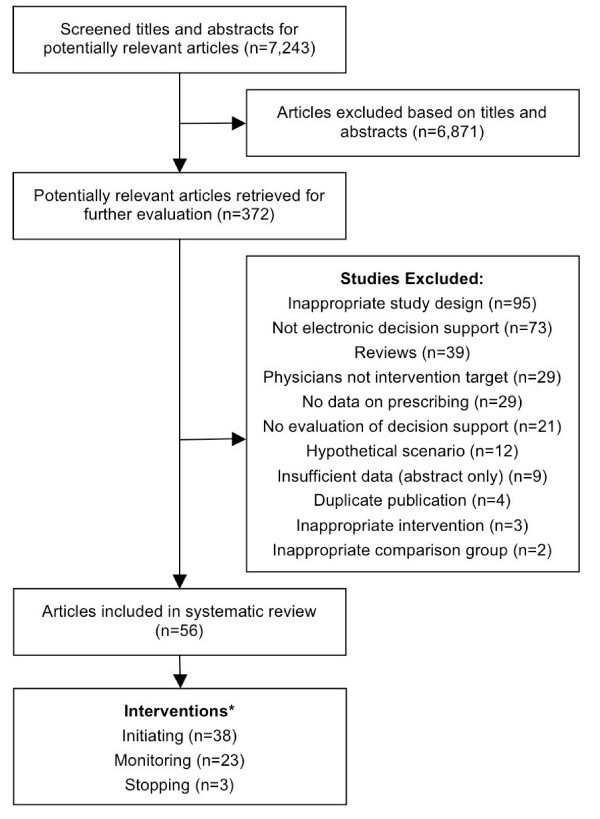
BACKGROUND: Computerised clinical decision support systems (CDSSs) are used widely to improve quality of care and patient outcomes. This systematic review evaluated the impact of CDSSs in targeting specific aspects of prescribing, namely initiating, monitoring and stopping therapy. We also examined the influence of clinical setting (institutional vs ambulatory care), system- or user-initiation of CDSS, multi-faceted vs stand alone CDSS interventions and clinical target on practice changes in line with the intent of the CDSS. METHODS: We searched Medline, Embase and PsychINFO for publications from 1990-2007 detailing CDSS prescribing interventions. Pairs of independent reviewers extracted the key features and prescribing outcomes of methodologically adequate studies (experiments and strong quasi-experiments). RESULTS: 56 studies met our inclusion criteria, 38 addressing initiating, 23 monitoring and three stopping therapy. At the time of initiating therapy, CDSSs appear to be somewhat more effective after, rather than before, drug selection has occurred (7/12 versus 12/26 studies reporting statistically significant improvements in favour of CDSSs on = 50% of prescribing outcomes reported). CDSSs also appeared to be effective for monitoring therapy, particularly using laboratory test reminders (4/7 studies reporting significant improvements in favour of CDSSs on the majority of prescribing outcomes). None of the studies addressing stopping therapy demonstrated impacts in favour of CDSSs over comparators. The most consistently effective approaches used system-initiated advice to fine-tune existing therapy by making recommendations to improve patient safety, adjust the dose, duration or form of prescribed drugs or increase the laboratory testing rates for patients on long-term therapy. CDSSs appeared to perform better in institutional compared to ambulatory settings and when decision support was initiated automatically by the system as opposed to user initiation. CDSSs implemented with other strategies such as education were no more successful in improving prescribing than stand alone interventions. Cardiovascular disease was the most studied clinical target but few studies demonstrated significant improvements on the majority of prescribing outcomes. CONCLUSION: Our understanding of CDSS impacts on specific aspects of the prescribing process remains relatively limited. Future implementation should build on effective approaches including the use of system-initiated advice to address safety issues and improve the monitoring of therapy.
Overview
The claims and statistics of this paper haven’t been checked yet.
Run the check — free, no account needed. It reads the open-access text and checks the sources it cites.
Integrity signals
Registry
Cites
Statistics
Figures
Verification
Claims the paper makes
The claims and statistics of this paper haven’t been checked yet.
Run the check — free, no account needed. It reads the open-access text and checks the sources it cites.
Claims other papers make about this one
Each is checked against this paper’s own text: does it say what the citing paper says it does?
In the citing paper
“Despite these limitations, some reviews have demonstrated the benefits of computer-over paper-based decision support, 12 system-over user-initiated tools, 10 11 and integrated over stand-alone systems, 10 and the advantage of providing specific treatment recommendations or advice rather than a simple problem assessment requiring further consideration by end users.12”
From Computerized clinical decision support for prescribing: provision does not guarantee uptake (2010) · cites this paper as [10]
Self-check
Percentages, sums and reported differences re-computed from the paper’s own numbers.
The self-check needs the paper’s full text.
Citations
Cites
Effectiveness and efficiency of guideline dissemination and implementation strategies
Grimshaw, J., Thomas, R., MacLennan, G., Fraser, C., Ramsay, C., Vale, L., Whitty, P., Eccles, M., Matowe, L., Shirran, L., et al. (2004) · Health Technology Assessment · doi:10.3310/hta8060 · Cited by 3,044
Garg, A. X., Adhikari, N. K. J., McDonald, H., Rosas-Arellano, M. P., Devereaux, P. J., Beyene, J., Sam, J., & Haynes, R. B. (2005) · JAMA · doi:10.1001/jama.293.10.1223 · Cited by 2,936
Kawamoto, K., Houlihan, C. A., Balas, E. A., & Lobach, D. F. (2005) · BMJ · doi:10.1136/bmj.38398.500764.8f · Cited by 2,703
Grimshaw, J., Shirran, L., Thomas, R. E., Mowatt, G., Fraser, C. M., Bero, L. A., Grilli, R. G., Harvey, E., Oxman, A., & O’Brien, M. A. (2001) · Medical Care · doi:10.1097/00005650-200108002-00002 · Cited by 1,805
(2001) · PubMed · Cited by 1,709
Electronic Alerts to Prevent Venous Thromboembolism among Hospitalized Patients
Kucher, N., Koo, S., Quiroz, R., Cooper, J. M., Paterno, M. D., Soukonnikov, B., & Goldhaber, S. Z. (2005) · New England Journal of Medicine · doi:10.1056/nejmoa041533 · Cited by 944
Physician Inpatient Order Writing on Microcomputer Workstations
Tierney, W. M. (1993) · JAMA · doi:10.1001/jama.269.3.379 · Cited by 549
A Computerized Reminder System to Increase the Use of Preventive Care for Hospitalized Patients
Dexter, P. R., Perkins, S., Overhage, J. M., Maharry, K., Kohler, R. B., & McDonald, C. J. (2001) · New England Journal of Medicine · doi:10.1056/nejmsa010181 · Cited by 519
Christakis, D., Mell, L. K., Koepsell, T. D., Zimmerman, F. J., & Connell, F. A. (2001) · PEDIATRICS · doi:10.1542/peds.107.3.524 · Cited by 409
A Randomized Trial of "Corollary Orders" to Prevent Errors of Omission
Overhage, J. M., Tierney, W. M., Zhou, X., & McDonald, C. J. (1997) · Journal of the American Medical Informatics Association · doi:10.1136/jamia.1997.0040364 · Cited by 375
Research works printed but not linked: 1
- Bero L, Deane K, Eccles M, Grimshaw J, Gruen R, Mayhew A, Oxman AD, Pantoja T, Paulsen E, Shepperd S, et al: Cochrane Effective Practice and Organisation of Care Group. About The Cochrane Collaboration (Cochrane Review Groups (CRGs)). 2009
Cited by
Sorted by citations
The Impact of eHealth on the Quality and Safety of Health Care: A Systematic Overview
Black, A. D., Car, J., Pagliari, C., Anandan, C., Cresswell, K., Bokun, T., McKinstry, B., Procter, R., Majeed, A., & Sheikh, A. (2011) · PLoS Medicine · doi:10.1371/journal.pmed.1000387 · Cited by 1,442
Health IT and Patient Safety: Building Safer Systems for Better Care
Chou, D. (2012) · JAMA · doi:10.1001/jama.308.21.2282-a · Cited by 496
Nuckols, T. K., Smith-Spangler, C., Morton, S. C., Asch, S. M., Patel, V. M., Anderson, L. J., Deichsel, E. L., & Shekelle, P. G. (2014) · Systematic Reviews · doi:10.1186/2046-4053-3-56 · Cited by 340
Computerized clinical decision support for prescribing: provision does not guarantee uptake
Moxey, A., Robertson, J., Newby, D., Hains, I., Williamson, M., & Pearson, S.-A. (2010) · Journal of the American Medical Informatics Association · doi:10.1197/jamia.m3170 · Cited by 305
Self-citationThe Ariadne principles: how to handle multimorbidity in primary care consultations
Muth, C., van den Akker, M., Blom, J. W., Mallen, C. D., Rochon, J., Schellevis, F., Becker, A., Beyer, M., Gensichen, J. S., Kirchner, H., et al. (2014) · BMC Medicine · doi:10.1186/s12916-014-0223-1 · Cited by 307
Metadata
- Authors
- Pearson, S.-A., Moxey, A., Robertson, J., Hains, I., Williamson, M., Reeve, J., & Newby, D.
- Affiliations
- UNSW Sydney (AU)
- University of Newcastle Australia (AU)
- Corresponding author
- Pearson, Sallie-Anne
- Venue
- BMC Health Services Research
- Published
- 2009-08-28
- Volume
- 9
- Issue
- 1
- Pages
- 154-154
- ISSN
- 1472-6963 (ISSN-L)
- PMC
- PMC2744674
- OpenAlex
- W2080746135
- Cited by
- 193
- References
- 80
- Citations by year
- 2026: 3 · 2025: 3 · 2024: 2 · 2023: 4 · 2022: 10 · 2021: 3 · 2020: 12 · 2019: 14 · 2018: 10 · 2017: 20 · 2016: 16 · 2015: 17 · 2014: 17 · 2013: 18 · 2012: 16
- FWCI
- 2.19
- Type
- journal article
- Language
- en
- Open access
- gold
- doi.org
- Licence
- Locations
- BMC Health Services Research (publishedVersion, cc-by)
- PubMed Central (publishedVersion, cc-by)
- PubMed (publishedVersion)
- DOAJ (DOAJ: Directory of Open Access Journals) (submittedVersion)
- Figshare (submittedVersion, cc-by)
- NOVA (University of Newcastle Australia) (submittedVersion)
- Topics
- Health Sciences › Health Professions › Health Information Management › Electronic Health Records Systems
- Health Sciences › Medicine › Geriatrics and Gerontology › Pharmaceutical Practices and Patient Outcomes
- Health Sciences › Medicine › Health Informatics › Artificial Intelligence in Healthcare and Education
- Keywords
- drug prescribing, drug initiation, treatment monitoring, patient safety, multicomponent intervention, cardiovascular disease
- MeSH terms
- Humans, Practice Patterns, Physicians', Drug Prescriptions, User-Computer Interface, Decision Support Systems, Clinical
About these checks
Registry, retraction, Cites and statistics results are computed, not judged, with one exception: a printed reference that no index lists is read once by a model before it counts as a citation error. Claims are extracted by a model and kept only when their quote appears verbatim in the text; each cited source is then checked, with a model’s help, for whether it says what the claim relies on. Those verdicts can be wrong — read the claim’s quote and the cited source before relying on one.
Statistics and arithmetic are recomputed, not judged.
Confidence bands are shown only for fields calibrated on our annotated test set. None is calibrated yet, so no band is shown.
What counts as a claim ›How we measure confidence ›How we check this ›
Are you an author, or do you see a problem with this page? Request a review
