

The DOI matches its Crossref record; 19 of the 19 references it cites were found in a registry or an index.
Household catastrophic health expenditure: evidence from Georgia and its policy implications
Open accessAbstract
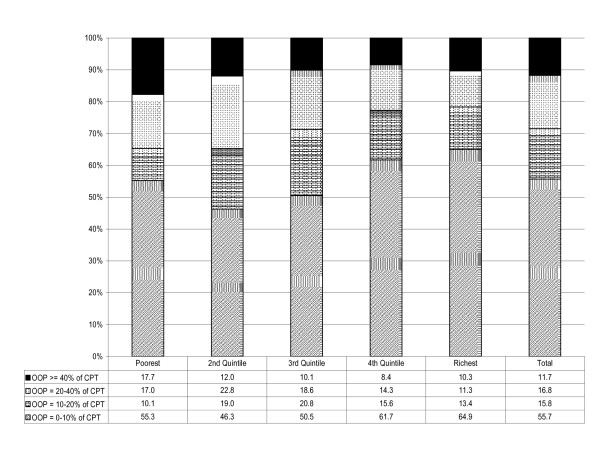
Background: To quantify extent of catastrophic household health expenditures, determine factors influencing it and estimate Fairness in Financial Contribution (FFC) index in Georgia to establish the baseline for expected reforms and contribute to the design and fine-tuning of the major reforms in health care financing initiated by the government mid-2007. Methods: The research is based on the nationally representative Health Care Utilization and Expenditure survey conducted during May-June 2007, prior to preparing for new phase of implementation for the health care financing reforms. Households' catastrophic health expenditures were estimated according to the methodology proposed by WHO – Ke Xu [1]. A logistic regression (logit) model was used to predict probability of catastrophic health expenditure occurrence. Results: In Georgia between 2000 and 2007 access to care for poor has improved slightly and the share of households facing catastrophic health expenditures have seemingly increased from 2.8% in 1999 to 11.7% in 2007. However, this variance may be associated with the methodological differences of the respective surveys from which the analysis were derived. The high level of the catastrophic health expenditure may be associated with the low share of prepayment in national health expenditure, adequate availability of services and a high level of poverty in the country. Major factors determining the financial catastrophe related to ill health were hospitalization, household members with chronic illness and poverty status of the household. The FFC for Georgia appears to have improved since 2004. Conclusion: Reducing the prevalence of catastrophic health expenditure is a policy objective of the government, which can be achieved by focusing on increased financial protection offered to poor and expanding government financed benefits for poor and chronically ill by including and expanding inpatient coverage and adding drug benefits. This policy recommendation may also be relevant for other Low and Middle Income countries with similar levels of out of pocket payments and catastrophic health expenditures.
Overview
The claims and statistics of this paper haven’t been checked yet.
Run the check — free, no account needed. It reads the open-access text and checks the sources it cites.
Integrity signals
Registry
Cites
Statistics
Figures
Verification
Claims the paper makes
The claims and statistics of this paper haven’t been checked yet.
Run the check — free, no account needed. It reads the open-access text and checks the sources it cites.
Claims other papers make about this one
Each is checked against this paper’s own text: does it say what the citing paper says it does?
The source backs part of the claim, not all of it — or backs it for a different population, condition or comparison.
In the citing paper
“The incidence of catastrophic health expenditure we found in sub-Saharan Africa was lower than in China in the last decade,139 but higher than in Europe,140–142 Asia,134,143,144 and South America,145,146 irrespective of the definition used.”
From Catastrophic health expenditure in sub-Saharan Africa: systematic review and meta-analysis (2022) · cites this paper as [141]
Experimental — accuracy not yet measured
Self-check
Percentages, sums and reported differences re-computed from the paper’s own numbers.
The self-check needs the paper’s full text.
Citations
Cites
(1990) · Choice Reviews Online · doi:10.5860/choice.27-3338 · Cited by 35,305
Hosmer, D. W., & Lemeshow, S. (2000) · doi:10.1002/0471722146 · Cited by 20,302
Household catastrophic health expenditure: a multicountry analysis
Xu, K., EVANS, D. B., Kawabata, K., Zeramdini, R., Klavus, J., & Murray, C. J. L. (2003) · The Lancet · doi:10.1016/s0140-6736(03)13861-5 · Cited by 2,322
Catastrophe and impoverishment in paying for health care: with applications to Vietnam 1993–1998
Wagstaff, A. R., & van Doorslaer, E. K. A. (2003) · Health Economics · doi:10.1002/hec.776 · Cited by 1,228
Protecting Households From Catastrophic Health Spending
Xu, K., EVANS, D. B., Carrin, G., Aguilar-Rivera, A. M., Musgrove, P., & Evans, T. (2007) · Health Affairs · doi:10.1377/hlthaff.26.4.972 · Cited by 1,074
Health systems performance assessment: debates, methods and empiricism.
Murray, C. J. L., & EVANS, D. B. (2003) · Cited by 855
Health: perception versus observation
Sen, A. K. (2002) · BMJ · doi:10.1136/bmj.324.7342.860 · Cited by 708
Su, T. T. (2004) · Bulletin of the World Health Organization · doi:10.2471/blt.05.023739 · Cited by 379
A Look at Catastrophic Medical Expenses and the Poor
Berki, S. E. (1986) · Health Affairs · doi:10.1377/hlthaff.5.4.138 · Cited by 248
Odekon, M. (2015) · The SAGE Encyclopedia of World Poverty · doi:10.4135/9781483345727.n582 · Cited by 140
Measuring financial protection in health in the United States
Waters, H., Anderson, G. F., & Mays, J. (2004) · Health Policy · doi:10.1016/j.healthpol.2004.01.003 · Cited by 138
European Observatory on Health Care Systems
Saltman, R. B. (1998) · European Journal of Public Health · doi:10.1093/eurpub/8.4.336-a · Cited by 135
Health care-seeking behaviour and out-of-pocket payments in Tbilisi, Georgia
Gotsadze, G., Bennett, S., Ranson, K., & Gzirishvili, D. (2005) · Health Policy and Planning · doi:10.1093/heapol/czi029 · Cited by 129
Self-citationWyszewianski, L. (1986) · PubMed · Cited by 102
Health Care during Transition and Health Systems Reform: Evidence from the Poorest CIS Countries
Bonilla-Chacín, M. E., Murrugarra, E., & Temourov, M. (2005) · Social Policy and Administration · doi:10.1111/j.1467-9515.2005.00446.x · Cited by 54
Health Care Systems in Transition: Georgia
Gamkrelidze, A., Atun, R. A., Gotsadze, G., & MacLehose, L. (2002) · Cited by 50
Self-citationGotsadze, G., D, A. Z. M., & Vasadze, O. (2004) · Social Science & Medicine · doi:10.1016/j.socscimed.2004.06.017 · Cited by 35
Self-citationSummary measures of the distribution of household financial contributions to health
Xu, K., Klavus, J., Aguilar-Rivera, A. M., Carrin, G., Zeramdini, R., & Murray, C. J. L. (2003) · Cited by 14
Katsitadze, I. (2004) · Cited by 2
Research works printed but not linked: 7
- Xu K, Aguilar A, Carrin G, Evans DB, Hanvoravongchai P, Kawabata K, Klavus J, Knaul F, Murray CMJ, Ortiz JP, Zeramdini R, Annan S, Doorslear EV: Distribution of health payments and catastrophic expenditures Methodology. 2005, World Health Organization, Discussion Paper, Number 2
- The World Bank: 2004, Georgia: Review of the Health Sector. Report No. 29413 -GE. Washington
- Georgia Primary Health Care Development Project, MoLHSA, Department of Statistics, Ministry of Economic Development, Oxford Policy Management, UK, Curatio International Foundation (CIF). Georgia Health Utilization and Expenditure Survey (HUES), Results f r om household survey on the use of health services and expenditure on Health, Final report. 2007
- The world health report 2000: health systems. 2000, Geneva: World Health Organization
- Greene W: Econometric analysis. 1997, New Jersey: Prentice Hall International Inc
- Saksena P, Xu K, Carrin G: The Impact of Universal Insurance Program on Catastrophic Health Expenditure: Simulation Analysis for Kenya. 2006, Discussion Paper no 8; World Health Organization
- State Department of Statistics: Medical service in Georgia: Survey report on population's health-care expenses and unrecorded medical service. 2000, Tbilisi: State Department of Statistics of Georgia
Cited by
Sorted by citations
Kankeu, H. T., Saksena, P., Xu, K., & EVANS, D. B. (2013) · Health Research Policy and Systems · doi:10.1186/1478-4505-11-31 · Cited by 409
Financial Risk Protection and Universal Health Coverage: Evidence and Measurement Challenges
Saksena, P., Hsu, J., & EVANS, D. B. (2014) · PLoS Medicine · doi:10.1371/journal.pmed.1001701 · Cited by 300
Alam, K., & Mahal, A. S. (2014) · Globalization and Health · doi:10.1186/1744-8603-10-21 · Cited by 272
Pata, U. K. (2021) · The European Journal of Health Economics · doi:10.1007/s10198-021-01321-0 · Cited by 268
Trends in catastrophic health expenditure in India: 1993 to 2014
Pandey, A., Ploubidis, G. B., Clarke, L., & Dandona, L. (2018) · Bulletin of the World Health Organization · doi:10.2471/blt.17.191759 · Cited by 238
Metadata
- Authors
- Gotsadze, G., Zoidze, A., & Rukhadze, N.
- Affiliations
- Curatio International Foundation (GE)
- Corresponding author
- Rukhadze, Natia
- ORCID
- Gotsadze, George
- Venue
- BMC Health Services Research
- Published
- 2009-04-28
- Volume
- 9
- Issue
- 1
- Pages
- 69-69
- ISSN
- 1472-6963 (ISSN-L)
- PMC
- PMC2695816
- OpenAlex
- W2051202685
- Cited by
- 169
- References
- 19
- Citations by year
- 2026: 2 · 2025: 6 · 2024: 4 · 2023: 6 · 2022: 15 · 2021: 17 · 2020: 14 · 2019: 15 · 2018: 11 · 2017: 10 · 2016: 9 · 2015: 11 · 2014: 24 · 2013: 9 · 2012: 5
- FWCI
- 8.46
- Type
- journal article
- Language
- en
- Open access
- gold
- doi.org
- Licence
- Locations
- BMC Health Services Research (publishedVersion, cc-by)
- PubMed Central (publishedVersion, cc-by)
- PubMed (publishedVersion)
- DOAJ (DOAJ: Directory of Open Access Journals) (submittedVersion)
- Topics
- Health Sciences › Medicine › Public Health, Environmental and Occupational Health › Healthcare Systems and Reforms
- Social Sciences › Economics, Econometrics and Finance › Economics and Econometrics › Economic and Financial Impacts of Cancer
- Social Sciences › Economics, Econometrics and Finance › Economics and Econometrics › Global Health Care Issues
- Keywords
- catastrophic health expenditure, household health expenditure, health financing reform, out-of-pocket costs, financial protection, poverty, chronic disease, hospitalization, drug benefits, Georgia
- MeSH terms
- Catastrophic Illness, Health Expenditures, Family Characteristics, Georgia (Republic), Health Services, Health Services Accessibility, Health Services Research, Health Surveys, Humans, Poverty Areas, Surveys and Questionnaires, Logistic Models, Health Care Reform
About these checks
Registry, retraction, Cites and statistics results are computed, not judged, with one exception: a printed reference that no index lists is read once by a model before it counts as a citation error. Claims are extracted by a model and kept only when their quote appears verbatim in the text; each cited source is then checked, with a model’s help, for whether it says what the claim relies on. Those verdicts can be wrong — read the claim’s quote and the cited source before relying on one.
Statistics and arithmetic are recomputed, not judged.
Confidence bands are shown only for fields calibrated on our annotated test set. None is calibrated yet, so no band is shown.
What counts as a claim ›How we measure confidence ›How we check this ›
Are you an author, or do you see a problem with this page? Request a review
