

The DOI matches its Crossref record; 37 of the 38 references it cites were found in a registry or an index.
Fenofibrate Intervention and Event Lowering in Diabetes (FIELD) study: baseline characteristics and short-term effects of fenofibrate [ISRCTN64783481]
Open accessAbstract
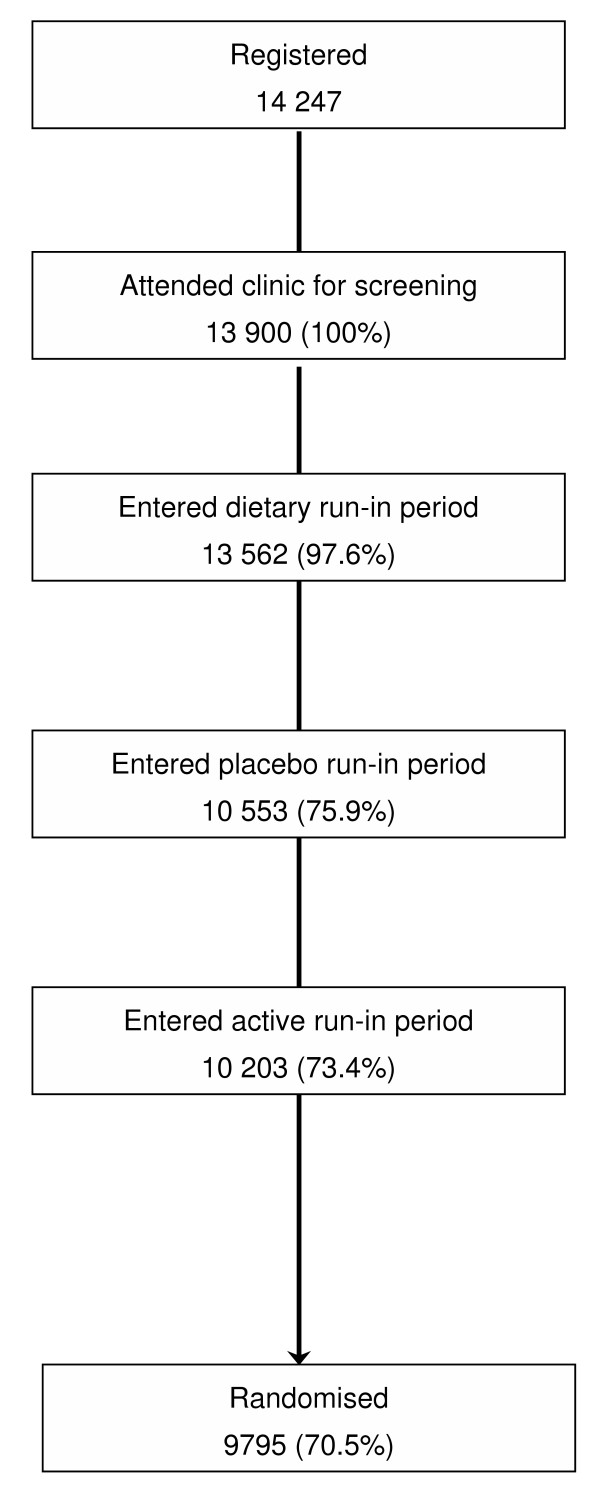
Objective: The Fenofibrate Intervention and Event Lowering in Diabetes (FIELD) Study is examining the effects of long-term fibrate therapy on coronary heart disease (CHD) event rates in patients with diabetes mellitus. This article describes the trial's run-in phase and patients' baseline characteristics. Research design and methods: FIELD is a double-blind, placebo-controlled trial in 63 centres in 3 countries evaluating the effects of fenofibrate versus placebo on CHD morbidity and mortality in 9795 patients with type 2 diabetes mellitus. Patients were to have no indication for lipid-lowering therapy on randomization, but could start these or other drugs at any time after randomization. Follow-up in the study was to be for a median duration of not less than 5 years and until 500 major coronary events (fatal coronary heart disease plus nonfatal myocardial infarction) had occurred. Results: About 2100 patients (22%) had some manifestation of cardiovascular disease (CVD) at baseline and thus high risk status. Less than 25% of patients without CVD had a (UKPDS determined) calculated 5-year CHD risk of <5%, but nearly all had a 5-year stroke risk of <10%. Despite this, half of the cohort were obese (BMI > 30), most were men, two-thirds were aged over 60 years, and substantial proportions had NCEP ATP III features of the metabolic syndrome independent of their diabetes, including low HDL (60%), high blood pressure measurement or treatment for hypertension (84%), high waist measurement (68%), and raised triglycerides (52%). After a 6-week run-in period before randomisation with all participants receiving 200 mg comicronized fenofibrate, there were declines in total and LDL cholesterol (10%) and triglycerides (26%) and an increase in HDL cholesterol (6.5%). Conclusion: The study will show the effect of PPAR-alpha agonist action on CHD and other vascular outcomes in patients with type 2 diabetes including substantial numbers with low to moderate CVD risk but with the various components of the metabolic syndrome. The main results of the study will be reported in late 2005.
Overview
The claims and statistics of this paper haven’t been checked yet.
Run the check — free, no account needed. It reads the open-access text and checks the sources it cites.
Integrity signals
Registry
Cites
Statistics
Figures
Verification
Claims the paper makes
The claims and statistics of this paper haven’t been checked yet.
Run the check — free, no account needed. It reads the open-access text and checks the sources it cites.
Claims other papers make about this one
Each is checked against this paper’s own text: does it say what the citing paper says it does?
The cited source doesn’t support the claim as written.
In the citing paper
“In fact, clinical studies have consistently demonstrated that fibrates reduce fasting TG levels by 30–50%, depending on baseline values and the specific agent used [77].”
From Targeting triglycerides for cardiovascular risk reduction (2026) · cites this paper as [77]
Checked by a reasoning model — may be wrong.
Experimental — accuracy not yet measuredThe source backs part of the claim, not all of it — or backs it for a different population, condition or comparison.
In the citing paper
“The greatest reductions in serum TG are usually observed in subjects with elevated baseline TG including those with the metabolic syndrome (MetS).”
From Fenofibrate and metabolic syndrome (2010) · cites this paper as [1]
Experimental — accuracy not yet measuredThe source backs part of the claim, not all of it — or backs it for a different population, condition or comparison.
In the citing paper
“Clinical trials examining the cardiovascular benefits of FF alone or combined with statins have produced mixed results.”
From Fenofibrate and metabolic syndrome (2010) · cites this paper as [1]
Experimental — accuracy not yet measuredThe source backs part of the claim, not all of it — or backs it for a different population, condition or comparison.
In the citing paper
“Consistently, creatinine elevations observed in the FIELD [77] and ACCORD-Lipid [80] trials resolved after treatment discontinuation and were not associated with markers of tubular damage.”
From Targeting triglycerides for cardiovascular risk reduction (2026) · cites this paper as [77]
Experimental — accuracy not yet measuredThe check wasn’t confident either way, so it gives no verdict — never disputed.
In the citing paper
“In contrast, later studies conducted largely in patients receiving statin therapy, such as FIELD [77] and ACCORD-Lipid [80], did not demonstrate a reduction in major cardiovascular events with fenofibrate in the overall study populations.”
From Targeting triglycerides for cardiovascular risk reduction (2026) · cites this paper as [77]
Experimental — accuracy not yet measured
Self-check
Percentages, sums and reported differences re-computed from the paper’s own numbers.
The self-check needs the paper’s full text.
Citations
Cites
Friedewald, W. T., Levy, R. I., & Fredrickson, D. S. (1972) · Clinical Chemistry · doi:10.1093/clinchem/18.6.499 · Cited by 32,423
OLSSON, A. G., McMurray, J. J. V., Thorgeirsson, G., Spaulding, C. M., Slattery, J., Pyörälà, K., Færgeman, O., Wright, R. S., Berg, K. M., Wilhelmsen, L., et al. (1994) · The Lancet · Cited by 8,467
Antihyperlipidemic and Biochemical Activities of Mcy Protein in Streptozotocin Induced Diabetic Rats
Marella, S., Maddirela, D. R., Badri, K. R., Kumar, M. V. J., & Chippada, A. R. (2015) · Cellular Physiology and Biochemistry · doi:10.1159/000373954 · Cited by 5,938
Sever, P., Dahlöf, B., Poulter, N. R., Wedel, H., Beevers, G., Caulfield, M. J., Collins, R., Kjeldsen, S. E., Kristinsson, A., McInnes, G. T., et al. (2003) · The Lancet · doi:10.1016/s0140-6736(03)12948-0 · Cited by 3,790
Colhoun, H. M., Betteridge, D. J., Durrington, P. N., Hitman, G. A., W Neil, H. A., Livingstone, S. J., Thomason, M. J., Mackness, M. I., Charlton-Menys, V., & Fuller, J. H. (2004) · The Lancet · doi:10.1016/s0140-6736(04)16895-5 · Cited by 3,755
SCANDINAVIANSIMVASTATINSURVIVAL (1994) · The Lancet · doi:10.1016/s0140-6736(94)90566-5 · Cited by 3,638
Mechanism of Action of Fibrates on Lipid and Lipoprotein Metabolism
Staels, B., Dallongeville, J., Auwerx, J., Schoonjans, K., Leitersdorf, E., & Fruchart, J.-C. (1998) · Circulation · doi:10.1161/01.cir.98.19.2088 · Cited by 1,786
The ALLHAT Officers and Coordinators for the ALLHAT Collaborative Research; Group, T. A. O. A. C. F. T. A. C. R. G. (2002) · JAMA · doi:10.1001/jama.288.23.2998 · Cited by 1,328
Cited by
Sorted by citations
Items 101–103 of 103
Januszewski, A. S., Li, L., O’Connell, R. L., Best, J. D., Simes, R. J., SULLIVAN, D. R., Davis, T. M. E., KEECH, A. C., & FIELD Study investigators (2026) · Internal Medicine Journal · doi:10.1111/imj.70561
KEECH, A. C., O’Connell, R. L., Januszewski, A. S., Li, L., Dalton, C., Simes, R. J., SULLIVAN, D. R., Taskinen, M., Scott, R. S., Best, J. D., et al. (2026) · Diabetologia · doi:10.1007/s00125-026-06848-6
Valle, C. D., Zuin, M., & Bilato, C. (2026) · European Journal of Clinical Investigation · doi:10.1111/eci.70267
Metadata
- Authors
- The FIELD Study Investigators
- Affiliations
- The University of Sydney (AU)
- Corresponding author
- The FIELD Study Investigators
- Venue
- Cardiovascular Diabetology
- Published
- 2005-08-22
- Volume
- 4
- Issue
- 1
- Pages
- 13-13
- ISSN
- 1475-2840 (ISSN-L)
- PMC
- PMC1266033
- OpenAlex
- W1791318806
- Cited by
- 103
- References
- 38
- Citations by year
- 2026: 5 · 2025: 5 · 2024: 1 · 2023: 2 · 2022: 4 · 2021: 4 · 2020: 3 · 2019: 2 · 2018: 4 · 2017: 3 · 2016: 4 · 2015: 4 · 2014: 6 · 2013: 4 · 2012: 3
- FWCI
- 10.18
- Type
- journal article
- Language
- en
- Open access
- gold
- doi.org
- Licence
- cc-by
- Locations
- Cardiovascular Diabetology (publishedVersion, cc-by)
- PubMed Central (publishedVersion, cc-by)
- UWA Profiles and Research Repository (UWA) (publishedVersion, other-oa)
- PubMed (publishedVersion)
- UNSWorks (University of New South Wales, Sydney, Australia) (submittedVersion, cc-by-nc-nd)
- Minerva Access (University of Melbourne) (submittedVersion, cc-by)
- National University of Singapore (submittedVersion, cc-by)
- DOAJ (DOAJ: Directory of Open Access Journals) (submittedVersion)
- Bond University Research Portal (Bond University) (submittedVersion, cc-by)
- Griffith Research Online (submittedVersion, cc-by)
- Spiral (Imperial College London) (submittedVersion, cc-by)
- Funders
- Diabetes Australia
- Diabetesliitto
- Medical Research Council
- National Health and Medical Research Council
- Topics
- Health Sciences › Medicine › Cardiology and Cardiovascular Medicine › Lipoproteins and Cardiovascular Health
- Health Sciences › Medicine › Endocrinology, Diabetes and Metabolism › Diabetes, Cardiovascular Risks, and Lipoproteins
- Health Sciences › Medicine › Nephrology › Chronic Kidney Disease and Diabetes
- Keywords
- fenofibrate, type 2 diabetes, coronary artery disease, PPARα agonist, metabolic syndrome, cardiovascular risk, lipid-lowering therapy, LDL cholesterol, HDL cholesterol, triglycerides, run-in phase, field trials
- MeSH terms
- Aged, Hypolipidemic Agents, Apolipoproteins B, Australia, Cardiovascular Diseases, Cholesterol, Coronary Disease, Diabetes Mellitus, Type 2, Double-Blind Method, Female, Finland, Humans, Cholesterol, HDL, Cholesterol, LDL, Male, Middle Aged, New Zealand, Obesity, Placebos, Fenofibrate, Triglycerides, Diabetes Complications
About these checks
Registry, retraction, Cites and statistics results are computed, not judged, with one exception: a printed reference that no index lists is read once by a model before it counts as a citation error. Claims are extracted by a model and kept only when their quote appears verbatim in the text; each cited source is then checked, with a model’s help, for whether it says what the claim relies on. Those verdicts can be wrong — read the claim’s quote and the cited source before relying on one.
Statistics and arithmetic are recomputed, not judged.
Confidence bands are shown only for fields calibrated on our annotated test set. None is calibrated yet, so no band is shown.
What counts as a claim ›How we measure confidence ›How we check this ›
Are you an author, or do you see a problem with this page? Request a review
