

Using mobile phone text messaging for malaria surveillance in rural Kenya
Open accessThe DOI matches its Crossref record; 24 of the 25 references it cites were found in a registry or an index.
Abstract
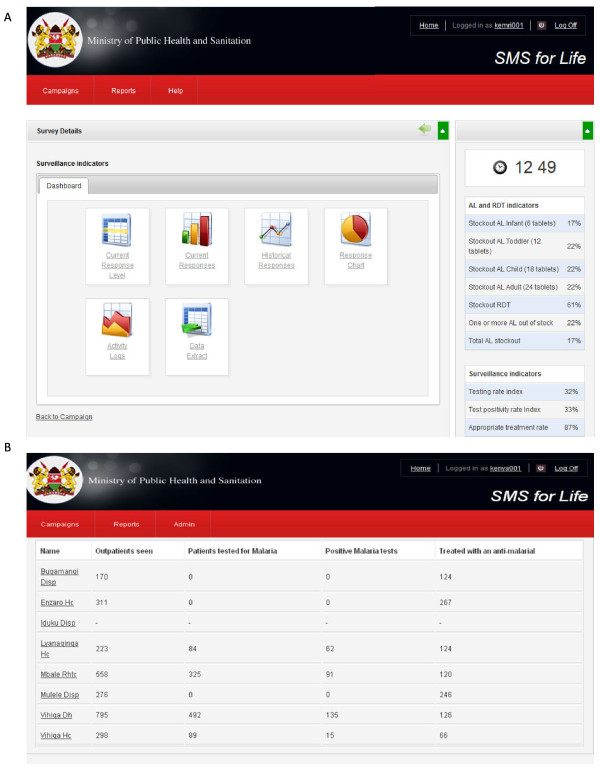
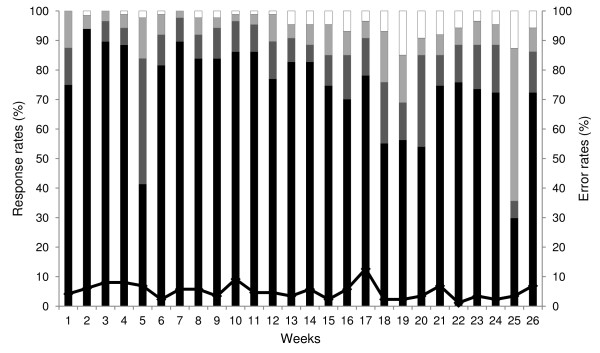
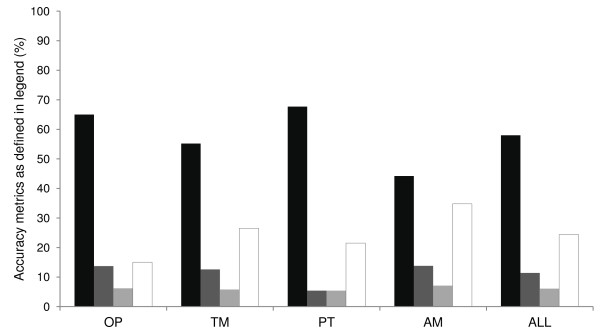
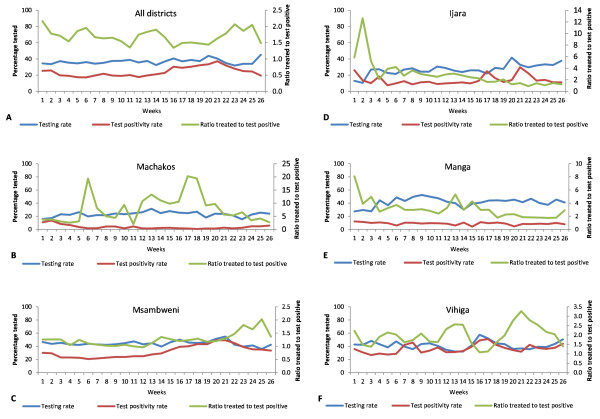
BACKGROUND: Effective surveillance systems are required to track malaria testing and treatment practices. A 26-week study "SMS for Life" was piloted in five rural districts of Kenya to examine whether SMS reported surveillance data could ensure real-time visibility of accurate data and their use by district managers to impact on malaria case-management. METHODS: Health workers from 87 public health facilities used their personal mobile phones to send a weekly structured SMS text message reporting the counts of four basic surveillance data elements to a web-based system accessed by district managers. Longitudinal monitoring of SMS reported data through the web-based system and two rounds of cross-sectional health facility surveys were done to validate accuracy of data. RESULTS: Mean response rates were 96% with 87% of facilities reporting on time. Fifty-eight per cent of surveillance data parameters were accurately reported. Overall mean testing rates were 37% with minor weekly variations ranging from 32 to 45%. Overall test positivity rate was 24% (weekly range: 17-37%). Ratio of anti-malarial treatments to test positive cases was 1.7:1 (weekly range: 1.3:1-2.2:1). District specific trends showed fluctuating patterns in testing rates without notable improvement over time but the ratio of anti-malarial treatments to test positive cases improved over short periods of time in three out of five districts. CONCLUSIONS: The study demonstrated the feasibility of using simple mobile phone text messages to transmit timely surveillance data from peripheral health facilities to higher levels. However, accuracy of data reported was suboptimal. Future work should focus on improving quality of SMS reported surveillance data.
Overview
The claims and statistics of this paper haven’t been checked yet.
Free: it reads the open-access text and checks the first 5 claims that cite a source we can check. Create a free account to check every claim.
Integrity signals
Registry
Cites
Statistics
Figures
Verification
Claims the paper makes
The claims and statistics of this paper haven’t been checked yet.
Free: it reads the open-access text and checks the first 5 claims that cite a source we can check. Create a free account to check every claim.
Claims other papers make about this one
Each is checked against this paper’s own text: does it say what the citing paper says it does?
The cited source says what the claim attributes to it.
In the citing paper
“An exception was a Kenyan study which showed data accuracy to be ‘sub-optimal’, with only 58% of data reporting as falling within ±10% of a predetermined gold standard (19).”
From Assessing the impact of mHealth interventions in low- and middle-income countries – what has been shown to work? (2014) · cites this paper as [19]
Self-check
Percentages, sums and reported differences re-computed from the paper’s own numbers.
The self-check needs the paper’s full text.
Citations
Cites
Weltgesundheitsorganisation (2005) · Cited by 3,799
WHO Guidelines for the treatment of malaria
Kunte, R., & Kunwar, R. (2011) · Medical Journal Armed Forces India · doi:10.1016/s0377-1237(16)30022-3 · Cited by 341
SMS for disease control in developing countries: a systematic review of mobile health applications
Déglise, C., Suggs, L. S., & Odermatt, P. (2012) · Journal of Telemedicine and Telecare · doi:10.1258/jtt.2012.110810 · Cited by 240 · cited 1×
“With the rapid increase of mobile phone connections in developing countries, the potential of using mobile phone text messages for field data collection is now widely recognized for its immediate communication, ease of use and reducing data transmission delays [9-13].”
BackgroundImproving public health information: a data quality intervention in KwaZulu-Natal, South Africa
Mphatswe, W., Mate, K., Bennett, B., Ngidi, H., Reddy, J., Barker, P., & Rollins, N. (2012) · Bulletin of the World Health Organization · doi:10.2471/blt.11.092759 · Cited by 196 · cited 1×
“As shown previously, improved support supervision, regular data audits and continuous feedback to health facilities on data quality is also needed [20].”
BackgroundBarrington, J., Wereko-Brobby, O., Ward, P., Mwafongo, W., & Kungulwe, S. (2010) · Malaria Journal · doi:10.1186/1475-2875-9-298 · Cited by 163 · cited 2×
“The SMS for Life system is a web-based, real-time data reporting application composed of an SMS management tool and a web-based reporting application [16].”
MethodA Research Agenda for Malaria Eradication: Monitoring, Evaluation, and Surveillance
The malERA Consultative Group on Monitoring, E. (2011) · PLoS Medicine · doi:10.1371/journal.pmed.1000400 · Cited by 161
Sentinel surveillance system for early outbreak detection in Madagascar
Randrianasolo, L., Raoelina, Y., Ratsitorahina, M., Ravolomanana, L., Andriamandimby, S., Heraud, J.-M., Rakotomanana, F., Ramanjato, R., Randrianarivo-Solofoniaina, A. E., & Richard, V. (2010) · BMC Public Health · doi:10.1186/1471-2458-10-31 · Cited by 145 · cited 3×
“Mphatswe W, Mate KS, Bennett B, Ngidi H, Reddy J, Barker PM, Rollins N: Improving public health information: a data quality intervention in KwaZulu-Natal, South Africa.”
BackgroundWorldwide Incidence of Malaria in 2009: Estimates, Time Trends, and a Critique of Methods
Cibulskis, R. E., Aregawi, M., Williams, R., Otten, M., & Dye, C. (2011) · PLoS Medicine · doi:10.1371/journal.pmed.1001142 · Cited by 143 · cited 1×
“Current reporting and use of malaria surveillance information is delayed and imprecise [4] leading to typically low estimates of malaria incidence from routine surveillance data [5].”
BackgroundAsiimwe, C., Gelvin, D., Lee, E., Amor, Y. B., Quinto, E., Katureebe, C., Sundaram, L., Bell, D., & Berg, M. (2011) · The American Society of Tropical Medicine and Hygiene · doi:10.4269/ajtmh.2011.10-0528 · Cited by 123 · cited 4×
“Mphatswe W, Mate KS, Bennett B, Ngidi H, Reddy J, Barker PM, Rollins N: Improving public health information: a data quality intervention in KwaZulu-Natal, South Africa.”
BackgroundInfluentialEvaluating the accuracy of data collection on mobile phones: A study of forms, SMS, and voice
Patnaik, S., Brunskill, E., & Thies, W. (2008) · DSpace@MIT (Massachusetts Institute of Technology) · Cited by 116
Research works printed but not linked: 4
- WHO Test. Treat. Track. Scaling up Diagnostic Testing, Treatment and Surveillance for Malaria 2012 Geneva: World Health Organization
- WHO World Malaria Report: 2012 2012 Geneva: World Health Organization
- Division of Malaria Control Malaria Surveillance Bulletin Issue 2 September 2012 2012 Kenya: Division of Malaria Control
- Zanzibar Malaria Control Programme Zanzibar Malaria Early Epidemic Detection System Biannual Report, Mid -Year 2009 vol. 1 (No. 1) 2009
Cited by
Hall, C. S., Fottrell, E., Wilkinson, S., & Byass, P. (2014) · Global Health Action · doi:10.3402/gha.v7.25606 · Cited by 384
“An exception was a Kenyan study which showed data accuracy to be ‘sub-optimal’, with only 58% of data reporting as falling within 910% of a predetermined gold standard (19).”
BackgroundGibson, D. G., Pereira, A., Farrenkopf, B. A., Labrique, A. B., Pariyo, G. W., & Hyder, A. A. (2017) · Journal of Medical Internet Research · doi:10.2196/jmir.7428 · Cited by 162
“Numerous studies used SMS and IVR surveys as a data collection tool within a research study [34-54] or as a surveillance instrument for health care workers [55-59] and were excluded from the review.”
MethodNjoroge, M., Zurovac, D., Ogara, E. A. A., Chuma, J., & Kirigia, D. (2017) · BMC Research Notes · doi:10.1186/s13104-017-2416-0 · Cited by 100
Self-citationMalaria diagnostic methods with the elimination goal in view
Oyegoke, O. O., Maharaj, L., Akoniyon, O. P., Kwoji, I., Roux, A. T., Adewumi, T. S., Maharaj, R., Oyebola, B. T., Adeleke, M. A., & Okpeku, M. (2022) · Parasitology Research · doi:10.1007/s00436-022-07512-9 · Cited by 82
“Other studies have also pointed out a loss of accuracy of reported data through this system (Githinji et al. 2014).”
BackgroundMobile phone imaging and cloud-based analysis for standardized malaria detection and reporting
Scherr, T., Gupta, S. L., Wright, D. W., & Haselton, F. R. (2016) · Scientific Reports · doi:10.1038/srep28645 · Cited by 68
Karageorgos, G. M., Andreadis, I., Psychas, K., Mourkousis, G., Kiourti, A., Lazzi, G., & Nikita, K. S. (2018) · IEEE Reviews in Biomedical Engineering · doi:10.1109/rbme.2018.2868896 · Cited by 53
“assigned to report malaria cases via SMS [82].”
BackgroundMethodFrancis, F. T., Ishengoma, D. S., Mmbando, B. P., Rutta, A. S. M., Malecela, M. N., Mayala, B. K., Lemnge, M. M., & Michael, E. (2017) · Malaria Journal · doi:10.1186/s12936-017-1956-z · Cited by 41
“In Kenya, the use of SMS for life has revealed that mobile phone text messages can be used to transmit timely surveillance data from peripheral health facilities to higher levels [13].”
BackgroundA citizen science approach for malaria mosquito surveillance and control in Rwanda
Murindahabi, M. M., Asingizwe, D., Poortvliet, P. M., van Vliet, A. J. H., Hakizimana, E., Mutesa, L., Takken, W., & Koenraadt, C. J. M. (2018) · NJAS - Wageningen Journal of Life Sciences · doi:10.1016/j.njas.2018.07.005 · Cited by 37
“The website also provided current and historical data and summaries of testing rates, test positivity rates and appropiate treatment rates at each health facility and aggregated at the district level (Githinji et al., 2014).”
BackgroundEffectiveness of a Mobile Short-Message-Service–Based Disease Outbreak Alert System in Kenya
Toda, M., Njeru, I., Zurovac, D., Tipo, S. O., Kareko, D., Mwau, M., & Morita, K. (2016) · Emerging Infectious Diseases · doi:10.3201/eid2204.151459 · Cited by 36
“These systemic challenges, reported in other IDSR (13) and mHealth surveillance (14) projects, must be addressed to avoid compromising the sustainability of such interventions.”
BackgroundSelf-citationPinchoff, J., Chaponda, M., Shields, T., Lupiya, J. S., Kobayashi, T., Mulenga, M., Moss, W. J., & Curriero, F. C. (2015) · American Journal of Tropical Medicine and Hygiene · doi:10.4269/ajtmh.15-0283 · Cited by 33
Martin, D. W., Sloan, M. L., Gleason, B. L., de Wit, L., Vandi, M. A., Kargbo, D. K., Clemens, N., Kamara, A. S., Njuguna, C. K., Sesay, S., et al. (2020) · Health Security · doi:10.1089/hs.2019.0081 · Cited by 37
Pinchoff, J., Larsen, D. A., Renn, S., Pollard, D., Fornadel, C. M., Maire, M., Sikaala, C., Sinyangwe, C., Winters, B., Bridges, D. J., et al. (2016) · Malaria Journal · doi:10.1186/s12936-015-1073-9 · Cited by 31
“Second, health facility data may be delayed or inaccurate due to recording errors or the lack of diagnostic confirmation [23–25].”
BackgroundWang, R.-B., Dong, J.-Q., Xia, Z., Cai, T., Zhang, Q.-F., Zhang, Y., Tian, Y.-H., Sun, X., Zhang, G., Li, Q.-P., et al. (2016) · Infectious Diseases of Poverty · doi:10.1186/s40249-016-0191-0 · Cited by 29
“A new malaria case report system can be introduced to these regions employing data collection with mobile phones, tablets, and other online devices [17, 18].”
Backgroundvan der Horst, T., Al-mafazy, A.-W. H., Fakih, B. S., Stuck, L. H., Ali, A., Yukich, J. O., & Hetzel, M. W. (2019) · American Journal of Tropical Medicine and Hygiene · doi:10.4269/ajtmh.19-0505 · Cited by 28
“sensitivity of the private sector was also reported by other studies.(20,21) It was noted that most private facilities (7/8) included in this study were for-profit institutions and providers”
ResultOkello, G. R., Gerrets, R. P., Zakayo, S. M., Molyneux, S. C., & Jones, C. H. D. (2018) · PLoS ONE · doi:10.1371/journal.pone.0189699 · Cited by 24
Franke, K. H., Krumkamp, R., Mohammed, A., Sarpong, N., Owusu‐Dabo, E., Brinkel, J., Fobil, J. N., Marinović, A. B., Asihene, P., Boots, M., et al. (2018) · BMC Medical Informatics and Decision Making · doi:10.1186/s12911-018-0600-3 · Cited by 23
Ndiaye, J. L., Diallo, I., Ndiaye, Y., Kouevidjin, E., Aw, I., Tairou, F., Ndoye, T., Halleux, C. M., Manga, I. A., Dieme, M. N., et al. (2018) · Pharmaceutical Medicine · doi:10.1007/s40290-018-0232-z · Cited by 21
“A pilot study in rural districts of Kenya using mobile text messaging for malaria surveillance demonstrated that phone reporting can improve timeliness and reporting of data [19].”
BackgroundMalaria Burden through Routine Reporting: Relationship between Incidence and Test Positivity Rates
Kigozi, S. P., Kigozi, R. N., Sserwanga, A., Nankabirwa, J. I., Staedke, S. G., Kamya, M. R., & Pullan, R. L. (2019) · The American Journal of Tropical Medicine and Hygiene · doi:10.4269/ajtmh.18-0901 · Cited by 20
“reporting, IR is strongly influencedby facility accessibility and/ or use by the catchment populations using distance to the health facility as a proxy.(26) We demonstrated here that after”
Amadi, J. A., Olago, D. O., Ong’amo, G. O., ORIASO, S. O., Nyamongo, I. K., & Estambale, B. B. A. (2018) · BMC Public Health · doi:10.1186/s12889-018-5513-7 · Cited by 16
“The ACSM mechanisms such as radio, television and cell phones have been used for social mobilization campaigns for tuberculosis [39] and malaria control [40].”
MethodBaloyi, R. E., Shandukani, M., Graffy, R., Misiani, E., Mayet, N. T., Mabunda, E., Mabuza, A. M., Qwabe, B., Ngwenyama, B., Reddy, C., et al. (2018) · Malaria Journal · doi:10.1186/s12936-018-2451-x · Cited by 14
Adegoke, O. J., Takane, M., Biya, O., Ota, M. O. C., Murele, B., Mahoney, F. J., Nguku, P., & Okayasu, H. (2018) · Journal of Immunological Sciences · doi:10.29245/2578-3009/2018/si.1110 · Cited by 12
Sarma, S., Nemser, B., Cole-Lewis, H., Kaonga, N., Negin, J., Namakula, P., Ohemeng-Dapaah, S., & Kanter, A. S. (2018) · Global Health: Science and Practice · doi:10.9745/ghsp-d-16-00290 · Cited by 9
Mbunge, E., Millham, R. C., Sibiya, M. N., & Takavarasha, S. (2021) · Research Square · doi:10.21203/rs.3.rs-173130/v2 · Cited by 9
Ouédraogo, B., Gaudart, J., & Dufour, J.-C. (2017) · Informatics for Health and Social Care · doi:10.1080/17538157.2017.1354000 · Cited by 8
“3%) (24,29,33,37,44,46,47) data errors (data reliability, incoherencies in data) 7 (21.”
BackgroundInfluentialOkereke, P. U., Okereke, O. W., Ogunyinka, B. O., Aluele, S. I., Tiamiyu, R. A., Afolabi, M. A., Umeh, C. V., Nwibo, E. U., Ibekwe, S. N., Ogbu, A. C., et al. (2025) · Malaria Journal · doi:10.1186/s12936-025-05656-4 · Cited by 7
Odukoya, O., Faseru, B., Uguru, N., Jamda, M., Onigbogi, O., James, O., Leischow, S., & Ayo-Yusuf, O. (2020) · Substance Abuse · doi:10.1080/08897077.2018.1526844 · Cited by 6
“improve knowledge and motivate action among health care workers in some African countries with success.(4,5) However,”
BackgroundKaburi, B. B., Harries, M., Hauri, A. M., Kenu, E., Wyss, K., Silenou, B. C., Klett-Tammen, C. J., Ressing, C., Awolin, J., Lange, B., et al. (2024) · BMC Public Health · doi:10.1186/s12889-024-19205-2 · Cited by 7
Mbunge, E., Millham, R. C., Sibiya, M. N., & Takavarasha, S. (2021) · Research Square · doi:10.21203/rs.3.rs-173130/v1 · Cited by 7
Guerra, J., Davi, K. M., Rafael, F., Assane, H., Imboua, L., Diallo, F., Tamekloe, T. A., Kuassi, A. K., Ouro-kavalah, F., Tchaniley, G., et al. (2020) · PLoS ONE · doi:10.1371/journal.pone.0243131 · Cited by 6
Mobile Technologies Impact on Economic Development in Sub-Saharan Africa
Crossan, A., McKelvey, N., & Curran, K. (2017) · IGI Global eBooks · doi:10.4018/978-1-5225-2255-3.ch540 · Cited by 5
Impact of an Intervention to Minimize Overdiagnosis of Malaria Cases in a Low Risk Kenyan sub-County
Njuguna, J., Menge, D. M., Nzou, J., & Chege, C. (2015) · Journal of Health Care for the Poor and Underserved · doi:10.1353/hpu.2015.0101 · Cited by 4
Incentivizing optimal risk map use for Triatoma infestans surveillance in urban environments
Arevalo-Nieto, C., Sheen, J. K., Condori-Luna, G. F., Condori-Pino, C. E., Shinnick, J. E., Peterson, J. K., Castillo-Neyra, R., & Levy, M. Z. (2022) · PLOS Global Public Health · doi:10.1371/journal.pgph.0000145 · Cited by 4
Aung, P. L., Pumpaibool, T., Soe, T. N., & Kyaw, M. P. (2018) · Global Journal of Health Science · doi:10.5539/gjhs.v11n1p103 · Cited by 3
Dirjayanto, V. J., Harmen, C. A., & Arsyaf, M. A. (2022) · KELUWIH Jurnal Kesehatan dan Kedokteran · doi:10.24123/kesdok.v3i2.5009 · Cited by 4
“Selain itu, pada studi Hamainza et al, Quan et al, , Githinji et al, dan Moore et al, didapatkan pelaporan kasus yang dapat dilakukan dalam waktu sekitar 7 hari [19,20,25,26].”
BackgroundInfluentialOkello, G. A. (2017) · Open Research Online (The Open University) · doi:10.21954/ou.ro.0000ce33 · Cited by 4
Advance Warning and Response Systems in Kenya: A Scoping ReviewPreprint
Were, L. M., Otieno, J. A., Nyanchoka, M., Karanja, P. W., Omia, D. O., Ngere, P., Osoro, E., Njenga, M. K., Mulaku, M., & Ngere, I. (2025) · medRxiv · doi:10.1101/2025.04.23.25326250 · Cited by 3
How Mobile Technologies Are Leading to Economic Development in Sub-Saharan Africa
McKelvey, N., Crossan, A., & Curran, K. (2020) · Advances in information quality and management · doi:10.4018/978-1-7998-3479-3.ch118 · Cited by 2
Mobile Technologies Impact on Economic Development in Sub-Saharan Africa
Crossan, A., McKelvey, N., & Curran, K. (2018) · Advances in computer and electrical engineering book series · doi:10.4018/978-1-5225-7598-6.ch075 · Cited by 2
Citizen science for malaria vector surveillance in Rwanda
Murindahabi, M. M. (2020) · doi:10.18174/521433 · Cited by 2
Adaptive Interventions for Global Health: A Case Study of MalariaPreprint
Periáñez, Á., Trister, A. D., Nekkar, M., del Río, A. F., & Alonso, P. L. (2023) · arXiv (Cornell University) · doi:10.48550/arxiv.2303.02075 · Cited by 2
Malaria Trigram: improving the visualization of recurrence data for malaria elimination
de Morais, C. M., Monteiro, K. H. D. C., Brito-Sousa, J. D., Monteiro, W. M., Sampaio, V. D. S., Endo, P. T., & Kelner, J. (2021) · Malaria Journal · doi:10.1186/s12936-021-03964-z · Cited by 1
Vey, T., Kinnicutt, E., Day, A. G., West, N., Sleeth, J., Nchimbi, K. B., & Yeates, K. (2025) · Journal of Medical Internet Research · doi:10.2196/51524 · Cited by 1
mHealth and Health Care Service Delivery in Africa: A Systematic Review
Egede, A. E., Ilo, C. I., Ikechukwu-Nwobodo, M., Nnaji, T. A., Anaba, R. I., Nwimo, I. O., Elom, N. A., Ezugwu, U. A., Ezugwu, L. E., & Nkwoka, I. (2021) · Global Journal of Health Science · doi:10.5539/gjhs.v13n2p123
“Critical health policy stakeholders at the macro, meso, and micro levels seem to have adopted mHealth in dealing with health issues affecting Sub-Saharan Africa (Little et al., 2013; Githinji et al., 2014; Stanton et al., 2015; WHO, 2018), and this concept has gained a lot of attention due to the obvious belief that t…”
BackgroundInfluentialMalaria Trigram: Improving the Visualisation of Recurrence Data for Malaria EliminationPreprint
de Morais, C. M., Monteiro, K. H. D. C., Brito-Sousa, J. D., Monteiro, W. M., Sampaio, V. D. S., Endo, P. T., & Kelner, J. (2021) · Research Square · doi:10.21203/rs.3.rs-738189/v1
"How We Could Use Digital Health to Improve Action on Non-Communicable Diseases"
Ogweno, S. (2022) · Biomedical Journal of Scientific & Technical Research · doi:10.26717/bjstr.2022.45.007277
Aung, P. L. (2018) · Chula Digiverse · doi:10.58837/chula.the.2018.482
Al‐Wawi, M. Z., Hammouri, M., & Konstantinopoulou, S. (2024) · Advances in healthcare information systems and administration book series · doi:10.4018/979-8-3693-4402-6.ch004 · Cited by 2
Kaburi, B. B., Harries, M., Hauri, A. M., Kenu, E., Wyss, K., Silenou, B. C., Klett-Tammen, C. J., Ressing, C., Awolin, J., Lange, B., et al. (2024) · Figshare · doi:10.6084/m9.figshare.26129840
Kaburi, B. B., Harries, M., Hauri, A. M., Kenu, E., Wyss, K., Silenou, B. C., Klett-Tammen, C. J., Ressing, C., Awolin, J., Lange, B., et al. (2024) · Figshare · doi:10.6084/m9.figshare.26129771
Kaburi, B. B., Harries, M., Hauri, A. M., Kenu, E., Wyss, K., Silenou, B. C., Klett-Tammen, C. J., Ressing, C., Awolin, J., Lange, B., et al. (2024) · Figshare · doi:10.6084/m9.figshare.26740844
Ouédraogo, B. (2018) · theses.fr (ABES) · doi:10.70675/e7101e2dzee09z4275zb408z1f54041999d6 · Cited by 3
Akala, H. M., Kandie, R., Githuka, G. N., Kiplagat, R., Ahmeddin, O., Keitany, K. K., Kiarie, J., Wamari, A., Machini, B., Oyugi, E. O., et al. (2026) · Malaria Journal · doi:10.1186/s12936-026-05942-9
“The participant population was predominantly female (56.9%), consistent with previously reported gender-based differences in healthcare-seeking behavior [17, 25].”
InfluentialSelf-citationData processing pipelines and tools for routine health facility malaria surveillance in UgandaPreprint
Carter, A. R., Eganyu, T., Hergott, D., Rek, J., Okiring, J., Kyabayinze, D., Maiteki‐Sebuguzi, C., Mbaka, P., & Smith, D. L. (2026) · medRxiv · doi:10.64898/2026.07.22.26357569
Tembure, S., & Manjoro, W. S. (2026) · Computer Science and Information Technologies · doi:10.11591/csit.v7i3.p377-393
“[25], the likelihood of seeking healthcare services declines by roughly 5% with each additional kilometre.”
Metadata
- Authors
- Githinji, S., Kigen, S., Memusi, D., Nyandigisi, A., Wamari, A., Muturi, A., Jagoe, G., Ziegler, R., Snow, R. W., & Zurovac, D.
- Affiliations
- Kenya Medical Research Institute (KE)
- Ministry of Health (KE)
- Medicines for Malaria Venture (CH)
- Novartis (Switzerland) (CH)
- Boston University (US)
- Corresponding author
- Githinji, Sophie
- Venue
- Malaria Journal
- Published
- 2014-03-19
- Volume
- 13
- Issue
- 1
- Pages
- 107-107
- ISSN
- 1475-2875 (ISSN-L)
- PMC
- PMC3995152
- OpenAlex
- W2111690693
- Cited by
- 53
- References
- 25
- Citations by year
- 2026: 2 · 2025: 3 · 2024: 5 · 2022: 4 · 2021: 6 · 2020: 4 · 2019: 2 · 2018: 14 · 2017: 6 · 2016: 4 · 2015: 2 · 2014: 1
- FWCI
- 4.31
- Type
- journal article
- Language
- en
- Open access
- gold
- doi.org
- Licence
- cc-by
- Locations
- Malaria Journal (publishedVersion, cc-by)
- Europe PMC (PubMed Central) (publishedVersion, cc-by)
- PubMed Central (publishedVersion, cc-by)
- PubMed (publishedVersion)
- Greater South Information System
- Funders
- United States Agency for International Development
- Wellcome Trust (092654, 079080)
- Medicines for Malaria Venture
- Novartis Pharma
- Topics
- Health Sciences › Medicine › Public Health, Environmental and Occupational Health › Malaria Research and Control
- Health Sciences › Health Professions › General Health Professions › Mobile Health and mHealth Applications
- Health Sciences › Medicine › Epidemiology › Data-Driven Disease Surveillance
- Keywords
- malaria surveillance, text messaging, data accuracy, positivity rate, malaria treatment, district health management, rural health facilities
- MeSH terms
- Humans, Kenya, Malaria, Rural Population, Internet, Cell Phone, Text Messaging, Epidemiological Monitoring
About these checks
Registry, retraction, Cites and statistics results are computed, not judged, with one exception: a printed reference that no index lists is read once by a model before it counts as a citation error. Claims are extracted by a model and kept only when their quote appears verbatim in the text; each cited source is then checked, with a model’s help, for whether it says what the claim relies on. Those verdicts can be wrong — read the claim’s quote and the cited source before relying on one.
Statistics and arithmetic are recomputed, not judged.
Confidence bands are shown only for fields calibrated on our annotated test set. None is calibrated yet, so no band is shown.
What counts as a claim ›How we measure confidence ›How we check this ›
Are you an author, or do you see a problem with this page? Request a review
Data sources
Bibliographic data: Semantic Scholar, OpenAlex, Crossref.
Contains information from the Semantic Scholar Academic Graph Datasets, made available under the ODC Attribution License (ODC-BY 1.0).
Semantic Scholar’s data is described in: Kinney, R., et al. (2023). The Semantic Scholar Open Data Platform. arXiv:2301.10140.
