

Extraction of user's navigation commands from upper body force interaction in walker assisted gait
Open accessThe DOI matches its Crossref record; 28 of the 29 references it cites were found in a registry or an index, and 1 are not checked yet; none of the 7 sources its claims cite is checked for support yet.
Abstract
BACKGROUND: The advances in technology make possible the incorporation of sensors and actuators in rollators, building safer robots and extending the use of walkers to a more diverse population. This paper presents a new method for the extraction of navigation related components from upper-body force interaction data in walker assisted gait. A filtering architecture is designed to cancel: (i) the high-frequency noise caused by vibrations on the walker's structure due to irregularities on the terrain or walker's wheels and (ii) the cadence related force components caused by user's trunk oscillations during gait. As a result, a third component related to user's navigation commands is distinguished. RESULTS: For the cancelation of high-frequency noise, a Benedict-Bordner g-h filter was designed presenting very low values for Kinematic Tracking Error ((2.035 +/- 0.358).10(-2) kgf) and delay ((1.897 +/- 0.3697).10(1)ms). A Fourier Linear Combiner filtering architecture was implemented for the adaptive attenuation of about 80% of the cadence related components' energy from force data. This was done without compromising the information contained in the frequencies close to such notch filters. CONCLUSIONS: The presented methodology offers an effective cancelation of the undesired components from force data, allowing the system to extract in real-time voluntary user's navigation commands. Based on this real-time identification of voluntary user's commands, a classical approach to the control architecture of the robotic walker is being developed, in order to obtain stable and safe user assisted locomotion.
Checked 2026-11-22 · 1 reference not checked yet
Overview
CoChat Summary
## TL;DR
The paper presents a real-time two-stage filtering method to separate voluntary navigation commands from upper-body force signals in a robotic walker, by removing vibration noise and gait-cadence components. In experiments with 5 healthy subjects and 30 walking trials, the method achieved about 80% attenuation of cadence-related energy while preserving nearby frequency information.
## Key findings
- A Benedict-Bordner g-h filter for high-frequency noise cancellation produced very low Kinematic Tracking Error of (2.035 ± 0.358)·10^-2 kgf and delay of (1.897 ± 0.3697)·10^1 ms.
- The Fourier Linear Combiner filtering architecture attenuated about 80% of the cadence-related force-signal energy, without compromising information in frequencies close to the notch filters.
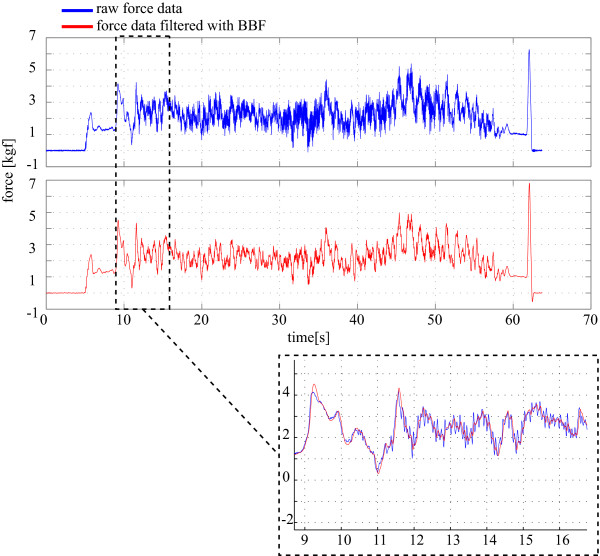
- Using mean coefficients across users/sensors/repetitions, the paper reports BBF performance of mean KTE (2.035 ± 0.358)·10^-2 kgf and delay (1.897 ± 0.3697)·10^1 ms, versus CDF mean KTE (1.951 ± 0.350)·10^-1 kgf and delay (2.413 ± 0.131)·10^1 ms.
- In the validation experiments, 5 healthy subjects completed 30 repetitions on a 40 m indoor track with a 90° curve, and the authors report the methodology worked robustly across subjects with small standard deviations.
## Methods
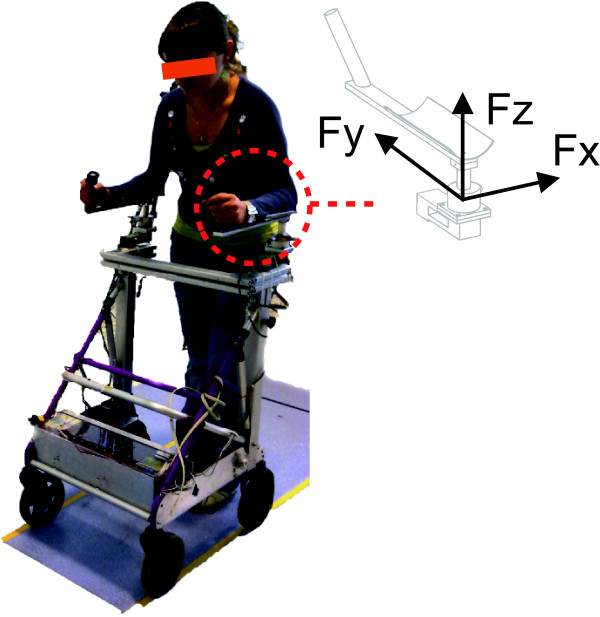
- The study is a method-development and validation paper for a robotic walker from the Simbiosis Project, using 3D force sensors under the forearm supports to capture upper-body force interaction during gait.
- Validation used 5 healthy subjects, walking at preferred speed on a 40 m indoor track with a turn; force data were recorded at 1 kHz, with 30 total trials.
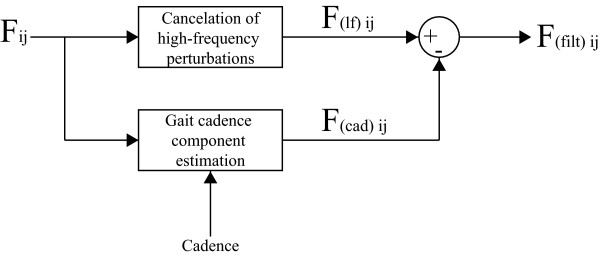
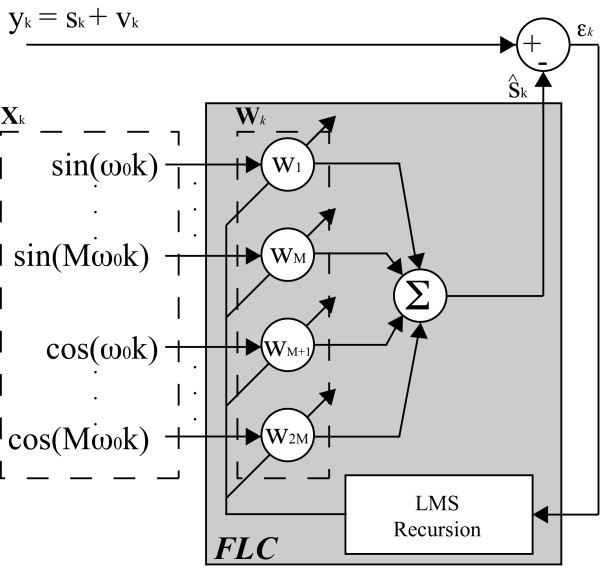
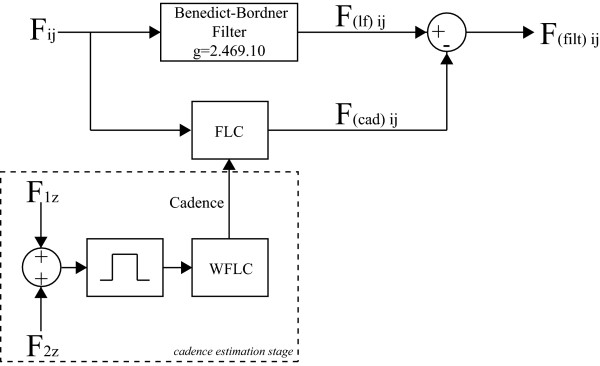
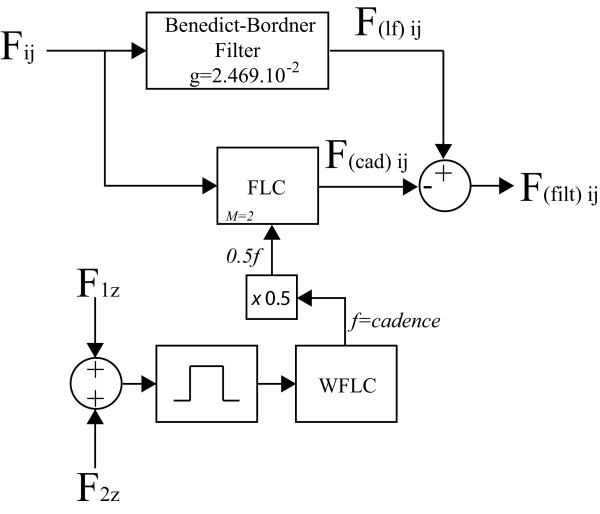
- The analysis used a two-stage filtering architecture: a Benedict-Bordner g-h filter to cancel vibration-related high-frequency noise, followed by a Fourier Linear Combiner / WFLC-FLC approach to estimate and subtract cadence-related components; filter tuning relied on KTE and delay.
## Limitations
- The paper states that the experiments were done with healthy subjects only; individuals with pathological gait will be addressed in the future.
- The final clinical validation is not yet complete; the text says the device will later be taken to a clinical environment for final validation.
- Evident from the text: the study validates filtering on a controlled indoor track and does not yet report real-world deployment outcomes or downstream navigation-command classification performance.
Model-written summary. Check it against the paper before relying on it.
Integrity signals
Registry
Cites
Statistics
Figures
Verification
Claims the paper makes
0 Valid · 2 Not valid · 8 Not checked · 28 Own results and interpretations
A result the paper reports from its own data — it cites no other source for it, so there is none to check. The quote shows it is in the paper.
In the paper
“As it can be seen, KTE for BBF and CDF are very similar.”
§ Extraction of user's navigation commands from upper body force interaction in walker assisted gait > Methods > Data analysis
plain- Asserted: passes — The authors put it forward as true.
- Checkable: passes — It can be checked against evidence.
- Load-bearing: passes — The paper’s conclusions depend on it.
- Based: passes — The paper gives a reason why it holds.
A result the paper reports from its own data — it cites no other source for it, so there is none to check. The quote shows it is in the paper.
In the paper
“Nevertheless, delay is significantly smaller when using the BBF approach.”
§ Extraction of user's navigation commands from upper body force interaction in walker assisted gait > Methods > Data analysis
plainstates a cause- Asserted: passes — The authors put it forward as true.
- Checkable: passes — It can be checked against evidence.
- Load-bearing: passes — The paper’s conclusions depend on it.
- Based: passes — The paper gives a reason why it holds.
A result the paper reports from its own data — it cites no other source for it, so there is none to check. The quote shows it is in the paper.
In the paper
“Finally, transient events related to user's navigation commands are also found within the force sensor data.”
§ Extraction of user's navigation commands from upper body force interaction in walker assisted gait > Methods
plainstates an association- Asserted: passes — The authors put it forward as true.
- Checkable: passes — It can be checked against evidence.
- Load-bearing: passes — The paper’s conclusions depend on it.
- Based: passes — The paper gives a reason why it holds.
A result the paper reports from its own data — it cites no other source for it, so there is none to check. The quote shows it is in the paper.
In the paper
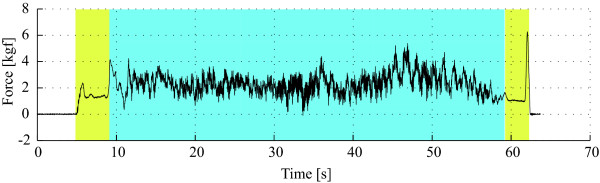
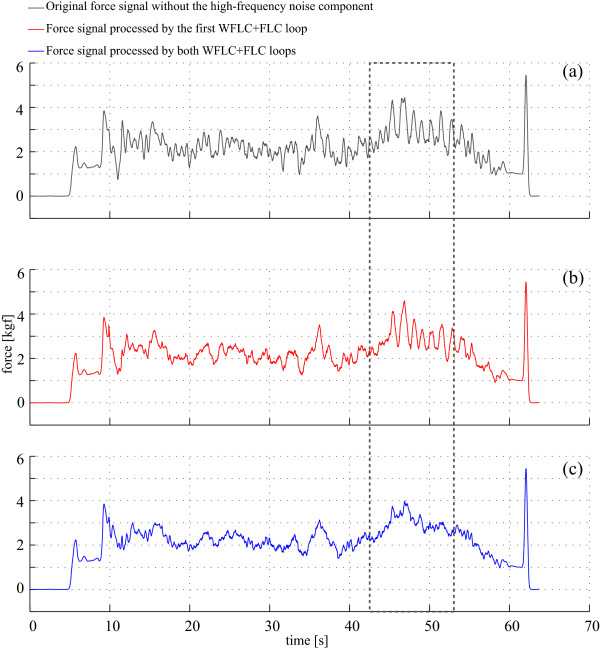
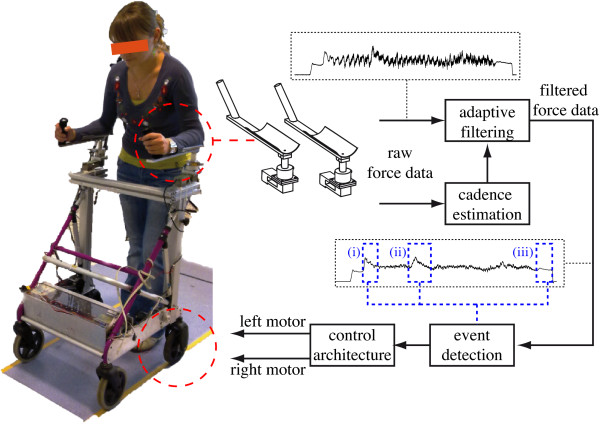
“As an example, at the beginning of the blue area in Figure 2, a high amplitude peak identifying the initial pushing force to move the device is observed.”
§ Extraction of user's navigation commands from upper body force interaction in walker assisted gait > Methods
plainstates an associationSingle case- Asserted: passes — The authors put it forward as true.
- Checkable: passes — It can be checked against evidence.
- Load-bearing: unclear — It is unclear whether the paper’s conclusions depend on it.
- Based: passes — The paper gives a reason why it holds.
A result the paper reports from its own data — it cites no other source for it, so there is none to check. The quote shows it is in the paper.
In the paper
“Considering the components related to user's guidance intentions, the authors obtained empirically that the y-components of forces are the most important.”
§ Extraction of user's navigation commands from upper body force interaction in walker assisted gait > Methods > Data analysis
plainstates an association- Asserted: passes — The authors put it forward as true.
- Checkable: passes — It can be checked against evidence.
- Load-bearing: passes — The paper’s conclusions depend on it.
- Based: passes — The paper gives a reason why it holds.
18 more claims
Create a free account to see all 38 claims and to verify the 4 references still open.
- Probably not a substantial claim. 10
- It may state two separate claims as one. 6
Citations
Cites
Discrete-Time Signal Processing
Oppenheim, A. V., & Schafer, R. W. (1989) · Cited by 12,663
(1991) · Springer eBooks · doi:10.1007/978-3-7091-2840-4 · Cited by 5,095
Alexander, S. T. (1986) · Springer eBooks · doi:10.1007/978-1-4612-4978-8 · Cited by 2,646
The biomechanics and motor control of human gait : normal, elderly and pathological
Winter, D. A. (1991) · University of Waterloo Press eBooks · Cited by 1,428
The biomechanics and motor control of human gait: Normal, elderly, and pathological
Brand, R. A. (1992) · Journal of Biomechanics · doi:10.1016/0021-9290(92)90236-t · Cited by 1,103
Tracking and Kalman Filtering Made Easy
Brookner, E. (1998) · doi:10.1002/0471224197 · Cited by 435 · cited 4×
“G-h filters are affected by two error sources, [16]: (i) the lag, dynamic, bias or systematic error, which are related to the constant velocity assumption, and (ii) the measurement error, which is inherent to the sensor and measurement process.”
InfluentialAdaptive cancelling of physiological tremor for improved precision in microsurgery
Riviere, C. N., Rader, R. S., & Thakor, N. V. (1998) · IEEE Transactions on Biomedical Engineering · doi:10.1109/10.686791 · Cited by 260 · cited 1×
“Therefore, the WFLC adapts in real-time its amplitude, frequency and phase, [23].”
BackgroundSynthesis of an optimal set of radar track-while-scan smoothing equations
Benedict, T., & Bordner, G. (1962) · IRE Transactions on Automatic Control · doi:10.1109/tac.1962.1105477 · Cited by 202
Ambulatory devices for chronic gait disorders in the elderly.
Hook, F. W. V., Demonbreun, D., & Weiss, B. D. (2003) · PubMed · Cited by 171
Joyce, B. M., & Kirby, R. (1991) · PubMed · Cited by 144
Research works printed but not linked: 2
- Frizera A Gallego J Rocon de Lima E Abellanas A Pons J Ceres R Online Cadence Estimation through Force Interaction in Walker Assisted Gait ISSNIP Biosignals and Biorobotics Conference 2010, Vitoria, Brazil 2010 1 5
- Frizera A Abellanas A Ceres R Pons JL Raya R Study and Characterization of Feet Kinematics in Walker Assisted Gait Revista Iberoamericana de Automatica e Informatica Industrial (RIAI) 2009 6 4 74 84
Cited by
Assistive mobility devices focusing on Smart Walkers: Classification and review
Martins, M. M., Santos, C. P., Frizera-Neto, A., & Ceres, R. (2012) · Robotics and Autonomous Systems · doi:10.1016/j.robot.2011.11.015 · Cited by 260
Self-citationA review of the functionalities of smart walkers
Martins, M., Santos, C. P., Frizera, A., et al. (2015) · Medical Engineering & Physics · doi:10.1016/j.medengphy.2015.07.006 · Cited by 111
Self-citationHuman–Robot–Environment Interaction Interface for Smart Walker Assisted Gait: AGoRA Walker
M., S. D. S., Garzón, M., Múnera, M., & Cifuentes, C. A. (2019) · Sensors · doi:10.3390/s19132897 · Cited by 83
Multimodal Human–Robot Interaction for Walker-Assisted Gait
Cifuentes, C. A., Rodríguez, C., Frizera, A., Bastos-Filho, T., & Carelli, R. (2014) · IEEE Systems Journal · doi:10.1109/jsyst.2014.2318698 · Cited by 71
Self-citationRobotics to Enable Older Adults to Remain Living at Home
Pearce, A. J., Adair, B., Miller, K., Ozanne, E., Said, C., Santamaria, N., & Morris, M. E. (2012) · Journal of Aging Research · doi:10.1155/2012/538169 · Cited by 68
Admittance Controller with Spatial Modulation for Assisted Locomotion using a Smart Walker
Jiménez, M. F., Monllor, M., Frizera, A., Bastos-Filho, T., Robertí, F., & Carelli, R. O. (2018) · Journal of Intelligent & Robotic Systems · doi:10.1007/s10846-018-0854-0 · Cited by 68
Self-citationEmpowering and Assisting Natural Human Mobility: The Simbiosis Walker
Frizera, A., Ceres, R., Rocón, E., & Pons, J. L. (2011) · International Journal of Advanced Robotic Systems · doi:10.5772/10666 · Cited by 71
Self-citationPosture estimation and human support using wearable sensors and walking-aid robot
Huang, J., Xu, W., Mohammed, S., & Shu, Z. (2014) · Robotics and Autonomous Systems · doi:10.1016/j.robot.2014.11.013 · Cited by 41
Smart Walkers: Advanced Robotic Human Walking-Aid Systems
Frizera, A., Elías, A., Cifuentes, C. A., Rodríguez, C., Bastos-Filho, T., & Carelli, R. O. (2015) · Springer tracts in advanced robotics · doi:10.1007/978-3-319-12922-8_4 · Cited by 32
Self-citationM., S. D. S., Múnera, M., Provot, T., et al. (2021) · Sensors · doi:10.3390/s21093242 · Cited by 25
de Mello, R. C., M., S. D. S., Scheidegger, W. M., Múnera, M., Cifuentes, C. A., Ribeiro, M. R. N., & Frizera, A. (2021) · Robotics and Autonomous Systems · doi:10.1016/j.robot.2021.103981 · Cited by 31
Self-citationDesign and Control of an Omni-Directional Robotic Walker Based on Human–Machine Interaction
Ji, J., Chen, W., Wang, W., & Xi, J. (2021) · IEEE Access · doi:10.1109/access.2021.3103202 · Cited by 24
Improving Tracking through Human-Robot Sensory Augmentation
Li, Y., Eden, J., Carboni, G., et al. (2020) · IEEE Robotics and Automation Letters · doi:10.1109/lra.2020.2998715 · Cited by 22
Design and Analysis of a Smart Rehabilitation Walker With Passive Pelvic Mechanism
Ji, J., Guo, S., Xi, F., & Zhang, L. (2019) · Journal of Mechanisms and Robotics · doi:10.1115/1.4045509 · Cited by 21
Assistive Robots for Physical and Cognitive Rehabilitation in Cerebral Palsy
Raya, R., Rocón, E., Urendes, E. J., Velasco, M. A., Clemotte, A., & Ceres, R. (2015) · Springer tracts in advanced robotics · doi:10.1007/978-3-319-12922-8_5 · Cited by 22
Self-citationReal time control of the ASBGo walker through a physical human–robot interface
Martins, M., Santos, C. P., Frizera, A., & Ceres, R. (2013) · Measurement · doi:10.1016/j.measurement.2013.10.031 · Cited by 19
Self-citationM., S. D. S., Molina, J. F., Gomez-Vargas, D., Múnera, M., & Cifuentes, C. A. (2018) · IEEE ANDESCON · doi:10.1109/andescon.2018.8564594 · Cited by 20
Reppou, S. E., Tsardoulias, E., Kintsakis, A. M., Symeonidis, A. L., Mitkas, P. A., Psomopoulos, F. E., Karagiannis, G. T., Zieliński, C., Prunet, V., Merlet, J., et al. (2016) · International Journal of Social Robotics · doi:10.1007/s12369-016-0361-z · Cited by 18
Assessment of a Robotic Walker in Older Adults With Parkinson's Disease in Daily Living Activities
M., S. D. S., A., D. E. G., Otálora, S., Arias-Castro, M. C., Rodas, A. G., Múnera, M., & Cifuentes, C. A. (2021) · Frontiers in Neurorobotics · doi:10.3389/fnbot.2021.742281 · Cited by 20
A novel human-machine interface for guiding: The NeoASAS smart walker
Martins, M., Frizera, A., Urendes, E. J., Santos, C. P., Ceres, R., & Bastos-Filho, T. (2012) · ISSNIP Biosignals and Biorobotics Conference: Biosignals and Robotics for Better and Safer Living · doi:10.1109/brc.2012.6222195 · Cited by 17
Self-citationSmart technologies for older people
Morris, M. E. (2012) · Cited by 15
Sensor fusion to control a robotic walker based on upper-limbs reaction forces and gait kinematics
Cifuentes, C. A., Rodríguez, C., Frizera, A., & Bastos-Filho, T. (2014) · IEEE/RAS-EMBS International Conference on Biomedical Robotics and Biomechatronics (BioRob) · doi:10.1109/biorob.2014.6913927 · Cited by 12
Self-citationOnline System for Gait Parameters Estimation Using a LRF Sensor for Assistive Devices
Aguirre, A., M., S. D. S., Múnera, M., & Cifuentes, C. A. (2020) · IEEE Sensors Journal · doi:10.1109/jsen.2020.3028279 · Cited by 11
Can smart rollators be used for gait monitoring and fall prevention ?
Dune, C., Gorce, P., & Merlet, J. (2012) · HAL · doi:10.13140/2.1.2267.5843 · Cited by 15
Simulation study on assist-as-needed control of a rehabilitation robotic walker
Wang, W., Gong, T., Song, Z., Wang, Z., & Ji, J. (2023) · Technology and Health Care · doi:10.3233/thc-236025 · Cited by 7
Semi-Remote Gait Assistance Interface: A Joystick with Visual Feedback Capabilities for Therapists
A., D. E. G., M., S. D. S., Gomez-Vargas, D., Jiménez, M. F., Múnera, M., & Cifuentes, C. A. (2021) · Sensors · doi:10.3390/s21103521 · Cited by 7
A new integrated device to read user intentions when walking with a Smart Walker
Martins, M., Santos, C. P., Seabra, E. A. R., et al. (2013) · 2022 IEEE 20th International Conference on Industrial Informatics (INDIN) · doi:10.1109/indin.2013.6622899 · Cited by 6
Self-citationChanges in the Determinism of the Gait Dynamics with the Intervention of a Robotic Walker
Wan, X., & Yamada, Y. (2020) · Applied Sciences · doi:10.3390/app10144939 · Cited by 6
Motion Control and Fall Prevention for an Active Walker Mobility Aid
Irgenfried, S., & Wörn, H. (2013) · Mechanisms and machine science · doi:10.1007/978-94-007-7485-8_20 · Cited by 6
A Therapist Helping Hand for Walker-Assisted Gait Rehabilitation: A Pre-Clinical Assessment
M., S. D. S., Jiménez, M. F., Múnera, M., Bastos-Filho, T., Frizera, A., & Cifuentes, C. A. (2019) · IEEE Colombian Conference on Automatic Control (CCAC) · doi:10.1109/ccac.2019.8920943 · Cited by 5
Self-citationA turning control of electric wheeled walker device by PSD camera information
Saito, D., & Murakami, T. (2014) · IEEE International Workshop on Advanced Motion Control (AMC) · doi:10.1109/amc.2014.6823352 · Cited by 5
Frizera, A., Ceres, R., & Pons, J. L. (2011) · Revista Iberoamericana de Automática e Informática Industrial RIAI · doi:10.1016/s1697-7912(11)70028-0 · Cited by 6
Self-citationGait Phase Estimation Based on User–Walker Interaction Force
Li, P., Akiyama, Y., Wan, X., et al. (2021) · Applied Sciences · doi:10.3390/app11177888 · Cited by 4
A Survey on Rollator‐Type Mobility Assistance Robots
Geravand, M., Werner, C., Hauer, K. A., & Peer, A. (2023) · Wiley eBooks · doi:10.1002/9781119863663.ch15 · Cited by 4
Human-Robot Interaction for Assisting Human Locomotion
Cifuentes, C. A., & Frizera, A. (2016) · Springer tracts in advanced robotics · doi:10.1007/978-3-319-34063-0_2 · Cited by 3
Self-citationAn Effective Body Posture Management System using Novel Intelligent Crutch Tool Mechanism
Padmavathi, B. L., Sahithi, S. L. Y., Sudarshan, V. S., et al. (2023) · International Conference on Recent Advances in Electrical, Electronics, Ubiquitous Communication, and Computational Intelligence (RAEEUCCI) · doi:10.1109/raeeucci57140.2023.10134331 · Cited by 2
Path Planning based on Probabilistic Foam for a Robotic Smart Walker in Dynamic Environments*
Lima, A. P. H., Alsina, P. J., de Medeiros, A. A. D., et al. (2024) · Latin American Robotics Symposium · doi:10.1109/lars64411.2024.10786475 · Cited by 2
Machado, F., Loureiro, M., de Mello, R. C., Díaz, C. A. R., & Frizera, A. (2025) · Elsevier eBooks · doi:10.1016/b978-0-12-819877-3.00012-3 · Cited by 2
Self-citationSensing Methodologies for Gait Parameters Estimation and Control
Pinto-Bernal, M. J., M., S. D. S., Múnera, M., & Cifuentes, C. A. (2021) · Springer eBooks · doi:10.1007/978-3-030-79630-3_5 · Cited by 2
Cognitive HRI for Human Mobility Assistance
Cifuentes, C. A., & Frizera, A. (2016) · Springer tracts in advanced robotics · doi:10.1007/978-3-319-34063-0_4 · Cited by 1
Self-citationMultimodal Interface for Human Mobility Assistance
Cifuentes, C. A., & Frizera, A. (2016) · Springer tracts in advanced robotics · doi:10.1007/978-3-319-34063-0_5 · Cited by 1
Self-citationUsers’ adaptations to the proportional speed control of a motorised walker
Yeoh, W. L., Choi, J., Loh, P. Y., et al. (2021) · Disability and Rehabilitation Assistive Technology · doi:10.1080/17483107.2021.2017031
Smart walker's instrumentation and development with compliant optical fiber sensors
Junior, A. G. L., & Frizera, A. (2022) · Elsevier eBooks · doi:10.1016/b978-0-32-385952-3.00022-6
Self-citationFrizera, A., Ceres, R., & Pons, J. L. (2011) · Revista Iberoamericana de Automática e Informática Industrial RIAI · doi:10.4995/riai.2011.02.10
Self-citationA Common Methodology for Cloud Robotics Experimentation
de Mello, R. C., Ribeiro, M. R. N., & Frizera, A. (2022) · Springer tracts in advanced robotics · doi:10.1007/978-3-031-16908-3_5
Self-citationPesquisa e desenvolvimento de Tecnologia Assistiva: uma revisão sistemática sobre andadores
da SILVA, J. C. A., & COSTA, D. D. S. (2022) · doi:10.5151/ped2022-4921976
Fakhouri, A. S., Fakhouri, F. S., Ijaz, M. F., et al. (2024) · Journal of Disability Research · doi:10.57197/jdr-2024-0100
Cheng, J., & Shen, T. (2026) · IEEE Transactions on Medical Robotics and Bionics · doi:10.1109/tmrb.2026.3713989
Evaluation of VR-based speed and direction control strategies for pediatric robotic gait training
Loureiro, M., Sorozábal, P., Bezerra, M., et al. (2026) · Journal of NeuroEngineering and Rehabilitation · doi:10.1186/s12984-026-02158-5
Self-citation
Metadata
- Authors
- Frizera Neto, A., Gallego, J. A., Rocon, E., Pons, J. L., & Ceres, R.
- Affiliations
- Consejo Superior de Investigaciones Científicas (ES)
- Venue
- BioMedical Engineering OnLine
- Published
- 2010-08-05
- Volume
- 9
- Issue
- 1
- Pages
- 37-37
- ISSN
- 1475-925X (ISSN-L)
- PMC
- PMC2924341
- OpenAlex
- W2104060902
- Cited by
- 48
- References
- 28
- Citations by year
- 2026: 2 · 2025: 1 · 2024: 2 · 2023: 3 · 2022: 3 · 2021: 8 · 2020: 3 · 2019: 3 · 2018: 2 · 2016: 4 · 2015: 3 · 2014: 4 · 2013: 3 · 2012: 4
- FWCI
- 1.89
- Type
- journal article
- Language
- en
- Open access
- gold
- doi.org
- Licence
- cc-by
- Locations
- BioMedical Engineering OnLine (publishedVersion, cc-by)
- PubMed Central (publishedVersion, cc-by)
- PubMed (publishedVersion)
- DOAJ (DOAJ: Directory of Open Access Journals) (submittedVersion)
- Funders
- Ministerio de Ciencia e Innovación
- Topics
- Physical Sciences › Engineering › Biomedical Engineering › Prosthetics and Rehabilitation Robotics
- Health Sciences › Health Professions › Occupational Therapy › Assistive Technology in Communication and Mobility
- Health Sciences › Health Professions › Physical Therapy, Sports Therapy and Rehabilitation › Balance, Gait, and Falls Prevention
- Keywords
- rollator, robotic walker, trunk oscillation
- MeSH terms
- Algorithms, Biomechanical Phenomena, Gait, Robotics, User-Computer Interface, Walkers, Reproducibility of Results
About these checks
Registry, retraction, Cites and statistics results are computed, not judged, with one exception: a printed reference that no index lists is read once by a model before it counts as a citation error. Claims are extracted by a model and kept only when their quote appears verbatim in the text; each cited source is then checked, with a model’s help, for whether it says what the claim relies on. Those verdicts can be wrong — read the claim’s quote and the cited source before relying on one.
A language model drew the claims from the paper on 2026-10-10, under version 3 of the claim definition (model deepseek-v4.1-flash, prompt extract-v3).
A second model labelled each claim on 2026-10-10 (model jev-1.13-20260917, definition revision gold-guideline-v0.2).
Statistics and arithmetic are recomputed, not judged.
Confidence bands are shown only for fields calibrated on our annotated test set. None is calibrated yet, so no band is shown.
What counts as a claim ›How we measure confidence ›How we check this ›
Are you an author, or do you see a problem with this page? Request a review
Data sources
Bibliographic data: Semantic Scholar, OpenAlex, Crossref.
Contains information from the Semantic Scholar Academic Graph Datasets, made available under the ODC Attribution License (ODC-BY 1.0).
Semantic Scholar’s data is described in: Kinney, R., et al. (2023). The Semantic Scholar Open Data Platform. arXiv:2301.10140.
