

Methods to measure potential spatial access to delivery care in low-and middle-income countries: a case study in rural Ghana.
Open accessThe DOI matches its Crossref record; 40 of the 40 references it cites were found in a registry or an index.
Abstract
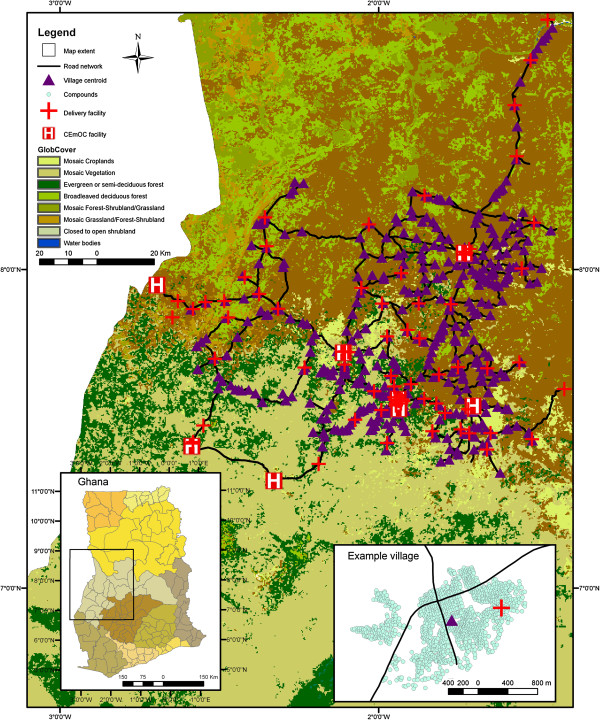
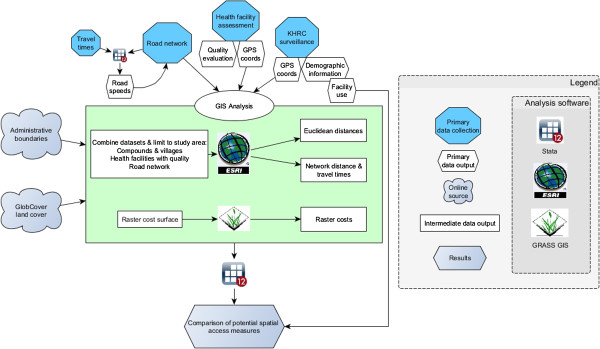
BACKGROUND: Access to skilled attendance at childbirth is crucial to reduce maternal and newborn mortality. Several different measures of geographic access are used concurrently in public health research, with the assumption that sophisticated methods are generally better. Most of the evidence for this assumption comes from methodological comparisons in high-income countries. We compare different measures of travel impedance in a case study in Ghana's Brong Ahafo region to determine if straight-line distance can be an adequate proxy for access to delivery care in certain low- and middle-income country (LMIC) settings. METHODS: We created a geospatial database, mapping population location in both compounds and village centroids, service locations for all health facilities offering delivery care, land-cover and a detailed road network. Six different measures were used to calculate travel impedance to health facilities (straight-line distance, network distance, network travel time and raster travel time, the latter two both mechanized and non-mechanized). The measures were compared using Spearman rank correlation coefficients, absolute differences, and the percentage of the same facilities identified as closest. We used logistic regression with robust standard errors to model the association of the different measures with health facility use for delivery in 9,306 births. RESULTS: Non-mechanized measures were highly correlated with each other, and identified the same facilities as closest for approximately 80% of villages. Measures calculated from compounds identified the same closest facility as measures from village centroids for over 85% of births. For 90% of births, the aggregation error from using village centroids instead of compound locations was less than 35 minutes and less than 1.12 km. All non-mechanized measures showed an inverse association with facility use of similar magnitude, an approximately 67% reduction in odds of facility delivery per standard deviation increase in each measure (OR = 0.33). CONCLUSION: Different data models and population locations produced comparable results in our case study, thus demonstrating that straight-line distance can be reasonably used as a proxy for potential spatial access in certain LMIC settings. The cost of obtaining individually geocoded population location and sophisticated measures of travel impedance should be weighed against the gain in accuracy.
Overview
The claims and statistics of this paper haven’t been checked yet.
Free: it reads the open-access text and checks the first 5 claims that cite a source we can check. Create a free account to check every claim.
Integrity signals
Registry
Cites
Statistics
Figures
Verification
Claims the paper makes
The claims and statistics of this paper haven’t been checked yet.
Free: it reads the open-access text and checks the first 5 claims that cite a source we can check. Create a free account to check every claim.
Self-check
Percentages, sums and reported differences re-computed from the paper’s own numbers.
The self-check needs the paper’s full text.
Citations
Cites
The Concept of Access: Definition and Relationship to Consumer Satisfaction
Penchansky, R., & Thomas, J. W. (1981) · Medical Care · doi:10.1097/00005650-198102000-00001 · Cited by 3,437 · cited 1×
“The term “spatial access” encompasses two of the formative five dimensions of access described by Penchansky and Thomas: accessibility, referring to the spatial relationship between location of supply and demand; and availability, referring to the adequacy of provider supply in relation to demand [5,6].”
BackgroundSpatial accessibility of primary care: concepts, methods and challenges
Guagliardo, M. F. (2004) · International Journal of Health Geographics · doi:10.1186/1476-072x-3-3 · Cited by 1,533
Still too far to walk: Literature review of the determinants of delivery service use
Gabrysch, S., & Campbell, O. M. (2009) · BMC Pregnancy and Childbirth · doi:10.1186/1471-2393-9-34 · Cited by 1,255 · cited 1×
“Many factors influence the use of skilled delivery care, including characteristics of the mother and of the service environment [2].”
Self-citationMonitoring emergency obstetric care : a handbook
Disability (2009) · Cited by 986
Lozano, R., Wang, H., Foreman, K. J., Rajaratnam, J. K., Naghavi, M., Marcus, J. R., Dwyer-Lindgren, L., Lofgren, K. T., Phillips, D., Atkinson, C., et al. (2011) · The Lancet · doi:10.1016/s0140-6736(11)61337-8 · Cited by 880 · cited 1×
“Overview & data sources Ghana is a West African country with a high maternal mortality ratio estimated at 328 per 100,000 in 2011 [26].”
BackgroundGRASS GIS: A multi-purpose open source GIS
Neteler, M., Bowman, M. H., Landa, M., & Metz, M. (2012) · Environmental Modelling & Software · doi:10.1016/j.envsoft.2011.11.014 · Cited by 804
Wang, F., & Luo, W. (2005) · Health & Place · doi:10.1016/j.healthplace.2004.02.003 · Cited by 664 · cited 1×
“Accessibility and availability are often combined into a single index to measure geographic coverage of care, ranging in complexity from a simple ratio of provider supply to patient demand, to more complex indices such as the two-step floating catchment area method [7,8].”
BackgroundApparicio, P., Abdelmajid, M., Riva, M., & Shearmur, R. (2008) · International Journal of Health Geographics · doi:10.1186/1476-072x-7-7 · Cited by 567
Gabrysch, S., Cousens, S., Cox, J., & Campbell, O. M. R. (2011) · PLoS Medicine · doi:10.1371/journal.pmed.1000394 · Cited by 353 · cited 2×
“While often neglected, the impact of geographic access to skilled care on choice of delivery place is of similar magnitude as that of education or wealth [3].”
BackgroundSelf-citationTanser, F., Gijsbertsen, B., & Herbst, K. (2006) · Social Science & Medicine · doi:10.1016/j.socscimed.2006.01.015 · Cited by 348 · cited 6×
“However, both studies were conducted in more mountainous regions of East Africa, and their findings might not hold true in other flatter settings.”
BackgroundMethodInfluential
Cited by
Gabrysch, S., Nesbitt, R., Schoeps, A., Hurt, L. S., Soremekun, S., Edmond, K. M., Manu, A. A., Lohela, T. J., Danso, S., Tomlin, K., et al. (2019) · The Lancet Global Health · doi:10.1016/s2214-109x(19)30165-2 · Cited by 141
Self-citationTanou, M., & Kamiya, Y. (2019) · BMC Public Health · doi:10.1186/s12889-019-7150-1 · Cited by 110
“The advantage of this method is that it can be generalized for other similar topography and cultural contexts in West Africa [28].”
BackgroundMethodResultWong, K. L. M., Benova, L., & Campbell, O. M. R. (2017) · PLOS ONE · doi:10.1371/journal.pone.0184432 · Cited by 86
“Seven of these then estimated straight-line distance from geospatial coordinates; and four others—Mills et al. 2008 [30], Joharifard et al. 2012 [31], Nesbitt et al. 2014 [32] and Johnson et al. 2015 [33]–estimated road network distance by further adding a shape file of vector data (a file to store…”
BackgroundInfluentialThe geography of maternal and newborn health: the state of the art
Ebener, S., Guerra-Arias, M., Campbell, J., Tatem, A. J., Moran, A. C., Johnson, F. A., Fogstad, H., Stenberg, K., Neal, S., Bailey, P., et al. (2015) · International Journal of Health Geographics · doi:10.1186/s12942-015-0012-x · Cited by 99
“, 2014 [66] Africa Subnational Accuracy of different measures of geographic access as proxies for access to services.”
BackgroundDotse-Gborgbortsi, W., Dwomoh, D., Alegana, V., Hill, A., Tatem, A. J., & Wright, J. (2020) · BMJ Global Health · doi:10.1136/bmjgh-2019-002020 · Cited by 78
“24 However, a sample of origin–destination pairs was used to compare travel time, mechanised network distance and Euclidean distance to evaluate this choice of distance metric, and this showed a high correlation between all three measures.”
The influence of distance and quality of care on place of delivery in rural Ghana.
Nesbitt, R. C., Lohela, T. J., Soremekun, S., Vesel, L., Manu, A., Okyere, E., Grundy, C., Amenga-Etego, S., Owusu-Agyei, S., Kirkwood, B. R., et al. (2016) · Scientific Reports · doi:10.1038/srep30291 · Cited by 78
Self-citationAlford‐Teaster, J., Lange, J. M., Hubbard, R. A., Lee, C. I., Haas, J. S., Shi, X., Carlos, H. A., Henderson, L. M., Hill, D. A., Tosteson, A. N. A., et al. (2016) · International Journal of Health Geographics · doi:10.1186/s12942-016-0039-7 · Cited by 79
Methods of Measuring Spatial Accessibility to Health Care in Uganda
Ouma, P., Macharia, P. M., Okiro, E. A., & Alegana, V. A. (2021) · Global perspectives on health geography · doi:10.1007/978-3-030-63471-1_6 · Cited by 83
Tanou, M., Kishida, T., & Kamiya, Y. (2021) · Reproductive Health · doi:10.1186/s12978-021-01249-x · Cited by 79
“We also confirmed that travel time to the closest health centers had negative effects on women’s use of healthcare services in line with the numerous studies conducted in Sub-Saharan Africa countries [37, 40].”
BackgroundMethodInfluentialSpatial accessibility to basic public health services in South Sudan
Macharia, P. M., Ouma, P., Gogo, E. G., Snow, R. W., & Noor, A. M. (2017) · Geospatial health · doi:10.4081/gh.2017.510 · Cited by 76
Improving the spatial accessibility of healthcare in North Kivu, Democratic Republic of Congo
Pu, Q., Yoo, E., Rothstein, D. H., Cairo, S. B., & Malemo, L. (2020) · Applied Geography · doi:10.1016/j.apgeog.2020.102262 · Cited by 75
Spatial Access to Emergency Services in Low- and Middle-Income Countries: A GIS-Based Analysis
Tansley, G., Schuurman, N., Amram, O., & Yanchar, N. L. (2015) · PLoS ONE · doi:10.1371/journal.pone.0141113 · Cited by 73
“These methods have been previously demonstrated to provide comparable results to the network analysis approach taken in this study [37].”
ResultBanke-Thomas, A. O., Wright, O., & Collins, L. (2018) · Journal of Global Health · doi:10.7189/jogh.09.010414 · Cited by 67
Stewart, B. T., Tansley, G., Gyedu, A., Ofosu, A. A., Donkor, P., Appiah-Denkyira, E., Quansah, R. E., Clarke, D., Volmink, J. A., & Mock, C. (2016) · JAMA Surgery · doi:10.1001/jamasurg.2016.1239 · Cited by 62
“5) 1412 (578-3090)b 1157 (510-2569)b 123 (30-239)b”
Distribution of Medication Considering Information, Transshipment, and Clustering: Malaria in Malawi
Parvin, H., Beygi, S., Helm, J. E., Larson, P. S., & Oyen, M. P. V. (2017) · Production and Operations Management · doi:10.1111/poms.12826 · Cited by 59
“in analytical approaches for tractability (see Paterson et al. 2011 for references). Most of the literature assumes infinite capacity for replenishment, although some papers model a finite supply or production capacity. In our setting, the total amount of medication available is restricted, having been donated or sold…”
BackgroundPetricola, S., Reinmuth, M., Lautenbach, S., Hatfield, C. R. S., & Zipf, A. (2022) · International Journal of Health Geographics · doi:10.1186/s12942-022-00315-2 · Cited by 61
“However, they did not conclude on the best approach but rather highlighted some differences to be adapted according to the context [27, 28].”
BackgroundKim, J., Hagen, E., Muindi, Z., Mbonglou, G., & Laituri, M. (2022) · The Science of The Total Environment · doi:10.1016/j.scitotenv.2022.153398 · Cited by 62
“Since smallsized residential lots are densely located in the study area, we assumed that a travel distance obtained from the Euclidean approach would not be substantially different from that obtained from the pedestrian networkbased approach (e.g., Davis et al., 2020; Nesbitt et al., 2014; Shores et al., 2019).”
An urban-to-rural continuum of malaria risk: new analytic approaches characterize patterns in Malawi
Larson, P. S., Eisenberg, J. N. S., Berrocal, V. J., Mathanga, D. P., & Wilson, M. L. (2021) · Malaria Journal · doi:10.1186/s12936-021-03950-5 · Cited by 51
Access to maternal health services: geographical inequalities, United Republic of Tanzania
Hanson, C., Gabrysch, S., Mbaruku, G. M., Cox, J., Mkumbo, E., Manzi, F., Schellenberg, J., & Ronsmans, C. (2017) · Bulletin of the World Health Organization · doi:10.2471/blt.17.194126 · Cited by 62
“Other 10 254 (46) 5804 (40) Household wealth quintile < 0.”
Self-citationWang, W., Winner, M. B. F., & Burgert‐Brucker, C. R. (2017) · Global Health Science and Practice · doi:10.9745/ghsp-d-16-00311 · Cited by 58
“However, Nesbitt and colleagues compared 6 differentmeasures of spatial access and found that the straightline linkage yields results similar to other geospatial algorithms in a developing-country setting.(20) Finally, the buffer linkage between DHS clusters and SPA facilities may not be appropriate in areas where the…”
BackgroundResultDefar, A., Okwaraji, Y. B., Tigabu, Z., Persson, L. Å., & Alemu, K. (2019) · International Journal for Equity in Health · doi:10.1186/s12939-019-1079-y · Cited by 53
Measuring access to urban centres in rural Northeast Brazil: A spatial accessibility poverty index
Benevenuto, R., & Caulfield, B. M. (2019) · Journal of Transport Geography · doi:10.1016/j.jtrangeo.2019.102553 · Cited by 56
Schmitz, M. M., Serbanescu, F., Arnott, G. E., Dynes, M. M., Chaote, P., Msuya, A. A., & Chen, Y. N. (2019) · BMJ Global Health · doi:10.1136/bmjgh-2019-001568 · Cited by 57
Factors associated with delivery outside a health facility: cross‐sectional study in rural Malawi
Mazalale, J., Kambala, C., Brenner, S., Chinkhumba, J., Lohmann, J., Mathanga, D. P., Robberstad, B., Muula, A. S., & Allegri, M. D. (2015) · Tropical Medicine & International Health · doi:10.1111/tmi.12473 · Cited by 51
Ferguson, W., Kemp, K. K., & Kost, G. J. (2016) · International Journal of Health Geographics · doi:10.1186/s12942-016-0037-9 · Cited by 46
Wang, W., & Mallick, L. M. (2019) · BMJ Global Health · doi:10.1136/bmjgh-2018-000765 · Cited by 44
“Research, however, has found that straight-line linkage actually yielded similar results to other geospatial linking methods.(45) The linkage methodology used in this paper adds to the limited amount of literature on connecting health facility data with population data to understand the relationship between service pr…”
ResultMeasuring spatial accessibility and equity to healthcare services using fuzzy inference system
Sabokbar, H. A. F., Mohammadi, H., Tahmasbi, S., Rafii, Y., & Hosseini, . (2021) · Applied Geography · doi:10.1016/j.apgeog.2021.102584 · Cited by 46
Mróz, E., Willis, T., Thomas, C., Janes, C. R., Singini, D., Njungu, M., & Smith, M. W. (2023) · International Journal of Health Geographics · doi:10.1186/s12942-023-00338-3 · Cited by 44
Farrow, N. E., Commander, S. J., Reed, C. R., Mueller, J. L., Gupta, A., Loh, A. H. P., Sekabira, J., & Fitzgerald, T. N. (2020) · Surgical Endoscopy · doi:10.1007/s00464-020-08151-w · Cited by 36
Kruk, M. E., Hermosilla, S., Larson, E., Vail, D., Chen, Q., Mazuguni, F., Byalugaba, B., & Mbaruku, G. (2015) · Tropical Medicine & International Health · doi:10.1111/tmi.12518 · Cited by 32
“However, recent work comparing Euclidian distance with network distance (distance along roads) found the two to be comparable in identifying nearest health facilities in a rural African setting [51].”
BackgroundBationo, C. S., Gaudart, J., Dieng, S., Cissoko, M., Taconet, P., Ouédraogo, B., Somé, A., Zongo, I., Soma, D. D., Tougri, G., et al. (2021) · Scientific Reports · doi:10.1038/s41598-021-99457-9 · Cited by 34
“Indeed, studies conducted elsewhere have shown that targeting hotspots helps to reduce malaria transmission [50,51].”
Wariri, O., Egwu, O., Alhassan, J. A. K., Dase, E., Jalo, I., Laima, C. H., Farouk, H. U., El-Nafaty, A. U., Okomo, U. A., & Dotse‐Gborgbortsi, W. (2021) · PLoS ONE · doi:10.1371/journal.pone.0245297 · Cited by 38
“While generalising the address to town level for all women in a locality protects the confidentiality and privacy of the study participants, it may have led to acceptable aggregation error [48].”
BackgroundFogliati, P., Straneo, M., Brogi, C., Fantozzi, P. L., Salim, R., Msengi, H. M., Azzimonti, G., & Putoto, G. (2015) · PLoS ONE · doi:10.1371/journal.pone.0139460 · Cited by 28
“Although straight-line (Euclidean) distance can be reasonably used as a proxy for potential spatial access in flatter areas [56], raster or network methods are more suitable to estimate travel time in mountainous contexts and can supply adequate details for planning at local level.”
BackgroundTansley, G., Stewart, B. T., Gyedu, A., Boakye, G., Lewis, D. J., Hoogerboord, M., & Mock, C. (2016) · World Journal of Surgery · doi:10.1007/s00268-016-3765-x · Cited by 30
“Estimating travel time is associated with unique challenges in LMICs due to the influence of variable road conditions and transportation infrastructure on overland speeds [28].”
High Poverty and Hardship Financing Among Patients with Noncommunicable Diseases in Rural Haiti
Kwan, G. F., Yan, L. D., Isaac, B., Bhangdia, K. P., Jean-Baptiste, W., Belony, D., Gururaj, A., Louiné, M., Vertilus, S., Pierre-Louis, D., et al. (2020) · Global Heart · doi:10.5334/gh.388 · Cited by 23
“While our measure of distance did not account for different walking paths, roads directions, road quality, or transportation cost, it is a reasonable proxy for measuring spatial access [45].”
BackgroundAlemu, S. M., Tura, A. K., do Amaral, G. S. G., Moughalian, C., Weitkamp, G., Stekelenburg, J., & Biesma, R. G. (2022) · Journal of Global Health · doi:10.7189/jogh.12.04066 · Cited by 25
Kim, C. S., Tappis, H., McDaniel, P. M., Soroush, M. S., Fried, B. J., Weinberger, M., Trogdon, J. G., Lich, K. H., & Delamater, P. L. (2020) · Health & Place · doi:10.1016/j.healthplace.2020.102452 · Cited by 21
Carter, E. D., Leslie, H. H., Marchant, T., Amouzou, A., & Munos, M. K. (2021) · BMJ Open · doi:10.1136/bmjopen-2020-045704 · Cited by 24
“65 Cluster displacement Displacement of cluster central points might induce additional error in analyses based on geographical proximity.”
Keyes, E., Parker, C., Zissette, S., Bailey, P., & Augusto, O. J. (2019) · BMJ Global Health · doi:10.1136/bmjgh-2018-000772 · Cited by 22
Spatial Interaction Model for Healthcare Accessibility: What Scale Has to Do with It
de Mello‐Sampayo, F. (2020) · Sustainability · doi:10.3390/su12104324 · Cited by 19
“This study adds to the growing body of literature that highlights the association between the distribution of healthcare facilities or hospitals and the socio-economic characteristics and health level of neighborhood residents [30,31,37,50,64].”
ResultDeterminants and patterns of care-seeking for childhood illness in rural Pune District, India
Marsh, A. D., Hirve, S. S., Lele, P., Chavan, U., Bhattacharjee, T., Nair, H., Juvekar, S. K., & Campbell, H. J. (2020) · Journal of Global Health · doi:10.7189/jogh.10.010601 · Cited by 19
Designing, Implementing, and Managing a National Emergency Medical Service in Sierra Leone
Ragazzoni, L., Caviglia, M., Rosi, P., Buson, R., Pini, S., Merlo, F., Corte, F. D., Vandy, M. J., Jambai, A., & Putoto, G. (2020) · Prehospital and Disaster Medicine · doi:10.1017/s1049023x20001442 · Cited by 17
Ouma, P., Malla, L., Wachira, B. W., Kiarie, H., Mumo, J. M., Snow, R. W., English, M., & Okiro, E. A. (2022) · PLOS Global Public Health · doi:10.1371/journal.pgph.0000216 · Cited by 17
Spatial evolution model of port group hinterland from the perspective of intermodal transport
Huang, G., Feng, X., Chen, M., Jiang, L., Wang, H., & Wang, S. (2021) · Maritime Policy & Management · doi:10.1080/03088839.2021.2009134 · Cited by 17
“, railways, freeways and inland waterways), which leads to errors in the calculation results and actual conditions (Dannenberg, Kunze, and Nduru 2011; Nesbitt et al. 2014).”
BackgroundMethodInfluentialWang, W., Winner, M. B. F., Burgert‐Brucker, C. R., & Colston, J. M. (2014) · doi:10.13140/rg.2.1.4494.4408 · Cited by 22
Wong, K. L., Brady, O. J., Campbell, O. M. R., & Beňová, L. (2018) · Journal of The Royal Society Interface · doi:10.1098/rsif.2018.0252 · Cited by 15
Sizing Up Transport Poverty Alleviation: A Structural Equation Modeling Empirical Analysis
Jiang, L., Wen, H., & Qi, W. (2020) · Journal of Advanced Transportation · doi:10.1155/2020/8835514 · Cited by 17
“Moreover, in spite of the increasing body of research dedicated to evaluating access to house facilities and healthcare services in rural China or low and middle income countries [31, 32], only few notable exceptions have been dedicated to quantitative evaluation of the overall accessibility poverty in such context [3…”
BackgroundBoateng, L. A., Adom, F., Angwaawie, P., Boateng, L. A., Danquah, E., Dotse, W.-G., Frimpong-Amenyo, R.-P., Head, M., Lamptey, R., Lartey, A., et al. (2020) · Transactions of the Royal Society of Tropical Medicine and Hygiene · doi:10.1093/trstmh/traa071 · Cited by 18
Access to the COVID-19 services during the pandemic - a scoping review
Raeisi, A., Kiani, B., Hesami, A., Goshayeshi, L., Firouraghi, N., MohammadEbrahimi, S., & Hashtarkhani, S. (2022) · Geospatial health · doi:10.4081/gh.2022.1079 · Cited by 15
Roberts, T., Shiode, S., Grundy, C., Patel, V., Shidhaye, R. R., & Rathod, S. D. (2020) · Epidemiology and Psychiatric Sciences · doi:10.1017/s204579601900088x · Cited by 17
Self-citationKurji, J., Talbot, B., Bulcha, G., Bedru, K. H., Sudhakar, M., Abebe, L., Wordofa, M. A., Welch, V. A., Labonté, R., & Kulkarni, M. A. (2020) · BMC Health Services Research · doi:10.1186/s12913-020-05572-0 · Cited by 16
“Despite this, Euclidean distances have been shown to perform comparatively well; they are proposed to be suitable for low resource settings where road-networks and land-cover data needed for cost-distances, are not easily available [47].”
BackgroundBhangdia, K. P., Iyer, H. S., Joseph, J. P., Dorne, R. L., Mukherjee, J. S., & Fadelu, T. A. (2022) · BMJ Open · doi:10.1136/bmjopen-2021-056123 · Cited by 14
Optimising spatial accessibility to inform rationalisation of specialist health services
Smith, C. M., Fry, H., Anderson, C. S., Maguire, H., & Hayward, A. C. (2017) · International Journal of Health Geographics · doi:10.1186/s12942-017-0088-6 · Cited by 13
“Previous studies of service accessibility include measures of provider-population relationships, such as simple ratios of provider supply to patient demand [23]; and gravity models, which account for the diminishing attractiveness of services with increased distance [24].”
BackgroundGuidelines for creating framework data for GIS analysis in low‐ and middle‐income countries
Makanga, P. T., Schuurman, N., Sacoor, C. N., Boene, H. E., von Dadelszen, P., & Firoz, T. (2016) · Canadian Geographies / Géographies canadiennes · doi:10.1111/cag.12295 · Cited by 12
“These methods have all been shown to produce comparably accurate results for identifying the closest facilities (Nesbitt et al. 2014).”
Networks of need: a geospatial analysis of secondary cities
Shores, A., Johnson, H., Fugate, D., & Laituri, M. (2019) · Applied Network Science · doi:10.1007/s41109-019-0229-x · Cited by 13
Application of geographic information systems in maternal health: a scoping review
Ahmadian, L., Salehi, F., & Bahaadinbeigy, K. (2020) · Eastern Mediterranean Health Journal · doi:10.26719/emhj.20.095 · Cited by 15
“(26) 2014 Compare methods to measure potential spatial access to delivery care in lowand middle-income countries Ghana Kintampo Health Research Centre surveillance data; health facility assessment; Ghana registered midwives association”
MethodHande, V., Chan, J., & Polo, A. (2022) · JCO Global Oncology · doi:10.1200/go.22.00106 · Cited by 11
Mumo, E., Agutu, N. O., Moturi, A. K., Cherono, A., Muchiri, S. K., Snow, R. W., & Alegana, V. A. (2023) · International Journal of Health Geographics · doi:10.1186/s12942-023-00327-6 · Cited by 12
Improving Skilled Birth Attendance in Ghana: An Evidence-Based Policy Brief
Apanga, P. A., & Awoonor‐Williams, J. K. (2017) · Journal of Health Care for the Poor and Underserved · doi:10.1353/hpu.2017.0097 · Cited by 14
Mochida, K., Nonaka, D., Wamulume, J., & Kobayashi, J. (2021) · International Journal of Environmental Research and Public Health · doi:10.3390/ijerph18105409 · Cited by 10
“Although there are several ways to measure geological proximity (i.e., travel distance and travel time), the results obtained by these methods were similar to those obtained in a previous study in Ghana [14].”
MethodResultKemp, C. G., Sorensen, R. J. D., Puttkammer, N. H., Grand’Pierre, R., Honoré, J. G., Lipira, L. E., & Adolph, C. (2018) · Journal of Global Health Reports · doi:10.29392/joghr.2.e2018023 · Cited by 12
Pinto, L., Lein, A. C., Mahoque, R., Wright, D. W., Sasser, S. M., & Staton, C. A. (2018) · BMC Emergency Medicine · doi:10.1186/s12873-018-0162-9 · Cited by 12
Musau, M. M., Njogu, A., Maina, A., Snow, R. W., Beňová, L., Okiro, E. A., Linard, C., & Macharia, P. M. (2025) · Population Health Metrics · doi:10.1186/s12963-025-00432-7 · Cited by 10
Kim, C., Tappis, H., Natiq, L., Fried, B. J., Lich, K. H., Delamater, P. L., Weinberger, M., & Trogdon, J. G. (2021) · Global Public Health · doi:10.1080/17441692.2021.1873400 · Cited by 10
Johnson, M., Adewole, W. A., Alegana, V. A., Utazi, C. E., McGrath, N. M., & Wright, J. (2025) · Population Health Metrics · doi:10.1186/s12963-025-00374-0 · Cited by 7
“Network distance may have limited utility in SSA, where pedestrian travel is common, and not necessarily restricted to roads and footpaths [76].”
A decision support tool to place drinking water sources in rural communities
Ferreira, S., Meunier, S., Heinrich, M., Cherni, J. A., Darga, A., & Quéval, L. (2022) · The Science of The Total Environment · doi:10.1016/j.scitotenv.2022.155069 · Cited by 7
Kea, A. Z., Lindtjørn, B., Gebretsadik, A., & Hinderaker, S. G. (2023) · PLOS Global Public Health · doi:10.1371/journal.pgph.0002466 · Cited by 7
Health and Distance to Healthcare in Papua New Guinea
Kassens, A. L., & Rodgers, Y. V. D. M. (2019) · New frontiers in regional science: Asian perspectives · doi:10.1007/978-981-13-6268-2_10 · Cited by 6
Aimone, A., Brown, P., Owusu‐Agyei, S., Zlotkin, S. H., & Cole, D. C. (2017) · BMJ Open · doi:10.1136/bmjopen-2016-013192 · Cited by 5
Larson, P. S. (2018) · Springer eBooks · doi:10.1007/978-981-13-2526-7_8 · Cited by 5
Mansour, A., Sirichotiratana, N., Viwatwongkasem, C., Khan, M. M., & Srithamrongsawat, S. (2021) · International Journal for Equity in Health · doi:10.1186/s12939-020-01338-6 · Cited by 6
“The existing measurements of accessibility and health care services utilization include raster and network data models [25], Digiroad [26], the combination of land cover (GlobCover), elevation, road and river layers in AccessMod [27], Euclidian distance [28], the combination of the two-step floating catchment area met…”
MethodWatmough, G. R., & Marcinko, C. L. J. (2021) · Elsevier eBooks · doi:10.1016/b978-0-12-817976-5.00012-7 · Cited by 5
Abredu, J., Dwumfour, C. K., Alipitio, B., Alordey, M., Dzomeku, V. M., & Witter, S. (2024) · PLOS Global Public Health · doi:10.1371/journal.pgph.0002902 · Cited by 4
Chen, J., Alam, K., Bentley, S. A., McKendrick, A. M., Tennant, M., Thompson, S., & Turner, A. W. (2025) · BMC Health Services Research · doi:10.1186/s12913-025-12723-8 · Cited by 4
“While it is acknowledged that Euclidean distances are more accurate in metropolitan areas [26] than in remote areas, they are still considered a useful and reasonable approach to measure spatial access in rural areas [47].”
Aimone, A., Brown, P. E., Zlotkin, S. H., Cole, D. C., & Owusu‐Agyei, S. (2016) · Malaria Journal · doi:10.1186/s12936-016-1388-1 · Cited by 5
“Another study conducted in the BrongAhafo region of Ghana, by Nesbitt and colleagues, compared different measures of travel impedance to estimate access to delivery care [52].”
BackgroundLuo, E. M., Opare-Addo, H. S., Adomako, J., Danso, K. A., Peltzman, T., & Anderson, F. W. J. (2018) · Maternal and Child Health Journal · doi:10.1007/s10995-018-2492-3 · Cited by 4
de Mello‐Sampayo, F. (2022) · International Journal of Environmental Research and Public Health · doi:10.3390/ijerph19105921 · Cited by 4
Mehta, A., Kim, D., Allo, N., Odusola, A. O., Malolan, C., & Nwariaku, F. E. (2023) · BMJ Global Health · doi:10.1136/bmjgh-2023-012315 · Cited by 3
Desafios da cobertura vacinal no Brasil: fake news e desigualdades
da Silva, T. M. R., & de Sá, A. C. M. G. N. (2024) · doi:10.29327/5389264.1-7 · Cited by 9
Saúde Global, Meio Ambiente e Desigualdades
Galvão, L. A., & Buss, P. M. (2024) · doi:10.29327/5389264.1-10 · Cited by 1
Sylla, E. H. M., Fall, N. A., Dotse‐Gborgbortsi, W., Sandie, A. B., Guèye, B. S., Senghor, D. B., Cissé, B., Bocoum, F. Y., Sy, I., & Fayé, C. (2025) · BMJ Open · doi:10.1136/bmjopen-2024-088606 · Cited by 1
Mapping rural healthcare accessibility in Jammu district India using geospatial techniques
Singh, R., & Kour, G. (2025) · Discover Public Health · doi:10.1186/s12982-025-00968-x · Cited by 1
“In a case study from rural Ghana [50] the use of ED method was shown as a reasonable substitute for measuring potential spatial access between village and HCFs. Compared to nearest neighbor and network-oriented methods, ED method calculates the linear distance between an input feature and…”
Fornah, L., Osborne, A., Musa, T. H., Gabriel, A. N. A., & Shimbre, M. S. (2025) · Reproductive Health · doi:10.1186/s12978-025-02114-x · Cited by 1
Li, J., & Liu, Y. (2026) · Journal of Rural Studies · doi:10.1016/j.jrurstud.2026.104123 · Cited by 1
District-level healthcare accessibility under flood-conditioned road network disruption in Pakistan
Khan, R., Lauer, M., & Marwan, M. (2026) · Spatial Information Research · doi:10.1007/s41324-026-00695-8 · Cited by 1
“This approach is consistent with prior accessibility studies in low-and middle-income settings that model access relative to key service or administrative centres [ 31].”
Makanga, P. T. (2016) · Summit (Simon Fraser University) · Cited by 1
Kroh, P. (2018) · International Multidisciplinary Scientific GeoConference SGEM ... · doi:10.5593/sgem2018/2.3/s11.059 · Cited by 1
Geospatial Assessment of Access to Health Facilities over Unpaved Rural Road Networks
Alaka, O. B., Ajayi, O., & Bolaji, O. (2020) · International Journal of Multidisciplinary Research and Growth Evaluation · doi:10.54660/.ijmrge.2020.1.5.1199-1214 · Cited by 13
Aimone, A. (2016) · TSpace (University of Toronto) · Cited by 1
EQUITABLE ACCESS TO WATER IN A RURAL COMMUNITY IN KENYA
Anjum, Z. (2019) · MacSphere (McMaster University) · doi:10.71548/22659
Transport Development and Poverty Reduction in Northeast Brazil
Benevenuto, R. (2020) · Arrow@dit (Dublin Institute of Technology) · doi:10.13140/rg.2.2.36141.10721
Socioeconomic inequalities in skilled birth attendance in Zimbabwe: a comparative analysis
Lukwa, A. T. (2020) · Open University of Cape Town (University of Cape Town)
Context and heterogeneity: a novel approach to explaining maternal health inequalities in Zambia
Sochas, L. (2022) · London School of Economics and Political Science Theses Online (London School of Economics and Political Science) · doi:10.21953/lse.00004217
The burdens of low-value care in hysterectomy attributable to hospital ownership in ChinaPreprint
Pan, J., Luo, H., Lan, T., Coyte, P. C., & Ju, K. (2023) · Research Square · doi:10.21203/rs.3.rs-3639662/v1
Malta, D. C., de Araújo, V. E. M., Cardoso, L. S. D. M., da Silva, A. G., Veloso, G. A., Hartz, Z., Ferrinho, P. D. L. G. M., de Barros, F. P. C., Ferreira, A. V. L., Cardoso, P., et al. (2024) · doi:10.29327/5389264.1-1
Dias, C. M., Barreto, M., Namorado, S., Nunes, B., Neto, M., & Sousa‐Uva, M. (2024) · doi:10.29327/5389264.1-5
Intersetorialidade: lições aprendidas para trabalhar fora da caixa
Akerman, M., Mendes, R., Santana, C. L. A., Noronha, G., Andrade, D. R., Lico, F. M. D. C., Sacardo, D. P., de Carvalho, F. F. B., & dos Santos, C. C. B. (2024) · doi:10.29327/5389264.1-3
Melo, A. D., Balonas, S., Ruão, T., Felício, M. M., Dias, C. M., Barreto, M., Namorado, S., Nunes, B., Neto, M., & Sousa‐Uva, M. (2024) · doi:10.29327/5389264.1-4
Determinantes sociais e desigualdades em saúde em Portugal: ontem e hoje
Felício, M. M., de Leão, T. P., & Matos, C. (2024) · doi:10.29327/5389264.1-2
Martins, A. L. J., de Miranda, W. D., Silveira, F., & Paes-Sousa, R. (2024) · doi:10.29327/5389264.1-11 · Cited by 1
Metadata
- Authors
- Nesbitt, R. C., Gabrysch, S., Laub, A., Soremekun, S., Manu, A., Kirkwood, B. R., Amenga-Etego, S., Wiru, K., Höfle, B., & Grundy, C.
- Affiliations
- Heidelberg University (DE)
- London School of Hygiene & Tropical Medicine (GB)
- Kintampo Health Research Centre (GH)
- Corresponding author
- Nesbitt, Robin C
- ORCID
- Venue
- International Journal of Health Geographics
- Published
- 2014
- Volume
- 13
- Issue
- 1
- Pages
- 25
- ISSN
- 1476-072X (ISSN-L)
- PMC
- PMC4086697
- OpenAlex
- W2101301119
- Cited by
- 115
- References
- 40
- Citations by year
- 2026: 6 · 2025: 6 · 2024: 16 · 2023: 6 · 2022: 13 · 2021: 13 · 2020: 13 · 2019: 11 · 2018: 8 · 2017: 8 · 2016: 9 · 2015: 5 · 2014: 1
- FWCI
- 7.22
- Type
- journal article
- Language
- en
- Open access
- gold
- doi.org
- Licence
- cc-by
- Locations
- International Journal of Health Geographics (publishedVersion, cc-by)
- Europe PMC (PubMed Central) (publishedVersion, cc-by)
- PubMed Central (publishedVersion, cc-by)
- PubMed (publishedVersion)
- heiDOK (Heidelberg University) (acceptedVersion, other-oa)
- LSHTM Research Online (London School of Hygiene and Tropical Medicine) (acceptedVersion)
- Greater South Information System
- Funders
- Bill and Melinda Gates Foundation
- World Health Organization
- Baden-Württemberg Stiftung
- London School of Hygiene and Tropical Medicine
- Deutsche Forschungsgemeinschaft
- Daimler und Benz Stiftung
- Graduiertenakademie, Technische Universität Dresden
- European Social Fund
- Topics
- Health Sciences › Medicine › Pediatrics, Perinatology and Child Health › Global Maternal and Child Health
- Social Sciences › Health › Public Health and Social Inequalities
- Health Sciences › Medicine › Public Health, Environmental and Occupational Health › Global Health and Surgery
- Keywords
- travel impedance, institutional delivery, straight-line distance, network distance, rural health facilities, Brong Ahafo Region, low- and middle-income countries
- MeSH terms
- Adolescent, Adult, Female, Ghana, Health Services Accessibility, Humans, Infant, Newborn, Middle Aged, Poverty, Pregnancy, Rural Population, Delivery, Obstetric, Young Adult, Spatial Analysis
About these checks
Registry, retraction, Cites and statistics results are computed, not judged, with one exception: a printed reference that no index lists is read once by a model before it counts as a citation error. Claims are extracted by a model and kept only when their quote appears verbatim in the text; each cited source is then checked, with a model’s help, for whether it says what the claim relies on. Those verdicts can be wrong — read the claim’s quote and the cited source before relying on one.
Statistics and arithmetic are recomputed, not judged.
Confidence bands are shown only for fields calibrated on our annotated test set. None is calibrated yet, so no band is shown.
What counts as a claim ›How we measure confidence ›How we check this ›
Are you an author, or do you see a problem with this page? Request a review
Data sources
Bibliographic data: Semantic Scholar, OpenAlex, Crossref.
Contains information from the Semantic Scholar Academic Graph Datasets, made available under the ODC Attribution License (ODC-BY 1.0).
Semantic Scholar’s data is described in: Kinney, R., et al. (2023). The Semantic Scholar Open Data Platform. arXiv:2301.10140.
