

The DOI matches its Crossref record; 22 of the 22 references it cites were found in a registry or an index.
Alterations of lipid metabolism in Wilson disease
Abstract
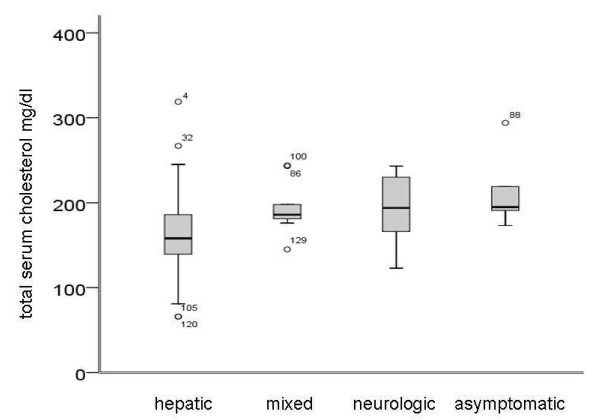
Introduction: Wilson disease (WD) is an inherited disorder of human copper metabolism, characterised by accumulation of copper predominantly in the liver and brain, leading to severe hepatic and neurological disease. Interesting findings in animal models of WD (Atp7b-/- and LEC rats) showed altered lipid metabolism with a decrease in the amount of triglycerides and cholesterol in the serum. However, serum lipid profile has not been investigated in large human WD patient cohorts to date. Patients and Methods: This cohort study involved 251 patients examined at the Heidelberg and Dresden (Germany) University Hospitals. Patients were analysed on routine follow-up examinations for serum lipid profile, including triglycerides, cholesterol, high density lipoprotein (HDL) and low density lipoprotein (LDL). Data on these parameters at time of diagnosis were retrieved by chart review where available. For statistical testing, patients were subgrouped by sex, manifestation (hepatic, neurological, mixed and asymptomatic) and treatment (D-penicillamine, trientine, zinc or combination). Results: A significant difference in total serum cholesterol was found in patients with hepatic symptoms, which diminished under therapy. No alterations were observed for HDL, LDL and triglycerides. Conclusion: Contradictory to previous reports using WD animal models (Atp7b-/- and LEC rats), the most obvious alteration in our cohort was a lower serum cholesterol level in hepatic-affected patients, which might be related to liver injury. Our data suggested unimpaired cholesterol metabolism in Wilson disease under therapy, independent of the applied medical treatment.
Overview
The claims and statistics of this paper haven’t been checked yet.
Run the check — free, no account needed. It reads the open-access text and checks the sources it cites.
Integrity signals
Registry
Cites
Statistics
Figures
Verification
Claims the paper makes
The claims and statistics of this paper haven’t been checked yet.
Run the check — free, no account needed. It reads the open-access text and checks the sources it cites.
Claims other papers make about this one
Each is checked against this paper’s own text: does it say what the citing paper says it does?
The source backs part of the claim, not all of it — or backs it for a different population, condition or comparison.
In the citing paper
“Altogether, these data suggest that aberrant copper homeostasis and elevated plasma cholesterol are not causally linked in dogs or humans”
From CCC- and WASH-mediated endosomal sorting of LDLR is required for normal clearance of circulating LDL (2016) · cites this paper as [24]
Experimental — accuracy not yet measured
Self-check
Percentages, sums and reported differences re-computed from the paper’s own numbers.
The self-check needs the paper’s full text.
Citations
Cites
Ala, A., Walker, A. P., Ashkan, K., Dooley, J. S., & Schilsky, M. L. (2007) · The Lancet · doi:10.1016/s0140-6736(07)60196-2 · Cited by 1,446
Diagnosis and phenotypic classification of Wilson disease1
Ferenci, P., Caca, K., Loudianos, G., Mieli‐Vergani, G., Tanner, S., Sternlieb, I., Schilsky, M., Cox, D., & Berr, F. (2003) · Liver International · doi:10.1034/j.1600-0676.2003.00824.x · Cited by 927
The Wilson disease gene: spectrum of mutations and their consequences
Thomas, G. R., Forbes, J. R., Roberts, E. A., Walshe, J. M., & Cox, D. W. (1995) · Nature Genetics · doi:10.1038/ng0295-210 · Cited by 568
Excessive Intake of Zinc Impairs Immune Responses
Chandra, R. K. (1984) · JAMA: The Journal of the American Medical Association · doi:10.1001/jama.1984.03350110043027 · Cited by 478
Dooley, J. S., & Ala, A. (2010) · Evidence‐Based Gastroenterology and Hepatology · doi:10.1002/9781444314403.ch31 · Cited by 386
Wilson Disease: Clinical Presentation, Treatment, and Survival
Stremmel, W., Meyerrose, K.-W., Niederau, C., Hefter, H., Kreuzpaintner, G., & Strohmeyer, G. (1991) · Annals of Internal Medicine · doi:10.7326/0003-4819-115-9-720 · Cited by 303
Self-citationFerenci, P., Członkowska, A., Merle, U., Ferenc, S., Gromadzka, G., Yurdaydin, C., Vogel, W., Bruha, R., Schmidt, H. T., & Stremmel, W. (2007) · Gastroenterology · doi:10.1053/j.gastro.2007.02.057 · Cited by 271
Self-citationFerenci, P. (2006) · Human Genetics · doi:10.1007/s00439-006-0202-5 · Cited by 271
Hüster, D., Purnat, T. D., Burkhead, J. L., Ralle, M., Fiehn, O., Stuckert, F., Olson, N. E., Teupser, D., & Lutsenko, S. (2007) · Journal of Biological Chemistry · doi:10.1074/jbc.m607496200 · Cited by 240
Zinc Lowers High-Density Lipoprotein-Cholesterol Levels
Hooper, P. L., Visconti, L., Garry, P. J., & Johnson, G. C. (1980) · JAMA · doi:10.1001/jama.1980.03310170058030 · Cited by 238
Cited by
CCC- and WASH-mediated endosomal sorting of LDLR is required for normal clearance of circulating LDL
Bartuzi, P., Billadeau, D. D., Favier, R., Rong, S., Dekker, D., Fedoseienko, A., Fieten, H., Wijers, M., Levels, J. H., Huijkman, N., et al. (2016) · Nature Communications · doi:10.1038/ncomms10961 · Cited by 205
Metadata
- Authors
- Seessle, J., Gohdes, A., Gotthardt, D. N., Pfeiffenberger, J., Eckert, N., Stremmel, W., Reuner, U., & Weiss, K. H.
- Venue
- Lipids in Health and Disease
- Published
- 2011-05-19
- Volume
- 10
- Issue
- 1
- ISSN
- 1476-511X
- PMC
- PMC3127787
- Cited by
- 42
- References
- 22
- Language
- en
About these checks
Registry, retraction, Cites and statistics results are computed, not judged, with one exception: a printed reference that no index lists is read once by a model before it counts as a citation error. Claims are extracted by a model and kept only when their quote appears verbatim in the text; each cited source is then checked, with a model’s help, for whether it says what the claim relies on. Those verdicts can be wrong — read the claim’s quote and the cited source before relying on one.
Statistics and arithmetic are recomputed, not judged.
Confidence bands are shown only for fields calibrated on our annotated test set. None is calibrated yet, so no band is shown.
What counts as a claim ›How we measure confidence ›How we check this ›
Are you an author, or do you see a problem with this page? Request a review
Data sources
Bibliographic data: Semantic Scholar, OpenAlex, Crossref.
Contains information from the Semantic Scholar Academic Graph Datasets, made available under the ODC Attribution License (ODC-BY 1.0).
Semantic Scholar’s data is described in: Kinney, R., et al. (2023). The Semantic Scholar Open Data Platform. arXiv:2301.10140.
