

The DOI matches its Crossref record; 74 of the 74 references it cites were found in a registry or an index.
A socio-ecological approach to physical activity interventions in childcare: a systematic review
Open accessAbstract
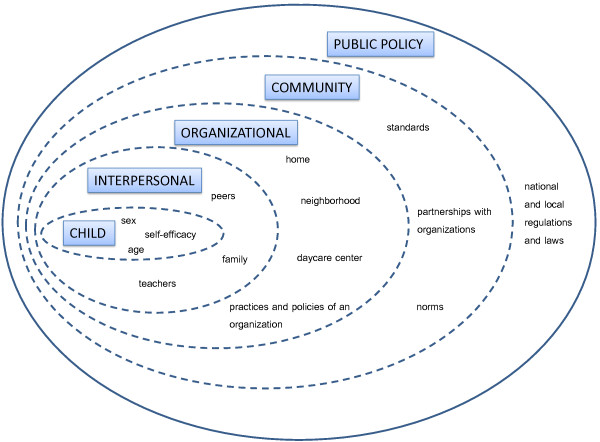
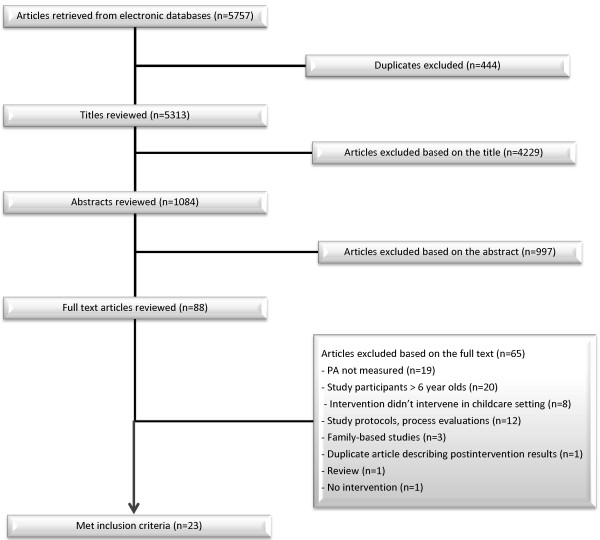
The promotion of physical activity (PA) in young children requires effective interventions. This article reviews the evidence on PA interventions in childcare by applying a socio-ecological approach. A computer-based literature search for intervention studies aimed at increasing children's PA levels was run across four databases: SPORTDiscus, ISI Web of Science, PsycINFO and ERIC. The participants had to be in childcare, aged 2-6-year-old, and their pre- and post- intervention PA levels measured. Selection was restricted to peer-reviewed publications and to studies conducted in childcare settings. Twenty-three studies met the inclusion criteria and their methodological quality was assessed. Seven studies exhibited high methodological quality; twelve were rated as moderate and four low. The effectiveness of the interventions was determined according to the post-intervention behavioral changes reported in children's PA. Fourteen studies found increases in PA levels or reductions in sedentary time, although the changes were modest. The data remain too limited to allow firm conclusions to be drawn on the effectiveness of the components mediating PA interventions, although PA-specific in-service teacher training seems a potential strategy. The findings of this review indicate that children's PA remained low and did not approach the 180 min/day criteria. It may be that more intensive multilevel and multicomponent interventions based on a comprehensive model are needed.
Overview
The claims and statistics of this paper haven’t been checked yet.
Run the check — free, no account needed. It reads the open-access text and checks the sources it cites.
Integrity signals
Registry
Cites
Statistics
Figures
Verification
Claims the paper makes
The claims and statistics of this paper haven’t been checked yet.
Run the check — free, no account needed. It reads the open-access text and checks the sources it cites.
Claims other papers make about this one
Each is checked against this paper’s own text: does it say what the citing paper says it does?
In the citing paper
“Both experience and personal characteristics played an important role in the promotion of PA among children in the childcare setting (61).”
From How can physical activity be promoted among children and adolescents? A systematic review of reviews across settings (2019) · cites this paper as [61]
In the citing paper
“while one review stated that evidence on parental support “remains unclear” (61).”
From How can physical activity be promoted among children and adolescents? A systematic review of reviews across settings (2019) · cites this paper as [61]
In the citing paper
“Nevertheless, Mehtälä et al. (61) also stated that family is the most influential setting for young children, and that a partnership between families and childcare is crucial.”
From How can physical activity be promoted among children and adolescents? A systematic review of reviews across settings (2019) · cites this paper as [61]
In the citing paper
“Research focuses primarily on individual level interventions even though community and policy level interventions are considered to be more effective in terms of public health (61).”
From How can physical activity be promoted among children and adolescents? A systematic review of reviews across settings (2019) · cites this paper as [61]
Self-check
Percentages, sums and reported differences re-computed from the paper’s own numbers.
The self-check needs the paper’s full text.
Citations
Cites
The Ecology of Human Development: Experiments by Nature and Design
Bronfenbrenner, U. (1979) · Harvard University Press eBooks · doi:10.4159/9780674028845 · Cited by 26,084
Health Behavior and Health Education: Theory, Research, and Practice
(1992) · Annals of Internal Medicine · doi:10.7326/0003-4819-116-4-350_1 · Cited by 13,232
The ecology of human development : experiments by nature and design
Bronfenbrenner, U. (1979) · Cited by 12,580
‘Small Changes' to Diet and Physical Activity Behaviors for Weight Management
Hills, A. P., Byrne, N. M., Lindstrom, R. C., & Hill, J. O. (2013) · Obesity Facts · doi:10.1159/000345030 · Cited by 9,526
(1985) · Europe PMC (PubMed Central) · Cited by 9,143
An ecological perspective on health promotion programs
McLeroy, K. R., Bibeau, D., Steckler, A., & Glanz, K. (1988) · Health Education Quarterly · doi:10.1177/109019818801500401 · Cited by 8,502
A review of correlates of physical activity of children and adolescents
SALLIS, J. F., PROCHASKA, J. J., & TAYLOR, W. C. (2000) · Medicine & Science in Sports & Exercise · doi:10.1097/00005768-200005000-00014 · Cited by 4,421
Health behavior and health education
(1990) · Choice Reviews Online · doi:10.5860/choice.28-2173 · Cited by 2,919
Translating Social Ecological Theory into Guidelines for Community Health Promotion
Stokols, D. (1996) · American Journal of Health Promotion · doi:10.4278/0890-1171-10.4.282 · Cited by 2,763
Physical activity from childhood to adulthood
Telama, R., Yang, X., Viikari, J., Välimäki, I., Wanne, O., & Raitakari, O. (2005) · American Journal of Preventive Medicine · doi:10.1016/j.amepre.2004.12.003 · Cited by 1,585
Cited by
Sorted by citations
Items 201–202 of 202
Touching Grass in the Age of AI: Hyperreality and What is at Stake for Leisure?
Tewari, K., & Du, X. (2026) · Leisure Sciences · doi:10.1080/01490400.2026.2721399
Yang, P., Wang, Y., Jiang, X., Ding, Z., Zhang, L., Bao, X., 阚迪, Shen, H., Hu, J., & Yin, J. (2026) · JMIR Research Protocols · doi:10.2196/94697
Metadata
- Authors
- Mehtälä, M. A., Sääkslahti, A., Inkinen, M., & Poskiparta, M. E.
- Affiliations
- University of Jyväskylä (FI)
- ORCID
- Sääkslahti, Arja
- Venue
- International Journal of Behavioral Nutrition and Physical Activity
- Published
- 2014
- Volume
- 11
- Issue
- 1
- Pages
- 22
- ISSN
- 1479-5868 (ISSN-L)
- PMC
- PMC3936868
- OpenAlex
- W2150485155
- Cited by
- 199
- References
- 72
- Citations by year
- 2026: 8 · 2025: 11 · 2024: 26 · 2023: 22 · 2022: 18 · 2021: 23 · 2020: 13 · 2019: 21 · 2018: 15 · 2017: 15 · 2016: 12 · 2015: 12 · 2014: 3
- FWCI
- 1.64
- Type
- journal article
- Language
- en
- Open access
- gold
- doi.org
- Licence
- cc-by
- Locations
- International Journal of Behavioral Nutrition and Physical Activity (publishedVersion, cc-by)
- Europe PMC (PubMed Central) (publishedVersion, cc-by)
- PubMed Central (publishedVersion, cc-by)
- PubMed (publishedVersion)
- Jyväskylä University Digital Archive (University of Jyväskylä) (submittedVersion, cc-by)
- Topics
- Health Sciences › Medicine › Public Health, Environmental and Occupational Health › Physical Activity and Health
- Social Sciences › Psychology › Developmental and Educational Psychology › Children's Physical and Motor Development
- Health Sciences › Medicine › Public Health, Environmental and Occupational Health › Obesity, Physical Activity, Diet
- Keywords
- physical activity interventions, child care, young children, socio-ecological model, sedentary behavior, teacher professional development, multilevel interventions, multicomponent intervention, intervention effectiveness, physical activity promotion
- MeSH terms
- Child, Child Behavior, Child, Preschool, Health Promotion, Humans, Motor Activity, Socioeconomic Factors, Health Behavior, Guidelines as Topic, Internet
About these checks
Registry, retraction, Cites and statistics results are computed, not judged, with one exception: a printed reference that no index lists is read once by a model before it counts as a citation error. Claims are extracted by a model and kept only when their quote appears verbatim in the text; each cited source is then checked, with a model’s help, for whether it says what the claim relies on. Those verdicts can be wrong — read the claim’s quote and the cited source before relying on one.
Statistics and arithmetic are recomputed, not judged.
Confidence bands are shown only for fields calibrated on our annotated test set. None is calibrated yet, so no band is shown.
What counts as a claim ›How we measure confidence ›How we check this ›
Are you an author, or do you see a problem with this page? Request a review
