

The DOI matches its Crossref record; 22 of the 22 references it cites were found in a registry or an index.
Fc gamma receptor IIIa polymorphisms in advanced colorectal cancer patients correlated with response to anti-EGFR antibodies and clinical outcome
Open accessAbstract
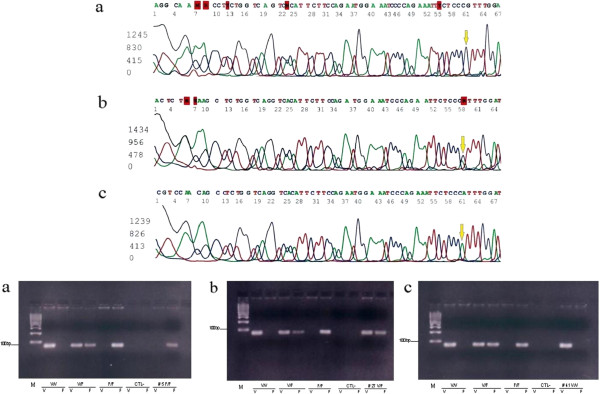
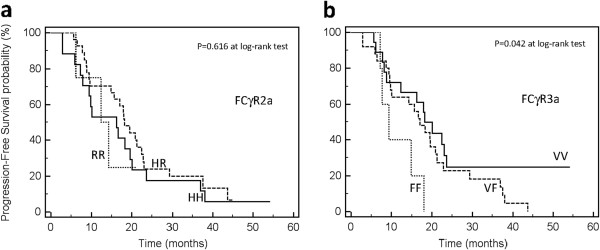
Background: Anti-EGFR monoclonal antibodies have shown efficacy in the treatment of metastatic colorectal cancer (mCRC). One of the mechanism is the antibody-dependent cell-mediated cytotoxicity (ADCC) in which Fc region of the antibody binds to the Fc gamma receptors (FcγR) expressed by immune cells. The present study investigated the association between single nucleotide polymorphisms of FcγRIIa and FcγRIIIa and clinical outcome in mCRC treated with anti-EGFR antibodies. Methods: Seventy-four consecutive patients with mCRC were analyzed. The genotypes for FcγRIIa-131 histidine (H)/arginine (R), FcγRIIIa-158 valine (V)/phenylanaline (F) polymorphisms were evaluated by directly sequencing. Multiplex allele-specific polymerase chain reaction was performed for FcγRIIIa-158 valine (V)/phenylanaline (F). Correlations between FcγR polymorphisms, baseline patient and tumor features were studied by contingency tables and the chi-square test. The Kaplan-Meier product limit method was applied to the progression-free survival (PFS) curves. Univariate analysis was performed with the log-rank test. Cox proportional-hazards regression was used to analyze the effect of multiple risk factors on PFS. Results: FcγRIIIa polymorphisms were significantly associated with response to anti-EGFR-based therapy in 49 patients with kras wt tumors (p=0.035). There was not association with response for FcγRIIa polymorphisms. Furthermore, obtained results suggested that prognosis is particularly unfavorable for patients carrying the FcγRIIIa-158F/F genotype (median PFS V/V, V/F, F/F: 18.2 vs 17.3 vs 9.4 months). No prognostic ability was identified for FcγRIIa polymorphisms. Conclusions: In mCRC patients the presence of FcγRIIIa-F can predict resistance to anti-EGFR therapy and unfavorable prognosis.
Overview
The claims and statistics of this paper haven’t been checked yet.
Run the check — free, no account needed. It reads the open-access text and checks the sources it cites.
Integrity signals
Registry
Cites
Statistics
Figures
Verification
Claims the paper makes
The claims and statistics of this paper haven’t been checked yet.
Run the check — free, no account needed. It reads the open-access text and checks the sources it cites.
Claims other papers make about this one
Each is checked against this paper’s own text: does it say what the citing paper says it does?
In the citing paper
“Cetuximab-treated patients with FcγRIIa-131R and/or FcγIIIa-158F genotypes had shorter PFS than 131H/H and/or 158 V/V carriers [143].”
From Resistance to anti-EGFR therapies in metastatic colorectal cancer: underlying mechanisms and reversal strategies (2021) · cites this paper as [143]
Self-check
Percentages, sums and reported differences re-computed from the paper’s own numbers.
The self-check needs the paper’s full text.
Citations
Cites
Siegel, R. L., Ward, E., Brawley, O. W., & Jemal, A. (2011) · CA A Cancer Journal for Clinicians · doi:10.3322/caac.20121 · Cited by 4,075
Cartron, G., Dacheux, L., Salles, G. A., Solal‐Céligny, P., BARDOS, P., Colombat, P., & Watier, H. (2002) · Blood · doi:10.1182/blood.v99.3.754 · Cited by 1,954
Weng, W., & Levy, R. (2003) · Journal of Clinical Oncology · doi:10.1200/jco.2003.05.013 · Cited by 1,324
Musolino, A., Naldi, N., Bortesi, B., Pezzuolo, D., Capelletti, M., Missale, G., Laccabue, D., Zerbini, A., Camisa, R., Bisagni, G., et al. (2008) · Journal of Clinical Oncology · doi:10.1200/jco.2007.14.8957 · Cited by 981
Molecular Mechanisms of Resistance to Cetuximab and Panitumumab in Colorectal Cancer
Bardelli, A., & Siena, S. (2010) · Journal of Clinical Oncology · doi:10.1200/jco.2009.24.6116 · Cited by 746
Bibeau, F., Lopez-Crapez, E., Di Fiore, F., Thezenas, S., Ychou, M., Blanchard, F., Lamy, A., Penault-Llorca, F., Frébourg, T., Michel, P., et al. (2009) · Journal of Clinical Oncology · doi:10.1200/jco.2008.18.0463 · Cited by 521
Zhang, W., Gordon, M. A., Schultheis, A. M., Yang, D., Nagashima, F., Azuma, M., Chang, H.-M., Borucka, E., Lurje, G., Sherrod, A. E., et al. (2007) · Journal of Clinical Oncology · doi:10.1200/jco.2006.08.8021 · Cited by 487
Monoclonal antibodies in the treatment of metastatic colorectal cancer: A review
Tol, J., & Punt, C. J. A. (2010) · Clinical Therapeutics · doi:10.1016/j.clinthera.2010.03.012 · Cited by 178
Cutsem, E. V., Tejpar, S., Vanbeckevoort, D., Peeters, M., Humblet, Y., Gelderblom, H. A. J., Vermorken, J. B., Viret, F., Glimelius, B. L. G., Gallerani, E., et al. (2012) · Journal of Clinical Oncology · doi:10.1200/jco.2011.40.9243 · Cited by 133
Carlotti, E., Palumbo, G. A., Oldani, E., Tibullo, D., Salmoiraghi, S., Rossi, A., Golay, J., Pulsoni, A., Foà, R., & Rambaldi, A. (2007) · Haematologica · doi:10.3324/haematol.11288 · Cited by 96
Cited by
Sorted by citations
Pereira, N. A., Chan, K. F., Lin, P. C., & Song, Z. (2018) · mAbs · doi:10.1080/19420862.2018.1466767 · Cited by 345
Zhou, J., Ji, Q., & Li, Q. (2021) · Journal of Experimental & Clinical Cancer Research · doi:10.1186/s13046-021-02130-2 · Cited by 246
Ferris, R. L., Lenz, H., Trotta, A. M., García‐Foncillas, J., Schulten, J., Audhuy, F., Merlano, M. C., & Milano, G. A. (2017) · Cancer Treatment Reviews · doi:10.1016/j.ctrv.2017.11.008 · Cited by 193
Self-citationNagelkerke, S. Q., Schmidt, D. E., de Haas, M., & Kuijpers, T. W. (2019) · Frontiers in Immunology · doi:10.3389/fimmu.2019.02237 · Cited by 94
Current challenges of metastatic breast cancer
Lim, B., & Hortobágyi, G. N. (2016) · Cancer and Metastasis Reviews · doi:10.1007/s10555-016-9636-y · Cited by 87
Metadata
- Authors
- Calemma, R., Ottaiano, A., Trotta, A. M., Nasti, G., Romano, C., Napolitano, M., Galati, D., Borrelli, P., Zanotta, S., Cassata, A., Castello, G., Iaffaioli, V. R., & Scala, S.
- Affiliations
- Istituto Nazionale Tumori IRCCS "Fondazione G. Pascale" (IT)
- Corresponding author
- Scala, Stefania
- ORCID
- Venue
- Journal of Translational Medicine
- Published
- 2012-11-21
- Volume
- 10
- Issue
- 1
- Pages
- 232-232
- ISSN
- 1479-5876 (ISSN-L)
- PMC
- PMC3551834
- OpenAlex
- W2121910124
- Cited by
- 47
- References
- 22
- Citations by year
- 2026: 3 · 2025: 3 · 2024: 3 · 2023: 2 · 2022: 4 · 2021: 4 · 2020: 2 · 2019: 6 · 2018: 2 · 2017: 3 · 2016: 9 · 2015: 1 · 2014: 3 · 2013: 2
- FWCI
- 0.95
- Type
- journal article
- Language
- en
- Open access
- gold
- doi.org
- Licence
- cc-by
- Locations
- Journal of Translational Medicine (publishedVersion, cc-by)
- PubMed Central (publishedVersion, cc-by)
- PubMed (publishedVersion)
- DOAJ (DOAJ: Directory of Open Access Journals) (submittedVersion, cc-by-sa)
- Topics
- Health Sciences › Medicine › Oncology › Colorectal Cancer Treatments and Studies
- Life Sciences › Immunology and Microbiology › Immunology › Monoclonal and Polyclonal Antibodies Research
- Health Sciences › Medicine › Pulmonary and Respiratory Medicine › Lung Cancer Treatments and Mutations
- Keywords
- FcγRIIIa, FCGR2A, single nucleotide polymorphisms, metastatic colorectal cancer, anti-EGFR monoclonal antibody, antibody-dependent cellular cytotoxicity, treatment response, progression-free survival, prognostic factors, KRAS wild-type tumors
- MeSH terms
- Adult, Aged, Aged, 80 and over, Alleles, Antibodies, Monoclonal, Base Sequence, DNA Mutational Analysis, Female, Humans, Male, Middle Aged, Molecular Sequence Data, Neoplasm Metastasis, Neoplasm Staging, Proto-Oncogene Proteins, Colorectal Neoplasms, Multivariate Analysis, Proto-Oncogene Proteins p21(ras), Treatment Outcome, Receptors, IgG, Disease-Free Survival, ras Proteins, Polymorphism, Single Nucleotide, ErbB Receptors
About these checks
Registry, retraction, Cites and statistics results are computed, not judged, with one exception: a printed reference that no index lists is read once by a model before it counts as a citation error. Claims are extracted by a model and kept only when their quote appears verbatim in the text; each cited source is then checked, with a model’s help, for whether it says what the claim relies on. Those verdicts can be wrong — read the claim’s quote and the cited source before relying on one.
Statistics and arithmetic are recomputed, not judged.
Confidence bands are shown only for fields calibrated on our annotated test set. None is calibrated yet, so no band is shown.
What counts as a claim ›How we measure confidence ›How we check this ›
Are you an author, or do you see a problem with this page? Request a review
