

The DOI matches its Crossref record; 1 of the 1 references it cites were found in a registry or an index.
Antibiotic treatment leads to the elimination of Wolbachia endosymbionts and sterility in the diplodiploid collembolan Folsomia candida
Open accessAbstract
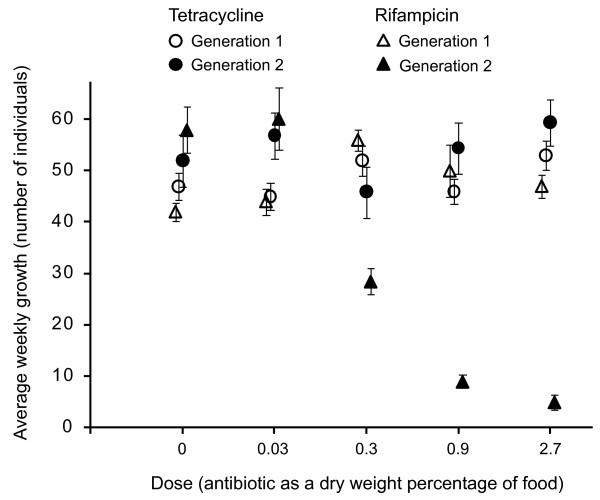
BACKGROUND: Wolbachia is an extremely widespread bacterial endosymbiont of arthropods and nematodes that causes a variety of reproductive peculiarities. Parthenogenesis is one such peculiarity but it has been hypothesised that this phenomenon may be functionally restricted to organisms that employ haplodiploid sex determination. Using two antibiotics, tetracycline and rifampicin, we attempted to eliminate Wolbachia from the diplodiploid host Folsomia candida, a species of springtail which is a widely used study organism. RESULTS: Molecular assays confirmed that elimination of Wolbachia was successfully achieved through continuous exposure of populations (over two generations and several weeks) to rifampicin administered as 2.7% dry weight of their yeast food source. The consequence of this elimination was total sterility of all individuals, despite the continuation of normal egg production. CONCLUSION: Microbial endosymbionts play an obligatory role in the reproduction of their diplodiploid host, most likely one in which the parthenogenetic process is facilitated by Wolbachia. A hitherto unknown level of host-parasite interdependence is thus recorded.
Overview
The claims and statistics of this paper haven’t been checked yet.
Run the check — free, no account needed. It reads the open-access text and checks the sources it cites.
Integrity signals
Registry
Cites
Statistics
Figures
Verification
Claims the paper makes
The claims and statistics of this paper haven’t been checked yet.
Run the check — free, no account needed. It reads the open-access text and checks the sources it cites.
Self-check
Percentages, sums and reported differences re-computed from the paper’s own numbers.
The self-check needs the paper’s full text.
Citations
Cites
Structural Mechanism for Rifampicin Inhibition of Bacterial RNA Polymerase
Campbell, E. A., Korzheva, N., Mustaev, A., Murakami, K., Nair, S., Goldfarb, A., & Darst, S. A. (2001) · Cell · doi:10.1016/s0092-8674(01)00286-0 · Cited by 1,556 · cited 1×
“The mode of action of rifampicin is to disrupt an even earlier step in the process of protein synthesis: rifampin binds to prokaryotic DNA-dependent RNA polymerase, inhibiting transcription of DNA to messenger RNA and thereby precluding subsequent translation of RNA to proteins [25].”
Research works printed but not linked: 25
- Stouthamer R, Breeuwer JA, Hurst GD: Wolbachia pipientis: microbial manipulator of arthropod reproduction. Annu Rev Microbiol. 1999, 53: 71-102. 10.1146/annurev.micro.53.1.71. · DOI
- Werren JH, Zhang W, Guo RL: Evolution and phylogeny of Wolbachia: reproductive parasites of arthropods. Proc R Soc B Biol Sci. 1995, 261: 55-71. 10.1098/rspb.1995.0117. · DOI
- Werren JH: Biology of Wolbachia. Annu Rev Entomol. 1997, 42: 587-609. 10.1146/annurev.ento.42.1.587. · DOI
- Rousset F, Bouchon D, Pintureau B, Juchault P, Solignac M: Wolbachia endosymbionts responsible for various alterations of sexuality in arthropods. Proc R Soc B Biol Sci. 1992, 250: 91-98. 10.1098/rspb.1992.0135. · DOI
- Stevens L, Giordano R, Fialho RF: Male-killing, nematode infections, bacteriophage infection, and virulence of cytoplasmic bacteria in the genus Wolbachia. Annu Rev Ecol Syst. 2001, 32: 519-545. 10.1146/annurev.ecolsys.32.081501.114132. · DOI
- Stouthamer R, Breeuwer JAJ, Luck RF, Werren JH: Molecular identification of microorganisms associated with parthenogenesis. Nature. 1993, 361: 66-68. 10.1038/361066a0. · DOI
- International Standards Organization: Soil quality-inhibition of reproduction of Collembola (Folsomia candida) by soil pollutants. Report No ISO 11267:199(E). Geneva. 1999, 10.1146/annurev.ento.50.071803.130331. · DOI
- Fountain MT, Hopkin ST: Folsomia candida (Collembola): a "standard" soil arthropod. Ann Rev Entomol. 2005, 50: 201-222. 10.1038/188958a0. · DOI
- Goto HE: Facultative parthenogenesis in Collembola (Insecta). Nature. 1960, 188: 958-959. 10.1016/j.pedobi.2004.04.004. · DOI
- Frati F, Negri I, Fanciulli PP, Pellecchia M, De Paola V, Scali V, Dallai R: High levels of genetic differentiation between Wolbachia-infected and non-infected populations of Folsomia candida (Collembola, Isotomidae). Pedobiologia. 2004, 48: 461-468. 10.1016/j.pedobi.2004.04.004. · DOI
- Hopkin ST: Biology of the Springtails. Insecta: Collembola. 1997, Oxford: Oxford University Press
- Kiauta B: Review of the germ cell chromosome cytology of Collembola, with a list of chromosome numbers and data on two species new to cytology. Genen en Phaenen. 1970, 13: 89-99.
- Vandekerckhove TTM, Watteyne S, Willems A, Swings JG, Mertens J, Gillis M: Phylogenetic analysis of the 16SrRNA of the cytoplasmic bacterium Wolbachia from the novel host Folsomia candida (Hexapoda, Collembola) and its implications for wolbachial taxonomy. FEMS Microbiol Lett. 1999, 180: 279-286. · DOI
- Lo N, Casiraghi M, Salati E, Bazzocchi C, Bandi C: How many Wolbachia supergroups exist?. Mol Biol Evol. 2002, 19: 341-346. 10.1098/rspb.2001.1797. · DOI
- Stouthamer R: Wolbachia-induced parthenogenesis. Influential Passengers: Inherited Microorganisms and Invertebrate Reproduction. Edited by: O'Neill SL, Hoffmann AA, Werren JH. 1997, Oxford: Oxford University Press, 102-124. · DOI
- Weeks AR, Breeuwer JAJ: Wolbachia-induced parthenogenesis in a genus of phytophagous mites. Proc R Soc B Biol Sci. 2001, 268: 2245-2251. 10.1007/s00441-006-0253-x. · DOI
- Riparbelli MG, Giordano R, Callaini G: Centrosome inheritance in the parthenogenetic egg of the collembolan Folsomia candida. Cell Tissue Res. 2006, 326: 861-872. 10.1007/s00040-004-0746-0. · DOI
- Matsuura K, Fujimoto M, Goka K: Sexual and asexual colony foundation and the mechanism of facultative parthenogenesis in the termite Reticulitermes speratus (Isoptera, Rhinotermitidae). Insectes Soc. 2004, 51: 325-332. 10.1002/(SICI)1097-010X(19991015)285:3<215::AID-JEZ4>3.0.CO;2-5. · DOI
- Dallai R, Fanciulli PP, Frati F: Chromosome elimination and sex determination in springtails (Insecta, Collembola). J Exp Zool. 1999, 285: 215-225. 10.1073/pnas.101304298. · DOI
- Dedeine F, Vavre F, Fleury F, Loppin B, Hochberg ME, Boulétreau M: Removing symbiotic Wolbachia bacteria specifically inhibits oogenesis in a parasitic wasp. Proc Natl Acad Sci USA. 2001, 98: 6247-6252. 10.1073/pnas.0607845104. · DOI
- Pannebakker BA, Loppin B, Elemans CPH, Humblot L, Vavre F: Parasitic inhibition of cell death facilitates symbiosis. Proc Natl Acad Sci USA. 2007, 104: 212-215. 10.1111/j.1365-294X.2004.02203.x. · DOI
- Zchori-Fein E, Perlman SJ: Distribution of the bacterial symbiont Cardinium in arthropods. Mol Ecol. 2004, 13: 2009-2016. 10.1128/MMBR.65.2.232-260.2001. · DOI
- Molavi A: Antimicrobials III: sulfonamides, trimethoprim and anti-mycobacterial agents. Basic Pharmacology in Medicine. Edited by: Di Palma J, Di Gregorio J. 1990, New York: McGraw-Hill, 3
- Campbell EA, Korzheva N, Mustaev A, Murakami K, Nair S, Goldfarb A, Darst SA: Structural mechanism for rifampicin inhibition of bacterial RNA polymerase. Cell. 2001, 104: 901-912. 10.2307/3224315. · DOI · Paper page
- Chang SL: Some physiological observations on two aquatic Collembola. Trans Am Microsc Soc. 1966, 85: 359-371. 10.2307/3224315. · DOI
Metadata
- Authors
- Pike, N., & Kingcombe, R.
- Affiliations
- University of Oxford (GB)
- Corresponding author
- Pike, Nathan
- Venue
- BMC Biology
- Published
- 2009-08-24
- Volume
- 7
- Issue
- 1
- Pages
- 54-54
- ISSN
- 1741-7007 (ISSN-L)
- PMC
- PMC2739161
- OpenAlex
- W2087567813
- Cited by
- 74
- References
- 1
- Citations by year
- 2026: 3 · 2024: 4 · 2023: 5 · 2022: 7 · 2021: 5 · 2020: 8 · 2019: 9 · 2018: 5 · 2017: 5 · 2016: 4 · 2015: 5 · 2014: 5 · 2013: 4 · 2012: 1
- FWCI
- 1.84
- Type
- journal article
- Language
- en
- Open access
- gold
- doi.org
- Licence
- Locations
- BMC Biology (publishedVersion, cc-by)
- Europe PMC (PubMed Central) (publishedVersion, cc-by)
- PubMed Central (publishedVersion, cc-by)
- PubMed (publishedVersion)
- DOAJ (DOAJ: Directory of Open Access Journals) (submittedVersion)
- Funders
- University of Rochester
- Università degli Studi di Siena
- University of Oxford
- Topics
- Life Sciences › Agricultural and Biological Sciences › Insect Science › Insect symbiosis and bacterial influences
- Life Sciences › Agricultural and Biological Sciences › Insect Science › Insect and Arachnid Ecology and Behavior
- Life Sciences › Agricultural and Biological Sciences › Ecology, Evolution, Behavior and Systematics › Animal Behavior and Reproduction
- Keywords
- Wolbachia, endosymbionts, Folsomia candida, Collembola, parthenogenesis, reproductive sterility, antibiotic removal, tetracycline, rifampicin, haplodiploidy
- MeSH terms
- Animals, Anti-Bacterial Agents, Arthropods, Denmark, Diet, Diploidy, Female, France, United Kingdom, Male, Ovum, Parthenogenesis, Reproduction, Rifampin, Symbiosis, Tetracycline, Polymerase Chain Reaction, Cloning, Organism, Wolbachia, Clutch Size
About these checks
Registry, retraction, Cites and statistics results are computed, not judged, with one exception: a printed reference that no index lists is read once by a model before it counts as a citation error. Claims are extracted by a model and kept only when their quote appears verbatim in the text; each cited source is then checked, with a model’s help, for whether it says what the claim relies on. Those verdicts can be wrong — read the claim’s quote and the cited source before relying on one.
Statistics and arithmetic are recomputed, not judged.
Confidence bands are shown only for fields calibrated on our annotated test set. None is calibrated yet, so no band is shown.
What counts as a claim ›How we measure confidence ›How we check this ›
Are you an author, or do you see a problem with this page? Request a review
How to cite
Cite CoChat for the checks on this page, and the paper for its own findings.
- This page
- CoChat. (2026). Citation check: Antibiotic treatment leads to the elimination of Wolbachia endosymbionts and sterility in the diplodiploid collembolan Folsomia candida. https://app.cochat.ai/papers/10.1186/1741-7007-7-54
- The paper
- Pike, N., & Kingcombe, R. (2009). Antibiotic treatment leads to the elimination of Wolbachia endosymbionts and sterility in the diplodiploid collembolan Folsomia candida. BMC Biology. https://doi.org/10.1186/1741-7007-7-54
