

Can user testing of a clinical trial patient information sheet make it fit-for-purpose? - a randomized controlled trial
Open accessThe DOI matches its Crossref record; 21 of the 21 references it cites were found in a registry or an index; none of the 39 sources its claims cite is checked for support yet.
Abstract
BACKGROUND: The participant information sheet (PIS) provided to potential trial participants is a critical part of the process of valid consent. However, there is long-standing concern that these lengthy and complex documents are not fit-for-purpose. This has been supported recently through the application of a performance-based approach to testing and improving readability called user testing. This method is now widely used to improve patient medicine leaflets--determining whether people can find and understand key facts. This study applied for the first time a controlled design to determine whether a PIS developed through user testing had improved readability over the original, using a sheet from a UK trial in acute myeloid leukemia (AML16). METHODS: In the first phase the performance of the original PIS was tested on people in the target group for the trial. There were three rounds of testing including 50 people in total--with the information revised according to its performance after each of the first 2 rounds. In the second phase, the revised PIS was compared with the original in a parallel groups randomised controlled trial (RCT) A total of 123 participants were recruited and randomly allocated to read one version of the PIS to find and show understanding of 21 key facts. RESULTS: The first, developmental phase produced a revised PIS significantly altered in its wording and layout. In the second, trial phase 66% of participants who read the revised PIS were able to show understanding of all aspects of the trial, compared with 15% of those reading the original version (Odds Ratio 11.2; Chi-square = 31.5 p < .001). When asked to state a preference, 87.1% participants chose the revised PIS (Sign test p < .001). CONCLUSIONS: The original PIS for the AML16 trial may not have enabled valid consent. Combining performance-based user testing with expertise in writing for patients and information design led to a significantly improved and preferred information sheet. User testing is an efficient method for indicating strengths and weaknesses in trial information, and Research Ethics Committees and Institutional Review Boards should consider requesting such testing, to ensure that PIS are fit-for-purpose.
Overview
CoChat Summary
TL;DR
User testing plus writing and information-design revision produced a revised AML16 participant information sheet (PIS) that significantly improved readers’ ability to find and understand key trial facts compared with the original. In the randomized trial phase, 65.6% of participants reading the revised PIS achieved a clear round versus 14.5% reading the original, and 87.1% preferred the revised version.
Key findings
- In the trial phase, 40/61 (65.6%) participants reading the revised PIS found and understood all 21 key facts, compared with 8/55 (14.5%) reading the original PIS (chi-square = 31.5; p < .001; odds ratio = 11.2).
- Participants reading the original PIS failed to find more items on average (1.9 items, SE 0.2) than those reading the revised PIS (0.4 items, SE 0.2); mean difference 1.5 items (95% CI 1.0–2.0; F = 4.73; p = 0.032). Understanding of information once found did not differ significantly (original 0.3 items not understood vs revised 0.2; p = 0.17).
- Structured user-testing questions took less time for the revised PIS (26.4 minutes, SE 1.3) than the original (42.4 minutes, SE 1.7); mean difference 16.1 minutes (95% CI 12.0–20.2; p < .001). Total reading time did not differ significantly (revised 28.4 minutes vs original 27.6 minutes; p = .86).
- When asked to state a preference, 101/116 participants (87.1%) preferred the revised PIS and 15 (12.9%) preferred the original (sign test p < .001).
Methods
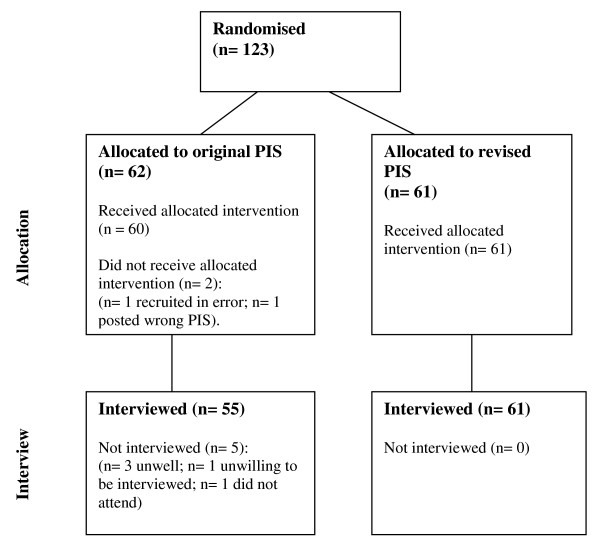
- Two-phase study: a developmental phase with 50 adults aged 55+ in three rounds of user testing (20 tested the original PIS, 10 a first revision, 20 a second revision), followed by a parallel-group randomized controlled trial with 123 participants randomized and 116 interviewed (55 original PIS, 61 revised PIS).
- Participants were members of the public recruited by local publicity, adults at least 55 years old, with exclusions for recent trial/readability study participation, close personal experience of leukemia, or being a healthcare professional; allocation in the trial phase was stratified by age and education using permuted blocks of four.
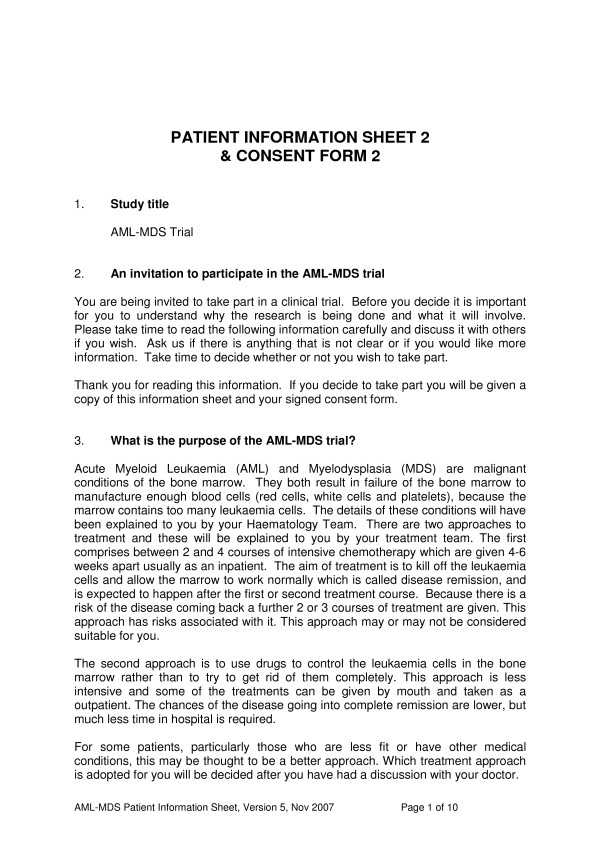
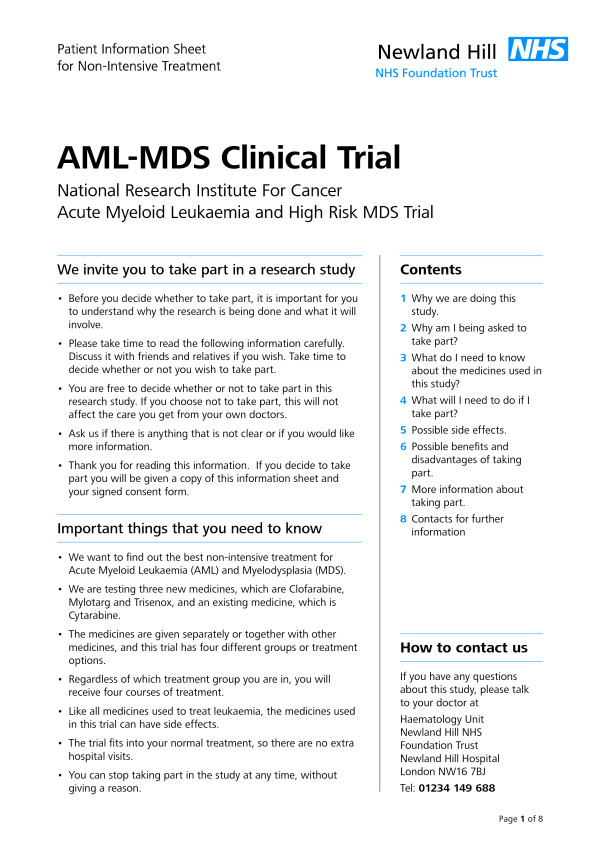
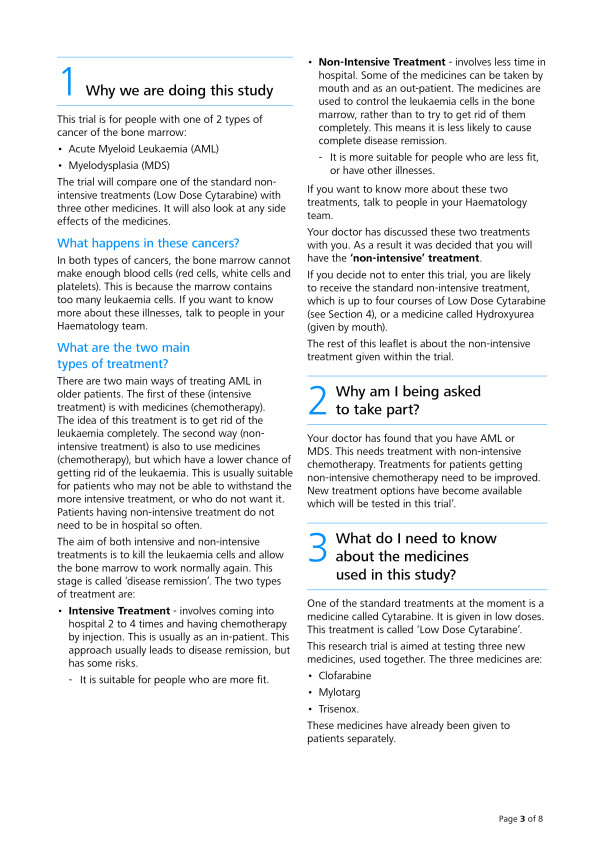
- The tested materials were the original AML16 PIS (10 pages, 3,200 words) and a revised PIS retaining meaning but with altered layout, appearance, structure, and wording; outcomes were finding and understanding 21 key facts across trial nature/purpose, consent, procedures, and safety/efficacy, with the primary outcome being proportion achieving all 21.
Limitations
- The paper states that participants were members of the public imagining trial participation, read the PIS at home before testing, and were interviewed in a quiet room rather than a busy clinic; they also had no spoken information from a recruiting clinician, so it is unclear whether clinician involvement would narrow differences between versions.
- The paper states that the study examined finding and understanding written information, not willingness to participate or actual trial recruitment/behavior, and that determining the relative effects of wording versus design revisions would require a different study design.
- Evident from the text: all seven randomized participants who were not interviewed had been allocated to the original PIS group, so attrition was unbalanced despite randomization.
Model-written summary. Check it against the paper before relying on it.
Integrity signals
Registry
Cites
Statistics
Figures
Verification
Claims the paper makes
0 Valid · 0 Not valid · 19 Not checked · 66 Own results and interpretations
A result the paper reports from its own data — it cites no other source for it, so there is none to check. The quote shows it is in the paper.
In the paper
“In the second, trial phase 66% of participants who read the revised PIS were able to show understanding of all aspects of the trial, compared with 15% of those reading the original version (Odds Ratio 11.2; Chi-square = 31.5 p < .001).”
§ Can user testing of a clinical trial patient information sheet make it fit-for-purpose? - a randomized controlled trial > Abstract > Results
plainstates an association- Asserted: passes — The authors put it forward as true.
- Checkable: passes — It can be checked against evidence.
- Load-bearing: passes — The paper’s conclusions depend on it.
- Based: passes — The paper gives a reason why it holds.
A result the paper reports from its own data — it cites no other source for it, so there is none to check. The quote shows it is in the paper.
In the paper
“On only 1 of the 21 questions did fewer than 16 out of 20 participants find and show understanding of the information.”
§ Can user testing of a clinical trial patient information sheet make it fit-for-purpose? - a randomized controlled trial > Results
plainn = 20- Asserted: passes — The authors put it forward as true.
- Checkable: passes — It can be checked against evidence.
- Load-bearing: passes — The paper’s conclusions depend on it.
- Based: passes — The paper gives a reason why it holds.
A result the paper reports from its own data — it cites no other source for it, so there is none to check. The quote shows it is in the paper.
In the paper
“Total items found but NOT understood | | 26 | | 11”
§ Can user testing of a clinical trial patient information sheet make it fit-for-purpose? - a randomized controlled trial > Developmental phase: method > Outcomes
plainstates a cause- Asserted: passes — The authors put it forward as true.
- Checkable: passes — It can be checked against evidence.
- Load-bearing: passes — The paper’s conclusions depend on it.
- Based: passes — The paper gives a reason why it holds.
A result the paper reports from its own data — it cites no other source for it, so there is none to check. The quote shows it is in the paper.
In the paper
“Participants understood almost all of the information they had found.”
§ Can user testing of a clinical trial patient information sheet make it fit-for-purpose? - a randomized controlled trial > Trial phase: results > Finding and understanding scores
plain- Asserted: passes — The authors put it forward as true.
- Checkable: passes — It can be checked against evidence.
- Load-bearing: unclear — It is unclear whether the paper’s conclusions depend on it.
- Based: passes — The paper gives a reason why it holds.
A result the paper reports from its own data — it cites no other source for it, so there is none to check. The quote shows it is in the paper.
In the paper
“When asked to state a preference, 87.1% participants chose the revised PIS (Sign test p < .001).”
§ Can user testing of a clinical trial patient information sheet make it fit-for-purpose? - a randomized controlled trial > Abstract > Results
plain- Asserted: passes — The authors put it forward as true.
- Checkable: passes — It can be checked against evidence.
- Load-bearing: passes — The paper’s conclusions depend on it.
- Based: passes — The paper gives a reason why it holds.
25 more claims
Create a free account to see all 85 claims and to verify the 39 references still open.
- It may state two separate claims as one. 32
- Probably not a substantial claim. 34
Self-check
Percentages, sums and reported differences re-computed from the paper’s own numbers.
Rated minor: it would not touch a result — a value no result rests on, a p-value that stays on the same side of the significance level, or a conflict that is clerical, resolved elsewhere in the paper, or outside its own findings.
In the paper
“| Highest educational attainment (1 = completed by 16;2 = by 18 or equivalent;3 = graduate) | 1 = 312 = 183 = 3 | 1 = 312 = 133 = 17 | 1 = 262 = 173 = 12 | 1 = 312 = 133 = 17 |”
§ Can user testing of a clinical trial patient information sheet make it fit-for-purpose? - a randomized controlled trial > Results
Reported 62 · recomputed 52
Citations
Cites
Flesch, R. (1948) · Journal of Applied Psychology · doi:10.1037/h0057532 · Cited by 5,391 · cited 1×
“Research into the quality of PIS has used either a checklist method - looking for the presence of features that might enhance or inhibit reading - or readability formulae, such as the Simple Measure of Gobbledygook (SMOG) or Flesch-Kincaid [17-19] - as indicators of readability.”
Kincaid, J. P., Fishburne, Jr., Robert P., R., Richard L., C., & Brad, S. (1975) · doi:10.21236/ada006655 · Cited by 3,497
SMOG Grading - A New Readability Formula.
McLaughlin, G. H. (1969) · The Journal of Reading · Cited by 2,081
Readability Standards for Informed-Consent Forms as Compared with Actual Readability
Paasche-Orlow, M. K., Taylor, H. A., & Brancati, F. L. (2003) · New England Journal of Medicine · doi:10.1056/nejmsa021212 · Cited by 754
Kincaid, J. P., Robert, P. F. L., Richard, L. R., & Brad, S. (1975) · Cited by 739
Improvement of informed consent and the quality of consent documents
Jefford, M., & Moore, R. (2008) · The Lancet Oncology · doi:10.1016/s1470-2045(08)70128-1 · Cited by 336
Strategies for Increasing Recruitment to Randomised Controlled Trials: Systematic Review
Caldwell, P. H. Y., Hamilton, S., Tan, A., & Craig, J. C. (2010) · PLoS Medicine · doi:10.1371/journal.pmed.1000368 · Cited by 307
Informed consent: study of quality of information given to participants in a clinical trial.
Lynoe, N., Sandlund, M., Dahlqvist, G., & Jacobsson, L. (1991) · BMJ · doi:10.1136/bmj.303.6803.610 · Cited by 249
Featherstone, K., & Donovan, J. L. (1998) · BMJ · doi:10.1136/bmj.317.7167.1177 · Cited by 230
Sugarman, J., McCrory, D. C., & Hubal, R. C. (1998) · Journal of the American Geriatrics Society · doi:10.1111/j.1532-5415.1998.tb02477.x · Cited by 203
Research works printed but not linked: 3
- Expert Scientific Group on Phase One Clinical Trials Final Report 2006 London: Her Majesty's Stationery Office
- The Association of the British Pharmaceutical Industry Guidelines for Phase 1 Clinical Trials 2007 http://www.abpi.org.uk/our-work/library/guidelines/Pages/phase-1-trials.aspx (accessed 17 March 2011)
- Knapp P Raynor DK Silcock J Parkinson B User testing of a participant information sheet for a Phase 3 trial of cholesterol-lowering therapy [abstract] Int J Phar Pract 2009 17 B74
Cited by
Moorcraft, S. Y., Marriott, C., Peckitt, C., Cunningham, D., Chau, I., Starling, N., Watkins, D., & Rao, S. (2016) · Trials · doi:10.1186/s13063-015-1105-3 · Cited by 236
“PIS are often reviewed/tested by patients prior to submission to ethics committees, and this can result in amendments to their wording and layout that make the final version easier to understand [32].”
Background
Metadata
- Authors
- Knapp, P., Raynor, D. K., Silcock, J., & Parkinson, B.
- Affiliations
- University of York (GB)
- University of Leeds (GB)
- University of Bradford (GB)
- Corresponding author
- Knapp, Peter
- Venue
- BMC Medicine
- Published
- 2011-07-21
- Volume
- 9
- Issue
- 1
- Pages
- 89-89
- ISSN
- 1741-7015 (ISSN-L)
- PMC
- PMC3152894
- OpenAlex
- W2079031597
- Semantic Scholar
- 9505e25ef96686605f01f063400593e8ea35b677
- Cited by
- 100
- References
- 21
- Citations by year
- 2026: 1 · 2025: 4 · 2024: 10 · 2023: 5 · 2022: 6 · 2021: 10 · 2020: 8 · 2019: 10 · 2018: 10 · 2017: 10 · 2016: 3 · 2015: 5 · 2014: 10 · 2013: 4 · 2012: 4
- FWCI
- 4.55
- Type
- journal article
- Language
- en
- Open access
- gold
- doi.org
- Licence
- Locations
- BMC Medicine (publishedVersion, cc-by)
- Europe PMC (PubMed Central) (publishedVersion, cc-by)
- PubMed Central (publishedVersion, cc-by)
- PubMed (publishedVersion)
- White Rose Research Online (University of Leeds, The University of Sheffield, University of York) (acceptedVersion)
- DOAJ (DOAJ: Directory of Open Access Journals) (submittedVersion)
- DigitalGeorgetown (Georgetown University Library) (submittedVersion)
- Funders
- University of Leeds
- Topics
- Health Sciences › Medicine › Public Health, Environmental and Occupational Health › Ethics in Clinical Research
- Health Sciences › Health Professions › General Health Professions › Health Literacy and Information Accessibility
- Health Sciences › Health Professions › General Health Professions › Patient-Provider Communication in Healthcare
- Keywords
- participant information sheet, informed consent, user testing, readability, clinical trial information, acute myeloid leukemia, information design, patient understanding, research ethics committees
- MeSH terms
- Aged, Clinical Trials as Topic, Female, United Kingdom, Humans, Male, Middle Aged, Comprehension, Consent Forms
About these checks
Registry, retraction, Cites and statistics results are computed, not judged, with one exception: a printed reference that no index lists is read once by a model before it counts as a citation error. Claims are extracted by a model and kept only when their quote appears verbatim in the text; each cited source is then checked, with a model’s help, for whether it says what the claim relies on. Those verdicts can be wrong — read the claim’s quote and the cited source before relying on one.
A language model drew the claims from the paper on 2026-11-25, under version 3 of the claim definition (model deepseek-v4.1-flash, prompt extract-v3).
A second model labelled each claim on 2026-11-25 (model jev-1.13-20260917, definition revision gold-guideline-v0.2).
Statistics and arithmetic are recomputed, not judged.
Confidence bands are shown only for fields calibrated on our annotated test set. None is calibrated yet, so no band is shown.
What counts as a claim ›How we measure confidence ›How we check this ›
Are you an author, or do you see a problem with this page? Request a review
How to cite
Cite CoChat for the checks on this page, and the paper for its own findings.
- This page
- CoChat. (2026). Citation check: Can user testing of a clinical trial patient information sheet make it fit-for-purpose? - a randomized controlled trial. https://app.cochat.ai/papers/10.1186/1741-7015-9-89
- The paper
- Knapp, P., Raynor, D. K., Silcock, J., & Parkinson, B. (2011). Can user testing of a clinical trial patient information sheet make it fit-for-purpose? - a randomized controlled trial. BMC Medicine. https://doi.org/10.1186/1741-7015-9-89
Data sources
Bibliographic data: Semantic Scholar, OpenAlex, Crossref.
Contains information from the Semantic Scholar Academic Graph Datasets, made available under the ODC Attribution License (ODC-BY 1.0).
Semantic Scholar’s data is described in: Kinney, R., et al. (2023). The Semantic Scholar Open Data Platform. arXiv:2301.10140.
