

WINPEPI updated: computer programs for epidemiologists, and their teaching potential
Open accessThe DOI matches its Crossref record; 25 of the 25 references it cites were found in a registry or an index.
Abstract
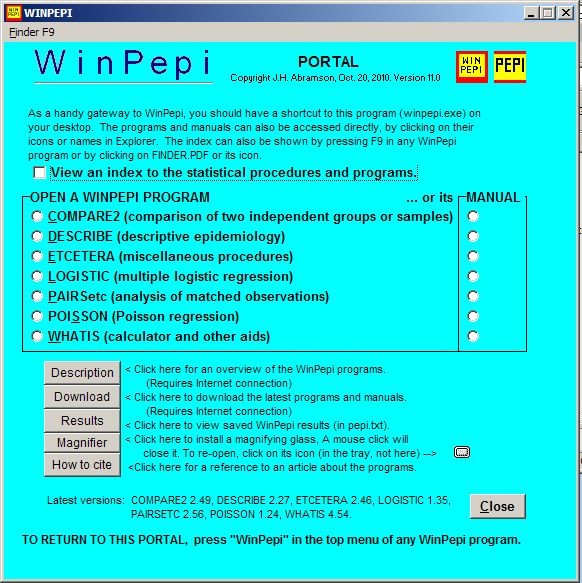
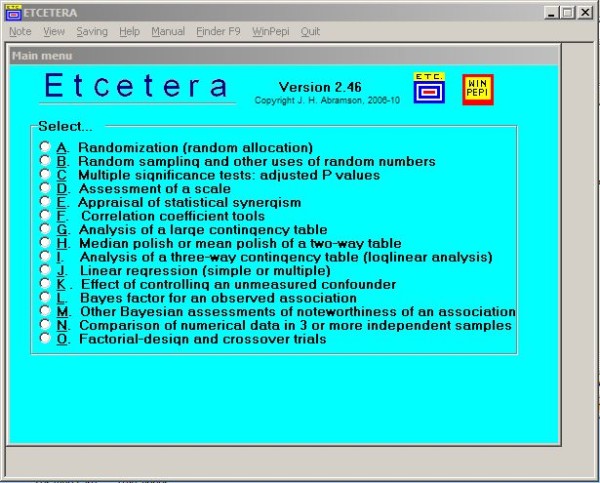
Background: The WINPEPI computer programs for epidemiologists are designed for use in practice and research in the health field and as learning or teaching aids. The programs are free, and can be downloaded from the Internet. Numerous additions have been made in recent years. Implementation: There are now seven WINPEPI programs: DESCRIBE, for use in descriptive epidemiology; COMPARE2, for use in comparisons of two independent groups or samples; PAIRSetc, for use in comparisons of paired and other matched observations; LOGISTIC, for logistic regression analysis; POISSON, for Poisson regression analysis; WHATIS, a "ready reckoner" utility program; and ETCETERA, for miscellaneous other procedures. The programs now contain 122 modules, each of which provides a number, sometimes a large number, of statistical procedures. The programs are accompanied by a Finder that indicates which modules are appropriate for different purposes. The manuals explain the uses, limitations and applicability of the procedures, and furnish formulae and references. Conclusions: WINPEPI is a handy resource for a wide variety of statistical routines used by epidemiologists. Because of its ready availability, portability, ease of use, and versatility, WINPEPI has a considerable potential as a learning and teaching aid, both with respect to practical procedures in the planning and analysis of epidemiological studies, and with respect to important epidemiological concepts. It can also be used as an aid in the teaching of general basic statistics.
Overview
The claims and statistics of this paper haven’t been checked yet.
Free: it reads the open-access text and checks the first 5 claims that cite a source we can check. Create a free account to check every claim.
Integrity signals
Registry
Cites
Statistics
Figures

Verification
Claims the paper makes
The claims and statistics of this paper haven’t been checked yet.
Free: it reads the open-access text and checks the first 5 claims that cite a source we can check. Create a free account to check every claim.
Claims other papers make about this one
Each is checked against this paper’s own text: does it say what the citing paper says it does?
In the citing paper
“We determined the sample size using the WinPepi software34 applying a randomized clinical trial sample size formula considering type I (α) and type II errors (β) of 0.05 and 0.20 (power = 80%), respectively.”
From Exploring the impact of probiotics on adult ADHD management through a double-blind RCT (2024) · cites this paper as [34]
Self-check
Percentages, sums and reported differences re-computed from the paper’s own numbers.
The self-check needs the paper’s full text.
Citations
Cites
Approximate is Better than “Exact” for Interval Estimation of Binomial Proportions
Agresti, A., & Coull, B. A. (1998) · The American Statistician · doi:10.1080/00031305.1998.10480550 · Cited by 3,223 · cited 1×
““ Exact ” methods are not necessarily better than other methods [12].”
MethodApproximate Is Better than "Exact" for Interval Estimation of Binomial Proportions
Agresti, A., & Coull, B. A. (1998) · The American Statistician · doi:10.2307/2685469 · Cited by 972
WINPEPI (PEPI-for-Windows): computer programs for epidemiologists
Abramson, J. H. (2004) · Epidemiologic Perspectives & Innovations · doi:10.1186/1742-5573-1-6 · Cited by 456
Self-citationBayesian perspectives for epidemiological research: I. Foundations and basic methods
Greenland, S. (2006) · International Journal of Epidemiology · doi:10.1093/ije/dyi312 · Cited by 383 · cited 1×
“…whether associations are worthy of note can make students aware that the usual significance tests and other statistical procedures may be misleading, in the opinion of proponents of Bayesian statistics, who urge that the Bayesian perspective should be included in elementary statistics courses [13].”
BackgroundEncyclopedia of Epidemiologic Methods
(2002) · Technometrics · doi:10.1198/tech.2002.s736 · Cited by 248
Computer Programs for Epidemiologists: Pepi Version 4.0
Gahlinger, P. M., & Abrahamson, J. (2001) · Cited by 158
Epidemiology Kept Simple: An Introduction to Traditional and Modern Epidemiology
Gerstman, B. B. (2013) · Cited by 141
Basic Biostatistics: Statistics for Public Health Practice
Gerstman, B. B. (2007) · Cited by 103
Epidemiology Kept Simple: An Introduction to Traditional and Modern Epidemiology
Gerstman, B. B. (2013) · Cited by 87
Computer Programs for Epidemiologists: PEPI Version 4.0
Pai, M., & McCulloch, M. (2002) · American Journal of Epidemiology · doi:10.1093/aje/155.8.776-a · Cited by 64
Research works printed but not linked: 1
- Gahlinger PM, Abramson JH: Computer Programs for Epidemiologic Analysis: PEPI Version 2. Stone Mountain, Georgia: USD Inc; 1995.
Cited by
The origin and evolution of mutations in acute myeloid leukemia
Welch, J. S., Ley, T. J., Link, D. C., Miller, C. A., Larson, D. E., Koboldt, D. C., Wartman, L. D., Lamprecht, T. L., Liu, F., Xia, J., et al. (2012) · Cell · doi:10.1016/j.cell.2012.06.023 · Cited by 1,575
“The expected Poisson distribution was generated by using WinPepi (Abramson, 2011).”
Kisely, S., Warren, N., McMahon, L., Dalais, C., Henry, I., & Siskind, D. (2020) · BMJ · doi:10.1136/bmj.m1642 · Cited by 1,056
“11 As we could not definitely exclude variation between studies, we used a random effects model for all the analyses and an I 2 statistic estimate of 50% or more as an indicator of possible heterogeneity.”
MethodAcademic Benefits of Peer Tutoring: A Meta-Analytic Review of Single-Case Research
Bowman-Perrott, L., Davis, H., Vannest, K., Williams, L., Greenwood, C., & Parker, R. (2013) · School Psychology Review · doi:10.1080/02796015.2013.12087490 · Cited by 307
“The Cohen’s d effect size was also obtained from WinPepi along with Cohen’s d SE (Abramson, 2011).”
MethodPoor Gait Performance and Prediction of Dementia: Results From a Meta-Analysis
Beauchet, O., Annweiler, C., Callisaya, M. L., De Cock, A.-M., Helbostad, J. L., Kressig, R. W., Srikanth, V., Steinmetz, J.-P., Blumen, H. M., Verghese, J., et al. (2016) · Journal of the American Medical Directors Association · doi:10.1016/j.jamda.2015.12.092 · Cited by 303
Kisely, S., Sawyer, E., Siskind, D., & Lalloo, R. (2016) · Journal of Affective Disorders · doi:10.1016/j.jad.2016.04.040 · Cited by 298
“In these cases, we used Win Pepi version 11.34 (Abramson, 2011).”
MethodInfluential
Metadata
- Authors
- Abramson, J. H.
- Affiliations
- Hebrew University of Jerusalem (IL)
- Corresponding author
- Abramson, Joseph H
- Venue
- Epidemiologic Perspectives & Innovations
- Published
- 2011-02-02
- Volume
- 8
- Issue
- 1
- Pages
- 1-1
- ISSN
- 1742-5573 (ISSN-L)
- PMC
- PMC3041648
- OpenAlex
- W2143040673
- Cited by
- 844
- References
- 25
- Citations by year
- 2026: 30 · 2025: 34 · 2024: 60 · 2023: 60 · 2022: 71 · 2021: 69 · 2020: 55 · 2019: 66 · 2018: 52 · 2017: 64 · 2016: 70 · 2015: 64 · 2014: 62 · 2013: 41 · 2012: 35
- FWCI
- 41.08
- Type
- journal article
- Language
- en
- Open access
- hybrid
- doi.org
- Licence
- cc-by
- creativecommons.org/licenses/by/2.0 (tdm)
- creativecommons.org/licenses/by/2.0 (vor)
- Locations
- Epidemiologic Perspectives & Innovations (publishedVersion, cc-by)
- PubMed Central (publishedVersion, cc-by)
- PubMed (publishedVersion)
- Topics
- Physical Sciences › Mathematics › Statistics and Probability › Statistical Methods in Epidemiology
- Physical Sciences › Mathematics › Statistics and Probability › Statistics Education and Methodologies
- Physical Sciences › Mathematics › Statistics and Probability › Probabilistic Statistics in Medicine
- Keywords
- statistical software, epidemiological analysis, descriptive epidemiology, logistic regression, Poisson regression, free software, epidemiological study design
About these checks
Registry, retraction, Cites and statistics results are computed, not judged, with one exception: a printed reference that no index lists is read once by a model before it counts as a citation error. Claims are extracted by a model and kept only when their quote appears verbatim in the text; each cited source is then checked, with a model’s help, for whether it says what the claim relies on. Those verdicts can be wrong — read the claim’s quote and the cited source before relying on one.
Statistics and arithmetic are recomputed, not judged.
Confidence bands are shown only for fields calibrated on our annotated test set. None is calibrated yet, so no band is shown.
What counts as a claim ›How we measure confidence ›How we check this ›
Are you an author, or do you see a problem with this page? Request a review
How to cite
Cite CoChat for the checks on this page, and the paper for its own findings.
- This page
- CoChat. (2026). Citation check: WINPEPI updated: computer programs for epidemiologists, and their teaching potential. https://app.cochat.ai/papers/10.1186/1742-5573-8-1
- The paper
- Abramson, J. H. (2011). WINPEPI updated: computer programs for epidemiologists, and their teaching potential. Epidemiologic Perspectives & Innovations. https://doi.org/10.1186/1742-5573-8-1
Data sources
Bibliographic data: Semantic Scholar, OpenAlex, Crossref.
Contains information from the Semantic Scholar Academic Graph Datasets, made available under the ODC Attribution License (ODC-BY 1.0).
Semantic Scholar’s data is described in: Kinney, R., et al. (2023). The Semantic Scholar Open Data Platform. arXiv:2301.10140.
