

WINPEPI updated: computer programs for epidemiologists, and their teaching potential
Open accessThe DOI matches its Crossref record; 25 of the 25 references it cites were found in a registry or an index.
Abstract
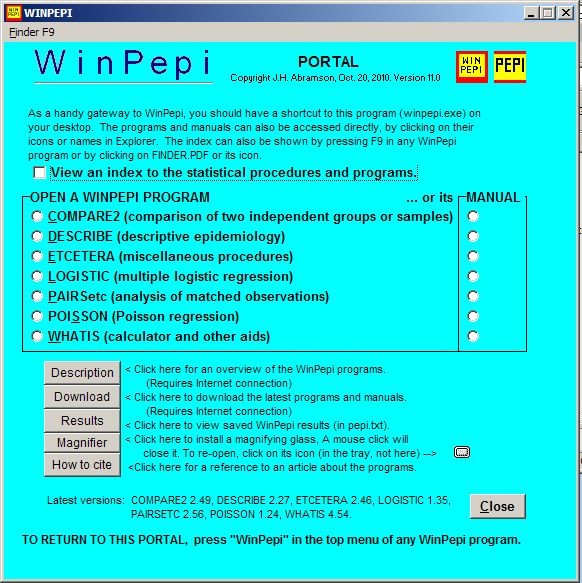
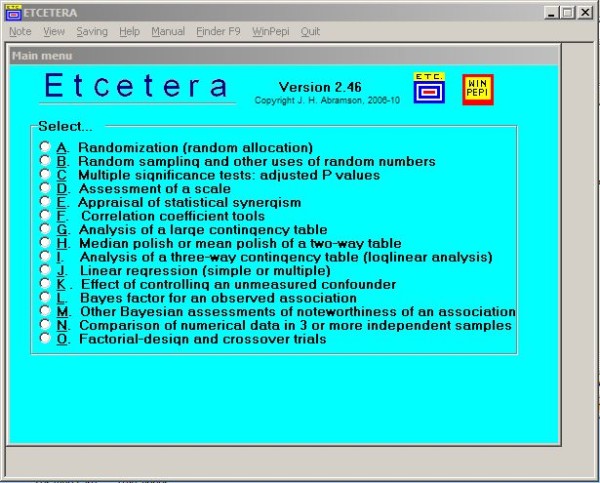
Background: The WINPEPI computer programs for epidemiologists are designed for use in practice and research in the health field and as learning or teaching aids. The programs are free, and can be downloaded from the Internet. Numerous additions have been made in recent years. Implementation: There are now seven WINPEPI programs: DESCRIBE, for use in descriptive epidemiology; COMPARE2, for use in comparisons of two independent groups or samples; PAIRSetc, for use in comparisons of paired and other matched observations; LOGISTIC, for logistic regression analysis; POISSON, for Poisson regression analysis; WHATIS, a "ready reckoner" utility program; and ETCETERA, for miscellaneous other procedures. The programs now contain 122 modules, each of which provides a number, sometimes a large number, of statistical procedures. The programs are accompanied by a Finder that indicates which modules are appropriate for different purposes. The manuals explain the uses, limitations and applicability of the procedures, and furnish formulae and references. Conclusions: WINPEPI is a handy resource for a wide variety of statistical routines used by epidemiologists. Because of its ready availability, portability, ease of use, and versatility, WINPEPI has a considerable potential as a learning and teaching aid, both with respect to practical procedures in the planning and analysis of epidemiological studies, and with respect to important epidemiological concepts. It can also be used as an aid in the teaching of general basic statistics.
Overview
The claims and statistics of this paper haven’t been checked yet.
Free: it reads the open-access text and checks the first 5 claims that cite a source we can check. Create a free account to check every claim.
Integrity signals
Registry
Cites
Statistics
Figures
Verification
Claims the paper makes
The claims and statistics of this paper haven’t been checked yet.
Free: it reads the open-access text and checks the first 5 claims that cite a source we can check. Create a free account to check every claim.
Claims other papers make about this one
Each is checked against this paper’s own text: does it say what the citing paper says it does?
In the citing paper
“We determined the sample size using the WinPepi software34 applying a randomized clinical trial sample size formula considering type I (α) and type II errors (β) of 0.05 and 0.20 (power = 80%), respectively.”
From Exploring the impact of probiotics on adult ADHD management through a double-blind RCT (2024) · cites this paper as [34]
Self-check
Percentages, sums and reported differences re-computed from the paper’s own numbers.
The self-check needs the paper’s full text.
Citations
Cites
Approximate is Better than “Exact” for Interval Estimation of Binomial Proportions
Agresti, A., & Coull, B. A. (1998) · The American Statistician · doi:10.1080/00031305.1998.10480550 · Cited by 3,223 · cited 1×
““ Exact ” methods are not necessarily better than other methods [12].”
MethodApproximate Is Better than "Exact" for Interval Estimation of Binomial Proportions
Agresti, A., & Coull, B. A. (1998) · The American Statistician · doi:10.2307/2685469 · Cited by 972
WINPEPI (PEPI-for-Windows): computer programs for epidemiologists
Abramson, J. H. (2004) · Epidemiologic Perspectives & Innovations · doi:10.1186/1742-5573-1-6 · Cited by 456
Self-citationBayesian perspectives for epidemiological research: I. Foundations and basic methods
Greenland, S. (2006) · International Journal of Epidemiology · doi:10.1093/ije/dyi312 · Cited by 383 · cited 1×
“…whether associations are worthy of note can make students aware that the usual significance tests and other statistical procedures may be misleading, in the opinion of proponents of Bayesian statistics, who urge that the Bayesian perspective should be included in elementary statistics courses [13].”
BackgroundEncyclopedia of Epidemiologic Methods
(2002) · Technometrics · doi:10.1198/tech.2002.s736 · Cited by 248
Computer Programs for Epidemiologists: Pepi Version 4.0
Gahlinger, P. M., & Abrahamson, J. (2001) · Cited by 158
Epidemiology Kept Simple: An Introduction to Traditional and Modern Epidemiology
Gerstman, B. B. (2013) · Cited by 141
Basic Biostatistics: Statistics for Public Health Practice
Gerstman, B. B. (2007) · Cited by 103
Epidemiology Kept Simple: An Introduction to Traditional and Modern Epidemiology
Gerstman, B. B. (2013) · Cited by 87
Computer Programs for Epidemiologists: PEPI Version 4.0
Pai, M., & McCulloch, M. (2002) · American Journal of Epidemiology · doi:10.1093/aje/155.8.776-a · Cited by 64
Research works printed but not linked: 1
- Gahlinger PM Abramson JH Computer Programs for Epidemiologic Analysis: PEPI Version 2 1995 Stone Mountain, Georgia: USD Inc
Cited by
Items 901–953 of 953
Associação entre obesidade, rigidez arterial e aterosclerose carotídea em adultos
Selli, R. (2023) · LA Referencia (Red Federada de Repositorios Institucionales de Publicaciones Científicas)
Freitas, E. I. V. R. (2023) · LA Referencia (Red Federada de Repositorios Institucionales de Publicaciones Científicas)
dos Santos, H. C. (2023) · LA Referencia (Red Federada de Repositorios Institucionales de Publicaciones Científicas)
Chen, L. L., Tohit, N. M., Ludin, A. F. M., Manaf, Z. A., & Shahar, S. (2026) · Frontiers in Nutrition · doi:10.3389/fnut.2025.1696806
Ziliotto, M., Ellwanger, J. H., Dombrowski, J. G., Marinho, C. R. F., Pontillo, A., & Chies, J. A. B. (2025) · Genetics and Molecular Biology · doi:10.1590/1678-4685-gmb-2025-0056
“The WinPepi 11.65 (Abramson, 2011) was used to perform the analysis.”
InfluentialChemmanchery, V., Mathew, A., Nishanth, V., Rashmitha, G. M., & Kumar, D. R. P. (2026) · Otorhinolaryngology Clinics - An International Journal · doi:10.5005/jp-journals-10003-1678
Validation of a synthetic lumbar spinal endoscopy simulator: skills transfer to real surgery
Kulcheski, Á. L., Milcent, P. A. A., Graells, X. S. I., Scalabrin, J. G. B., Nunes, C. P., & Filho, E. S. (2026) · Revista do Colégio Brasileiro de Cirurgiões · doi:10.1590/0100-6991e-20260022
Burnout and perceived stress in medical interns working at a hospital in Windhoek, Namibia
Kalenga, F., Koen, L., Asmal, L., Zunza, M., & Jones, R. (2026) · Journal of the Colleges of Medicine of South Africa · doi:10.4102/jcmsa.v4i1.302
“22 The lowest reported prevalence, client-related burnout at 43 % , yielded a sample size of 161 participants, with an estimated margin of error of ±7.65 % .”
InfluentialHealth Intervention Research with Women Babassu Coconut Breakers in Northeast BrazilPreprint
Vale, S. R. G. A., Cozendey-Silva, E. N., Bonfatti, R. J., dos Santos, D. V. S., Victorino, F., Gonçalves, M. C., & Teixeira, L. R. (2026) · Research Square · doi:10.21203/rs.3.rs-8571677/v1
Influence of genetic variation of TLR-5 on gene expression in rheumatoid arthritis in Iraqi patients
Lafta, A. K., Alwan, A. H., Hamed, S. L., & Alosami, M. H. (2026) · AIP conference proceedings · doi:10.1063/5.0322041
Oyeyemi, N., Onwudiegwu, U., Pughikumo, D., & Oyeyemi, A. S. (2026) · INTERNATIONAL JOURNAL OF HEALTH & MEDICAL RESEARCH · doi:10.58806/ijhmr.2026.v5i3n02
Blepharospasm as a research model for understanding the perception of facial expressions
Bloch, D., Livneh, V., Korenblum, S., Alcalay, R. N., Gurevich, T., & Biran, I. (2026) · Acta Psychologica · doi:10.1016/j.actpsy.2026.106751
Diversité Génétique des Molécules de Réponse Immunitaire Innée dans les Troubles Bipolaires
Oliveira, J. (2015) · theses.fr (ABES) · doi:10.70675/b5f62909z8b9az49b8zb797zc725c6e8f7ef
Herbig, B., Mayer, F., Norrefeldt, V., & Wargocki, P. L. (2026) · International Journal of Hygiene and Environmental Health · doi:10.1016/j.ijheh.2026.114809
Jaisue, D., Yukalang, N., & Glangkarn, S. (2026) · Journal of Public Health and Development · doi:10.55131/jphd/2026/240213
Eerik, K. (2026) · DSpace repository (University of Tartu)
Munoz-Boettcher, P., Hernández-Gotelli, C., Ibarguren, C., Zeng, R. W., Velez, J., Vries, A. D., Miller-Cushon, E., Heins, B., Lynch, R. A., Kolar, Q., et al. (2026) · JDS Communications · doi:10.3168/jdsc.2026-1039
“Sample size calculations were performed using WINPEPI (version 11.62; Abramson, 2011), assuming a statistical power of 80%, which resulted in a minimum required sample size of 99 cows per group.”
InfluentialOyeyemi, N., Onwudiegwu, U., Pughikumo, D., & Oyeyemi, A. S. (2026) · BMC Pregnancy and Childbirth · doi:10.1186/s12884-026-09376-8
“Randomization was done using computer generated random numbers (unstratified balanced allocation from WinPepi) [15] and random allocation concealment was done using sealed opaque enve-lopes numbered from 1 to 60 for each centre.”
Vipulan, M., Kumanan, T., Guruparan, M., Coonghe, P. A. D., & Rajeshkannan, N. (2026) · Cureus · doi:10.7759/cureus.110642
“WINPEPI updated: computer programs were used to calculate sensitivity, specificity, accuracy, positive predictive value, and negative predictive value for PAD in predicting CAD [19].”
Ghafoor, M., Saqib, M., Ashfaq, K., & Rehman, S. U. (2026) · Polish Journal of Veterinary Sciences · doi:10.24425/pjvs.2026.1277
“The data were entered into Microsoft Excel and analyzed using WinPepi (Abramson, 2011) and Statistix-10 (Data analysis software for researchers).”
Chotaliya, R., Mishra, N., Prasad, N., Buch, A. C., Kelkar, P., & Madan, V. V. (2026) · BMC Ophthalmology · doi:10.1186/s12886-026-05064-5
“WinPepi and Jamovi software were used for statistical analysis [27, 28].”
Esterhuizen, T. M., Mbuagbaw, L., Rehman, N., Yanwou, N., Swaby, D. J., Kittle, E., Licht, J.-C., & Thabane, L. (2026) · Contemporary Clinical Trials Communications · doi:10.1016/j.conctc.2026.101667
“BFs were calculated with WINPEPI version 11.0, a freeware suite of programs for epi-demiologists [28].”
InfluentialSubjective Sleep Quality and BMI z-Score in Adolescent Boys: A Case-Control Study
Kelmanson, I. A. (2026) · SN Comprehensive Clinical Medicine · doi:10.1007/s42399-026-02527-0
“Forty cases were selected via a simple random sample with - out replacement from the 230 eligible candidates [ 17].”
InfluentialKimoto, C. K., Zunza, M., Sambell, R., & Smit, Y. (2026) · World Nutrition · doi:10.26596/wn.202617270-79
“Sample size estimation was done using WinPepi computer programme (Abramson 2011).”
TAVARES, B. P., Luiz, K. G., Caldas, L. D., Guimarães, L. S. P., Nojima, L. I., Visconti, M. A., & Nojima, M. D. C. G. (2026) · Journal of Dental Research Dental Clinics Dental Prospects · doi:10.34172/joddd.42445
Characterization and validation of electronic medical record data for pharmacoepidemiologic research
Schneider, T., Punjani, T., Silva, J. M., Mbuagbaw, L., Gibson, P., & Holbrook, A. M. (2026) · Frontiers in Pharmacology · doi:10.3389/fphar.2026.1812502
“Percent agreement reported with 95% confidence intervals (CIs) calculated with WINPEPI was used for all items validated by comparing the data extraction with the chart or comparator data set (Abramson, 2011).”
Mwenda, R. B., Seif, S. A., Stephano, R. O., & Moshi, F. V. (2026) · Research Square · doi:10.21203/rs.3.rs-10063936/v1
Agnes, E. E., Lawrence, W., & Ifeayinwa, C.-N. (2026) · INTERNATIONAL JOURNAL OF HEALTH & MEDICAL RESEARCH · doi:10.58806/ijhmr.2026.v5i8n05
Genowska, A., Jaroszewicz, J., Zarębska‐Michaluk, D., Lewtak, K., Dobrowolska, K., Kanecki, K., Parfieniuk‐Kowerda, A., Nitsch-Osuch, A. S., Rzymski, P., & Flisiak, R. (2026) · Cancers · doi:10.3390/cancers18162579
“Analyses were performed using Statistica version 13 (TIBCO Software Inc., Palo Alto, CA, USA) and WinPepi version 11.65 [31].”
InfluentialRomanov, A. S., & Филипповна, Ш. Е. (2026) · Epilepsy and Paroxysmal Conditions · doi:10.17749/2077-8333/epi.par.con.2026.276
Владимирович, М. А., Mukhina, A. A., Efimova, I., Balinova, N., Rodina, Y. A., Zinchenko, R. A., Voronin, S. V., Shcherbina, A. Y., & Kutsev, S. I. (2026) · International Journal of Neonatal Screening · doi:10.3390/ijns12030068
“Additionally, Fisher’s 95% confidence interval (95% CI) for proportional data was computed using the freeware statistical program WinPepi v. 11.65 [32] (http://www.brixtonhealth. com/pepi4windows.html, assessed on 1 March 2026).”
InfluentialLago, N., Basso, A., Paolini, V., & Pretto, T. (2026) · Journal of Invertebrate Pathology · doi:10.1016/j.jip.2026.108719
Attitudes of elementary school teachers toward stuttering in Zahedan, Iran: A cross-sectional study
Asadollahpour, F., Sakhai, F., Louis, K. O. S., & Nakhaei, M. (2026) · Journal of Communication Disorders · doi:10.1016/j.jcomdis.2026.106686
Illangasinghe, T., Devanarayana, N. M., Wadasinghe, D., & Kumari, M. V. (2026) · medRxiv · doi:10.64898/2026.08.24.26361198
Ismail, N. H., Latif, A. H., Bakir, W. A.-E., & a, A. (2026) · Baghdad Journal of Biochemistry and Applied Biological Sciences · doi:10.47419/bjbabs.v7i4.523
Ssekitoleko, J., Akello, A. C., Kasinga, S., Kisekka, M., Schweizer, P. E., Ojok, L., Eltom, K. H., Truyen, U., Wahed, A. A. E., & Okuni, J. B. (2026) · Frontiers in Public Health · doi:10.3389/fpubh.2026.1931886
Bonifácio, D. B., de Paulo, R. S., Mendes, P. H. V., Lacerda, U. V., Cardoso, R. R., Souza, H. D. S., de Barros, F. A. R., & Bressan, J. (2026) · Journal of Food Science · doi:10.1111/1750-3841.71505
Szydlarska, D., Lewtak, K., Ciechomska, M. Z., Poznańska, A., Śliwczyński, A. M., & Kanecki, K. (2026) · Cancers · doi:10.3390/cancers18193125
ดานา, ก., Sawangthaisong, J., Taiwong, A., Jaisue, D., Khamkaew, Y., Phuakphan, W., & Somgit, W. (2026) · Community Health Development Quarterly Khon Kaen University
Krasairtechahirun, S., Dana, K., Taiwong, A., Kunork, B., & Larangsit, P. (2025) · Community Health Development Quarterly Khon Kaen University
Sompongpun, S., Kuhirunyaratn, P., Jindawong, B., Bumrerraj, S., Muktabhant, B., & Phunikhom, K. (2022) · Khon Kaen University Journal (Graduate Studies)
Wontaisong, N., Jumpajan, J., Phoolawan, P., & Tassana-iem, S. (2023) · Journal of Medicine and Public Health, Ubon Ratchathani University
Ortega, J. D., Infantes‐Lorenzo, J. A., Gómez-Buendía, A., Roy, Á., Velasco, C. A., Romero, B., Moreno, I., Domínguez, M., & Bezos, J. (2026) · Veterinary Sciences · doi:10.3390/vetsci13101083
“Wilson’s 95% confidence intervals (95% CI) were calculated for the percentage of positive reactors to the different tests using WinPepi version 11.65 [38].”
InfluentialMwenda, R. B., Seif, S. A., Stephano, R. O., & Moshi, F. V. (2026) · medRxiv · doi:10.64898/2026.10.13.26365390
Muhsen, K., Donkor, E. S., Johnson, S. A. M., Perry-Markovich, M., Kotey, F. C. N., Osei, M.-M., Gresham, L. S., Smolinski, M., & Cohen, D. (2026) · IJID One Health · doi:10.1016/j.ijidoh.2026.100164
Oanh, N. T. K., Tran-Trung, H., Giang, L. Đ., Na, H. T., Huynh, D. T., Khoa, N. Đ., Nguyen, M. C., Quang, L. D., Thu, N. T., Ha, N. X., et al. (2026) · Journal of Essential Oil Bearing Plants · doi:10.1080/0972060x.2026.2752199
Mwenda, R. B., Seif, S. A., Stephano, R. O., & Moshi, F. V. (2026) · Research Square · doi:10.21203/rs.3.rs-11120813/v1
David, S., Hohenfeld, C., Haberl, L., Pahl, J., Costa, A. S., Kilders, A., Hildebrand, F., Schulz, J. B., Reetz, K., & Haeger, A. (2023) · doi:10.3389/fneur.2023.1195694.s001
Lim, J., Pavalagantharajah, S., Verschoor, C. P., Lentz, E., Loeb, M., Levine, M., Smieja, M., Mbuagbaw, L., Kalina, D., Tarride, J.-E., et al. (2022) · doi:10.1371/journal.pone.0266663.r001
Metadata
- Authors
- Abramson, J. H.
- Affiliations
- Hebrew University of Jerusalem (IL)
- Corresponding author
- Abramson, Joseph H
- Venue
- Epidemiologic Perspectives & Innovations
- Published
- 2011-02-02
- Volume
- 8
- Issue
- 1
- Pages
- 1-1
- ISSN
- 1742-5573 (ISSN-L)
- PMC
- PMC3041648
- OpenAlex
- W2143040673
- Cited by
- 844
- References
- 25
- Citations by year
- 2026: 30 · 2025: 34 · 2024: 60 · 2023: 60 · 2022: 71 · 2021: 69 · 2020: 55 · 2019: 66 · 2018: 52 · 2017: 64 · 2016: 70 · 2015: 64 · 2014: 62 · 2013: 41 · 2012: 35
- FWCI
- 41.08
- Type
- journal article
- Language
- en
- Open access
- hybrid
- doi.org
- Licence
- cc-by
- creativecommons.org/licenses/by/2.0 (tdm)
- creativecommons.org/licenses/by/2.0 (vor)
- Locations
- Epidemiologic Perspectives & Innovations (publishedVersion, cc-by)
- PubMed Central (publishedVersion, cc-by)
- PubMed (publishedVersion)
- Topics
- Physical Sciences › Mathematics › Statistics and Probability › Statistical Methods in Epidemiology
- Physical Sciences › Mathematics › Statistics and Probability › Statistics Education and Methodologies
- Physical Sciences › Mathematics › Statistics and Probability › Probabilistic Statistics in Medicine
- Keywords
- statistical software, epidemiological analysis, descriptive epidemiology, logistic regression, Poisson regression, free software, epidemiological study design
About these checks
Registry, retraction, Cites and statistics results are computed, not judged, with one exception: a printed reference that no index lists is read once by a model before it counts as a citation error. Claims are extracted by a model and kept only when their quote appears verbatim in the text; each cited source is then checked, with a model’s help, for whether it says what the claim relies on. Those verdicts can be wrong — read the claim’s quote and the cited source before relying on one.
Statistics and arithmetic are recomputed, not judged.
Confidence bands are shown only for fields calibrated on our annotated test set. None is calibrated yet, so no band is shown.
What counts as a claim ›How we measure confidence ›How we check this ›
Are you an author, or do you see a problem with this page? Request a review
Data sources
Bibliographic data: Semantic Scholar, OpenAlex, Crossref.
Contains information from the Semantic Scholar Academic Graph Datasets, made available under the ODC Attribution License (ODC-BY 1.0).
Semantic Scholar’s data is described in: Kinney, R., et al. (2023). The Semantic Scholar Open Data Platform. arXiv:2301.10140.
