

The DOI matches its Crossref record; 49 of the 51 references it cites were found in a registry or an index.
Quantitative change of EEG and respiration signals during mindfulness meditation
Open accessAbstract
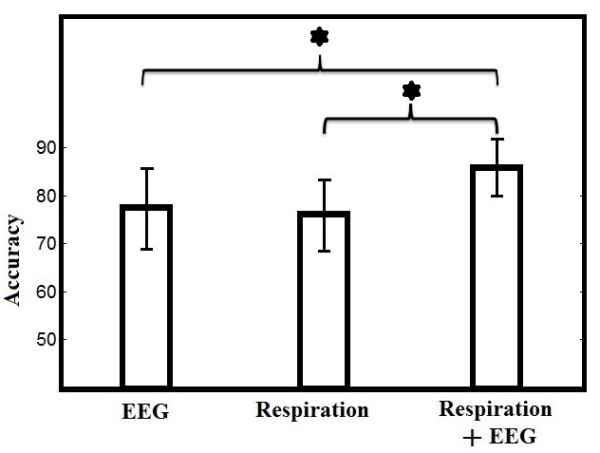
BACKGROUND: This study investigates measures of mindfulness meditation (MM) as a mental practice, in which a resting but alert state of mind is maintained. A population of older people with high stress level participated in this study, while electroencephalographic (EEG) and respiration signals were recorded during a MM intervention. The physiological signals during meditation and control conditions were analyzed with signal processing. METHODS: EEG and respiration data were collected and analyzed on 34 novice meditators after a 6-week meditation intervention. Collected data were analyzed with spectral analysis, phase analysis and classification to evaluate an objective marker for meditation. RESULTS: Different frequency bands showed differences in meditation and control conditions. Furthermore, we established a classifier using EEG and respiration signals with a higher accuracy (85%) at discriminating between meditation and control conditions than a classifier using the EEG signal only (78%). CONCLUSION: Support vector machine (SVM) classifier with EEG and respiration feature vector is a viable objective marker for meditation ability. This classifier should be able to quantify different levels of meditation depth and meditation experience in future studies.
Overview
The claims and statistics of this paper haven’t been checked yet.
Run the check — free, no account needed. It reads the open-access text and checks the sources it cites.
Integrity signals
Registry
Cites
Statistics
Figures

Verification
Claims the paper makes
The claims and statistics of this paper haven’t been checked yet.
Run the check — free, no account needed. It reads the open-access text and checks the sources it cites.
Claims other papers make about this one
Each is checked against this paper’s own text: does it say what the citing paper says it does?
The cited source says what the claim attributes to it.
In the citing paper
“During these components, explicit instruction to slow ones breath is not given, however, it has been reported in multiple investigations that breath slows during the practice (Ditto et al., 2006; Ahani et al., 2014).”
From Maladaptive autonomic regulation in PTSD accelerates physiological aging (2015) · cites this paper as Ahani et al., 2014
The cited source says what the claim attributes to it.
In the citing paper
“Although mindfulness instructions do not involve purposefully slowing the breath, the rate of breathing commonly slows down automatically during mindfulness meditation (Ahani et al., 2014).”
From Being able to think when caught in the maelstrom - how adolescents used mindfulness when facing exams. (2024) · cites this paper as Ahani et al., 2014
Self-check
Percentages, sums and reported differences re-computed from the paper’s own numbers.
The self-check needs the paper’s full text.
Citations
Cites
Cortes, C., & Vapnik, V. (1995) · Machine Learning · doi:10.1007/bf00994018 · Cited by 59,421
LIBSVM: A library for support vector machines
Chang, C.-C., & Lin, C.-J. (2011) · ACM Transactions on Intelligent Systems and Technology · doi:10.1145/1961189.1961199 · Cited by 40,918
A Global Measure of Perceived Stress
Cohen, S., Kamarck, T., & Mermelstein, R. (1983) · Journal of Health and Social Behavior · doi:10.2307/2136404 · Cited by 32,807
An Analysis of Transformations
Box, G. E. P., & Cox, D. R. (1964) · Journal of the Royal Statistical Society Series B (Statistical Methodology) · doi:10.1111/j.2517-6161.1964.tb00553.x · Cited by 15,287
Libsvm : A library for support vector machines
Ferrari, V. (2008) · Medical Entomology and Zoology · Cited by 10,123
An Information-Maximization Approach to Blind Separation and Blind Deconvolution
Bell, A. J., & Sejnowski, T. J. (1995) · Neural Computation · doi:10.1162/neco.1995.7.6.1129 · Cited by 8,986
(2008) · Medical Entomology and Zoology · Cited by 7,477
On the use of windows for harmonic analysis with the discrete Fourier transform
Harris, F. J. (1978) · Proceedings of the IEEE · doi:10.1109/proc.1978.10837 · Cited by 7,326
Digital Signal Processing: Principles, Algorithms, and Applications
Proakis, J. G., & Manolakis, D. G. (1992) · Cited by 4,601
Kabat-Zinn, J. (1982) · General Hospital Psychiatry · doi:10.1016/0163-8343(82)90026-3 · Cited by 4,255
Research works printed but not linked: 3
- Welsh KA, Breitner JCS, Magruder-Habib KM: Detection of dementia in the elderly using telephone screning of cognitive status. Neuropsychiatry Neuropsychol Behav Neurol 1993, 6: 103-110.
- Bach FR, Jordan MI: Kernel independent component analysis. J Mach Learn Res 2002, 3: 1-48.
- Oken B, Zajdel D, Wild H: Induced and trait differences in EEG phase synchrony and power for experienced meditators versus non-meditators. 2007.
Cited by
Sorted by citations
A systematic review of the neurophysiology of mindfulness on EEG oscillations
Lomas, T., Ivtzan, I., & Fu, C. H. Y. (2015) · Neuroscience & Biobehavioral Reviews · doi:10.1016/j.neubiorev.2015.09.018 · Cited by 506
A Review on Machine Learning for EEG Signal Processing in Bioengineering
Hosseini, M.-P., Hosseini, A., & Ahi, K. (2020) · IEEE Reviews in Biomedical Engineering · doi:10.1109/rbme.2020.2969915 · Cited by 471
Basso, J. C., McHale, A., Ende, V., Oberlin, D. J., & Suzuki, W. A. (2019) · Behavioural Brain Research · doi:10.1016/j.bbr.2018.08.023 · Cited by 255
The neuroscience of meditation: classification, phenomenology, correlates, and mechanisms
Brandmeyer, T., Arnaud Delorme, A., & Wahbeh, H. (2019) · Progress in brain research · doi:10.1016/bs.pbr.2018.10.020 · Cited by 164
Self-citationMaladaptive autonomic regulation in PTSD accelerates physiological aging
Williamson, J. B., Porges, E. C., Lamb, D. G., & Porges, S. W. (2015) · Frontiers in Psychology · doi:10.3389/fpsyg.2014.01571 · Cited by 116
“During these components, explicit instruction to slow ones breath is not given, however, it has been reported in multiple investigations that breath slows during the practice (Ditto et al., 2006; Ahani et al., 2014).”
Background
Metadata
- Authors
- Ahani, A., Wahbeh, H., Nezamfar, H., Miller, M., Erdogmus, D., & Oken, B.
- Affiliations
- Northeastern University (US)
- Oregon Health & Science University (US)
- Corresponding author
- Oken, Barry
- Venue
- Journal of NeuroEngineering and Rehabilitation
- Published
- 2014-05-14
- Volume
- 11
- Issue
- 1
- Pages
- 87-87
- ISSN
- 1743-0003 (ISSN-L)
- PMC
- PMC4060143
- OpenAlex
- W2153257584
- Cited by
- 159
- References
- 51
- Citations by year
- 2026: 16 · 2025: 19 · 2024: 21 · 2023: 19 · 2022: 16 · 2021: 16 · 2020: 13 · 2019: 7 · 2018: 7 · 2017: 10 · 2016: 10 · 2015: 4
- FWCI
- 9.47
- Type
- journal article
- Language
- en
- Open access
- gold
- doi.org
- Licence
- cc-by
- Locations
- Journal of NeuroEngineering and Rehabilitation (publishedVersion, cc-by)
- PubMed Central (publishedVersion, cc-by)
- PubMed (publishedVersion)
- Funders
- National Science Foundation (0914808, 1149570, 1136027)
- National Center for Complementary and Integrative Health (K24AT005121, K01AT004951)
- Topics
- Social Sciences › Psychology › Clinical Psychology › Mindfulness and Compassion Interventions
- Life Sciences › Neuroscience › Cognitive Neuroscience › EEG and Brain-Computer Interfaces
- Physical Sciences › Computer Science › Artificial Intelligence › Emotion and Mood Recognition
- Keywords
- mindfulness meditation, EEG, respiratory signals, support vector classifier, older adults, stress, frequency band analysis, phase analysis
- MeSH terms
- Aged, Brain, Electroencephalography, Female, Humans, Male, Middle Aged, Respiration, Signal Processing, Computer-Assisted, Meditation, Support Vector Machine, Mindfulness
About these checks
Registry, retraction, Cites and statistics results are computed, not judged, with one exception: a printed reference that no index lists is read once by a model before it counts as a citation error. Claims are extracted by a model and kept only when their quote appears verbatim in the text; each cited source is then checked, with a model’s help, for whether it says what the claim relies on. Those verdicts can be wrong — read the claim’s quote and the cited source before relying on one.
Statistics and arithmetic are recomputed, not judged.
Confidence bands are shown only for fields calibrated on our annotated test set. None is calibrated yet, so no band is shown.
What counts as a claim ›How we measure confidence ›How we check this ›
Are you an author, or do you see a problem with this page? Request a review
