

Scaling up antiretroviral therapy in Uganda: using supply chain management to appraise health systems strengthening
Open accessThe DOI matches its Crossref record; 24 of the 25 references it cites were found in a registry or an index.
Abstract
BACKGROUND: Strengthened national health systems are necessary for effective and sustained expansion of antiretroviral therapy (ART). ART and its supply chain management in Uganda are largely based on parallel and externally supported efforts. The question arises whether systems are being strengthened to sustain access to ART. This study applies systems thinking to assess supply chain management, the role of external support and whether investments create the needed synergies to strengthen health systems. METHODS: This study uses the WHO health systems framework and examines the issues of governance, financing, information, human resources and service delivery in relation to supply chain management of medicines and the technologies. It looks at links and causal chains between supply chain management for ART and the national supply system for essential drugs. It combines data from the literature and key informant interviews with observations at health service delivery level in a study district. RESULTS: Current drug supply chain management in Uganda is characterized by parallel processes and information systems that result in poor quality and inefficiencies. Less than expected health system performance, stock outs and other shortages affect ART and primary care in general. Poor performance of supply chain management is amplified by weak conditions at all levels of the health system, including the areas of financing, governance, human resources and information. Governance issues include the lack to follow up initial policy intentions and a focus on narrow, short-term approaches. CONCLUSION: The opportunity and need to use ART investments for an essential supply chain management and strengthened health system has not been exploited. By applying a systems perspective this work indicates the seriousness of missing system prerequisites. The findings suggest that root causes and capacities across the system have to be addressed synergistically to enable systems that can match and accommodate investments in disease-specific interventions. The multiplicity and complexity of existing challenges require a long-term and systems perspective essentially in contrast to the current short term and program-specific nature of external assistance.
Overview
The claims and statistics of this paper haven’t been checked yet.
Free: it reads the open-access text and checks the first 5 claims that cite a source we can check. Create a free account to check every claim.
Integrity signals
Registry
Cites
Statistics
Figures
Verification
Claims the paper makes
The claims and statistics of this paper haven’t been checked yet.
Free: it reads the open-access text and checks the first 5 claims that cite a source we can check. Create a free account to check every claim.
Claims other papers make about this one
Each is checked against this paper’s own text: does it say what the citing paper says it does?
The source backs part of the claim, not all of it — or backs it for a different population, condition or comparison.
In the citing paper
“It has been noted in other sub-Saharan African contexts that systems weaknesses, gaps in local capacity, and perceived lack of transparency have been found to contribute to the decision for external actors to implement parallel structures and vertical programmes that introduce health sector fragmentation [1, 4, 29, 32, 38, 42].”
From Health sector fragmentation: three examples from Sierra Leone (2019) · cites this paper as [42]
Experimental — accuracy not yet measuredThe cited source says what the claim attributes to it.
In the citing paper
“This fragmentation dilutes resources and capacity, duplicates activities and creates administrative inefficiencies [38, 42].”
From Health sector fragmentation: three examples from Sierra Leone (2019) · cites this paper as [42]
The cited source says what the claim attributes to it.
In the citing paper
“As seen in other countries, challenges within the health sector include the potentially irreversible dynamics of external assistance favouring disease-specific interventions and creation of parallel structures and programmes while neglecting a long-term vision for health systems strengthening [1, 14, 42].”
From Health sector fragmentation: three examples from Sierra Leone (2019) · cites this paper as [42]
Self-check
Percentages, sums and reported differences re-computed from the paper’s own numbers.
The self-check needs the paper’s full text.
Citations
Cites
The Discovery of Grounded Theory: Strategies for Qualitative Research.
Wagner, H. R., Glaser, B. G., & Strauss, A. L. (1968) · Social Forces · doi:10.2307/2575405 · Cited by 46,361
The Discovery of Grounded Theory; Strategies for Qualitative Research
Glaser, B. G., Strauss, A. L., & Strutzel, E. (1968) · Nursing Research · doi:10.1097/00006199-196807000-00014 · Cited by 39,449
Designing qualitative research
(1989) · Choice Reviews Online · doi:10.5860/choice.27-1232 · Cited by 9,905
Learning from Strangers: The Art and Method of Qualitative Interview Studies
Adler, P. A., Adler, P., & Weiss, R. S. (1995) · Contemporary Sociology · doi:10.2307/2076552 · Cited by 3,586 · cited 1×
“National level assessments were based on principles of Grounded Theory implying that the process of data collection and emerging findings continuously shape research approaches [25-27].”
MethodLeverage Points—Places to Intervene in a System
(2012) · Thinking in Systems · doi:10.4324/9781849773386-15 · Cited by 1,643
Systems thinking for health systems strengthening.
de Savigny, D., & Adam, T. (2009) · Cited by 1,074
An assessment of interactions between global health initiatives and country health systems
(2009) · The Lancet · doi:10.1016/s0140-6736(09)60919-3 · Cited by 511 · cited 1×
“Extensive literature reviews have summarized findings about the effects of GHIs on health systems [17-19].”
BackgroundBiesma, R. G., Brugha, R., Harmer, A., Walsh, A., Spicer, N., & Walt, G. (2009) · Health Policy and Planning · doi:10.1093/heapol/czp025 · Cited by 423 · cited 2×
“Surveys on health system effects of disease-specific programs unanimously report adverse effects in the area of governance with parallel bureaucracies, a general lack of aid coordination and integration to national systems [7,15,17,52-62].”
BackgroundHealth Financing Revisited: A Practitioner's Guide
Gottret, P., & Schieber, G. (2006) · World Bank Publications · doi:10.1596/978-0-8213-6585-4 · Cited by 267
McPake, B., Asiimwe, D., Mwesigye, F., Ofumbi, M., Ortenblad, L., Streefland, P., & Turinde, A. (1999) · Social Science & Medicine · doi:10.1016/s0277-9536(99)00144-6 · Cited by 246 · cited 1×
“The average leakage rate for drugs across ten public health facilities in Uganda was estimated at 73%, with lowest availability of high demand drugs, such as those to treat malaria [41].”
BackgroundInvestment in HIV/AIDS programs: Does it help strengthen health systems in developing countries?
Yu, D., Souteyrand, Y., Banda, M. A., Kaufman, J., & Perriëns, J. H. (2008) · Globalization and Health · doi:10.1186/1744-8603-4-8 · Cited by 214
Antimalarial Drug Quality in the Most Severely Malarious Parts of Africa – A Six Country Study
Bate, R., Coticelli, P., Tren, R., & Attaran, A. (2008) · PLoS ONE · doi:10.1371/journal.pone.0002132 · Cited by 161 · cited 1×
“A study in six Sub-Saharan African countries shows that counterfeits and sub-standard drugs are becoming commonplace [51].”
BackgroundThe Global Fund: managing great expectations
Brugha, R., Donoghue, M., Starling, M., Ndubani, P., Ssengooba, F., Fernandes, B., & Walt, G. (2004) · The Lancet · doi:10.1016/s0140-6736(04)16595-1 · Cited by 126 · cited 2×
“Surveys on health system effects of disease-specific programs unanimously report adverse effects in the area of governance with parallel bureaucracies, a general lack of aid coordination and integration to national systems [7,15,17,52-62].”
BackgroundPEPFAR Implementation: Progress and Promise
Scott, K. S., & Curran, J. (2007) · Cited by 114
MILLS, A. J. (2005) · Europe PMC (PubMed Central) · Cited by 110
Aid coordination for health sector reform: a conceptual framework for analysis and assessment
Buse, K., & Walt, G. (1996) · Health Policy · doi:10.1016/0168-8510(96)00855-x · Cited by 86 · cited 1×
“Surveys on health system effects of disease-specific programs unanimously report adverse effects in the area of governance with parallel bureaucracies, a general lack of aid coordination and integration to national systems [7,15,17,52-62].”
BackgroundGreater Than the Sum: Systems Thinking in Tobacco control
Best, A., Clark, P. I., Leischow, S. J., & Trochim, W. M. K. (2007) · University Libraries (University of Maryland) · doi:10.13016/rs5h-nxu0 · Cited by 82 · cited 2×
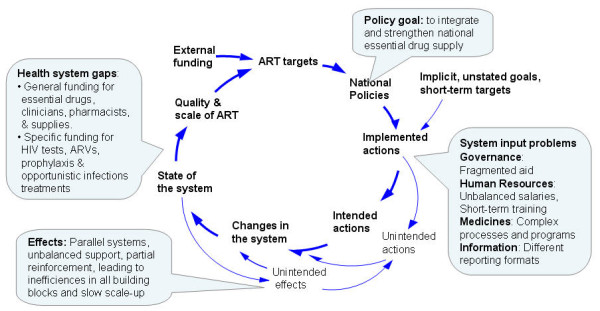
“unintended actions at different dimensions of the health system as conceptualized by systems thinking [23].”
BackgroundOomman, N., Bernstein, M. J., & Rosenzweig, S. C. (2007) · Cited by 82
Waddington, C. (2004) · Europe PMC (PubMed Central) · doi:10.1590/s0042-96862004000900013 · Cited by 49 · cited 1×
“Surveys on health system effects of disease-specific programs unanimously report adverse effects in the area of governance with parallel bureaucracies, a general lack of aid coordination and integration to national systems [7,15,17,52-62].”
BackgroundPromoting Country Ownership and Stewardship of Health Programs: The Global Fund Experience
Atun, R. A., & Kazatchkine, M. D. (2009) · JAIDS Journal of Acquired Immune Deficiency Syndromes · doi:10.1097/qai.0b013e3181bbcd58 · Cited by 39 · cited 1×
“Research has, however, focused on single effects and paid little attention to the interactions among health system building blocks and interventions or the role of contextual and governance issues [20-24].”
BackgroundCommitting to Results: Improving the Effectiveness of HIV/AIDS Assistance
Ainsworth, M., Hahn, J. A., & Vaillancourt, D. A. (2005) · doi:10.1596/978-0-8213-6388-1 · Cited by 31
Bernstein, M. J., & Sessions, M. (2007) · Cited by 26
Committing to Results: Improving the Effectiveness of HIV/AIDS Assistance
Ainsworth, M. (2005) · Cited by 18
Uganda edges closer to AIDS treatment for all
Bamuturaki, M. (2008) · Bulletin of the World Health Organization · doi:10.2471/blt.08.020608 · Cited by 11
Research works printed but not linked: 1
- Wilkinson D Brugha R Hewitt S Assessment of proposal development and review process of the Global Fund to Fight AIDS, Tuberculosis and Malaria: assessment report 2006 Soborg, Denmark, Euro Health Group
Cited by
Warren, A. E., Wyss, K., Shakarishvili, G., Atun, R., & de Savigny, D. (2013) · Globalization and Health · doi:10.1186/1744-8603-9-30 · Cited by 160
“Of all the interventions nested within Medicines and Technology, it is vital that the strengthening of supply chain management and procurement systems is not overlooked [92].”
BackgroundPolypharmacy management by 2030: a patient safety challenge.
Mair, A. R., Fernández-Llimós, F., Alonso, A., Harrison, C., Hurding, S., Kempen, T. G. H., Kinnear, M., Michael, N., McIntosh, J., & Wilson, M. (2017) · Edinburgh Napier Research Repository (Edinburgh Napier University) · Cited by 148
Anderson, G. A., Ilcisin, L. A. S., Kayima, P., Abesiga, L., Benitez, N. P., Ngonzi, J. N. J., Ronald, M., & Shrime, M. G. (2017) · PLoS ONE · doi:10.1371/journal.pone.0187293 · Cited by 131
Rogers, H. E., Akiteng, A. R., Mutungi, G. N., Ettinger, A. S., & Schwartz, J. I. (2018) · BMC Health Services Research · doi:10.1186/s12913-018-3426-x · Cited by 118
Overcoming health systems barriers to successful malaria treatment
Rao, B., Schellenberg, D. M., & Ghani, A. C. (2013) · Trends in Parasitology · doi:10.1016/j.pt.2013.01.005 · Cited by 112
Metadata
- Authors
- Windisch, R., Waiswa, P., Neuhann, F., Scheibe, F., & de Savigny, D.
- Affiliations
- Swiss Tropical and Public Health Institute (CH)
- Makerere University (UG)
- Heidelberg University (DE)
- Corresponding author
- Windisch, Ricarda
- Venue
- Globalization and Health
- Published
- 2011
- Volume
- 7
- Issue
- 1
- Pages
- 25
- ISSN
- 1744-8603 (ISSN-L)
- PMC
- PMC3161852
- OpenAlex
- W2070456588
- Semantic Scholar
- 2f637472bdf236156c1d5a523eb681bda84f4858
- Cited by
- 67
- References
- 25
- Citations by year
- 2026: 3 · 2025: 2 · 2024: 5 · 2023: 2 · 2022: 3 · 2021: 7 · 2020: 4 · 2019: 9 · 2018: 5 · 2017: 6 · 2016: 5 · 2015: 4 · 2014: 6 · 2013: 4 · 2012: 2
- FWCI
- 9.73
- Type
- journal article
- Language
- en
- Open access
- gold
- doi.org
- Licence
- cc-by
- Locations
- Globalization and Health (publishedVersion, cc-by)
- Europe PMC (PubMed Central) (publishedVersion, cc-by)
- PubMed Central (publishedVersion, cc-by)
- PubMed (publishedVersion)
- edoc (University of Basel) (acceptedVersion)
- DOAJ (DOAJ: Directory of Open Access Journals) (submittedVersion)
- edoc (University of Basel)
- Funders
- Universität Basel
- Instituut voor Tropische Geneeskunde
- European Commission
- Karolinska Institutet
- Topics
- Social Sciences › Economics, Econometrics and Finance › Economics and Econometrics › Pharmaceutical Economics and Policy
- Health Sciences › Medicine › Public Health, Environmental and Occupational Health › Healthcare Systems and Reforms
- Health Sciences › Medicine › Public Health, Environmental and Occupational Health › Healthcare Systems and Practices
- Keywords
- antiretroviral therapy, pharmaceutical supply chain, health system strengthening, HIV/AIDS, external support, health system governance, health care financing, healthcare workers, health information systems, drug shortages, essential medicines, systems thinking, Uganda
About these checks
Registry, retraction, Cites and statistics results are computed, not judged, with one exception: a printed reference that no index lists is read once by a model before it counts as a citation error. Claims are extracted by a model and kept only when their quote appears verbatim in the text; each cited source is then checked, with a model’s help, for whether it says what the claim relies on. Those verdicts can be wrong — read the claim’s quote and the cited source before relying on one.
Statistics and arithmetic are recomputed, not judged.
Confidence bands are shown only for fields calibrated on our annotated test set. None is calibrated yet, so no band is shown.
What counts as a claim ›How we measure confidence ›How we check this ›
Are you an author, or do you see a problem with this page? Request a review
Data sources
Bibliographic data: Semantic Scholar, OpenAlex, Crossref.
Contains information from the Semantic Scholar Academic Graph Datasets, made available under the ODC Attribution License (ODC-BY 1.0).
Semantic Scholar’s data is described in: Kinney, R., et al. (2023). The Semantic Scholar Open Data Platform. arXiv:2301.10140.
