

Executive functions and selective attention are favored in middle-aged healthy women carriers of the Val/Val genotype of the catechol-o-methyltransferase gene: a behavioral genetic study
Open accessThe DOI matches its Crossref record; 88 of the 90 references it cites were found in a registry or an index.
Abstract
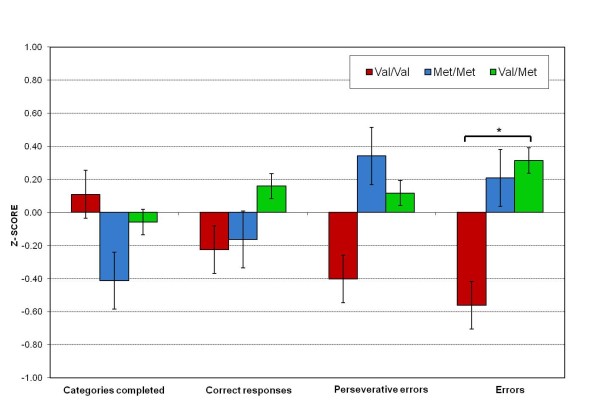
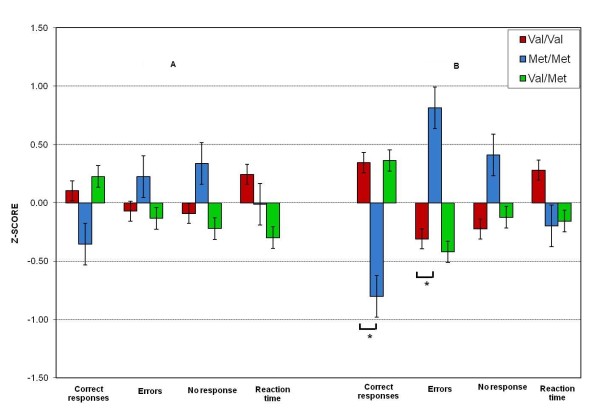
BACKGROUND: Cognitive deficits such as poor memory, the inability to concentrate, deficits in abstract reasoning, attention and set-shifting flexibility have been reported in middle-aged women. It has been suggested that cognitive decline may be due to several factors which include hormonal changes, individual differences, normal processes of aging and age-related changes in dopaminergic neurotransmission. Catechol-O-methyltransferase (COMT), a common functional polymorphism, has been related to executive performance in young healthy volunteers, old subjects and schizophrenia patients. The effect of this polymorphism on cognitive function in middle-aged healthy women is not well known. The aim of the current study was to investigate whether measures of executive function, sustained attention, selective attention and verbal fluency would be different depending on the COMT genotype and task demand. METHOD: We genotyped 74 middle-aged healthy women (48 to 65 years old) for the COMT Val158Met polymorphism. We analyzed the effects of this polymorphism on executive functions (Wisconsin Card Sorting Test), selective attention (Stroop test), sustained attention (Continuous Performance Test) and word generation (Verbal Fluency test), which are cognitive functions that involve the frontal lobe. RESULTS: There were 27 women with the Val/Val COMT genotype, 15 with the Met/Met genotype, and 32 with the Val/Met genotype. Women carriers of the Val/Val genotype performed better in executive functions, as indicated by a lower number of errors committed in comparison with the Met/Met or Val/Met groups. The correct responses on selective attention were higher in the Val/Val group, and the number of errors committed was higher in the Met/Met group during the incongruence trial in comparison with the Val/Val group. Performance on sustained attention and the number of words generated did not show significant differences between the three genotypes. CONCLUSION: These findings indicate that middle-aged women carriers of the Val158 allele, associated with high-activity COMT, showed significant advantage over Met allele in executive processes and cognitive flexibility. These results may help to explain, at least in part, individual differences in cognitive decline in middle-aged women with dopamine-related genes.
Overview
The claims and statistics of this paper haven’t been checked yet.
Free: it reads the open-access text and checks the first 5 claims that cite a source we can check. Create a free account to check every claim.
Integrity signals
Registry
Cites
Statistics
Figures
Verification
Claims the paper makes
The claims and statistics of this paper haven’t been checked yet.
Free: it reads the open-access text and checks the first 5 claims that cite a source we can check. Create a free account to check every claim.
Claims other papers make about this one
Each is checked against this paper’s own text: does it say what the citing paper says it does?
The cited source says what the claim attributes to it.
In the citing paper
“A polymorphism of COMT with decreased function (Chen et al., 2004), was associated with increased activation of the IFG during action cancelation (Congdon et al., 2009) and decreased interference inhibition (Solis-Ortiz et al., 2010), although conflicting results have also been reported (Kramer et al., 2007).”
From Response Inhibition and Interference Control in Obsessive–Compulsive Spectrum Disorders (2014) · cites this paper as Solis-Ortiz et al., 2010
Self-check
Percentages, sums and reported differences re-computed from the paper’s own numbers.
The self-check needs the paper’s full text.
Citations
Cites
Folstein, M. F., Folstein, S. E., & McHugh, P. R. (1975) · Journal of Psychiatric Research · doi:10.1016/0022-3956(75)90026-6 · Cited by 88,282
Hirono, N., Mori, E., Ikejiri, Y., Imamura, T., Shimomura, T., Hashimoto, M., Yamashita, H., & Ikeda, M. (1997) · Brain and nerve · Cited by 21,039
Kok, J. S., Berg, I. J., & Scherder, E. J. A. (2013) · Dementia and Geriatric Cognitive Disorders Extra · doi:10.1159/000353441 · Cited by 20,589
Older Adults' Reasons for Using Technology while Aging in Place
Peek, S. T. M., Luijkx, K. G., Rijnaard, M. D., Nieboer, M. E., van der Voort, C. S., Aarts, S., van Hoof, J., Vrijhoef, H. J. M., & Wouters, E. J. M. (2016) · Gerontology · doi:10.1159/000430949 · Cited by 19,690
Sensitivity and False Alarm Rate of a Fall Sensor in Long-Term Fall Detection in the Elderly
Kangas, M., Korpelainen, R., Vikman, I., Nyberg, L., & Jämsä, T. (2015) · Gerontology · doi:10.1159/000362720 · Cited by 18,909
Studies of interference in serial verbal reactions
Stroop, J. R. (1935) · Journal of Experimental Psychology · doi:10.1037/h0054651 · Cited by 18,622
Genetic dissection of complex traits: guidelines for interpreting and reporting linkage results
Lander, E., & Kruglyak, L. (1995) · Nature Genetics · doi:10.1038/ng1195-241 · Cited by 5,239
Effect of COMT Val 108/158 Met genotype on frontal lobe function and risk for schizophrenia
Egan, M. F., Goldberg, T. E., Kolachana, B. S., Callicott, J. H., Mazzanti, C. M., Straub, R. E., Goldman, D., & Weinberger, D. R. (2001) · Proceedings of the National Academy of Sciences · doi:10.1073/pnas.111134598 · Cited by 2,381
A continuous performance test of brain damage
Rosvold, H. E., Mirsky, A. F., Sarason, I., Bransome, E. D., & Beck, L. H. (1956) · Journal of Consulting Psychology · doi:10.1037/h0043220 · Cited by 2,261 · cited 1×
“A computerized version of the Continuous Performance Test (CPT) was used to examine the ability to sustain attention [ 59 ].”
MethodAn application of prefrontal cortex function theory to cognitive aging.
West, R. L. (1996) · Psychological Bulletin · doi:10.1037//0033-2909.120.2.272 · Cited by 2,052
Research works printed but not linked: 1
- [61]Benton A Hamsher KD Varney N Spreen O Contribution to Neuropsychological Assessment 1983 New York: Oxford University Press
Cited by
Brisch, R., Saniotis, A., Wolf, R., Bielau, H., Bernstein, H.-G., Steiner, J., Bogerts, B., Braun, A. K., Jankowski, Z., Kumaritlake, J., et al. (2014) · Frontiers in Psychiatry · doi:10.3389/fpsyt.2014.00047 · Cited by 517
Logue, S. F., & Gould, T. J. (2014) · Pharmacology Biochemistry and Behavior · doi:10.1016/j.pbb.2013.08.007 · Cited by 477
Hall, K. T., Lembo, A. J., Kirsch, I., Ziogas, D. C., Douaiher, J., Jensen, K. B., Conboy, L. A., Kelley, J. M., Kokkotou, E., & Kaptchuk, T. J. (2012) · PLoS ONE · doi:10.1371/journal.pone.0048135 · Cited by 205
Response Inhibition and Interference Control in Obsessive–Compulsive Spectrum Disorders
van Velzen, L. S., Vriend, C., de Wit, S. J., & van den Heuvel, O. A. (2014) · Frontiers in Human Neuroscience · doi:10.3389/fnhum.2014.00419 · Cited by 169
Ira, E., Zanoni, M., Ruggeri, M., Dazzan, P., & Tosato, S. (2013) · Journal of Psychiatry and Neuroscience · doi:10.1503/jpn.120178 · Cited by 99
Warneke, W., Klaus, S., Fink, H., Langley‐Evans, S. C., & Voigt, J. (2013) · Pharmacology Biochemistry and Behavior · doi:10.1016/j.pbb.2013.11.016 · Cited by 58
Genetic Polymorphisms Influence Recovery from Traumatic Brain Injury
Weaver, S. M., Chau, A., Tremont, J. N. P., & Grafman, J. H. (2012) · The Neuroscientist · doi:10.1177/1073858411435706 · Cited by 45
Bajerska, J., Woźniewicz, M., Suwalska, A., & Jeszka, J. (2014) · PubMed · Cited by 43
Weaver, S. M., Tremont, J. N. P., Chau, A., Cristofori, I., Moretti, L., & Grafman, J. H. (2012) · Brain Imaging and Behavior · doi:10.1007/s11682-012-9197-9 · Cited by 38
The COMT val158met polymorphism in ultra-endurance athletes
van Breda, K., Collins, M., Stein, D. J., & Rauch, L. (2015) · Physiology & Behavior · doi:10.1016/j.physbeh.2015.07.039 · Cited by 25
Endophenotypes as a measure of suicidality
Chistiakov, D. A., Kekelidze, Z. I., & Chekhonin, V. P. (2012) · Journal of Applied Genetics · doi:10.1007/s13353-012-0113-1 · Cited by 24
Gender effects of the COMT Val158Met genotype on verbal fluency in healthy adults
Soeiro‐de‐Souza, M. G., Bio, D. S., David, D. P., Missio, G., LIMA, B., Fernandes, F. D. S., Machado‐Vieira, R., & Moreno, R. A. (2013) · Molecular Medicine Reports · doi:10.3892/mmr.2013.1564 · Cited by 23
Dopaminergic gene polymorphisms and cognitive function in a north Indian schizophrenia cohort
Kukshal, P., Kodavali, V. C., Srivastava, V., Wood, J. A., McClain, L. L., Bhatia, T., Bhagwat, A. M., Deshpande, S. N., Nimgaonkar, V. L., & Thelma, B. K. (2013) · Journal of Psychiatric Research · doi:10.1016/j.jpsychires.2013.07.007 · Cited by 23
Cognitive flexibility in humans and other laboratory animals
Highgate, Q., & Schenk, S. (2020) · Journal of the Royal Society of New Zealand · doi:10.1080/03036758.2020.1784240 · Cited by 23
Jin, J., Liu, L., Gao, Q., Chan, R. C. K., Li, H., Chen, Y., Wang, Y., & Qian, Q. (2015) · Genes Brain & Behavior · doi:10.1111/gbb.12270 · Cited by 21
González‐Giraldo, Y., Rojas, J., Novoa, P., Mueller, S. T., Piper, B. J., Adán, A., & Forero, D. A. (2014) · Neuropsychobiology · doi:10.1159/000366483 · Cited by 19
Khanthiyong, B., Thanoi, S., Reynolds, G. P., & Nudmamud‐Thanoi, S. (2019) · International Journal of Medical Sciences · doi:10.7150/ijms.35789 · Cited by 14
Modulation of the COMT Val158Met polymorphism on resting-state EEG power
Solís-Ortiz, S., Elva, P.-L., & Gutiérrez-Muñoz, M. (2015) · Frontiers in Human Neuroscience · doi:10.3389/fnhum.2015.00136 · Cited by 10
Self-citationFacial Sadness Recognition is Modulated by Estrogen Receptor Gene Polymorphisms in Healthy Females
Gutiérrez-Muñoz, M., Fajardo-Araujo, M. E., González-Pérez, E. G., Aguirre-Arzola, V. E., & Solís-Ortiz, S. (2018) · Brain Sciences · doi:10.3390/brainsci8120219 · Cited by 10
Self-citationCherner, M., Watson, C. W.-M., Saloner, R., Halpin, L. E., Minassian, A., Murray, S. S., Vaida, F., Bousman, C., & Everall, I. (2019) · Addictive Behaviors · doi:10.1016/j.addbeh.2019.06.012 · Cited by 10
Apa, Z. L., Gilsoul, J., Dideberg, V., & Collette, F. (2024) · PLoS ONE · doi:10.1371/journal.pone.0303343 · Cited by 4
Implementing Genomics in the Care of Neuropsychiatric Patients in Latin America
Forero, D. A., Urriago, H., López‐León, S., González‐Giraldo, Y., de Miranda, D. M., & Jovel, C. A. E. (2018) · Elsevier eBooks · doi:10.1016/b978-0-12-811531-2.00005-9 · Cited by 4
Kaleybar, M. S., Gharamaleki, H. B., Yousefi, R., & Rahbaran, R. (2019) · The Neuroscience Journal of Shefaye Khatam · doi:10.29252/shefa.7.2.1 · Cited by 3
Solís-Ortiz, S., & González-Pérez, E. G. (2020) · Brain and Cognition · doi:10.1016/j.bandc.2020.105613 · Cited by 3
Self-citationEllenbroek, B. A., & Youn, J. (2016) · Elsevier eBooks · doi:10.1016/b978-0-12-801657-2.00009-4 · Cited by 3
Kwak, Y. (2011) · Deep Blue (University of Michigan)
Lozano, R. P. (2012) · Dipòsit Digital de Documents de la UAB (Universitat Autònoma de Barcelona)
Smith, J. M. (2015) · OhioLink ETD Center (Ohio Library and Information Network)
A longitudinal study of attention and inhibitory control in 6- to 11-year-old children
Lewis, F. C. (2017) · Minerva Access (University of Melbourne)
Haas, E. C. (2021) · Online Publication Service of Würzburg University (Würzburg University) · doi:10.25972/opus-21985
Automatic classification of fatty acid amide hydrolase polymorphism genotype based on EEG signal
Javanshir, R., Sedghi, M., Esmaeili, M., Charsouei, S., Anvar, L. H., & Ahmadalipour, A. (2024) · Soft Computing · doi:10.1007/s00500-024-10306-z
Determinants and correlates of placebo response in children with ADHD
Fageera, W. (2015) · eScholarship@McGill (McGill) · doi:10.82308/1866
Metadata
- Authors
- Solís-Ortiz, S., Pérez-Luque, E., Morado-Crespo, L., & Gutiérrez-Muñoz, M.
- Affiliations
- Universidad de Guanajuato (MX)
- Corresponding author
- Solís-Ortiz, Silvia
- Venue
- Behavioral and Brain Functions
- Published
- 2010
- Volume
- 6
- Issue
- 1
- Pages
- 67
- ISSN
- 1744-9081 (ISSN-L)
- PMC
- PMC2987980
- OpenAlex
- W2104667993
- Cited by
- 28
- References
- 90
- Citations by year
- 2024: 1 · 2023: 1 · 2020: 2 · 2019: 3 · 2018: 2 · 2016: 1 · 2015: 3 · 2014: 4 · 2013: 5 · 2012: 4
- FWCI
- 1.42
- Type
- journal article
- Language
- en
- Open access
- gold
- doi.org
- Licence
- cc-by
- Locations
- Behavioral and Brain Functions (publishedVersion, cc-by)
- PubMed Central (publishedVersion, cc-by)
- PubMed (publishedVersion)
- DOAJ (DOAJ: Directory of Open Access Journals) (submittedVersion, cc-by-sa)
- Funders
- Consejo Nacional de Ciencia y Tecnología
- Universidad de Guanajuato
- Topics
- Life Sciences › Neuroscience › Cellular and Molecular Neuroscience › Neurotransmitter Receptor Influence on Behavior
- Life Sciences › Neuroscience › Cognitive Neuroscience › Neural and Behavioral Psychology Studies
- Social Sciences › Psychology › Experimental and Cognitive Psychology › Cognitive Abilities and Testing
- Keywords
- catechol-O-methyltransferase, COMT Val158Met polymorphism, executive function, selective attention, sustained attention, verbal fluency, middle-aged women, cognitive decline, dopamine, cognitive flexibility, frontal lobe, age-related cognitive change
- MeSH terms
- Aged, Attention, Catechol O-Methyltransferase, Cognition, Female, Heterozygote, Humans, Middle Aged, Polymorphism, Genetic, Psychomotor Performance, Verbal Behavior, Executive Function
About these checks
Registry, retraction, Cites and statistics results are computed, not judged, with one exception: a printed reference that no index lists is read once by a model before it counts as a citation error. Claims are extracted by a model and kept only when their quote appears verbatim in the text; each cited source is then checked, with a model’s help, for whether it says what the claim relies on. Those verdicts can be wrong — read the claim’s quote and the cited source before relying on one.
Statistics and arithmetic are recomputed, not judged.
Confidence bands are shown only for fields calibrated on our annotated test set. None is calibrated yet, so no band is shown.
What counts as a claim ›How we measure confidence ›How we check this ›
Are you an author, or do you see a problem with this page? Request a review
Data sources
Bibliographic data: Semantic Scholar, OpenAlex, Crossref.
Contains information from the Semantic Scholar Academic Graph Datasets, made available under the ODC Attribution License (ODC-BY 1.0).
Semantic Scholar’s data is described in: Kinney, R., et al. (2023). The Semantic Scholar Open Data Platform. arXiv:2301.10140.
