

The efficacy of a brief intervention in reducing hazardous drinking in working age men in Russia: the HIM (Health for Izhevsk men) individually randomised parallel group exploratory trial
Open accessThe DOI matches its Crossref record; 27 of the 27 references it cites were found in a registry or an index.
Abstract
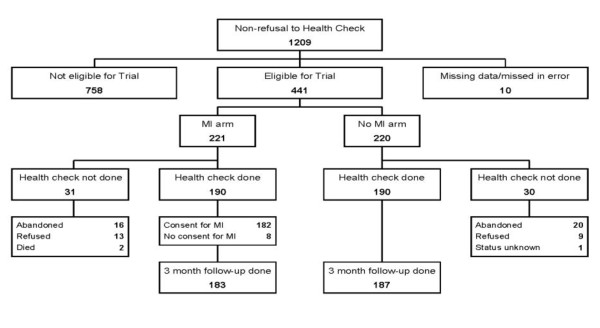
BACKGROUND: Russia has particularly low life expectancy for an industrialised country, with mortality at working ages having fluctuated dramatically over the past few decades, particularly among men. Alcohol has been identified as the most likely cause of these temporal variations. One approach to reducing the alcohol problem in Russia is 'brief interventions' which seek to change views of the personal acceptability of excessive drinking and to encourage self-directed behaviour change. Very few studies to evaluate the efficacy of brief interventions in Russia have been conducted. Motivational Interviewing (MI) is a person-centred counselling style which can be adapted to brief interventions in which help is offered in thinking through behaviour in the context of values and goals, to decide whether change is needed, and if so, how it may best be achieved. METHODS: This paper reports on an individually randomised two-armed parallel group exploratory trial. The primary hypothesis is that a brief adaptation of MI will be effective in reducing self-reported hazardous and harmful drinking at 3 months. Participants were drawn from the Izhevsk Family Study II, with eligibility determined based on proxy reports of hazardous and harmful drinking in the past year. All participants underwent a health check, with MI subsequently delivered to those in the intervention arm. Signed consent was obtained from those in the intervention arm only at this point. Both groups were then invited for 3 and 12 month follow ups. The control group did not receive any additional intervention. RESULTS: 441 men were randomised. Of these 61 did not have a health check leaving 190 in each trial arm. Follow up at 3 months was high (97% of those having a health check), and very similar in the two trial arms (183 in the intervention and 187 in the control). No significant differences were detected between the randomised groups in either the primary or the secondary outcomes at three months in the intention to treat analyses. The unadjusted odds ratio (95% CI) for the effect of MI on hazardous and harmful drinking was 0.77 (0.51, 1.16). An adjusted odds ratio of 0.52 (0.28, 0.94) was obtained in the pre-specified per protocol analysis. CONCLUSIONS: This trial demonstrates that it is possible to engage Russian men who drink hazardously in a brief intervention aimed at reducing alcohol related harm. However the results with respect to the efficacy are equivocal and further, larger-scale trials are warranted. TRIAL REGISTRATION: ISRCTN: ISRCTN82405938.
Overview
The claims and statistics of this paper haven’t been checked yet.
Free: it reads the open-access text and checks the first 5 claims that cite a source we can check. Create a free account to check every claim.
Integrity signals
Registry
Cites
Statistics
Figures
Verification
Claims the paper makes
The claims and statistics of this paper haven’t been checked yet.
Free: it reads the open-access text and checks the first 5 claims that cite a source we can check. Create a free account to check every claim.
Claims other papers make about this one
Each is checked against this paper’s own text: does it say what the citing paper says it does?
The cited source doesn’t support the claim as written.
In the citing paper
“Blinding of participants and personnel (performance bias) All outcomes Low risk”
From Psychosocial and pharmacologic interventions to reduce harmful alcohol use in low- and middle-income countries (2023) · cites this paper as Allen 2011
Checked by a reasoning model — may be wrong.
Experimental — accuracy not yet measuredThe source backs part of the claim, not all of it — or backs it for a different population, condition or comparison.
In the citing paper
“Random sequence generation (selection bias) Unclear risk”
From Psychosocial and pharmacologic interventions to reduce harmful alcohol use in low- and middle-income countries (2023) · cites this paper as Allen 2011
Experimental — accuracy not yet measuredThe source backs part of the claim, not all of it — or backs it for a different population, condition or comparison.
In the citing paper
“Allocation concealment (selection bias) Unclear risk”
From Psychosocial and pharmacologic interventions to reduce harmful alcohol use in low- and middle-income countries (2023) · cites this paper as Allen 2011
Experimental — accuracy not yet measuredThe cited source says what the claim attributes to it.
In the citing paper
“Five included brief intervention trials with 2240 participants reported on remission from harmful alcohol use (Allen 2011; Huis In't Veld 2019; L'Engle 2014; Pengpid 2015; Signor 2013). All trials operationalized remission as abstinence and/or low‐risk drinking.”
From Psychosocial and pharmacologic interventions to reduce harmful alcohol use in low- and middle-income countries (2023) · cites this paper as Allen 2011
The check wasn’t confident either way, so it gives no verdict — never disputed.
In the citing paper
“Incomplete outcome data (attrition bias) All outcomes Unclear risk”
From Psychosocial and pharmacologic interventions to reduce harmful alcohol use in low- and middle-income countries (2023) · cites this paper as Allen 2011
Experimental — accuracy not yet measured
2 more claims about this paper
Create a free account to see every claim other papers make about this one.
Self-check
Percentages, sums and reported differences re-computed from the paper’s own numbers.
The self-check needs the paper’s full text.
Citations
Cites
SAUNDERS, J. B., AASLAND, O. G., BABOR, T. F., DE LA FUENTE, J. R., & GRANT, M. (1993) · Addiction · doi:10.1111/j.1360-0443.1993.tb02093.x · Cited by 13,597 · cited 9×
“Adjustments for the baseline values of the outcomes and the imbalance in AUDIT score reduced the OR (95% CI) to 0.64 (0.39, 1.06).”
MethodInfluentialMotivational interviewing: preparing people for change.
Miller, W. R., & Rollnick, S. (2002) · Guilford Press eBooks · Cited by 7,915
Effectiveness of brief alcohol interventions in primary care populations
Kaner, E. F., Beyer, F. R., Muirhead, C., Campbell, F., Pienaar, E. D., Bertholet, N., Daeppen, J. B., Saunders, J. B., & Burnand, B. (2018) · Cochrane Database of Systematic Reviews · doi:10.1002/14651858.cd004148.pub4 · Cited by 1,665
Moyer, A., Finney, J. W., Swearingen, C. E., & Vergun, P. (2002) · Addiction · doi:10.1046/j.1360-0443.2002.00018.x · Cited by 1,092 · cited 3×
“It is known however that effect sizes for brief interventions are smaller when, as in this study, dependent drinkers are not excluded [26].”
BackgroundMethodInfluentialHuge variation in Russian mortality rates 1984–94: artefact, alcohol, or what?
Leon, D. A., Chenet, L., Shkolnikov, V. M., Zakharov, S., Shapiro, J., Rakhmanova, G., Vassin, S., & McKee, M. (1997) · The Lancet · doi:10.1016/s0140-6736(97)03360-6 · Cited by 779 · cited 1×
“Over the past 25 years life expectancy has fluctuated dramatically, driven largely by deaths among working age men whose pattern implicates alcohol as a major factor [3,4].”
BackgroundSelf-citationEffectiveness of brief alcohol interventions in primary care populations
Kaner, E. F. S., Dickinson, H. O., Beyer, F. R., Campbell, F., Schlesinger, C., Heather, N., Saunders, J. B., Burnand, B., & Pienaar, E. D. (2007) · Cochrane Database of Systematic Reviews · doi:10.1002/14651858.cd004148.pub3 · Cited by 746 · cited 2×
“Reductions in volume of alcohol consumed are typically about 10-15%[13] and reductions in the proportions of hazardous drinkers are between 10-19%[14].”
Whitlock, E. P., Polen, M. R., Green, C. A., Orleans, T., & Klein, J. (2004) · Annals of Internal Medicine · doi:10.7326/0003-4819-140-7-200404060-00017 · Cited by 717
Brief Physician Advice for Problem Drinkers: Long-Term Efficacy and Benefit-Cost Analysis
Fleming, M. F., Mundt, M. P., French, M. T., Manwell, L. B., Stauffacher, E. A., & Barry, K. L. (2002) · Alcoholism: Clinical & Experimental Research · doi:10.1097/00000374-200201000-00006 · Cited by 538 · cited 1×
“Reductions in alcohol problems of a similar magnitude and in health service utilisation have also been identified [15].”
BackgroundHazardous alcohol drinking and premature mortality in Russia: a population based case-control study
Leon, D. A., Saburova, L., Tomkins, S., Andreev, E., Kiryanov, N., McKee, M., & Shkolnikov, V. M. (2007) · The Lancet · doi:10.1016/s0140-6736(07)60941-6 · Cited by 438 · cited 2×
“This was based on 1750 men who were the controls in a case-control study of premature mortality conducted 2003-5 [5] supplemented by a further 250 men recruited using an identical protocol in 2006.”
BackgroundMethodSelf-citationTrends in European life expectancy: a salutary view
Leon, D. A. (2011) · International Journal of Epidemiology · doi:10.1093/ije/dyr061 · Cited by 316 · cited 1×
“In 2008, for males it was only 62 years [2].”
BackgroundSelf-citationRandomized consent designs for clinical trials: An update
Zelen, M. (1990) · Statistics in Medicine · doi:10.1002/sim.4780090611 · Cited by 288
Traditional markers of excessive alcohol use
Conigrave, K. M., Davies, P., Haber, P., & Whitfield, J. B. (2003) · Addiction · doi:10.1046/j.1359-6357.2003.00581.x · Cited by 287 · cited 1×
“The health check involved the doctor taking a medical history, measuring blood pressure, height and weight and taking a blood sample which was used to determine levels of the liver enzyme gamma-glutamyltransferase (GGT), a proxy marker for heavy alcohol drinking [21].”
MethodMortality trends and setbacks: global convergence or divergence?
McMichael, A. J., McKee, M., Shkolnikov, V., & Valkonen, T. (2004) · The Lancet · doi:10.1016/s0140-6736(04)15902-3 · Cited by 227 · cited 1×
“Russia has one of the lowest life expectancies among industrialised countries [1].”
BackgroundSelf-citationAlcohol and Russian mortality: a continuing crisis
Leon, D. A., Shkolnikov, V. M., & McKee, M. (2009) · Addiction · doi:10.1111/j.1360-0443.2009.02655.x · Cited by 194 · cited 1×
“Over the past 25 years life expectancy has fluctuated dramatically, driven largely by deaths among working age men whose pattern implicates alcohol as a major factor [3,4].”
BackgroundSelf-citationMcCambridge, J., & Day, M. (2008) · Addiction · doi:10.1111/j.1360-0443.2007.02080.x · Cited by 156 · cited 1×
“This could have also diluted any effect of the MI intervention [24].”
BackgroundSelf-citationOn drug treatment and social control: Russian narcology's great leap backwards
Elovich, R., & Drucker, E. (2008) · Harm Reduction Journal · doi:10.1186/1477-7517-5-23 · Cited by 114 · cited 1×
“The aim of most treatments in Russia is to achieve a “cure” or complete abstention, rather than harm reduction [12].”
Post-Soviet Placebos: Epistemology and Authority in Russian Treatments for Alcoholism
Raikhel, E. (2009) · Culture Medicine and Psychiatry · doi:10.1007/s11013-009-9163-1 · Cited by 107 · cited 2×
“While coding is regarded as a means of inducing a placebo effect, active pharmacological interventions such as disulfiram that produce unpleasant reactions if the person drinks are also employed [11].”
BackgroundAvailability and Characteristics of Nonbeverage Alcohols Sold in 17 Russian Cities in 2007
Gil, A., Polikina, O., Koroleva, N., McKee, M., Tomkins, S., & Leon, D. A. (2009) · Alcoholism: Clinical and Experimental Research · doi:10.1111/j.1530-0277.2008.00813.x · Cited by 71
Self-citationRussian alcohol policy in the making
Levintova, M. (2007) · Alcohol and Alcoholism · doi:10.1093/alcalc/agm040 · Cited by 60 · cited 1×
“In 2006 the Russian government imposed restrictions on the manufacture and sale of ethanol [7].”
BackgroundCochrane on Communism: the influence of ideology on the search for evidence
McKee, M. (2007) · International Journal of Epidemiology · doi:10.1093/ije/dym002 · Cited by 52 · cited 1×
“This has to be understood against a background of the rejection of randomisation by Soviet science [27].”
BackgroundSelf-citationMCCAMBRIDGE, J., & STRANG, J. (2003) · Drug and Alcohol Review · doi:10.1080/09595230310001613903 · Cited by 43 · cited 1×
“This was based on a previous topic-based approach to structuring the discussion in each session (see Additional file 1) [25].”
MethodSelf-citationPotential for Alcohol Policy to Decrease the Mortality Crisis in Russia
Khaltourina, D. A., & Korotayev, A. (2008) · Evaluation & the Health Professions · doi:10.1177/0163278708320160 · Cited by 39 · cited 1×
“However, the scale of the problem means that there is still much to be done [8,9].”
BackgroundGreenfield, S. F., Shields, A., Connery, H. S., Livchits, V., Yanov, S. A., Lastimoso, C. S., Strelis, A. K., Mishustin, S. P., Fitzmaurice, G., Mathew, T. A., et al. (2010) · Alcoholism: Clinical and Experimental Research · doi:10.1111/j.1530-0277.2009.01094.x · Cited by 29 · cited 1×
“The only other report of a trial of a brief intervention in Russia we have found is a protocol for a multi-arm randomised trial, including brief intervention aimed at reducing alcohol use and harms among TB patients in Tomsk, Siberia [19].”
BackgroundPrescribing in maternity care in Russia: The legacy of Soviet medicine
Danichevski, K., McKee, M., & Balabanova, D. (2007) · Health Policy · doi:10.1016/j.healthpol.2007.08.001 · Cited by 29 · cited 1×
“Even today there is relatively little expertise in the conduct or analysis of RCTs apart from in the pharmaceutical industry in Russia, with the principles of evidence-based medicine and practice being largely absent from the medical curriculum in Russia [28].”
BackgroundSelf-citationAlcohol policy in a Russian region: a stakeholder analysis
Gil, A. U., Polikina, O., Koroleva, N., Leon, D. A., & McKee, M. (2010) · European Journal of Public Health · doi:10.1093/eurpub/ckq030 · Cited by 28 · cited 1×
“However, the scale of the problem means that there is still much to be done [8,9].”
BackgroundSelf-citationDrug and Alcohol User Treatment/ Intervention Services in Russia-A Western Perspective
Fleming, P. M. (1996) · Substance Use & Misuse · doi:10.3109/10826089609045801 · Cited by 12 · cited 1×
“In Russia the treatment of alcohol problems is highly medicalised [10], and mainly delivered through specialist institutions (narcology dispensaries).”
BackgroundThe HIM (Health for Izhevsk Men) trial protocol
Tomkins, S., Allen, E., Savenko, O., McCambridge, J., Saburova, L., Kiryanov, N. A., Oralov, A., Gil, A. U., Leon, D. A., McKee, M., et al. (2008) · BMC Health Services Research · doi:10.1186/1472-6963-8-69 · Cited by 6
Self-citation
Research works printed but not linked: 2
- Babor TF Grant M WHO Programme on Substance Abuse. Project on identification and management of alcohol-related problems Report on Phase II: A randomized clinical trial of brief interventions in primary health care 1992 Geneva: World Health Organisation
- White S Russia Goes Dry 1996 Cambridge: Cambridge University Press
Cited by
Health and health systems in the Commonwealth of Independent States
Rechel, B., Roberts, B., Richardson, E., Shishkin, S. V., Школьников, В. М., Leon, D. A., Bobák, M., Karanikolos, M., & McKee, M. (2013) · The Lancet · doi:10.1016/s0140-6736(12)62084-4 · Cited by 112
Self-citationAcute pain management in burn patients: Appraisal and thematic analysis of four clinical guidelines
Gamst‐Jensen, H., Vedel, P. N., Lindberg-Larsen, V., & Egerod, I. (2014) · Burns · doi:10.1016/j.burns.2014.08.020 · Cited by 73
Motivational interviewing for substance use reduction
Schwenker, R., Dietrich, C. E., Hirpa, S., Nothacker, M., Smedslund, G., Frese, T., & Unverzagt, S. (2023) · Cochrane Database of Systematic Reviews · doi:10.1002/14651858.cd008063.pub3 · Cited by 56
From question-behaviour effects in trials to the social psychology of research participation
McCambridge, J. (2014) · Psychology and Health · doi:10.1080/08870446.2014.953527 · Cited by 52
“Though there are different types, the most common versions consent intervention participants to receive the intervention only at study entry, and avoid seeking consent from the control condition at that point for research procedures (Adamson, Cockayne, Puffer, & Torgerson, 2006; Allen et al., 2011).”
BackgroundSelf-citationBarrio, P., & Gual, A. (2016) · Patient Preference and Adherence · doi:10.2147/ppa.s109641 · Cited by 43
“Allen et al failed to show any significant difference on the same outcome.(48) Sellman et al reported a significant decrease in the percentage of heavy drinking days in the past 6 months favoring PCC (42.”
Metadata
- Authors
- Allen, E., Polikina, O., Saburova, L., McCambridge, J., Elbourne, D., Pakriev, S., Nekrasova, N., Vasilyev, M., Tomlin, K., Oralov, A., Gil, A., McKee, M., Kiryanov, N., & Leon, D. A.
- Affiliations
- London School of Hygiene & Tropical Medicine (GB)
- Izhevsk State Technical University (RU)
- Izhevsk State Medical Academy (RU)
- Sechenov University (RU)
- Corresponding author
- Allen, Elizabeth
- ORCID
- Venue
- Trials
- Published
- 2011-11-04
- Volume
- 12
- Issue
- 1
- Pages
- 238-238
- ISSN
- 1745-6215 (ISSN-L)
- PMC
- PMC3222605
- OpenAlex
- W2164403931
- Semantic Scholar
- 74b64b45d1ba5ae86e50398aaddf9a023ae891f9
- Cited by
- 18
- References
- 27
- Citations by year
- 2023: 2 · 2022: 2 · 2021: 1 · 2019: 2 · 2017: 3 · 2016: 1 · 2015: 2 · 2014: 2 · 2013: 1 · 2012: 2
- FWCI
- 1.20
- Type
- journal article
- Language
- en
- Open access
- gold
- doi.org
- Licence
- cc-by
- creativecommons.org/licenses/by/2.0 (tdm)
- Locations
- Trials (publishedVersion, cc-by)
- Europe PMC (PubMed Central) (publishedVersion, cc-by)
- PubMed Central (publishedVersion, cc-by)
- PubMed (publishedVersion)
- LSHTM Research Online (London School of Hygiene and Tropical Medicine) (acceptedVersion)
- DOAJ (DOAJ: Directory of Open Access Journals) (submittedVersion, cc-by-sa)
- Funders
- Wellcome Trust
- Topics
- Health Sciences › Medicine › Epidemiology › Substance Abuse Treatment and Outcomes
- Health Sciences › Medicine › Pathology and Forensic Medicine › Alcohol Consumption and Health Effects
- Social Sciences › Psychology › Applied Psychology › Behavioral Health and Interventions
- Keywords
- brief intervention, motivational interviewing, hazardous drinking, men's health, alcohol-related harm, Russian men, health check, behavior change, working-age men, alcohol-related harm reduction
- MeSH terms
- Adult, Alcohol Drinking, Humans, Interviews as Topic, Male, Middle Aged, Motivation, Russia, Outcome Assessment, Health Care
About these checks
Registry, retraction, Cites and statistics results are computed, not judged, with one exception: a printed reference that no index lists is read once by a model before it counts as a citation error. Claims are extracted by a model and kept only when their quote appears verbatim in the text; each cited source is then checked, with a model’s help, for whether it says what the claim relies on. Those verdicts can be wrong — read the claim’s quote and the cited source before relying on one.
Statistics and arithmetic are recomputed, not judged.
Confidence bands are shown only for fields calibrated on our annotated test set. None is calibrated yet, so no band is shown.
What counts as a claim ›How we measure confidence ›How we check this ›
Are you an author, or do you see a problem with this page? Request a review
Data sources
Bibliographic data: Semantic Scholar, OpenAlex, Crossref.
Contains information from the Semantic Scholar Academic Graph Datasets, made available under the ODC Attribution License (ODC-BY 1.0).
Semantic Scholar’s data is described in: Kinney, R., et al. (2023). The Semantic Scholar Open Data Platform. arXiv:2301.10140.
