

Hand washing with soap and water together with behavioural recommendations prevents infections in common work environment: an open cluster-randomized trial
Open accessThe DOI matches its Crossref record; 19 of the 19 references it cites were found in a registry or an index.
Abstract
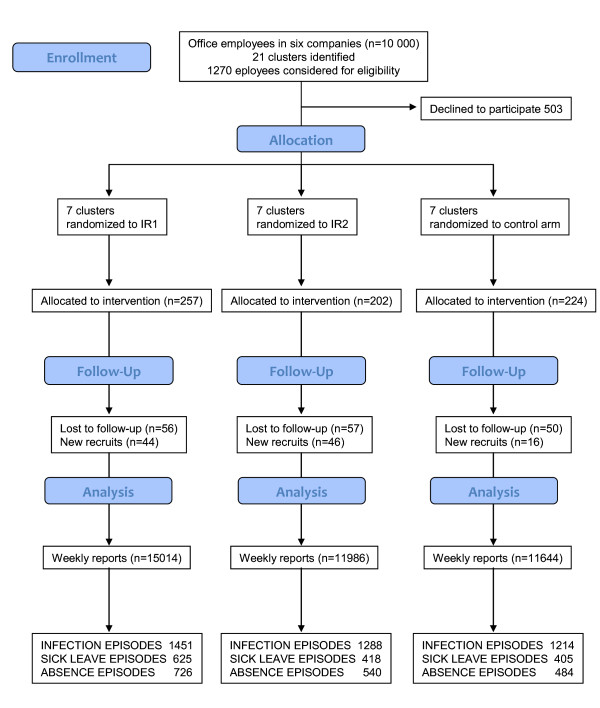
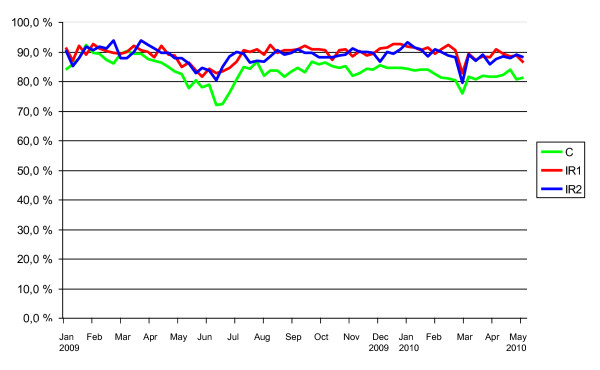
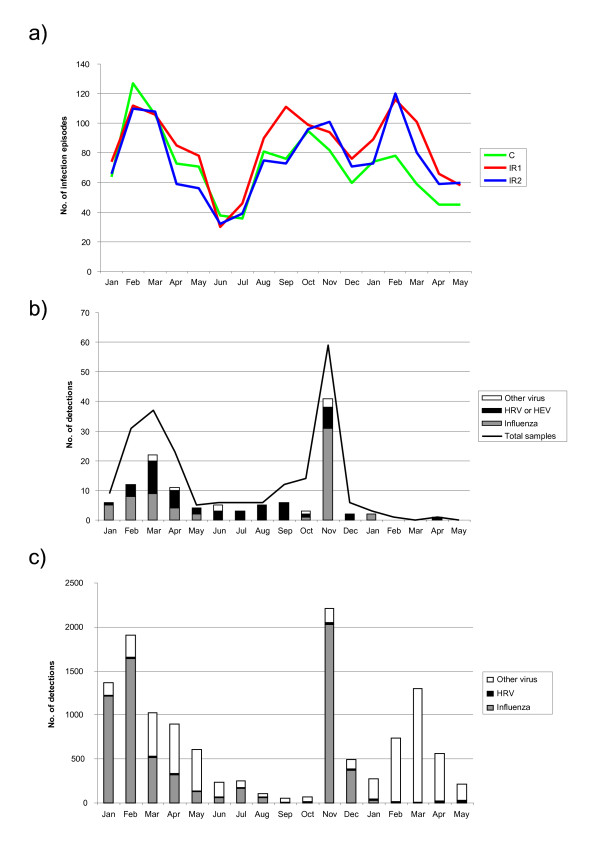
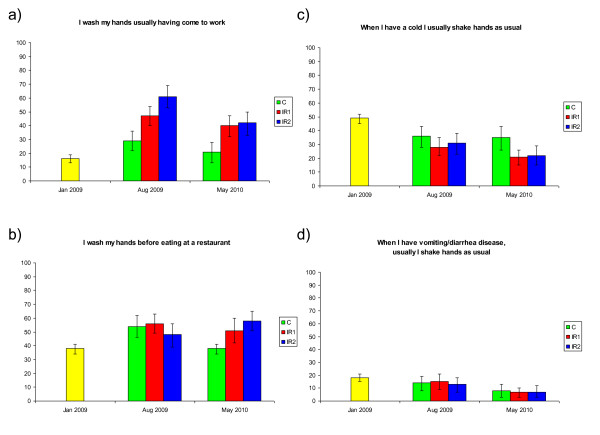
BACKGROUND: Hand hygiene is considered as an important means of infection control. We explored whether guided hand hygiene together with transmission-limiting behaviour reduces infection episodes and lost days of work in a common work environment in an open cluster-randomized 3-arm intervention trial. METHODS: A total of 21 clusters (683 persons) were randomized to implement hand hygiene with soap and water (257 persons), with alcohol-based hand rub (202 persons), or to serve as a control (224 persons). Participants in both intervention arms also received standardized instructions on how to limit the transmission of infections. The intervention period (16 months) included the emergence of the 2009 influenza pandemic and the subsequent national hand hygiene campaign influencing also the control arm. RESULTS: In the total follow-up period there was a 6.7% reduction of infection episodes in the soap-and water arm (p = 0.04). Before the onset of the anti-pandemic campaign, a statistically significant (p = 0.002) difference in the mean occurrence of infection episodes was observed between the control (6.0 per year) and the soap-and-water arm (5.0 per year) but not between the control and the alcohol-rub arm (5.6 per year). Neither intervention had a decreasing effect on absence from work. CONCLUSIONS: We conclude that intensified hand hygiene using water and soap together with behavioural recommendations can reduce the occurrence of self-reported acute illnesses in common work environment. Surprisingly, the occurrence of reported sick leaves also increased in the soap-and water-arm. TRIAL REGISTRATION: ClinicalTrials.gov: NCT00981877 SOURCE OF FUNDING: The Finnish Work Environment Fund and the National Institute for Health and Welfare.
Overview
The claims and statistics of this paper haven’t been checked yet.
Free: it reads the open-access text and checks the first 5 claims that cite a source we can check. Create a free account to check every claim.
Integrity signals
Registry
Cites
Statistics
Figures
Verification
Claims the paper makes
The claims and statistics of this paper haven’t been checked yet.
Free: it reads the open-access text and checks the first 5 claims that cite a source we can check. Create a free account to check every claim.
Claims other papers make about this one
Each is checked against this paper’s own text: does it say what the citing paper says it does?
The source backs part of the claim, not all of it — or backs it for a different population, condition or comparison.
In the citing paper
“whereas there was no difference between intervention groups in the Savolainen‐Kopra 2012 trial.”
From Physical interventions to interrupt or reduce the spread of respiratory viruses (2023) · cites this paper as Savolainen‐Kopra 2012
Experimental — accuracy not yet measuredThe check wasn’t confident either way, so it gives no verdict — never disputed.
In the citing paper
“In contrast, there was no significant difference between interventions in Savolainen‐Kopra 2012.”
From Physical interventions to interrupt or reduce the spread of respiratory viruses (2023) · cites this paper as Savolainen‐Kopra 2012
Experimental — accuracy not yet measuredThe check wasn’t confident either way, so it gives no verdict — never disputed.
In the citing paper
“Two trials stated that no adverse events were observed (Pandejpong 2012; Savolainen‐Kopra 2012).”
From Physical interventions to interrupt or reduce the spread of respiratory viruses (2023) · cites this paper as Savolainen‐Kopra 2012
Experimental — accuracy not yet measured
Self-check
Percentages, sums and reported differences re-computed from the paper’s own numbers.
The self-check needs the paper’s full text.
Citations
Cites
Effect of washing hands with soap on diarrhoea risk in the community: a systematic review
Curtis, V., & Cairncross, S. (2003) · The Lancet Infectious Diseases · doi:10.1016/s1473-3099(03)00606-6 · Cited by 1,208
Effect of hand hygiene on infectious disease risk in the community setting: a meta-analysis
Aiello, A. E., Coulborn, R. M., Perez, V., & Larson, E. L. (2008) · American Journal of Public Health · doi:10.2105/ajph.2007.124610 · Cited by 796 · cited 1×
“In recent meta-analyses, however, the overall evidence has been considered inconclusive due to differences in study designs and difficulty in adjusting for confounding factors [9,10].”
BackgroundEvidence-based model for hand transmission during patient care and the role of improved practices
Pittet, D., Allegranzi, B., Sax, H., Dharan, S., Pessoa-Silva, C. L., Donaldson, L., & Boyce, J. M. (2006) · The Lancet Infectious Diseases · doi:10.1016/s1473-3099(06)70600-4 · Cited by 790 · cited 1×
“Background Enhanced hand hygiene is a well established means to prevent the transmission of infections in hospital settings [1] as well as in other semi-closed environments with high infection pressure, such as day care centers [2-5], schools [6,7] and military service [8].”
BackgroundKampf, G., & Kramer, A. (2004) · Clinical Microbiology Reviews · doi:10.1128/cmr.17.4.863-893.2004 · Cited by 763 · cited 1×
“The absence of protection from infection episodes in the alcohol hand rub intervention group is at variance with a recent publication on a similar intervention reporting a remarkable reduction of disease episodes [11] and with some earlier studies [17,18].”
ResultCowling, B. J., Chan, K.-H., Fang, V. J., Cheng, C. K. Y., Fung, R. O. P., Wai, W., Sin, J., Seto, W. H., Yung, R., Chu, D. W. S., et al. (2009) · Annals of Internal Medicine · doi:10.7326/0003-4819-151-7-200910060-00142 · Cited by 533
Talaat, M., Afifi, S., Dueger, E., El-Ashry, N., Marfin, A., Kandeel, A., Mohareb, E., & El-Sayed, N. (2011) · Emerging Infectious Diseases · doi:10.3201/eid1704.101353 · Cited by 238 · cited 1×
“Background Enhanced hand hygiene is a well established means to prevent the transmission of infections in hospital settings [1] as well as in other semi-closed environments with high infection pressure, such as day care centers [2-5], schools [6,7] and military service [8].”
BackgroundComparative efficacy of hand hygiene agents in the reduction of bacteria and viruses
SICKBERTBENNETT, E., WEBER, D., GERGENTEAGUE, M., SOBSEY, M., SAMSA, G., & RUTALA, W. (2005) · American Journal of Infection Control · doi:10.1016/j.ajic.2004.08.005 · Cited by 187 · cited 1×
“Our main result of reduced respiratory infections through hand washing with soap and water combined with advice on coughing and sneezing is in agreement with several previously published studies in semi-closed populations such as hospitals and children’s day care centres [15,16].”
ResultSimmerman, J. M., Suntarattiwong, P., Levy, J., Jarman, R. G., Kaewchana, S., Gibbons, R. V., Cowling, B. J., Sanasuttipun, W., Maloney, S. A., Uyeki, T. M., et al. (2011) · Influenza and Other Respiratory Viruses · doi:10.1111/j.1750-2659.2011.00205.x · Cited by 177 · cited 1×
“In contrast, influenza transmission was not reduced by interventions to promote hand washing and face mask use in another study [13].”
BackgroundAn open randomized controlled trial of infection prevention in child day-care centers
UHARI, M., & MÖTTÖNEN, M. (1999) · The Pediatric Infectious Disease Journal · doi:10.1097/00006454-199908000-00004 · Cited by 126 · cited 1×
“Background Enhanced hand hygiene is a well established means to prevent the transmission of infections in hospital settings [1] as well as in other semi-closed environments with high infection pressure, such as day care centers [2-5], schools [6,7] and military service [8].”
BackgroundEffectiveness of a training program in reducing infections in toddlers attending day care centers
Carabin, H., Gyorkos, T. W., Soto, J. C., Joseph, L., Payment, P., & Collet, J.-P. (1999) · Epidemiology · doi:10.1097/00001648-199905000-00005 · Cited by 122
Cited by
Physical interventions to interrupt or reduce the spread of respiratory viruses
Jefferson, T., Del Mar, C. B., Dooley, L., Ferroni, E., Al-Ansary, L. A., Bawazeer, G. A., van Driel, M. L., Nair, N. S., Jones, M. A., Thorning, S., et al. (2011) · Cochrane Database of Systematic Reviews · doi:10.1002/14651858.cd006207.pub4 · Cited by 805
Hand washing promotion for preventing diarrhoea
Ejemot-Nwadiaro, R. I., Ehiri, J. E., Arikpo, D., Meremikwu, M. M., & Critchley, J. A. (2015) · Cochrane Database of Systematic Reviews · doi:10.1002/14651858.cd004265.pub3 · Cited by 332
Physical interventions to interrupt or reduce the spread of respiratory viruses
Jefferson, T., Del Mar, C. B., Dooley, L., Ferroni, E., Al-Ansary, L. A., Bawazeer, G. A., van Driel, M. L., Jones, M. A., Thorning, S., Beller, E. M., et al. (2020) · Cochrane Database of Systematic Reviews · doi:10.1002/14651858.cd006207.pub5 · Cited by 318
Physical interventions to interrupt or reduce the spread of respiratory viruses
Jefferson, T., Dooley, L., Ferroni, E., Al-Ansary, L. A., van Driel, M. L., Bawazeer, G. A., Jones, M. A., Hoffmann, T. C., Clark, J., Beller, E. M., et al. (2023) · Cochrane Database of Systematic Reviews · doi:10.1002/14651858.cd006207.pub6 · Cited by 291
WONG, V. W. Y., COWLING, B. J., & AIELLO, A. E. (2014) · Epidemiology and Infection · doi:10.1017/s095026881400003x · Cited by 146
“We excluded 31 studies after the full-length assessment [33–63] for the following reasons: studies were not RCTs, ineligible definition on ILI, no definition on respiratory diseases outcomes, hand hygiene interventions as a part of infection control programme, or no control group (see online Appendix).”
MethodHand-washing promotion for preventing diarrhoea
Ejemot-Nwadiaro, R. I., Ehiri, J. E., Arikpo, D., Meremikwu, M. M., & Critchley, J. (2021) · Cochrane Database of Systematic Reviews · doi:10.1002/14651858.cd004265.pub4 · Cited by 188
Taché, J., & Carpentier, B. (2013) · Food Control · doi:10.1016/j.foodcont.2013.07.026 · Cited by 106
“self-reported acute illness by Finnish office employees participating in an open cluster intervention trial (Savolainen-Kopra et al., 2012).”
BackgroundEffect of hand hygiene on infectious diseases in the office workplace: a systematic review
Zivich, P. N., Gancz, A. S., & Aiello, A. E. (2018) · American Journal of Infection Control · doi:10.1016/j.ajic.2017.10.006 · Cited by 58
Towards a data-driven characterization of behavioral changes induced by the seasonal flu
Gozzi, N., Perrotta, D., Paolotti, D., & Perra, N. (2020) · PLoS Computational Biology · doi:10.1371/journal.pcbi.1007879 · Cited by 54
“Thus, the routes of transmissions are intimately linked and affected by our behaviors; from social interactions to hygiene standards [44, 45].”
BackgroundYallew, W. W., Kumie, A., & Yehuala, F. M. (2017) · PLoS ONE · doi:10.1371/journal.pone.0181145 · Cited by 52
Bacteriological Aspects of Hand Washing: A Key for Health Promotion and Infections Control
Ataee, R. A., Ataee, M. H., Tavana, A. M., & Salesi, M. (2017) · International Journal of Preventive Medicine · doi:10.4103/2008-7802.201923 · Cited by 61
“[23] The lack of facilities for personnel hands washing will decrease their interest has shown.[24] Daily reports of infection associated with, could increase quantity and quality of hand washing.”
Arbogast, J. W., Moore-Schiltz, L. C., Jarvis, W. R., Harpster-Hagen, A., Hughes, J. M., & Parker, A. (2016) · Journal of Occupational and Environmental Medicine · doi:10.1097/jom.0000000000000738 · Cited by 49
Bowen, A. B., Agboatwalla, M., Ayers, T., Tobery, T. W., Tariq, M., & Luby, S. P. (2013) · Tropical Medicine & International Health · doi:10.1111/tmi.12046 · Cited by 42
“2005) and work environments (Hubner et al. 2010; Savolainen-Kopra et al. 2012); reduce school absenteeism (Bowen et al.”
BackgroundPerski, O., Szinay, D., Corker, E., Shahab, L., West, R., & Michie, S. (2021) · British Journal of Health Psychology · doi:10.1111/bjhp.12542 · Cited by 30
Mustikawati, I. S. (2017) · ARKESMAS (Arsip Kesehatan Masyarakat) · doi:10.22236/arkesmas.v2i1.514 · Cited by 58
Hovi, T., Ollgren, J. P., & Savolainen‐Kopra, C. (2017) · BMC Infectious Diseases · doi:10.1186/s12879-016-2157-z · Cited by 30
“Because of these undesired changes in the study setup, we initially made a simple global comparison of the infection rates of self-reported infection episodes between the arms before and during the pandemic and concluded, that frequent washing of hands with soap and water may reduce the rate of acute infections under…”
BackgroundMethodResultInfluentialSelf-citationMerk, H., Kühlmann‐Berenzon, S., Linde, A., & Nyrén, O. (2014) · BMC Infectious Diseases · doi:10.1186/1471-2334-14-509 · Cited by 26
“Moreover, despite the meticulous design of most intervention studies, many of them confirmed a statistically significant effect on the main outcome only in subgroup analyses [6,10-13] or the effect was confined to parts of the observation period [7,8].”
BackgroundResultInfluentialПродеус, А. П., Niborski, V., Schrezenmeir, J., Gorelov, A., Shcherbina, A., & Rumyantsev, A. G. (2016) · Journal of Pediatric Gastroenterology and Nutrition · doi:10.1097/mpg.0000000000001248 · Cited by 25
The little-known history of cleanliness and the forgotten pioneers of handwashing
Poczai, P., & Karvalics, L. Z. (2022) · Frontiers in Public Health · doi:10.3389/fpubh.2022.979464 · Cited by 24
Gao, L., Nie, Y., Wang, G., & Li, F. (2022) · Frontiers in Public Health · doi:10.3389/fpubh.2022.1053932 · Cited by 24
Veys, K., Dockx, K., Remoortel, H. V., Vandekerckhove, P. G., & Buck, E. D. J. D. (2021) · BMC Public Health · doi:10.1186/s12889-021-11815-4 · Cited by 22
“either liquid hand soap or alcohol-based hand rub was provided in toilets at work and for personal use, reported the number of respiratory illness episodes per total reported weeks [20].”
BackgroundMethodInfluentialStedman-Smith, M., DuBois, C. L. Z., Grey, S. F., Kingsbury, D. M., Shakya, S., Scofield, J., & Slenkovich, K. (2015) · Journal of Occupational and Environmental Medicine · doi:10.1097/jom.0000000000000421 · Cited by 18
Palo, S. K., Kanungo, S., Samal, M., Priyadarshini, S., Sahoo, D., & Pati, S. (2021) · Journal of preventive medicine and hygiene · doi:10.15167/2421-4248/jpmh2021.62.2.1503 · Cited by 18
Lange, S. L., Barnard, T. G., & Naicker, N. (2022) · Perspectives in Public Health · doi:10.1177/17579139221123404 · Cited by 10
Coller, G., Schiavon, M., & Ragazzi, M. (2021) · Environment Development and Sustainability · doi:10.1007/s10668-020-01109-x · Cited by 12
Al‐Ansary, L. A., Bawazeer, G. A., Beller, E., Clark, J. M., Conly, J. M., Mar, C. D., Dooley, E., Ferroni, E., Glasziou, P., Hoffmann, T., et al. (2020) · medRxiv · doi:10.1101/2020.04.14.20065250 · Cited by 12
“Savolainen-Kopra et al [44]”
Li, L., Xu, W., Wagner, A. L., Dong, X., Yin, J., Zhang, Y., & Boulton, M. L. (2018) · Journal of Infection and Public Health · doi:10.1016/j.jiph.2018.09.004 · Cited by 9
Hoffmann, T., Bakhit, M., Krzyżaniak, N., Mar, C. D., Scott, A. M., & Glasziou, P. (2021) · BMJ Open · doi:10.1136/bmjopen-2020-046175 · Cited by 14
The Efficacy of Common Household Cleaning Agents for SARS-CoV-2 Infection Control
Almeida, C. F., Purcell, D. F. J., Godfrey, D. I., & McAuley, J. (2022) · Viruses · doi:10.3390/v14040715 · Cited by 10
“effective than alcohol containing handwashes for other pathogens, including rhinoviruses, which are causative agents of the common cold [58] and bacteria [59].”
BackgroundHand-Washing Compliance Rate and the Influencing Factors
Fesharaki, M. G., Rahmati-Najarkolaei, F., Aghamiri, Z., & Mohamadian, M. (2014) · Archives of Clinical Infectious Diseases · doi:10.5812/archcid.17316 · Cited by 8
Hansen, S., Zimmerman, P.-A. P., & van de Mortel, T. (2018) · Journal of Infection Prevention · doi:10.1177/1757177418772184 · Cited by 9
Hand hygiene performance and beliefs among public university employees
Stedman-Smith, M., DuBois, C. L., & Grey, S. F. (2013) · Journal of Health Psychology · doi:10.1177/1359105313510338 · Cited by 10
“7 percent reduction in infections among workers in the intervention arm that consisted of education and soap and water (Savolainen-Kopra et al., 2012).”
BackgroundInfluentialA Systematic Review for Effective Preventive Public Education of Respiratory Infection
Han, W., Yu, J. S., Park, S., & Kwon, M. S. (2021) · International Journal of Environmental Research and Public Health · doi:10.3390/ijerph18083927 · Cited by 12
“They met soldiers admitted to training camps [7] and workers from various companies [5,9].”
BackgroundMethodInfluentialHovi, T., Ollgren, J. P., Haapakoski, J., Amiryousefi, A., & Savolainen‐Kopra, C. (2015) · Trials · doi:10.1186/s13063-015-0691-4 · Cited by 6
“After the onset of the trial, 16 new persons were recruited into the control clusters [12].”
BackgroundResultInfluentialSelf-citationLehtoranta, L. (2012) · Helda - University of Helsinki Institutional Repository · Cited by 7
Kim, J. H. S., Ko, R., Ji, M., Lee, J., Lee, C., & Lee, H. J. (2018) · Medicine · doi:10.1097/md.0000000000011594 · Cited by 6
“[18] In military environments, adopting simple hand washing programs that mandate hand washing at least 5 times daily significantly reduces the incidence of respiratory illness.”
BackgroundStedman-Smith, M., Kingsbury, D. M., DuBois, C. L. Z., & Grey, S. F. (2016) · Workplace Health & Safety · doi:10.1177/2165079916657107 · Cited by 6
Lee, R., Leung, C., Chen, H., Lee, P. H., & Kwok, S. W. H. (2020) · Journal of Applied Research in Intellectual Disabilities · doi:10.1111/jar.12731 · Cited by 7
Okoror, L. E., Kapona, O., Kasonde, M., Tobin, E. A., Asogun, D., & Otukoya Ashiat, M. (2020) · PubMed Central · doi:10.21010/ajid.v14i2.6 · Cited by 3
“…no cascade training, is more likely to result in higher IPC performance, regardless of the type of health care structure and whether the structure is certified or not (i.e. whether it has government permission to provide health care) (Savolainen-Kopra et al., 2012; Cohen 1998; Mott et al., 2007).”
BackgroundAfridayani, M., Prastiwi, Y. I., Aulawi, K., Rahmat, I., Nirwati, H., & Haryani, H. (2021) · Belitung Nursing Journal · doi:10.33546/bnj.1223 · Cited by 3
Hand hygiene practices - A workplace based survey in Ghana
Abruquah, A. A., & Lambon, S. P. (2014) · Cited by 4
Hovi, T., Ollgren, J. P., Haapakoski, J., & Savolainen‐Kopra, C. (2016) · Trials · doi:10.1186/s13063-016-1668-7 · Cited by 3
“As reported before [7], out of the 38,644 follow-up weekly reports evaluable, 10,817 included a reported exposure to RTI, and 2510 to GTI, while symptoms of RTI were reported to have occurred during 4662 weeks and those of GTI during 869 weeks.”
BackgroundMethodInfluentialSelf-citationUtami, S., Claramita, M., & Istiono, W. (2020) · Review of Primary Care Practice and Education (Kajian Praktik dan Pendidikan Layanan Primer) · doi:10.22146/rpcpe.54163 · Cited by 2
Perski, O., Szinay, D., Corker, E., Shahab, L., West, R., & Michie, S. (2021) · Qeios · doi:10.32388/ojxd82.2 · Cited by 2
An Immersive Augmented Reality Serious Game for Preventive Health Education
Carrión-Toro, M., Martinez, D. M., Carrera, C., Santórum, M., & Acosta-Vargas, P. (2026) · Applied Sciences · doi:10.3390/app16126147 · Cited by 1
Morrison, S. M. (2015) · Defense Technical Information Center (DTIC) · doi:10.21236/ad1012734 · Cited by 1
“Two studies evaluated effects of the intervention on lost-time from work.(148; 174) Results from this review can be used in conjunction with information obtained from a prospective analysis to perform cost-effectiveness analysis and determine which hygiene component is not only beneficial but is not expensive to imple…”
BackgroundDevelopment of methods for population-based surveillance of influenza
Merk, H. (2013) · Figshare · Cited by 1
Prevention of Neonatal Infections
Isaacs, D. (2013) · Wiley eBooks · doi:10.1002/9781118636657.ch23
Mitkä sosiaaliskognitiiviset tekijät selittävät varusmiesten käsihygieniaa?
Laine, H., Hankonen, N. E., Haukkala, A., & Jallinoja, P. T. (2013) · Sosiaalilääketieteellinen Aikakauslehti · doi:10.23990/sa.9358 · Cited by 2
Determining the In Vitro Efficiency of Handwashes
Ahuja, M. (2019) · International Journal for Research in Applied Science and Engineering Technology · doi:10.22214/ijraset.2019.1113
“[4] Carita Savolainen-Kopra, Haapakoksi Jaason, Peltola Pila A, Ziegler Thedi, Terttu Korpela, Pirjo Anttila, Ali Amiryousefi, Pentii Huovinen, Markku”
BackgroundDaud, F., Chua, S. P., & Mustaza, N. (2021) · International Electronic Conference on Environmental Research and Public Health (ECERPH) · doi:10.3390/ecerph-3-09015
Modelling infectious disease transmission potential as a function of human behaviourPreprint
Walters, C. E., Dunbar, M. B., Weston, D., & Hall, I. (2021) · medRxiv · doi:10.1101/2021.07.16.21260521
“Studies are not universally in agreement on the effectiveness of hand sanitiser gel on removing pathogens (for example, see Turner et al. (2010); Hovi et al. (2017); Savolainen-Kopra et al. (2012).”
BackgroundRANCANGAN PROGRAM BAGI KEBERHASILAN GERAKAN MENCUCI TANGAN YANG SEHAT BAGI PARA IBU DAN ANAK
Komalasari, R. (2023) · Sulolipu Media Komunikasi Sivitas Akademika dan Masyarakat · doi:10.32382/sulo.v23i1.413
Yaşlılarda Solunum Yolu Enfeksiyonu Gelişiminde Rol Oynayan Faktörler
Karabaş, M. V., Kırdar, S., Örün, H., & Ceylan, E. (2024) · JOURNAL OF BIOTECHNOLOGY AND STRATEGIC HEALTH RESEARCH · doi:10.34084/bshr.1585314
Lange, S. L., Barnard, T. G., Naicker, N., & Singh, A. (2025) · International Journal of Environmental Research and Public Health · doi:10.3390/ijerph22060846
“It can be expected that this figure will have improved during 2020–22 as there is research to suggest that fear during pandemics increases compliance with HH practices [12].”
Self-protective behavioural responses to fomite-transmitted disease threats
Walters, C. E., Dunbar, M. B., Weston, D., & Hall, I. (2025) · Mathematics in Medical and Life Sciences · doi:10.1080/29937574.2025.2518058
Veys, K., Dockx, K., Remoortel, H. V., Vandekerckhove, P., & Buck, E. D. J. D. (2021) · Figshare · doi:10.6084/m9.figshare.16681340
Veys, K., Dockx, K., Remoortel, H. V., Vandekerckhove, P., & Buck, E. D. J. D. (2021) · Figshare · doi:10.6084/m9.figshare.16681349
Veys, K., Dockx, K., Remoortel, H. V., Vandekerckhove, P., & Buck, E. D. J. D. (2021) · Figshare · doi:10.6084/m9.figshare.16681346
Veys, K., Dockx, K., Remoortel, H. V., Vandekerckhove, P., & Buck, E. D. J. D. (2021) · Figshare · doi:10.6084/m9.figshare.16681343
Veys, K., Dockx, K., Remoortel, H. V., Vandekerckhove, P., & Buck, E. D. J. D. (2021) · Figshare · doi:10.6084/m9.figshare.16681352
Veys, K., Dockx, K., Remoortel, H. V., Vandekerckhove, P., & Buck, E. D. J. D. (2021) · Figshare · doi:10.6084/m9.figshare.16681355
Metadata
- Authors
- Savolainen-Kopra, C., Haapakoski, J., Peltola, P. A., Ziegler, T., Korpela, T., Anttila, P., Amiryousefi, A., Huovinen, P., Huvinen, M., Noronen, H., Riikkala, P., Roivainen, M., Ruutu, P., Teirilä, J., Vartiainen, E., & Hovi, T.
- Affiliations
- Finnish Institute for Health and Welfare (FI)
- University of Helsinki (FI)
- University of Turku (FI)
- Outotec (Finland) (FI)
- Herttoniemi Hospital (FI)
- ORCID
- Venue
- Trials
- Published
- 2012-01-16
- Volume
- 13
- Issue
- 1
- Pages
- 10-10
- ISSN
- 1745-6215 (ISSN-L)
- PMC
- PMC3296604
- OpenAlex
- W2134725714
- Cited by
- 64
- References
- 19
- Citations by year
- 2026: 1 · 2025: 2 · 2024: 2 · 2023: 2 · 2022: 4 · 2021: 17 · 2020: 7 · 2019: 1 · 2018: 3 · 2017: 5 · 2016: 4 · 2015: 4 · 2014: 4 · 2013: 6 · 2012: 1
- FWCI
- 3.33
- Type
- journal article
- Language
- en
- Open access
- gold
- doi.org
- Licence
- Locations
- Trials (publishedVersion, cc-by)
- Europe PMC (PubMed Central) (publishedVersion, cc-by)
- PubMed Central (publishedVersion, cc-by)
- PubMed (publishedVersion)
- DOAJ (DOAJ: Directory of Open Access Journals) (submittedVersion)
- STM:n Hallinnonalan avoin julkaisuarkisto (Julkari) (submittedVersion)
- Funders
- Työsuojelurahasto
- Terveyden ja hyvinvoinnin laitos
- National Institutes of Health
- Topics
- Health Sciences › Medicine › Infectious Diseases › Infection Control in Healthcare
- Health Sciences › Medicine › Pediatrics, Perinatology and Child Health › Pediatric health and respiratory diseases
- Health Sciences › Medicine › Public Health, Environmental and Occupational Health › Travel-related health issues
- Keywords
- hand hygiene, soap and water, alcohol-based hand rub, infection control, workplace infection control, sick leave, absenteeism, 2009 H1N1 pandemic, hand hygiene campaign, acute illness
- MeSH terms
- Absenteeism, Adult, Alcohols, Communicable Disease Control, Disinfectants, Finland, Gels, Hand Disinfection, Humans, Hygiene, Health Knowledge, Attitudes, Practice, Middle Aged, Soaps, Time Factors, Virus Diseases, Water, Health Behavior, Occupational Health, Treatment Outcome, Workplace, Cost of Illness, Sick Leave, Young Adult
About these checks
Registry, retraction, Cites and statistics results are computed, not judged, with one exception: a printed reference that no index lists is read once by a model before it counts as a citation error. Claims are extracted by a model and kept only when their quote appears verbatim in the text; each cited source is then checked, with a model’s help, for whether it says what the claim relies on. Those verdicts can be wrong — read the claim’s quote and the cited source before relying on one.
Statistics and arithmetic are recomputed, not judged.
Confidence bands are shown only for fields calibrated on our annotated test set. None is calibrated yet, so no band is shown.
What counts as a claim ›How we measure confidence ›How we check this ›
Are you an author, or do you see a problem with this page? Request a review
Data sources
Bibliographic data: Semantic Scholar, OpenAlex, Crossref.
Contains information from the Semantic Scholar Academic Graph Datasets, made available under the ODC Attribution License (ODC-BY 1.0).
Semantic Scholar’s data is described in: Kinney, R., et al. (2023). The Semantic Scholar Open Data Platform. arXiv:2301.10140.
