

A novel approach for quantitative assessment of mucosal damage in inflammatory bowel disease
Open accessThe DOI matches its Crossref record; 27 of the 27 references it cites were found in a registry or an index.
Abstract
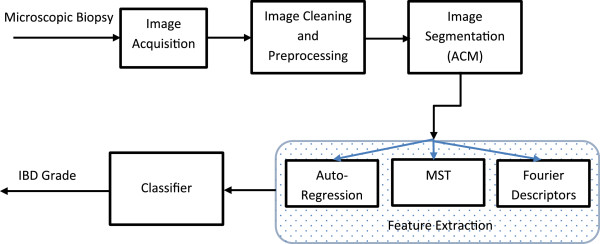
Aims: One of the main reliable histological features to suggest the diagnosis of inflammatory bowel disease is the presence of significant distortion of the crypt architecture indicating the chronic nature of the disease resulting in mucosal damage. This feature has a considerable intra-observer and inter-observer variability leading to significant subjectivity in colonic biopsy assessment. In this paper, we present a novel automated system to assess mucosal damage and architectural distortion in inflammatory bowel disease (IBD). Methods: The proposed system relies on advanced image understating and processing techniques to segment digitally acquired images of microscopic biopsies, then, to extract key features to quantify the crypts irregularities in shape and distribution. These features were used as inputs to an artificial intelligent classifier that, after a training phase, can carry out the assessment automatically. Results: The developed system was evaluated using 118 IBD biopsies. 116 out of 118 biopsies were correctly classified as compared to the consensus of three expert pathologists, achieving an overall precision of 98.31%. Conclusions: An automated intelligent system to quantitatively assess inflammatory bowel disease was developed. The proposed system utilized advanced image understanding techniques together with an intelligent classifier to conduct the assessment. The developed system proved to be reliable, robust, and minimizes subjectivity and inter- and intra-observer variability. Virtual slides: The virtual slide(s) for this article can be found here:http://www.diagnosticpathology.diagnomx.eu/vs/1797721309305023
Overview
The claims and statistics of this paper haven’t been checked yet.
Free: it reads the open-access text and checks the first 5 claims that cite a source we can check. Create a free account to check every claim.
Integrity signals
Registry
Cites
Statistics
Figures
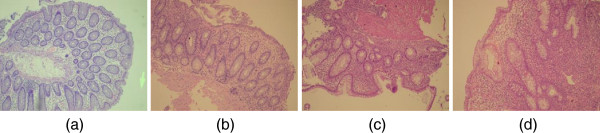
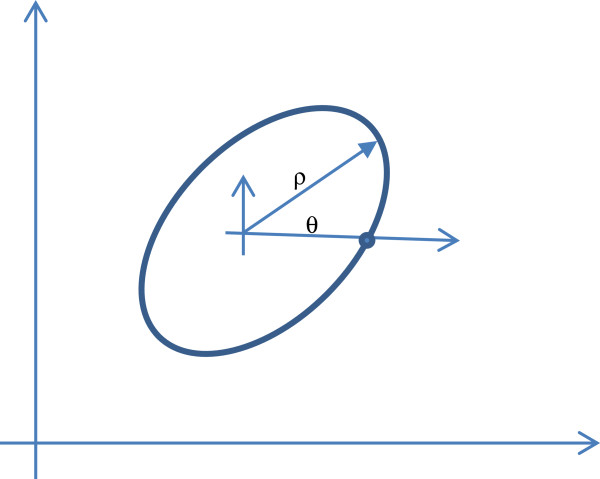
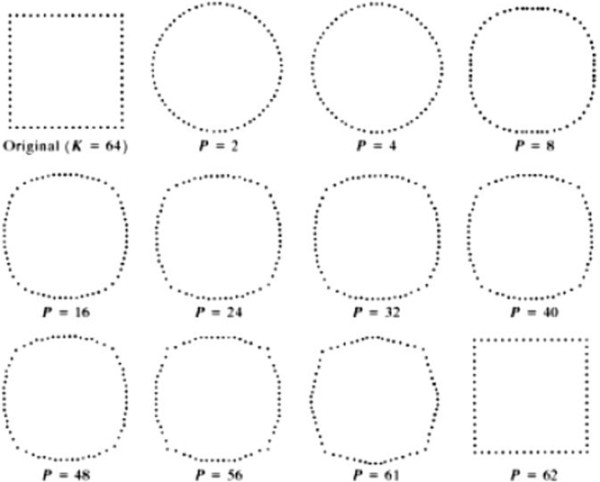
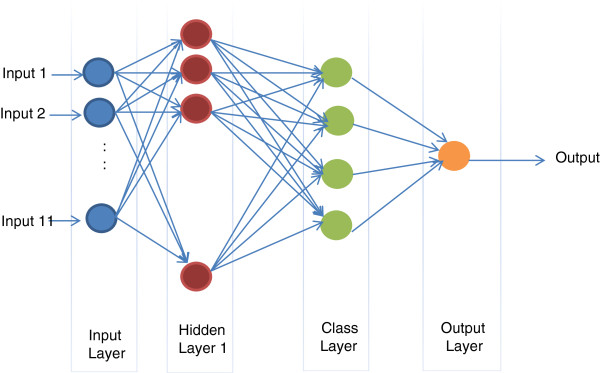
Verification
Claims the paper makes
The claims and statistics of this paper haven’t been checked yet.
Free: it reads the open-access text and checks the first 5 claims that cite a source we can check. Create a free account to check every claim.
Claims other papers make about this one
Each is checked against this paper’s own text: does it say what the citing paper says it does?
In the citing paper
“This system, evaluating 118 biopsies, demonstrated an overall precision rate exceeding 98% compared to the consensus of three expert pathologists.”
From Artificial intelligence and endo-histo-omics: new dimensions of precision endoscopy and histology in inflammatory bowel disease (2024) · cites this paper as [56]
In the citing paper
“A pioneering attempt to standardize biopsy interpretation emerged when Matalka and colleagues introduced an advanced image processing technique to automatically assess crypt architecture distortion and mucosal damage for IBD diagnosis.56”
From Artificial intelligence and endo-histo-omics: new dimensions of precision endoscopy and histology in inflammatory bowel disease (2024) · cites this paper as [56]
Self-check
Percentages, sums and reported differences re-computed from the paper’s own numbers.
The self-check needs the paper’s full text.
Citations
Cites
Kass, M., Witkin, A., & Terzopoulos, D. (1988) · International Journal of Computer Vision · doi:10.1007/bf00133570 · Cited by 17,070 · cited 1×
“The approach and its modifications have been heavily used in many pattern recognition applications over the last two decades [16,17].”
On Estimation of a Probability Density Function and Mode
Parzen, E. (1962) · The Annals of Mathematical Statistics · doi:10.1214/aoms/1177704472 · Cited by 10,585 · cited 3×
“The activation function is of exponential form [24].”
Specht, D. F. (1990) · Neural Networks · doi:10.1016/0893-6080(90)90049-q · Cited by 3,762 · cited 2×
“Interested reader can refer to [23,24] for further theoretical details about PNN.”
Fourier Descriptors for Plane Closed Curves
Zahn, C. T., & Roskies, R. Z. (1972) · IEEE Transactions on Computers · doi:10.1109/tc.1972.5008949 · Cited by 1,860 · cited 12×
“Assume that K boundary point samples are collected to represent the curve, then the Discrete Fourier Transform (DFT) can be used to calculate the K complex values representing the Fourier Transform of the closed curve in the frequency domain, such that, [18] z uð Þ ¼ 1 K XK−1 k¼0 r kð Þe−2πuk=K ; ∀u ¼ 0; 1;…;K−1; ð1Þ…”
InfluentialSpecht, D. F. (1990) · IEEE Transactions on Neural Networks · doi:10.1109/72.80210 · Cited by 576
Performance evaluation in content-based image retrieval: overview and proposals
Müller, H., Müller, W., Squire, D. M., Marchand-Maillet, S., & Pun, T. (2001) · Pattern Recognition Letters · doi:10.1016/s0167-8655(00)00118-5 · Cited by 552
Inoué, S., & Spring, K. R. (1997) · Video Microscopy · doi:10.1007/978-1-4615-5859-0_12 · Cited by 480
A randomized linear-time algorithm to find minimum spanning trees
Karger, D. R., Klein, P. N., & Tarjan, R. E. (1995) · Journal of the ACM · doi:10.1145/201019.201022 · Cited by 406
Application of affine-invariant Fourier descriptors to recognition of 3-D objects
Arbter, K., Snyder, W. E., Burkhardt, H., & Hirzinger, G. (1990) · IEEE Transactions on Pattern Analysis and Machine Intelligence · doi:10.1109/34.56206 · Cited by 396 · cited 11×
“Assume that K boundary point samples are collected to represent the curve, then the Discrete Fourier Transform (DFT) can be used to calculate the K complex values representing the Fourier Transform of the closed curve in the frequency domain, such that, [18] z uð Þ ¼ 1 K XK−1 k¼0 r kð Þe−2πuk=K ; ∀u ¼ 0; 1;…;K−1; ð1Þ…”
InfluentialDecision theory in expert systems and artificial intelligence
Horvitz, E. J., Breese, J. S., & Henrion, M. (1988) · International Journal of Approximate Reasoning · doi:10.1016/0888-613x(88)90120-x · Cited by 362 · cited 1×
“Traditional statistical classification procedures such as discriminant analysis are built on the Bayesian decision theory [22].”
Jenkins, D., Balsitis, M., Gallivan, S., Dixon, M. F., Gilmour, H. M., Shepherd, N. A., Theodossi, A., & Williams, G. T. (1997) · Journal of Clinical Pathology · doi:10.1136/jcp.50.2.93 · Cited by 360
Graph theory for image analysis: an approach based on the shortest spanning tree
Morris, O. J., Lee, M. D. J., & Constantinides, A. G. (1986) · IEE Proceedings F Communications, Radar and Signal Processing · doi:10.1049/ip-f-1.1986.0025 · Cited by 198
Graph theory for image analysis: an approach based on the shortest spanning tree
Morris, O. J., Lee, M. D. J., & Constantinides, A. G. (1986) · IEE Proceedings F Communications Radar and Signal Processing · doi:10.1049/ip-f-1:19860025 · Cited by 173 · cited 1×
“Whereas, a very praiseworthy density measure is Euclidean distances calculated through Minimal Spanning Tree algorithms [20,21].”
Analyzing huge pathology images with open source software
Deroulers, C., Ameisen, D., Badoual, M., Gerin, C., Granier, A., & Lartaud, M. (2013) · Diagnostic Pathology · doi:10.1186/1746-1596-8-92 · Cited by 108
Pathology of inflammatory bowel disease
Gramlich, T. L., & Petras, R. E. (2007) · Seminars in Pediatric Surgery · doi:10.1053/j.sempedsurg.2007.04.005 · Cited by 83
Kayser, K., Radziszowski, D., Bzdyl, P., Sommer, R., & Kayser, G. (2006) · Diagnostic Pathology · doi:10.1186/1746-1596-1-10 · Cited by 73 · cited 1×
“Quantification of pathological findings utilizing computerization and image analysis has always been a target for practicing pathologists [6-13].”
Pathology of inflammatory bowel diseases (IBD): variability with time and treatment
Geboes, K. (2001) · Colorectal Disease · doi:10.1046/j.1463-1318.2001.00187.x · Cited by 66
Theory of sampling and its application in tissue based diagnosis
Kayser, K., Schultz, H., Goldmann, T., Görtler, J., Kayser, G., & Vollmer, E. (2009) · Diagnostic Pathology · doi:10.1186/1746-1596-4-6 · Cited by 45 · cited 2×
“There has numerous attempts in this fiel d directed toward different pathological findings and diseases, some of which has be en transformed and adopted for routine diagnostic purposes and others remain as part of resea rch tools [6-8,10].”
Sharma, H., Alekseychuk, A., Leškovský, P., Hellwich, O., Anand, R., Zerbe, N., & Hufnagl, P. (2012) · Diagnostic Pathology · doi:10.1186/1746-1596-7-134 · Cited by 40 · cited 2×
“The ma in objective of this task is to standardize the interpretation of the histological features and m i imize the inter- and intraobserver variability [11,13].”
Validation of diagnostic accuracy using digital slides in routine histopathology
Fónyad, L., Krenács, T., Nagy, P., Zalatnai, A., Csomor, J., Sápi, Z., Pápay, J., Schönléber, J., Diczházi, C., & Molnár, B. (2012) · Diagnostic Pathology · doi:10.1186/1746-1596-7-35 · Cited by 40 · cited 1×
“Quantification of pathological findings utilizing computerization and image analysis has always been a target for practicing pathologists [6-13].”
Kayser, K., Shaver, M., Modlinger, F., Postl, K., & Moyers, J. J. (1986) · Pathology - Research and Practice · doi:10.1016/s0344-0338(86)80004-8 · Cited by 14 · cited 2×
“There has numerous attempts in this fiel d directed toward different pathological findings and diseases, some of which has be en transformed and adopted for routine diagnostic purposes and others remain as part of resea rch tools [6-8,10].”
Vido, J. R., Adam, R. L., Lorand-Metze, I. G. H., & Metze, K. (2011) · Diagnostic Pathology · doi:10.1186/1746-1596-6-93 · Cited by 14
Problem areas in the pathology of chronic inflammatory bowel disease
Ludeman, L., & Shepherd, N. A. (2006) · Current Diagnostic Pathology · doi:10.1016/j.cdip.2006.05.001 · Cited by 12
Quantitative low-resolution analysis of colon mucosa.
Kk, K., Modlinger, F., & Postl, K. (1985) · PubMed · Cited by 12
Absar, S., Mason, J., Anjum, K., & Haboubi, N. Y. (2006) · Techniques in Coloproctology · doi:10.1007/s10151-006-0284-z · Cited by 8 · cited 1×
“The use of standard definitions of histopathological terms makes a clear and definitive diagnosis of IBD easier, [14].”
Pathology of chronic inflammatory bowel disease
Williams, J. W., & Shepherd, N. A. (2005) · Surgery (Oxford) · doi:10.1383/surg.2005.23.10.346 · Cited by 4
Pathology of inflammatory bowel diseases (IBD): variability with time and treatment
Geboes, K. (2001) · Colorectal Disease · doi:10.1111/j.1463-1318.2001.00187.x
Research works printed but not linked: 1
- Kass M, Witkin A, Terzopoulos D: Snakes: active contour models. Proc Int Conf Computer Vision 1987:261-268.
Cited by
Artificial intelligence in gastroenterology: A state-of-the-art review
Kröner, P. T., Engels, M. M., Glicksberg, B. S., Johnson, K. W., Mzaik, O., van Hooft, J. E., Wallace, M. B., El-Serag, H. B., & Krittanawong, C. (2021) · World Journal of Gastroenterology · doi:10.3748/wjg.v27.i40.6794 · Cited by 165
Iacucci, M., Santacroce, G., Zammarchi, I., Maeda, Y., Del Amor, R., Meseguer, P., Kolawole, B. B., Chaudhari, U., Di Sabatino, A., Danese, S., et al. (2024) · The Lancet Gastroenterology & Hepatology · doi:10.1016/s2468-1253(24)00053-0 · Cited by 73
Predicting Colorectal Cancer Occurrence in IBD
Yalchin, M., Baker, A., Graham, T. A., & Hart, A. L. (2021) · Cancers · doi:10.3390/cancers13122908 · Cited by 46
Harakeh, S., Saber, S. H., Akefe, I. O., Ali, S. S., Hussain, M. B., Almasaudi, A. S., Saleh, S. M. M., & Almasaudi, S. B. (2022) · Saudi Journal of Biological Sciences · doi:10.1016/j.sjbs.2022.01.031 · Cited by 39
“), and hemorrhagic lesion (3 points) (Matalka et al., 2013).”
Role of Digital Health and Artificial Intelligence in Inflammatory Bowel Disease: A Scoping Review
Majidova, K., Handfield, J., Kafi, K., Martin, R., & Kubinski, R. (2021) · Genes · doi:10.3390/genes12101465 · Cited by 37
“AI can facilitate the differentiation between CD and UC and the assessment of the severity of IBD with high accuracy, through the determination of histological inflammation from biopsies [88,92].”
BackgroundMethod
Metadata
- Authors
- Matalka, I. I., Al-Omari, F. A., Salama, R. M., & Mohtaseb, A. H.
- Affiliations
- Jordan University of Science and Technology (JO)
- ORCID
- Matalka, Ismail I
- Venue
- Diagnostic Pathology
- Published
- 2013-09-20
- Volume
- 8
- Issue
- 1
- Pages
- 156-156
- ISSN
- 1746-1596 (ISSN-L)
- PMC
- PMC3852335
- OpenAlex
- W2152701667
- Cited by
- 25
- References
- 25
- Citations by year
- 2026: 1 · 2025: 3 · 2024: 4 · 2023: 1 · 2022: 5 · 2021: 3 · 2020: 2 · 2019: 1 · 2017: 1 · 2016: 1 · 2014: 3
- FWCI
- 1.47
- Type
- journal article
- Language
- en
- Open access
- gold
- doi.org
- Licence
- cc-by
- Locations
- Diagnostic Pathology (publishedVersion, cc-by)
- Europe PMC (PubMed Central) (publishedVersion, cc-by)
- PubMed Central (publishedVersion, cc-by)
- PubMed (publishedVersion)
- Greater South Information System
- Topics
- Physical Sciences › Computer Science › Artificial Intelligence › AI in cancer detection
- Health Sciences › Medicine › Gastroenterology › Inflammatory Bowel Disease
- Physical Sciences › Computer Science › Computer Vision and Pattern Recognition › Medical Image Segmentation Techniques
- Keywords
- inflammatory bowel disease, mucosal injury, colonic biopsy, image segmentation, artificial intelligence classifiers, observer variability, virtual slides
- MeSH terms
- Artificial Intelligence, Biopsy, Colon, Humans, Image Interpretation, Computer-Assisted, Intestinal Mucosa, Microscopy, Predictive Value of Tests, Prognosis, Severity of Illness Index, Reproducibility of Results, Inflammatory Bowel Diseases, Observer Variation, Automation, Laboratory
About these checks
Registry, retraction, Cites and statistics results are computed, not judged, with one exception: a printed reference that no index lists is read once by a model before it counts as a citation error. Claims are extracted by a model and kept only when their quote appears verbatim in the text; each cited source is then checked, with a model’s help, for whether it says what the claim relies on. Those verdicts can be wrong — read the claim’s quote and the cited source before relying on one.
Statistics and arithmetic are recomputed, not judged.
Confidence bands are shown only for fields calibrated on our annotated test set. None is calibrated yet, so no band is shown.
What counts as a claim ›How we measure confidence ›How we check this ›
Are you an author, or do you see a problem with this page? Request a review
Data sources
Bibliographic data: Semantic Scholar, OpenAlex, Crossref.
Contains information from the Semantic Scholar Academic Graph Datasets, made available under the ODC Attribution License (ODC-BY 1.0).
Semantic Scholar’s data is described in: Kinney, R., et al. (2023). The Semantic Scholar Open Data Platform. arXiv:2301.10140.
