

Systematic identifiability testing for unambiguous mechanistic modeling – application to JAK-STAT, MAP kinase, and NF-κ B signaling pathway models
Open accessThe DOI matches its Crossref record; 45 of the 45 references it cites were found in a registry or an index.
Abstract
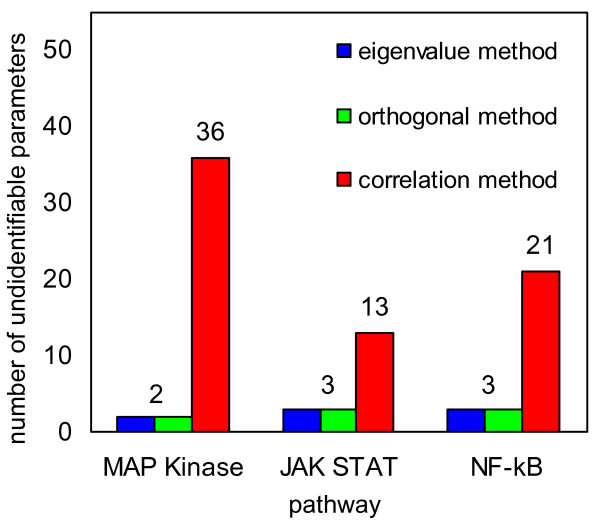
Background: When creating mechanistic mathematical models for biological signaling processes it is tempting to include as many known biochemical interactions into one large model as possible. For the JAK-STAT, MAP kinase, and NF-κ B pathways a lot of biological insight is available, and as a consequence, large mathematical models have emerged. For large models the question arises whether unknown model parameters can uniquely be determined by parameter estimation from measured data. Systematic approaches to answering this question are indispensable since the uniqueness of model parameter values is essential for predictive mechanistic modeling. Results: We propose an eigenvalue based method for efficiently testing identifiability of large ordinary differential models and compare this approach to three existing ones. The methods are benchmarked by applying them to models of the signaling pathways mentioned above. In all cases the eigenvalue method proposed here and the orthogonal method find the largest set of identifiable parameters, thus clearly outperforming the other approaches. The identifiability analysis shows that the pathway models are not identifiable, even under the strong assumption that all system state variables are measurable. We demonstrate how the results of the identifiability analysis can be used for model simplification. Conclusion: While it has undoubtedly contributed to recent advances in systems biology, mechanistic modeling by itself does not guarantee unambiguous descriptions of biological processes. We show that some recent signal transduction pathway models have reached a level of detail that is not warranted. Rigorous identifiability tests reveal that even if highly idealized experiments could be carried out to measure all state variables of these signaling pathways, some unknown parameters could still not be estimated. The identifiability tests therefore show that the level of detail of the investigated models is too high in principle, not just because too little experimental information is available. We demonstrate how the proposed method can be combined with biological insight, however, to simplify these models.
Overview
The claims and statistics of this paper haven’t been checked yet.
Free: it reads the open-access text and checks the first 5 claims that cite a source we can check. Create a free account to check every claim.
Integrity signals
Registry
Cites
Statistics
Figures
Verification
Claims the paper makes
The claims and statistics of this paper haven’t been checked yet.
Free: it reads the open-access text and checks the first 5 claims that cite a source we can check. Create a free account to check every claim.
Claims other papers make about this one
Each is checked against this paper’s own text: does it say what the citing paper says it does?
The cited source says what the claim attributes to it.
In the citing paper
“Fortunately, recent literature is correcting this (e.g. [129–140]).”
From Reverse engineering and identification in systems biology: strategies, perspectives and challenges (2014) · cites this paper as [132]
Self-check
Percentages, sums and reported differences re-computed from the paper’s own numbers.
The self-check needs the paper’s full text.
Citations
Cites
Lecture Notes in Computer Science 1205
(1999) · Industrial Robot: An International Journal · doi:10.1108/ir.1999.04926fae.001 · Cited by 38,662
Advanced engineering mathematics
(1998) · Choice Reviews Online · doi:10.5860/choice.35-5129 · Cited by 4,100
Principles of interleukin (IL)-6-type cytokine signalling and its regulation
HEINRICH, P. C., BEHRMANN, I., HAAN, S., HERMANNS, H. M., MÜLLER-NEWEN, G., & SCHAPER, F. (2003) · Biochemical Journal · doi:10.1042/bj20030407 · Cited by 3,884 · cited 1×
“This is justified, because the key function of SOCS1 is not its binding to STAT, but its inhibition of the activated receptor complex [39].”
BackgroundIntroduction to linear algebra
(2016) · Cybersecurity and Applied Mathematics · doi:10.1016/b978-0-12-804452-0.09998-x · Cited by 1,646
Parameter Estimation in Engineering and Science
de Oliveira, J. T., Beck, J. V., & Arnold, K. J. (1979) · International Statistical Review / Revue Internationale de Statistique · doi:10.2307/1403212 · Cited by 1,480 · cited 1×
“S is a block matrix that consists of time dependent blocks s ( t i ) of size n y × n p [34]: The entries of s ( t i ) are called sensitivity coefficients.”
BackgroundIdentification of parametric models : from experimental data
Walter, É., & Pronzato, L. (1997) · Cited by 1,197
Advanced Engineering Mathematics
Kreyszig, E. (1968) · Cited by 1,123
Schoeberl, B., Eichler-Jonsson, C., Gilles, E. D., & Müller, G. (2002) · Nature Biotechnology · doi:10.1038/nbt0402-370 · Cited by 950 · cited 6×
“In the present paper, output data of the form (2) is obtained from simulations with models that have been adjusted to experimental data by other authors before [1-3].”
BackgroundMethodInfluentialOn global identifiability for arbitrary model parametrizations
Ljung, L., & Glad, T. (1994) · Automatica · doi:10.1016/0005-1098(94)90029-9 · Cited by 643 · cited 2×
“These methods are based on power-series expansion [13], transfer function analysis [14], differential algebra [6,12,15], interval arithmetics [16], state isomorphisms [17-19] or semi-infinite programming [20,21].”
BackgroundMethodParameter Estimation in Engineering and Science.
Folks, J. L., Beck, J. V., & Arnold, K. J. (1978) · Journal of the Royal Statistical Society. Series A (General) · doi:10.2307/2344460 · Cited by 610
Research works printed but not linked: 3
- Asprey SP Macchietto S Dynamic model development: Methods, Theory and Applications 2003 Elsevier, Amsterdam, The Netherlands
- Froemel C Parameterreduktion in Stoffwechselmodellen mit Methoden der Statistik Master's thesis 2003 Fachhochschule Aachen, Abteilung Juelich, Fachbereich Physikalische Technik, Studienrichtung Technomathematik
- Quaiser T Marquardt W Moennigmann M Allgoewer F, Reuss M Local Identifiability Analysis of Large Signaling Pathway Models 2nd Conference Foundation of Systems Biology in Engineering, Proceedings Plenary and Contributed Papers, ISBN 978-3-8167-7436-5 2007 Stuttgart: Fraunhofer IRB Verlag 465 470
Cited by
Items 101–136 of 136
Towards predictive models for organic solvent nanofiltration
Goebel, R., Glaser, T., Niederkleine, I., & Skiborowski, M. (2018) · Computer-aided chemical engineering/Computer aided chemical engineering · doi:10.1016/b978-0-444-64235-6.50022-x · Cited by 2
Prikhodko, A., Shishlenin, M. A., & Stadnichenko, O. A. (2021) · Journal of Physics Conference Series · doi:10.1088/1742-6596/2092/1/012011 · Cited by 2
Karimi, H. (2013) · QSpace (Queen's University Library) · Cited by 2
Mathematical Modeling of Hepatitis C Virus Replication
Sulaimanov, N. (2013) · heiDOK (Heidelberg University) · doi:10.11588/heidok.00014967 · Cited by 2
“The following definitions are introduced to define the concept of at-a-point identifiability [74], [119].”
Model-based optimization of batch- and continuous crystallization processes
Fysikopoulos, D. (2018) · Loughborough University Institutional Repository (Loughborough University) · Cited by 2
Identifiability and Observability Assessment for Nonlinear Wind Turbine Control Systems
Schmitt, T. (2019) · TUbilio (Technical University of Darmstadt) · doi:10.26083/tuprints-00009264 · Cited by 2
Structural identifiability of large systems biology models
Joubert, D. (2020) · doi:10.18174/507603 · Cited by 2
Characterizing variability and uncertainty for parameter subset selection in PBPK models
Schacht, C. M., Kapraun, D. F., Meade, A. E., Bernstein, A. S., Tran, H. T., & Schlosser, P. M. (2025) · Toxicological Sciences · doi:10.1093/toxsci/kfaf103 · Cited by 1
Systems biology at the body scale: Toward adaptive digital twins in precision medicine
Montagud, A. (2026) · Current Opinion in Systems Biology · doi:10.1016/j.coisb.2026.100592 · Cited by 1
Bessa, I., & PONTES, K. V. (2015) · Anais do Congresso Brasileiro de Engenharia Química · doi:10.5151/chemeng-cobeq2014-1779-17606-178505 · Cited by 1
Identification the mathematical model of the transmission TB/HIV co-infection in endemic areas
Kabanikhin, S. I., Игоревна, К. О., Kashtanova, V., & Latyshenko, V. (2017) · International Multi-Conference on Engineering, Computer and Information Sciences (SIBIRCON) · doi:10.1109/sibircon.2017.8109841 · Cited by 1
Aston, P. J., Cranfield, K., O’Farrell, H., Cassenote, A. J. F., Mendes-Correa, C. J., Segurado, A. A. C., Hoang, P., Lankford, G. B., & Tran, H. T. (2018) · InTech eBooks · doi:10.5772/intechopen.75761 · Cited by 1
Set-Membership Parameter Estimation: Improved Understanding of Microgel Polymerization
Jung, F., Caspari, A., Mhamdi, A., & Mitsos, A. (2019) · IFAC-PapersOnLine · doi:10.1016/j.ifacol.2019.06.125 · Cited by 1
Santana, V. V., Martins, M. A. F., Rodrigues, A. E., LOUREIRO, J. M., Ribeiro, A. M., & Nogueira, I. B. R. (2021) · Industrial & Engineering Chemistry Research · doi:10.1021/acs.iecr.1c00214 · Cited by 1
Modeling BK Virus Infection in Renal Transplant Recipients
Myers, N., Droz, D., Rogers, B. W., Tran, H. T., Flores, K., Chan, C. C. W., Knechtle, S. J., Jackson, A. M., Luo, X., Chambers, E. T., et al. (2024) · Viruses · doi:10.3390/v17010050 · Cited by 1
de Lomana, A. L. G. (2010) · Repositori digital de la UPF (Universitat Pompeu Fabra) · Cited by 1
Hashemi, M. (2016) · theses.fr (ABES) · doi:10.70675/463fb4e5z928dz4933z93eczfa029dd1b53c · Cited by 1
Study and enhancement of Bayesian calibration applied to building energy models
Akkari, S. (2022) · theses.fr (ABES) · doi:10.70675/f0d96ff9zbffcz469eza5acz7cd9af735d60 · Cited by 1
Elmisaoui, S. (2023) · theses.fr (ABES) · doi:10.70675/c723c26ez1959z4caazab3bz027007c890d1 · Cited by 1
Skiborowski, M., Kerimoglu, N., Koch, K., Górak, A., & Marquardt, W. (2012) · Procedia Engineering · doi:10.1016/j.proeng.2012.08.996
Eghtesadi, Z. (2015) · QSpace (Queen's University Library)
Hashemi, M. (2016) · Publications Et Travaux Academiques de Lorraine (Universite de Lorraine)
Wagner, J. L. (2016) · NCSU Libraries Repository (North Carolina State University Libraries)
Leon, L. S. (2018) · NCSU Libraries Repository (North Carolina State University Libraries)
Bravo, N. (2019) · NCSU Libraries Repository (North Carolina State University Libraries)
Wing-Wake Interactions in Aeroelastic Systems.
Kirschmeier, B. A. (2019) · NCSU Libraries Repository (North Carolina State University Libraries)
An Objective Measure of Distributional Estimability as Applied to the Phase-Type Aging Model
Nie, C., Liu, X., & Provost, S. B. (2024) · Risks · doi:10.3390/risks12020037
Tassanbayev, S., Uskenbayeva, G., Shukirova, A., Kulniyazova, K., & Slastenov, I. (2025) · Processes · doi:10.3390/pr13103289
Ganscha, S. (2018) · Repository for Publications and Research Data (ETH Zurich) · doi:10.3929/ethz-b-000337027
Towards reliable characterization and model-based evaluation of organic solvent nanofiltration
Goebel, R. (2021) · Technische Universität Dortmund Eldorado (Technische Universität Dortmund) · doi:10.17877/de290r-22591
Development of a continuous process for the telomerization of butadiene with methanol
Hopf, L. (2015) · OPUS FAU (Kooperativer Bibliotheksverbund Berlin-Brandenburg (KOBV), on behalf of the Universitätsbibliothek Erlangen-Nürnberg)
Parameter Identifiability beyond the Fisher Information Approximation in Data-Driven ModelingPreprint
Wang, S., & Hao, W. (2026) · PubMed Central · doi:10.48550/arxiv.2602.20495
Model-based road friction estimation from steering torque at standstill and low-speed rolling
Snobar, F., Michalka, A., Horn, M., Schulz, T., & Graichen, K. (2026) · Vehicle System Dynamics · doi:10.1080/00423114.2026.2679166
Nyande, B. W., & Raponi, A. (2026) · Chemical Engineering Science · doi:10.1016/j.ces.2026.125072
An austenite decomposition model and its optimization-based parameterizationPreprint
Sannes, S., Jadachowski, L., Niederer, M., Suppan, C., & Steinboeck, A. (2026) · SSRN Electronic Journal · doi:10.2139/ssrn.7545542
Metadata
- Authors
- Quaiser, T., & Mönnigmann, M.
- Affiliations
- RWTH Aachen University (DE)
- Technische Universität Braunschweig (DE)
- Corresponding author
- Mönnigmann, Martin
- ORCID
- Mönnigmann, Martin
- Venue
- BMC Systems Biology
- Published
- 2009-05-09
- Volume
- 3
- Issue
- 1
- Pages
- 50-50
- ISSN
- 1752-0509 (ISSN-L)
- PMC
- PMC2714303
- OpenAlex
- W2098649922
- Cited by
- 114
- References
- 45
- Citations by year
- 2026: 3 · 2025: 4 · 2024: 10 · 2023: 6 · 2022: 8 · 2021: 6 · 2020: 10 · 2019: 14 · 2018: 6 · 2017: 4 · 2016: 6 · 2015: 10 · 2014: 4 · 2013: 9 · 2012: 5
- FWCI
- 1.88
- Type
- journal article
- Language
- en
- Open access
- gold
- doi.org
- Licence
- cc-by
- Locations
- BMC Systems Biology (publishedVersion, cc-by)
- Europe PMC (PubMed Central) (publishedVersion, cc-by)
- PubMed Central (publishedVersion, cc-by)
- PubMed (publishedVersion)
- DOAJ (DOAJ: Directory of Open Access Journals) (submittedVersion)
- RWTH Publications (RWTH Aachen) (submittedVersion, cc-by)
- Funders
- Deutsche Forschungsgemeinschaft
- Topics
- Life Sciences › Biochemistry, Genetics and Molecular Biology › Molecular Biology › Gene Regulatory Network Analysis
- Physical Sciences › Engineering › Control and Systems Engineering › Control Systems and Identification
- Physical Sciences › Mathematics › Modeling and Simulation › Mathematical Biology Tumor Growth
- Keywords
- identifiability analysis, parameter identifiability, JAK/STAT signaling, MAPK signaling, NF-κB signaling, model reduction, ordinary differential equation model, mechanistic modeling
- MeSH terms
- Models, Biological, Signal Transduction, NF-kappa B, Nonlinear Dynamics, Mitogen-Activated Protein Kinases, Principal Component Analysis, STAT Transcription Factors, Janus Kinases
About these checks
Registry, retraction, Cites and statistics results are computed, not judged, with one exception: a printed reference that no index lists is read once by a model before it counts as a citation error. Claims are extracted by a model and kept only when their quote appears verbatim in the text; each cited source is then checked, with a model’s help, for whether it says what the claim relies on. Those verdicts can be wrong — read the claim’s quote and the cited source before relying on one.
Statistics and arithmetic are recomputed, not judged.
Confidence bands are shown only for fields calibrated on our annotated test set. None is calibrated yet, so no band is shown.
What counts as a claim ›How we measure confidence ›How we check this ›
Are you an author, or do you see a problem with this page? Request a review
Data sources
Bibliographic data: Semantic Scholar, OpenAlex, Crossref.
Contains information from the Semantic Scholar Academic Graph Datasets, made available under the ODC Attribution License (ODC-BY 1.0).
Semantic Scholar’s data is described in: Kinney, R., et al. (2023). The Semantic Scholar Open Data Platform. arXiv:2301.10140.
