

The DOI matches its Crossref record.
Influenza vaccine titer determination using biolayer interferometry (BLI)
Open accessAbstract
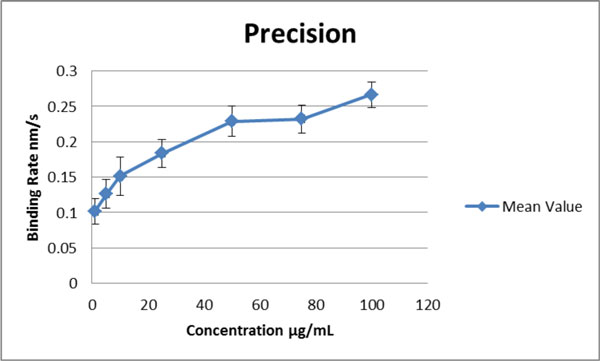
Background Fast, accurate determination of vaccine titer during influenza vaccine manufacture is important in understanding process performance and correctly scaling each process step. Traditionally Single Radial Immunodiffusion (SRID) assays have been used as the ‘gold standard’ but the assay requires very skilled operators to obtain reproducible results and is relatively low throughput. ELISAs have also been used to determine titer but have lower precision and dynamic range. BLI combines the high throughput characteristics of a 96well plate based ELISA assay in conjunction with improvements in accuracy and repeatability derived from a simpler direct measurement of mass transfer on binding. The assay is based on the binding of the vaccine to polyclonal antibodies that recognise the influenza epitopes presented by the vaccine. The polyclonal antibody is bound to a protein G or protein A derivatized biosensor, depending on the animal source of the antibody. This configuration gives increased flexibility by allowing swift changes between vaccines derived from different viral strains by simply binding the paired antibody for the new strain to a biosensor without the need for derivatization. Hence the assay is suitable for the rapid changes in the viral strains represented in a vaccine. A robust assay, capable of determining vaccine titer from various process stages has been developed. Figure 1 illustrates coefficient of variance and binding rate across a range of concentrations. The assay has been shown to be applicable to both attenuated and synthetic vaccines and is an effective test for vaccine potency. Materials and methods Samples taken directly from purification steps were assayed with zero sample clean up, having been only diluted with a proprietary ForteBio sample buffer. Protein A and Protein G biosensors were used in the assay. The system uses well plate technology allowing for high sample throughput.
Overview
The claims and statistics of this paper haven’t been checked yet.
Run the check — free, no account needed. It reads the open-access text and checks the sources it cites.
Integrity signals
Registry
Cites
Statistics
Figures
Verification
Claims the paper makes
The claims and statistics of this paper haven’t been checked yet.
Run the check — free, no account needed. It reads the open-access text and checks the sources it cites.
Claims other papers make about this one
Each is checked against this paper’s own text: does it say what the citing paper says it does?
The source backs part of the claim, not all of it — or backs it for a different population, condition or comparison.
In the citing paper
“This high-throughput, label-free method is specifically targeted for at-line use, provides acceptable precision, requires neither sample purification nor preparation, and has been successfully used in process development for biopharmaceuticals and vaccines.”
From Analytical methods for process and product characterization of recombinant adeno-associated virus-based gene therapies (2021) · cites this paper as [53]
Experimental — accuracy not yet measured
Self-check
Percentages, sums and reported differences re-computed from the paper’s own numbers.
The self-check needs the paper’s full text.
Citations
Cites
Still being checked.
Cited by
Sorted by citations
Gimpel, A. L., Katsikis, G., Sha, S., Maloney, A. J., Hong, M. S., Nguyen, T. N. T., Wolfrum, J., Springs, S. L., Sinskey, A. J., Manalis, S. R., et al. (2021) · Molecular Therapy - Methods & Clinical Development · doi:10.1016/j.omtm.2021.02.010 · Cited by 185
Metadata
- Authors
- Wheatley, D. W., Saunders, D., Welsh, J., Matthews, E., Srivastava, I., & Cox, M.
- Affiliations
- Pall Corporation (United Kingdom) (GB)
- Corresponding author
- Wheatley, David W
- Venue
- BMC Proceedings
- Published
- 2015-12
- Volume
- 9
- Issue
- S9
- ISSN
- 1753-6561 (ISSN-L)
- PMC
- PMC4685397
- OpenAlex
- W2294841778
- Cited by
- 3
- References
- 0
- Citations by year
- 2023: 1 · 2021: 2
- FWCI
- 0.00
- Type
- journal article
- Language
- en
- Open access
- gold
- doi.org
- Licence
- cc-by
- Locations
- BMC Proceedings (publishedVersion, cc-by)
- PubMed Central (publishedVersion, cc-by)
- Topics
- Health Sciences › Medicine › Epidemiology › Influenza Virus Research Studies
- Life Sciences › Biochemistry, Genetics and Molecular Biology › Molecular Biology › Advanced Biosensing Techniques and Applications
- Life Sciences › Immunology and Microbiology › Immunology › Biosimilars and Bioanalytical Methods
- Keywords
- influenza vaccination, biolayer interferometry, vaccine potency testing, polyclonal antibodies, high-throughput assay
About these checks
Registry, retraction, Cites and statistics results are computed, not judged, with one exception: a printed reference that no index lists is read once by a model before it counts as a citation error. Claims are extracted by a model and kept only when their quote appears verbatim in the text; each cited source is then checked, with a model’s help, for whether it says what the claim relies on. Those verdicts can be wrong — read the claim’s quote and the cited source before relying on one.
Statistics and arithmetic are recomputed, not judged.
Confidence bands are shown only for fields calibrated on our annotated test set. None is calibrated yet, so no band is shown.
What counts as a claim ›How we measure confidence ›How we check this ›
Are you an author, or do you see a problem with this page? Request a review
