

The DOI matches its Crossref record; 88 of the 88 references it cites were found in a registry or an index.
Comparison of single-molecule sequencing and hybrid approaches for finishing the genome of Clostridium autoethanogenum and analysis of CRISPR systems in industrial relevant Clostridia
Open accessAbstract
BACKGROUND: Clostridium autoethanogenum strain JA1-1 (DSM 10061) is an acetogen capable of fermenting CO, CO2 and H2 (e.g. from syngas or waste gases) into biofuel ethanol and commodity chemicals such as 2,3-butanediol. A draft genome sequence consisting of 100 contigs has been published. RESULTS: A closed, high-quality genome sequence for C. autoethanogenum DSM10061 was generated using only the latest single-molecule DNA sequencing technology and without the need for manual finishing. It is assigned to the most complex genome classification based upon genome features such as repeats, prophage, nine copies of the rRNA gene operons. It has a low G + C content of 31.1%. Illumina, 454, Illumina/454 hybrid assemblies were generated and then compared to the draft and PacBio assemblies using summary statistics, CGAL, QUAST and REAPR bioinformatics tools and comparative genomic approaches. Assemblies based upon shorter read DNA technologies were confounded by the large number repeats and their size, which in the case of the rRNA gene operons were ~5 kb. CRISPR (Clustered Regularly Interspaced Short Paloindromic Repeats) systems among biotechnologically relevant Clostridia were classified and related to plasmid content and prophages. Potential associations between plasmid content and CRISPR systems may have implications for historical industrial scale Acetone-Butanol-Ethanol (ABE) fermentation failures and future large scale bacterial fermentations. While C. autoethanogenum contains an active CRISPR system, no such system is present in the closely related Clostridium ljungdahlii DSM 13528. A common prophage inserted into the Arg-tRNA shared between the strains suggests a common ancestor. However, C. ljungdahlii contains several additional putative prophages and it has more than double the amount of prophage DNA compared to C. autoethanogenum. Other differences include important metabolic genes for central metabolism (as an additional hydrogenase and the absence of a phophoenolpyruvate synthase) and substrate utilization pathway (mannose and aromatics utilization) that might explain phenotypic differences between C. autoethanogenum and C. ljungdahlii. CONCLUSIONS: Single molecule sequencing will be increasingly used to produce finished microbial genomes. The complete genome will facilitate comparative genomics and functional genomics and support future comparisons between Clostridia and studies that examine the evolution of plasmids, bacteriophage and CRISPR systems.
Overview
The claims and statistics of this paper haven’t been checked yet.
Run the check — free, no account needed. It reads the open-access text and checks the sources it cites.
Integrity signals
Registry
Cites
Statistics
Figures
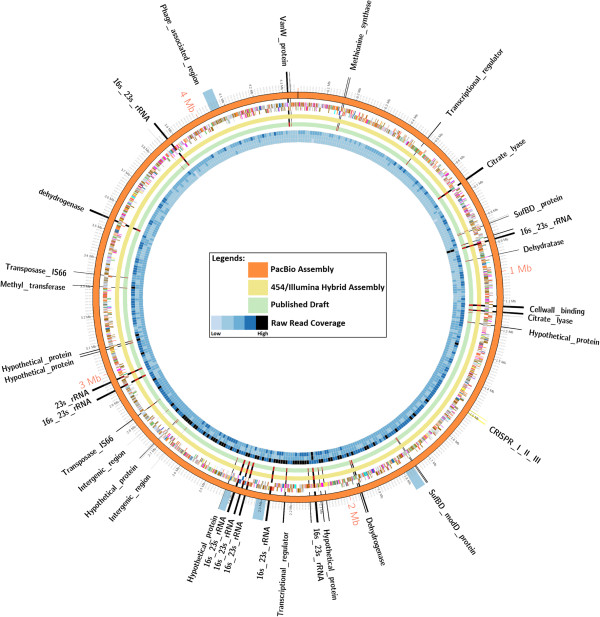
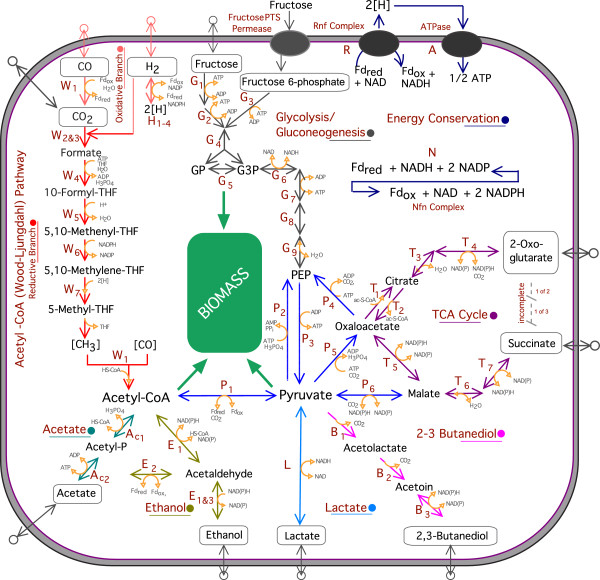
Verification
Claims the paper makes
The claims and statistics of this paper haven’t been checked yet.
Run the check — free, no account needed. It reads the open-access text and checks the sources it cites.
Claims other papers make about this one
Each is checked against this paper’s own text: does it say what the citing paper says it does?
In the citing paper
“These include elucidation of whole genome sequences for a range of acetogens including C. autoethanogenum (Brown et al., 2014; Humphreys et al., 2015; Utturkar et al., 2015), C. ljungdahlii (Köpke et al., 2010), C. aceticum (Poehlein et al., 2015), M. thermoacetica (Pierce et al., 2008), A. woodii (Poehlein et al., 2012), and E. limosum (Roh et al., 2011);”
From Gas Fermentation—A Flexible Platform for Commercial Scale Production of Low-Carbon-Fuels and Chemicals from Waste and Renewable Feedstocks (2016) · cites this paper as Brown et al., 2014
In the citing paper
“Some acetogens as C. autoethanogenum also have a native CRSIPR system, that has been shown to be actively transcribed (Brown et al., 2014).”
From Gas Fermentation—A Flexible Platform for Commercial Scale Production of Low-Carbon-Fuels and Chemicals from Waste and Renewable Feedstocks (2016) · cites this paper as Brown et al., 2014
Self-check
Percentages, sums and reported differences re-computed from the paper’s own numbers.
The self-check needs the paper’s full text.
Citations
Cites
SPAdes: A New Genome Assembly Algorithm and Its Applications to Single-Cell Sequencing
Bankevich, A., Nurk, S., Antipov, D., Gurevich, A. A., Dvorkin, M. V., Kulikov, A. S., Lesin, V. M., Nikolenko, S., Pham, S., Prjibelski, A. D., et al. (2012) · Journal of Computational Biology · doi:10.1089/cmb.2012.0021 · Cited by 26,312
Prodigal: prokaryotic gene recognition and translation initiation site identification
Hyatt, D., Chen, G.-L., LoCascio, P. F., Land, M., Larimer, F. W., & Hauser, L. (2010) · BMC Bioinformatics · doi:10.1186/1471-2105-11-119 · Cited by 12,692
Self-citationQUAST: quality assessment tool for genome assemblies
Gurevich, A., Saveliev, V., Vyahhi, N., & Tesler, G. (2013) · Bioinformatics · doi:10.1093/bioinformatics/btt086 · Cited by 11,172
Circos: An information aesthetic for comparative genomicsPreprint
Krzywinski, M. I., Schein, J. E., Birol, İ., Connors, J. M., Gascoyne, R. D., Horsman, D. E., Jones, S. J. M., & Marra, M. A. (2009) · Genome Research · doi:10.1101/gr.092759.109 · Cited by 11,073
Velvet: Algorithms for de novo short read assembly using de Bruijn graphsPreprint
Zerbino, D. R., & Birney, E. (2008) · Genome Research · doi:10.1101/gr.074492.107 · Cited by 9,587
Versatile and open software for comparing large genomes
Kurtz, S., Phillippy, A., Delcher, A. L., Smoot, M., Shumway, M., Antonescu, C., & Salzberg, S. L. (2004) · Genome Biology · doi:10.1186/gb-2004-5-2-r12 · Cited by 5,254
Nonhybrid, finished microbial genome assemblies from long-read SMRT sequencing data
Chin, C.-S., Alexander, D. H., Marks, P., Klammer, A. A., Drake, J., Heiner, C., Clum, A., Copeland, A., Huddleston, J., Eichler, E. E., et al. (2013) · Nature Methods · doi:10.1038/nmeth.2474 · Cited by 4,029
progressiveMauve: Multiple Genome Alignment with Gene Gain, Loss and Rearrangement
Darling, A. E., Mau, B., & Perna, N. T. (2010) · PLoS ONE · doi:10.1371/journal.pone.0011147 · Cited by 3,848
Real-Time DNA Sequencing from Single Polymerase Molecules
Eid, J., Fehr, A., Gray, J., Luong, K., Lyle, J., Otto, G., Peluso, P., Rank, D., Baybayan, P., Bettman, B., et al. (2009) · Science · doi:10.1126/science.1162986 · Cited by 3,732
ABySS: A parallel assembler for short read sequence dataPreprint
Simpson, J. T., Wong, K., Jackman, S. D., Schein, J. E., Jones, S. J. M., & Birol, İ. (2009) · Genome Research · doi:10.1101/gr.089532.108 · Cited by 3,658
Cited by
Sorted by citations
PacBio Sequencing and its Applications
Rhoads, A., & Au, K. F. (2015) · Genomics, Proteomics & Bioinformatics · doi:10.1016/j.gpb.2015.08.002 · Cited by 2,135
Lysogeny in nature: mechanisms, impact and ecology of temperate phages
Howard‐Varona, C., Hargreaves, K. R., Abedon, S. T., & Sullivan, M. B. (2017) · The ISME Journal · doi:10.1038/ismej.2017.16 · Cited by 886
Liew, F., Martin, M. E., Tappel, R. C., Heijstra, B. D., Mihalcea, C., & Köpke, M. (2016) · Frontiers in Microbiology · doi:10.3389/fmicb.2016.00694 · Cited by 485
Self-citationOne chromosome, one contig: complete microbial genomes from long-read sequencing and assembly
Koren, S., & Phillippy, A. M. (2014) · Current Opinion in Microbiology · doi:10.1016/j.mib.2014.11.014 · Cited by 422
C1-carbon sources for chemical and fuel production by microbial gas fermentation
Dürre, P., & Eikmanns, B. J. (2015) · Current Opinion in Biotechnology · doi:10.1016/j.copbio.2015.03.008 · Cited by 250
Metadata
- Authors
- Brown, S. D., Nagaraju, S., Utturkar, S., De Tissera, S., Segovia, S., Mitchell, W., Land, M. L., Dassanayake, A., & Köpke, M.
- Affiliations
- Oak Ridge National Laboratory (US)
- LanzaTech (New Zealand) (NZ)
- University of Tennessee at Knoxville (US)
- Corresponding author
- Brown, Steven D
- Köpke, Michael
- Venue
- Biotechnology for Biofuels
- Published
- 2014-03-21
- Volume
- 7
- Issue
- 1
- Pages
- 40-40
- ISSN
- 1754-6834 (ISSN-L)
- PMC
- PMC4022347
- OpenAlex
- W2151208862
- Cited by
- 145
- References
- 88
- Citations by year
- 2026: 5 · 2025: 9 · 2024: 6 · 2023: 7 · 2022: 11 · 2021: 10 · 2020: 9 · 2019: 13 · 2018: 13 · 2017: 18 · 2016: 18 · 2015: 18 · 2014: 8
- FWCI
- 8.48
- Type
- journal article
- Language
- en
- Open access
- gold
- doi.org
- Locations
- Biotechnology for Biofuels (publishedVersion, cc-by)
- Europe PMC (PubMed Central) (publishedVersion, cc-by)
- PubMed Central (publishedVersion, cc-by)
- PubMed (publishedVersion)
- Funders
- U.S. Department of Energy (AC05-00OR22725, DE--AC05--00OR22725, DE-AC05?, under Contract DE-AC05-00OR22725, 00OR22725)
- Battelle (DE-AC05- 00OR22725, AC05-00OR22725, DE-AC05)
- UT-Battelle (DE-AC05, DEAC05-00OR22725, Contract DE-AC05-00OR22725, AC05-00OR22725)
- Office of Science (DEAC05- 00OR22725, AC05-00OR22725)
- Oak Ridge National Laboratory (AC05-00OR22725, DE-AC05-00OR22725)
- Topics
- Life Sciences › Biochemistry, Genetics and Molecular Biology › Molecular Biology › Genomics and Phylogenetic Studies
- Life Sciences › Biochemistry, Genetics and Molecular Biology › Molecular Biology › Microbial Metabolic Engineering and Bioproduction
- Physical Sciences › Engineering › Biomedical Engineering › Biofuel production and bioconversion
- Keywords
- Clostridium autoethanogenum, Clostridium ljungdahlii, genome finishing, single-molecule sequencing, PacBio, hybrid sequencing, genome assembly comparison, CRISPR systems, prophages, plasmids, acetone-butanol-ethanol fermentation, acetogenic bacteria, hydrogenase, comparative genomics, industrial fermentation
About these checks
Registry, retraction, Cites and statistics results are computed, not judged, with one exception: a printed reference that no index lists is read once by a model before it counts as a citation error. Claims are extracted by a model and kept only when their quote appears verbatim in the text; each cited source is then checked, with a model’s help, for whether it says what the claim relies on. Those verdicts can be wrong — read the claim’s quote and the cited source before relying on one.
Statistics and arithmetic are recomputed, not judged.
Confidence bands are shown only for fields calibrated on our annotated test set. None is calibrated yet, so no band is shown.
What counts as a claim ›How we measure confidence ›How we check this ›
Are you an author, or do you see a problem with this page? Request a review
