

The effectiveness of M-health technologies for improving health and health services: a systematic review protocol
Open accessThe DOI matches its Crossref record; 32 of the 35 references it cites were found in a registry or an index.
Abstract
BACKGROUND: The application of mobile computing and communication technology is rapidly expanding in the fields of health care and public health. This systematic review will summarise the evidence for the effectiveness of mobile technology interventions for improving health and health service outcomes (M-health) around the world. FINDINGS: To be included in the review interventions must aim to improve or promote health or health service use and quality, employing any mobile computing and communication technology. This includes: (1) interventions designed to improve diagnosis, investigation, treatment, monitoring and management of disease; (2) interventions to deliver treatment or disease management programmes to patients, health promotion interventions, and interventions designed to improve treatment compliance; and (3) interventions to improve health care processes e.g. appointment attendance, result notification, vaccination reminders.A comprehensive, electronic search strategy will be used to identify controlled studies, published since 1990, and indexed in MEDLINE, EMBASE, PsycINFO, Global Health, Web of Science, the Cochrane Library, or the UK NHS Health Technology Assessment database. The search strategy will include terms (and synonyms) for the following mobile electronic devices (MEDs) and a range of compatible media: mobile phone; personal digital assistant (PDA); handheld computer (e.g. tablet PC); PDA phone (e.g. BlackBerry, Palm Pilot); Smartphone; enterprise digital assistant; portable media player (i.e. MP3 or MP4 player); handheld video game console. No terms for health or health service outcomes will be included, to ensure that all applications of mobile technology in public health and health services are identified. Bibliographies of primary studies and review articles meeting the inclusion criteria will be searched manually to identify further eligible studies. Data on objective and self-reported outcomes and study quality will be independently extracted by two review authors. Where there are sufficient numbers of similar interventions, we will calculate and report pooled risk ratios or standardised mean differences using meta-analysis. DISCUSSION: This systematic review will provide recommendations on the use of mobile computing and communication technology in health care and public health and will guide future work on intervention development and primary research in this field.
Overview
The claims and statistics of this paper haven’t been checked yet.
Free: it reads the open-access text and checks the first 5 claims that cite a source we can check. Create a free account to check every claim.
Integrity signals
Registry
Cites
Statistics
Figures
Verification
Claims the paper makes
The claims and statistics of this paper haven’t been checked yet.
Free: it reads the open-access text and checks the first 5 claims that cite a source we can check. Create a free account to check every claim.
Self-check
Percentages, sums and reported differences re-computed from the paper’s own numbers.
The self-check needs the paper’s full text.
Citations
Cites
Cochrane Handbook for Systematic Reviews of Interventions: Cochrane Book Series
(2008) · doi:10.1002/9780470712184 · Cited by 25,048 · cited 1×
“Two review authors will independently assess the risk of bias in included studies by considering the following characteristics, as recommended by the International Cochrane Collaboration [29]:”
Pharmacological interventions for somatoform disorders in adults
Kleinstäuber, M., Witthöft, M., Steffanowski, A., van Marwijk, H., Hiller, W., & Lambert, M. J. (2014) · Cochrane Database of Systematic Reviews · doi:10.1002/14651858.cd010628.pub2 · Cited by 11,335
The cochrane database of systematic reviews
Geddes, J. (1996) · Journal of Psychosomatic Research · doi:10.1016/s0022-3999(96)90063-x · Cited by 5,989
Cochrane Database of Systematic Reviews
(2008) · Encyclopedia of Public Health · doi:10.1007/978-1-4020-5614-7_436 · Cited by 4,527
Heron, K. E., & Smyth, J. M. (2010) · British Journal of Health Psychology · doi:10.1348/135910709x466063 · Cited by 1,438 · cited 2×
“diabetes care or chronic disease management [5,10,28]).”
Behavior change interventions delivered by mobile telephone short message service
Fjeldsoe, B. S., Marshall, A. L., & Miller, Y. D. (2009) · American Journal of Preventive Medicine · doi:10.1016/j.amepre.2008.09.040 · Cited by 1,213 · cited 3×
“text messaging [3,4,28]) to individual diseases or healthcare fields (e.”
Ukoumunne, Gulliford, Chinn, Sterne, & Burney (1999) · Health Technology Assessment · doi:10.3310/hta3050 · Cited by 1,210 · cited 1×
“studies [32].”
Text messaging as a tool for behavior change in disease prevention and management
Cole-Lewis, H., & Kershaw, T. (2010) · Epidemiologic Reviews · doi:10.1093/epirev/mxq004 · Cited by 1,190 · cited 3×
“text messaging [3,4,28]) to individual diseases or healthcare fields (e.”
American Journal of Preventive Medicine
Haynes, M. A., & Last, J. M. (1985) · American Journal of Preventive Medicine · doi:10.1016/s0749-3797(18)31428-4 · Cited by 1,151
Mobile phone-based interventions for smoking cessation
Whittaker, R., McRobbie, H., Bullen, C., Rodgers, A., & Gu, Y. (2016) · Cochrane Database of Systematic Reviews · doi:10.1002/14651858.cd006611.pub4 · Cited by 1,079
Healthcare via Cell Phones: A Systematic Review
Krishna, S., Boren, S. A., & Balas, E. A. (2009) · Telemedicine and e-Health · doi:10.1089/tmj.2008.0099 · Cited by 882 · cited 2×
“Current documented M-health interventions and programmes include: mobile phone text messaging to support management of diabetes, hypertension, asthma, eating disorders and HIV treatment [3-7]; mobile phone text messaging and PDAs as aids to smoking cessation, body weight loss, reducing alcohol consumption, sexually tr…”
Research Approaches to Mobile Use in the Developing World: A Review of the Literature
Donner, J. (2008) · The Information Society · doi:10.1080/01972240802019970 · Cited by 743 · cited 1×
“Whilst wireless communication network coverage and mobile phone ownership are not universal, or equally distributed, in low income countries, and the technology accessible to most of the population lags far behind that available in high income countries [19,21], there is still huge potential for Mhealth interventions…”
e-Health technologies show promise in developing countries
Blaya, J. A., Fraser, H. S. F., & Holt, B. (2010) · Health Affairs · doi:10.1377/hlthaff.2009.0894 · Cited by 581 · cited 3×
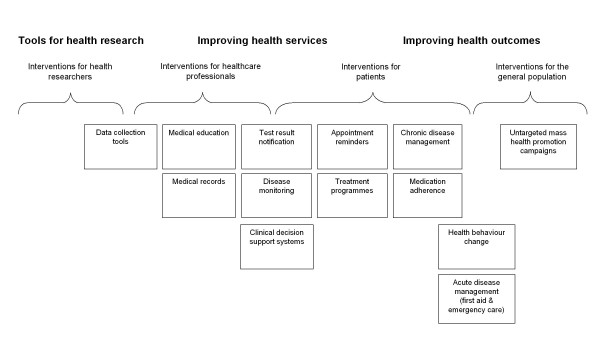
“M-health programmes and interventions use mobile electronic devices (MEDs), such as personal digital assistants (PDAs) and mobile phones, for a range of functions from clinical decision support systems and data collection tools for healthcare professionals [1,2], to supporting health behaviour change and chronic disea…”
Mobile phone messaging for preventive health care
Vodopivec-Jamsek, V., de Jongh, T., Gurol-Urganci, I., Atun, R., & Car, J. (2012) · Cochrane Database of Systematic Reviews · doi:10.1002/14651858.cd007457.pub2 · Cited by 319 · cited 1×
“Existing systematic reviews of M-health interventions, and recently published protocols [22-26], focus on the application of specific devices (e.”
SMS STI: A Review of the Uses of Mobile Phone Text Messaging in Sexual Health
Lim, M. S. C., Hocking, J. S., Hellard, M. E., & Aitken, C. K. (2008) · International Journal of STD & AIDS · doi:10.1258/ijsa.2007.007264 · Cited by 293 · cited 2×
“diabetes care or chronic disease management [5,10,28]).”
American Journal of Preventive Medicine
(2018) · The American Journal of Medicine · doi:10.1016/s0002-9343(18)30657-0 · Cited by 274
Lane, S. J., Heddle, N. M., Arnold, E., & Walker, I. (2006) · BMC Medical Informatics and Decision Making · doi:10.1186/1472-6947-6-23 · Cited by 208
Mobile phone-based interventions for smoking cessation
Whittaker, R., Borland, R., Bullen, C., Lin, R. B., McRobbie, H., & Rodgers, A. (2009) · Cochrane Database of Systematic Reviews · doi:10.1002/14651858.cd006611.pub2 · Cited by 196 · cited 1×
“mobile phones [6,9,10,13,27]) or specific functions (e.”
Dale, O., & Hagen, K. B. (2007) · Journal of Clinical Epidemiology · doi:10.1016/j.jclinepi.2006.04.005 · Cited by 191 · cited 2×
“mobile phones [6,9,10,13,27]) or specific functions (e.”
Lindquist, A. M., Johansson, P. E., Petersson, G. I., Saveman, B.-I., & Nilsson, G. C. (2008) · Journal of Medical Internet Research · doi:10.2196/jmir.1038 · Cited by 174 · cited 2×
“M-health programmes and interventions use mobile electronic devices (MEDs), such as personal digital assistants (PDAs) and mobile phones, for a range of functions from clinical decision support systems and data collection tools for healthcare professionals [1,2], to supporting health behaviour change and chronic disea…”
Use of handheld computers in medical education
Kho, A., Henderson, L. E., Dressler, D. D., & Kripalani, S. B. (2006) · Journal of General Internal Medicine · doi:10.1111/j.1525-1497.2006.00444.x · Cited by 157 · cited 2×
“mobile phones [6,9,10,13,27]) or specific functions (e.”
Are main lines and mobile phones substitutes or complements? Evidence from Africa
Hamilton, J. (2003) · Telecommunications Policy · doi:10.1016/s0308-5961(02)00089-7 · Cited by 124 · cited 1×
“In the last two decades, the global digital divide has narrowed most for mobile phone use, with many low income countries “leap-frogging” over fixed-line communications technologies, straight to expansion of wireless cellular communication networks [18-20].”
A taxonomic description of computer-based clinical decision support systems
Berlin, A., Sorani, M., & Sim, I. (2006) · Journal of Biomedical Informatics · doi:10.1016/j.jbi.2005.12.003 · Cited by 123 · cited 1×
“PDAs for data collection in healthcare and health research [1,8-10] and to support medical education and clinical practice [2,11-13].”
From the digital divide to digital opportunities : measuring infostates for development
Adam, L., Calovski, D., Dryburgh, H., & Ertl, H. (2005) · Cited by 121
Are electronic diaries useful for symptoms research? A systematic review
Burton, C. D., Weller, D., & Sharpe, M. (2007) · Journal of Psychosomatic Research · doi:10.1016/j.jpsychores.2006.12.022 · Cited by 118 · cited 1×
“PDAs for data collection in healthcare and health research [1,8-10] and to support medical education and clinical practice [2,11-13].”
Mobile phone messaging reminders for attendance at scheduled healthcare appointments
Car, J., Gurol-Urganci, I., de Jongh, T., Vodopivec-Jamsek, V., & Atun, R. (2008) · Cochrane Database of Systematic Reviews · doi:10.1002/14651858.cd007458 · Cited by 95 · cited 1×
“Existing systematic reviews of M-health interventions, and recently published protocols [22-26], focus on the application of specific devices (e.”
Enhancing ‘M-Health’ With South-To-South Collaborations
Curioso, W. H., & Mechael, P. N. (2010) · Health Affairs · doi:10.1377/hlthaff.2009.1057 · Cited by 95 · cited 1×
“Whilst the majority of Mhealth interventions are reported from high income countries, there is an emerging literature on the application of mobile technologies in low income countries [1,7,14-16].”
Mobile phone messaging for communicating results of medical investigations
Gurol-Urganci, I., de Jongh, T., Vodopivec-Jamsek, V., Car, J., & Atun, R. (2012) · Cochrane Database of Systematic Reviews · doi:10.1002/14651858.cd007456.pub2 · Cited by 85 · cited 1×
“Existing systematic reviews of M-health interventions, and recently published protocols [22-26], focus on the application of specific devices (e.”
Mobile phone messaging telemedicine for facilitating self management of long-term illnesses
de Jongh, T., Gurol-Urganci, I., Vodopivec-Jamsek, V., Car, J., & Atun, R. (2008) · Cochrane Database of Systematic Reviews · doi:10.1002/14651858.cd007459 · Cited by 52 · cited 1×
“Existing systematic reviews of M-health interventions, and recently published protocols [22-26], focus on the application of specific devices (e.”
Mobile Phones: An Appropriate Tool for Conservation and Development?
Burge, K. B. A. R. (2004) · Cited by 27
A Review of the Use of Handheld Computers in Medical Nutrition
Holubar, S. D., & Harvey‐Banchik, L. (2007) · Nutrition in Clinical Practice · doi:10.1177/0115426507022004428 · Cited by 13 · cited 1×
“PDAs for data collection in healthcare and health research [1,8-10] and to support medical education and clinical practice [2,11-13].”
Mobile phone messaging - a telemedicine for people with diabetes mellitus
Upadhyay, N., Upadhyay, B., Atun, R. A., Car, J., & Rajpopat, M. (2015) · Cochrane Database of Systematic Reviews · doi:10.1002/14651858.cd006393.pub2 · Cited by 4
Research works printed but not linked: 4
- Leach-Lemens C Using mobile phones in HIV care and prevention HIV & AIDS Treatment in Practice 2009 137 7
- Consulting VW mHealth for Development: The Opportunity of Mobile Technology for Healthcare in the Developing World 2009 Washington D.C. and Berkshire, UK
- Mechael PN Batavia H Kaonga N Searle S Kwan A Fu L Ossman J Barriers and Gaps Affecting mHealth in Low and Middle Income Countries: Policy White Paper 2010 Center for Global Health and Economic Development, Earth Institute, Columbia University
- ITU Mobile overtakes fixed: Implications for policy and regulation 2003 ITU International Telecommunications Union
Cited by
Free, C., Phillips, G., Galli, L., Watson, L., Felix, L., Edwards, P., Patel, V., & Haines, A. (2013) · PLoS Medicine · doi:10.1371/journal.pmed.1001362 · Cited by 1,766
“Methods We adhered to our published plan of investigation as outlined in the study protocol [32].”
Self-citationFree, C., Phillips, G., Watson, L., Galli, L., Felix, L., Edwards, P., Patel, V., & Haines, A. (2013) · PLoS Medicine · doi:10.1371/journal.pmed.1001363 · Cited by 1,187
“We adhered to our published plan of investigation as outlined in the study protocol [12].”
Self-citationBoulos, M., Wheeler, S., Tavares, C., & Jones, R. (2011) · BioMedical Engineering OnLine · doi:10.1186/1475-925x-10-24 · Cited by 1,071
Free, C., Knight, R., Robertson, S., Whittaker, R., Edwards, P., Zhou, W., Rodgers, A., Cairns, J., Kenward, M. G., & Roberts, I. (2011) · The Lancet · doi:10.1016/s0140-6736(11)60701-0 · Cited by 728
Self-citationMapping mHealth research: a decade of evolution
Fiordelli, M., Diviani, N., & Schulz, P. J. (2013) · Journal of Medical Internet Research · doi:10.2196/jmir.2430 · Cited by 570
Metadata
- Authors
- Free, C., Phillips, G., Felix, L., Galli, L., Patel, V., & Edwards, P.
- Affiliations
- London School of Hygiene & Tropical Medicine (GB)
- Corresponding author
- Free, Caroline
- Venue
- BMC Research Notes
- Published
- 2010-10-06
- Volume
- 3
- Issue
- 1
- Pages
- 250-250
- ISSN
- 1756-0500 (ISSN-L)
- PMC
- PMC2976743
- OpenAlex
- W2162268796
- Cited by
- 539
- References
- 35
- Citations by year
- 2026: 4 · 2025: 12 · 2024: 19 · 2023: 72 · 2022: 34 · 2021: 43 · 2020: 45 · 2019: 38 · 2018: 38 · 2017: 50 · 2016: 43 · 2015: 38 · 2014: 33 · 2013: 39 · 2012: 21
- FWCI
- 4.21
- Type
- journal article
- Language
- en
- Open access
- gold
- doi.org
- Licence
- cc-by
- creativecommons.org/licenses/by/2.0 (tdm)
- Locations
- BMC Research Notes (publishedVersion, cc-by)
- PubMed Central (publishedVersion, cc-by)
- PubMed (publishedVersion)
- LSHTM Research Online (London School of Hygiene and Tropical Medicine) (acceptedVersion)
- DOAJ (DOAJ: Directory of Open Access Journals) (submittedVersion)
- Funders
- Wellcome Trust (091834)
- Topics
- Health Sciences › Health Professions › General Health Professions › Mobile Health and mHealth Applications
- Physical Sciences › Computer Science › Information Systems › Mobile Learning in Education
- Social Sciences › Psychology › Applied Psychology › Digital Mental Health Interventions
- Keywords
- mobile health, mobile health intervention, health service outcomes, health promotion, medication adherence, disease management, healthcare process improvement, appointment attendance, vaccination reminders
About these checks
Registry, retraction, Cites and statistics results are computed, not judged, with one exception: a printed reference that no index lists is read once by a model before it counts as a citation error. Claims are extracted by a model and kept only when their quote appears verbatim in the text; each cited source is then checked, with a model’s help, for whether it says what the claim relies on. Those verdicts can be wrong — read the claim’s quote and the cited source before relying on one.
Statistics and arithmetic are recomputed, not judged.
Confidence bands are shown only for fields calibrated on our annotated test set. None is calibrated yet, so no band is shown.
What counts as a claim ›How we measure confidence ›How we check this ›
Are you an author, or do you see a problem with this page? Request a review
Data sources
Bibliographic data: Semantic Scholar, OpenAlex, Crossref.
Contains information from the Semantic Scholar Academic Graph Datasets, made available under the ODC Attribution License (ODC-BY 1.0).
Semantic Scholar’s data is described in: Kinney, R., et al. (2023). The Semantic Scholar Open Data Platform. arXiv:2301.10140.
