

Insecticide susceptibility of Aedes aegypti and Aedes albopictus in Central Africa
Open accessThe DOI matches its Crossref record; 48 of the 51 references it cites were found in a registry or an index, and 1 are not checked yet.
Abstract
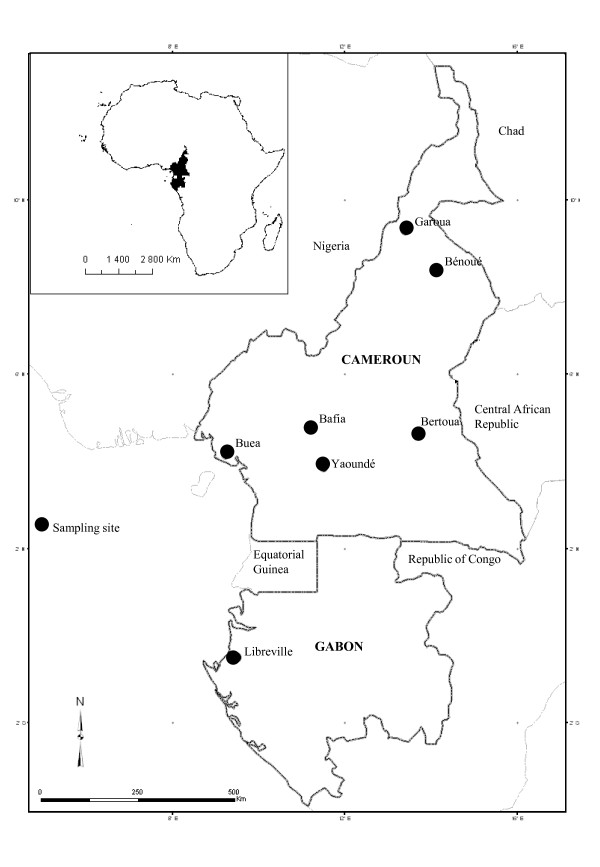
Background: Aedes aegypti(Linnaeus, 1762) and Aedes albopictus(Skuse, 1894) are the main vectors of dengue (DENV) and chikungunya (CHIKV) viruses worldwide. As there is still no vaccine or specific treatment for DENV and CHIKV, vector control remains the cornerstone of prevention and outbreak control. Unfortunately, vector control programs are facing operational challenges with mosquitoes becoming resistant to commonly used insecticides in several areas through the world. Throughout Central Africa no recent data are available susceptible/resistant status of either vector species since the introduction/arrival of Ae. albopictus in this area. We therefore studied the level of resistance of these two major vectors to insecticides commonly used in Africa for mosquito control. Results: Aedes aegypti and Ae. albopictus were sampled in six urban localities of Cameroon (Garoua, Bertoua, Yaoundé, Bafia, Buea) and Gabon (Libreville). Larval bioassays, carried out to determine the lethal concentrations (LC 50 and LC 95) and resistance ratios (RR 50 and RR 95) suggested that both vector species were susceptible to Bti(Bacillus thuringiensis var israeliensis) and temephos. Bioassays were also performed on adults using WHO diagnostic test kits to assess phenotypic resistance to deltamethrin, DDT, fenitrothion and propoxur. These experiments showed that one population of Ae. aegypti(Libreville) and two populations of Ae. albopictus(Buea and Yaoundé) were resistant to DDT (mortality 36% to 71%). Resistance to deltamethrin was also suspected in Ae. albopictus from Yaoundé (83% mortality). All other field mosquito populations were susceptible to deltamethrin, DDT, fenitrothion and propoxur. No increase in the knockdown times (Kdt 50 and Kdt 95) was noted in the Yaoundé resistant population compared to other Ae. albopictus populations, suggesting the possible involvement of metabolic resistance to deltamethrin and DDT. Conclusion: In view of the recent increase in dengue and chikungunya outbreaks in Central Africa, these unique comparative data on the insecticide susceptibility of Ae. aegypti and Ae. albopictus could help public health services to design more effective vector control measures.
Overview
The claims and statistics of this paper haven’t been checked yet.
Free: it reads the open-access text and checks the first 5 claims that cite a source we can check. Create a free account to check every claim.
Integrity signals
Registry
Cites
Statistics
Figures
Verification
Claims the paper makes
The claims and statistics of this paper haven’t been checked yet.
Free: it reads the open-access text and checks the first 5 claims that cite a source we can check. Create a free account to check every claim.
Claims other papers make about this one
Each is checked against this paper’s own text: does it say what the citing paper says it does?
The cited source says what the claim attributes to it.
In the citing paper
“Resistance to DDT, pyrethroids and other insecticides has been documented widely in dengue vectors, and continues to emerge, potentially impacting on intervention effectiveness [40, 117–119].”
From Is Dengue Vector Control Deficient in Effectiveness or Evidence?: Systematic Review and Meta-analysis (2016) · cites this paper as [117]
Self-check
Percentages, sums and reported differences re-computed from the paper’s own numbers.
The self-check needs the paper’s full text.
Citations
Cites
Insecticide Resistance in Insect Vectors of Human Disease
Hemingway, J., & Ranson, H. (2000) · Annual Review of Entomology · doi:10.1146/annurev.ento.45.1.371 · Cited by 1,558
Gubler, D. J. (2002) · Trends in Microbiology · doi:10.1016/s0966-842x(01)02288-0 · Cited by 1,523 · cited 1×
“With about 50-100 million reported cases annually, including 500 000 severe cases of dengue haemorrhagic fever (DHF) or dengue shock syndrome (DSS), DENV is the most prevalent mosquito-borne human virus worldwide [1].”
BackgroundThe molecular basis of insecticide resistance in mosquitoes
Hemingway, J., Hawkes, N. J., McCarroll, L., & Ranson, H. (2004) · Insect Biochemistry and Molecular Biology · doi:10.1016/j.ibmb.2004.03.018 · Cited by 1,109 · cited 1×
“albopictus [15,22], although a significant decrease in susceptibility to permethrin, malathion and temephos has been observed in Thailand [14].”
BackgroundAedes albopictus, an arbovirus vector: From the darkness to the light
Paupy, C., Delatte, H., Bagny, L., Corbel, V., & Fontenille, D. (2009) · Microbes and Infection · doi:10.1016/j.micinf.2009.05.005 · Cited by 1,024 · cited 2×
“Both species occur in sub-Saharan Africa: Ae. aegypti is native to Africa and Ae. albopictus has recently invaded several Central African countries [ 8 ].”
BackgroundSelf-citationDengue haemorrhagic fever: diagnosis, treatment, prevention and control
Crane, G. (1999) · Pathology · doi:10.1016/s0031-3025(16)34854-1 · Cited by 744
Dengue haemorrhagic fever: Diagnosis, treatment, prevention and control
Gould, E. A. (1998) · Transactions of the Royal Society of Tropical Medicine and Hygiene · doi:10.1016/s0035-9203(98)91100-2 · Cited by 717
Diabate, A., Baldet, T., Chandre, F., Akoobeto, M., Guiguemde, T. R., Darriet, F., Brengues, C., Guillet, P., Hemingway, J., Small, G. J., et al. (2002) · The American journal of tropical medicine and hygiene · doi:10.4269/ajtmh.2002.67.617 · Cited by 459 · cited 1×
“Contamination of larval breeding places by insecticides used in agriculture (cotton, vegetables) has also been shown to select for DDT and pyrethroid resistance in malaria vectors [48-52].”
BackgroundSelf-citationBrengues, C., Hawkes, N. J., Chandre, F., Mccarroll, L., Duchon, S., Guillet, P., Manguin, S., Morgan, J. C., & Hemingway, J. (2003) · Medical and Veterinary Entomology · doi:10.1046/j.1365-2915.2003.00412.x · Cited by 432 · cited 3×
“The Kdr mutation has been found in Ae. aegypti [ 39 ,16] but has never been reported in Ae. albopictus.”
BackgroundInfluentialSelf-citationVectors of Chikungunya virus in Senegal: current data and transmission cycles.
Diallo, M., Thonnon, J., Traore-Lamizana, M., & Fontenille, D. (1999) · The American journal of tropical medicine and hygiene · doi:10.4269/ajtmh.1999.60.281 · Cited by 423
Corbel, V., N’Guessan, R., Brengues, C., Chandre, F., Djogbenou, L., Martin, T., Akogbéto, M., Hougard, J. M., & Rowland, M. (2007) · Acta Tropica · doi:10.1016/j.actatropica.2007.01.005 · Cited by 382 · cited 2×
“Contamination of larval breeding places by insecticides used in agriculture (cotton, vegetables) has also been shown to select for DDT and pyrethroid resistance in malaria vectors [48-52].”
BackgroundSelf-citationStatus of pyrethroid resistance in Anopheles gambiae sensu lato.
Chandre, F., Darrier, F., Manga, L., Akogbeto, M. C., Faye, O., Mouchet, J., & Guillet, P. (1999) · Europe PMC (PubMed Central) · Cited by 380
Self-citationSaavedra‐Rodriguez, K., Urdaneta‐Marquez, L., Rajatileka, S., Moulton, M., Flores, A. E., Fernandez‐Salas, I., Bisset, J., Rodriguez, M., Mccall, P. J., Donnelly, M. J., et al. (2007) · Insect Molecular Biology · doi:10.1111/j.1365-2583.2007.00774.x · Cited by 350
Djouaka, R. F., Bakare, A. A., Coulibaly, O. N., Akogbeto, M. C., Ranson, H., Hemingway, J., & Strode, C. (2008) · BMC Genomics · doi:10.1186/1471-2164-9-538 · Cited by 342 · cited 1×
“Contamination of larval breeding places by insecticides used in agriculture (cotton, vegetables) has also been shown to select for DDT and pyrethroid resistance in malaria vectors [48-52].”
BackgroundPaupy, C., Ollomo, B., Kamgang, B., Moutailler, S., Rousset, D., Demanou, M., Hervé, J.-P., Leroy, E., & Simard, F. (2010) · Vector-Borne and Zoonotic Diseases · doi:10.1089/vbz.2009.0005 · Cited by 297
Self-citationConcurrent Chikungunya and Dengue Virus Infections during Simultaneous Outbreaks, Gabon, 2007
Leroy, E. M., Nkoghe, D., Ollomo, B., Nze-Nkogue, C., Becquart, P., Grard, G., Pourrut, X., Charrel, R., Moureau, G., Ndjoyi-Mbiguino, A., et al. (2009) · Emerging Infectious Diseases · doi:10.3201/eid1504.080664 · Cited by 255
Lumjuan, N., McCarroll, L., Prapanthadara, L.-A., Hemingway, J., & Ranson, H. (2005) · Insect Biochemistry and Molecular Biology · doi:10.1016/j.ibmb.2005.03.008 · Cited by 234
(2010) · LSTM Online Archive (Liverpool School of Tropical Medicine) · Cited by 222
Marcombe, S., Poupardin, R., Darriet, F., Reynaud, S., Bonnet, J., Strode, C., Brengues, C., Yébakima, A., Ranson, H., Corbel, V., et al. (2009) · BMC Genomics · doi:10.1186/1471-2164-10-494 · Cited by 205
Self-citationMelo-Santos, M. A. V., Varjal-Melo, J. J. M., Araújo, A. P., Gomes, T. C. S., Paiva, M. H. S., Regis, L. N., Furtado, A. F., Magalhaes, T., Macoris, M. L. G., Andrighetti, M. T. M., et al. (2010) · Acta Tropica · doi:10.1016/j.actatropica.2009.10.015 · Cited by 187
Resistance of Aedes aegypti from the state of São Paulo, Brazil, to organophosphates insecticides
Macoris, M. D. L. D. G., Andrighetti, M. T. M., Takaku, L., Glasser, C. M., Otrera, V. C. G., & Bracco, J. E. (2003) · Memórias do Instituto Oswaldo Cruz · doi:10.1590/s0074-02762003000500020 · Cited by 184 · cited 3×
“Resistance to multiple insecticides (e.g. pyrethroids and organophosphates) has been reported in Ae. aegypti in South-East Asia [17,18], South America and the Caribbean [19-21].”
BackgroundInsecticide Susceptibility of Aedes aegypti and Aedes albopictus across Thailand
Ponlawat, A., Scott, J. G., & Harrington, L. C. (2005) · Journal of Medical Entomology · doi:10.1603/0022-2585(2005)042[0821:isoaaa]2.0.co;2 · Cited by 174
Comparison of house spraying and insecticide-treated nets for malaria control.
(2000) · Europe PMC (PubMed Central) · Cited by 170
Chikungunya Virus, Cameroon, 2006
Peyrefitte, C. N., Rousset, D., Pastorino, B. A. M., Pouillot, R., Bessaud, M., Tock, F., Mansaray, H., Merle, O. L., Pascual, A. M., Paupy, C., et al. (2007) · Emerging Infectious Diseases · doi:10.3201/eid1305.061500 · Cited by 158 · cited 2×
“In West and Central Africa, where DENV epidemics remained limited until 5 years ago, the number of outbreaks or case reports has increased significantly in several areas, including Cameroon in 2006 [ 2 ,3], Gabon in 2007 [4], and West African countries such as Mali in 2008, and Cape Verde and Senegal in 2009 [5].”
Self-citationParis, M., Tetreau, G., Laurent, F., Lélu, M., Després, L., & David, J. (2010) · Pest Management Science · doi:10.1002/ps.2046 · Cited by 155 · cited 6×
“Resistance to Bti has been described in Culex pipiens in the USA [28] and suspected in Aedes rusticus in France [29], but no resistance to this pesticide has been reported to date in Ae. aegypti or Ae. albopictus worldwide.”
BackgroundInfluentialJirakanjanakit, N., Rongnoparut, P., Saengtharatip, S., Chareonviriyaphap, T., Duchon, S., Bellec, C., & Yoksan, S. (2007) · Journal of Economic Entomology · doi:10.1093/jee/100.2.545 · Cited by 155
INSECTICIDE RESISTANCE IN CULEX PIPIENS FROM NEW YORK
Paul, A., Harrington, L. C., Zhang, L., & Scott, J. G. (2005) · Journal of the American Mosquito Control Association · doi:10.2987/8756-971x(2005)21[305:iricpf]2.0.co;2 · Cited by 140 · cited 3×
“Resistance to Bti has been described in Culex pipiens in the USA [28] and suspected in Aedes rusticus in France [29], but no resistance to this pesticide has been reported to date in Ae. aegypti or Ae. albopictus worldwide.”
BackgroundInfluentialYadouleton, A., Martin, T., Padonou, G., Chandre, F., Asidi, A., Djogbenou, L., Dabiré, R., Aïkpon, R., Boko, M., Glitho, I., et al. (2011) · Parasites & Vectors · doi:10.1186/1756-3305-4-60 · Cited by 132
Self-citationRecent expansion of dengue virus serotype 3 in West Africa
Franco, L., Di Caro, A., Carletti, F., Vapalahti, O., Renaudat, C., Zeller, H., & Tenorio, A. (2010) · Eurosurveillance · doi:10.2807/ese.15.07.19490-en · Cited by 128 · cited 1×
“In West and Central Africa, where DENV epidemics remained limited until 5 years ago, the number of outbreaks or case reports has increased significantly in several areas, including Cameroon in 2006 [2,3], Gabon in 2007 [4], and West African countries such as Mali in 2008, and Cape Verde and Senegal in 2009 [5].”
BackgroundSomboon, P., Prapanthadara, L., & Suwonkerd, W. (2003) · PubMed · Cited by 116
Current insecticide resistance patterns in mosquito vectors in Thailand.
Chareonviriyahpap, T., Aum-Aung, B., & Ratanatham, S. (1999) · PubMed · Cited by 113
Strategies and utility of imputed SNP genotypes for genomic analysis in dairy cattle
Khatkar, M. S., Moser, G., Hayes, B. J., & Raadsma, H. W. (2012) · BMC Genomics · doi:10.1186/1471-2164-13-538 · Cited by 107
Kamgang, B., HAPPI, J. Y., Boisier, P., Njiokou, F., Hervé, J.-P., Simard, F., & Paupy, C. (2010) · Medical and Veterinary Entomology · doi:10.1111/j.1365-2915.2010.00869.x · Cited by 106
Self-citationChung, Y. K., Koon, L. L., & Yin, P. F. (2001) · Journal of Medical Entomology · doi:10.1603/0022-2585-38.4.475 · Cited by 98
PYRETHROID INSECTICIDE-RESISTANT STRAIN OF AEDES AEGYPTI FROM CUBA INDUCED BY DELTAMETHRIN SELECTION
Rodríguez, M. M., Bisset, J. A., de Armas, Y., & Ramos, F. (2005) · Journal of the American Mosquito Control Association · doi:10.2987/8756-971x(2006)21[437:pisoaa]2.0.co;2 · Cited by 86 · cited 1×
“pyrethroids and organophosphates) has been reported in Ae. aegypti in South-East Asia [17,18], South America and the Caribbean [ 19-21 ].”
BackgroundCharacterization of deltamethrin resistance in field populations of Aedes aegypti in Thailand.
Yaicharoen, R., Kiatfuengfoo, R., Chareonviriyaphap, T., & Rongnoparut, P. (2005) · PubMed · Cited by 77
Marcombe, S., Carron, A., Darriet, F., Etienne, M., Agnew, P., Tolosa, M., Yp-Tcha, M. M., Lagneau, C., Yébakima, A., & Corbel, V. (2009) · The American Journal of Tropical Medicine and Hygiene · doi:10.4269/ajtmh.2009.80.745 · Cited by 73 · cited 1×
“aegypti [39,16] but has never been reported in Ae.”
BackgroundSelf-citationChen, C. D., Nazni, W. A., Lee, H. L., & Sofian‐Azirun, M. (2005) · PubMed · Cited by 64
Trend of Temephos Resistance in Aedes (Stegomyia) Mosquitoes in Thailand During 2003–2005
Jirakanjanakit, N., Saengtharatip, S., Rongnoparut, P., Duchon, S., Bellec, C., & Yoksan, S. (2007) · Environmental Entomology · doi:10.1603/0046-225x(2007)36[506:totria]2.0.co;2 · Cited by 64 · cited 1×
“pyrethroids and organophosphates) has been reported in Ae. aegypti in South-East Asia [17, 18 ], South America and the Caribbean [19-21].”
BackgroundCurrent resistance status to temephos in Aedes aegypti from different regions of Argentina
Albrieu-Llinás, G., Seccacini, E., Cn, G., & Licastro, S. (2010) · Memórias do Instituto Oswaldo Cruz · doi:10.1590/s0074-02762010000100019 · Cited by 61 · cited 3×
“Resistance to multiple insecticides (e.g. pyrethroids and organophosphates) has been reported in Ae. aegypti in South-East Asia [17,18], South America and the Caribbean [19-21].”
BackgroundRole of Myzus persicae (Hemiptera: Aphididae) and its secondary hosts in plum pox virus propagation
MANACHINI, B. R. I., P, C., L, C., et al. (2007) · Nova Science Publishers (Nova Science Publishers, Inc.) · doi:10.1603/0022-0493(2007)100 · Cited by 58
A comparison of surveillance systems for the dengue vector Aedes aegypti in Port of Spain, Trinidad.
Rawlins, S. C., Martinez, R., Wiltshire, S., & Legall, G. (1998) · PubMed · Cited by 52
Temephos resistance in two forms of Aedes aegypti and its significance for the resistance mechanism.
Paeporn, P., Komalamisra, N., Deesin, V., Rongsriyam, Y., Eshita, Y., & Thongrungkiat, S. (2003) · PubMed · Cited by 37
Kawada, H., Maekawa, Y., Abé, M., Ohashi, K., Ohba, S., & Takagi, M. (2010) · Japanese Journal of Infectious Diseases · doi:10.7883/yoken.63.19 · Cited by 34 · cited 10×
“Resistance to Bti has been described in Culex pipiens in the USA [28] and suspected in Aedes rusticus in France [29], but no resistance to this pesticide has been reported to date in Ae. aegypti or Ae. albopictus worldwide.”
BackgroundInfluentialPing, L. T., Yatiman, R., & Gek, L.-P. S. (2001) · PubMed · Cited by 32
Oxidase activity in relation to insecticide resistance in vectors of public health importance.
Nazni, W. A., Kamaludin, M. Y., Lee, H. L., Rashid, T. R. T. A., & Sa'diyah, I. (2000) · Tropical biomedicine · Cited by 27
Susceptibility of Italian populations of Aedes albopictus to temephos and to other insecticides.
Romi, R., Toma, L., Severini, F., & Luca, M. D. (2003) · PubMed · Cited by 25
First Confirmed Dengue-1 Fever Cases Reported from Cameroon
Krippner, R., & von Laer, G. (2006) · Journal of Travel Medicine · doi:10.2310/7060.2002.24119 · Cited by 22 · cited 1×
“In West and Central Africa, where DENV epidemics remained limited until 5 years ago, the number of outbreaks or case reports has increased significantly in several areas, including Cameroon in 2006 [2,3], Gabon in 2007 [4], and West African countries such as Mali in 2008, and Cape Verde and Senegal in 2009 [5].”
BackgroundSusceptibility of two cambodian population of Aedes aegypti mosquito larvae to temephos during 2001
Polson, K. A., Curtis, C. F., Seng, C., Olson, J. K., Chantha, N., & Rawlins, S. C. (2001) · LSHTM Research Online (London School of Hygiene and Tropical Medicine) · Cited by 17
Paeporn, P., Komalamisra, N., Thongrungkiat, S., Deesin, V., Eshita, Y., & Rongsriyam, Y. (2003) · PubMed · Cited by 9
Research works printed but not linked: 7
- 11. WHO Report of the Scientific Working Group on dengue 2006 Document WHO/TDR/SWG/08, Geneva, Switzerland, World Health Organization
- 23. Mouchet J Cordellier V Germain M Carnevale P Barathe J Sannier C Résistance aux insecticides d'Aedes aegypti et Culex pipiens fatigans en Afrique centrale 1972 WHO/VBC/72/381, 12P, Geneva, Switzerland, World Health Organization
- 24. WHO Guidelines for laboratory and field testing of mosquito larvicides 2005 Document WHO/CDS/WHOPES/GCDPP/13, Geneva, Switzerland, World Health Organization
- 25. WHO Guidelines for testing mosquito adulticides for indoor residual spraying and treatment of mosquito nets 2006 Document WHO/CDS/NTD/WHOPES/GCDPP/3, Geneva, Switzerland, World Health Organization
- 26. Giner M Vassal C Kouaik Z Chiroleu F Vassal JM Win DL version 2.0 1999 Paris: CIRAD-CA, U.R.B.I/M.A.B.I.S
- 27. WHO Test Procedures for insecticide resistance monitoring in malaria vectors, bio-efficacy and persistence of insecticide on treated surfaces 1998 Document WHO/CDS/CPC/MAL/98.12, Geneva, Switzerland, World Health Organization
- 30. Lee HL Lime W A reevaluation of the susceptibility of field collected Aedes (Stegomyia) aegypti (Linnaeus) larvae to temephos in Malaysia Mosquito-Borne Dis Bull 1989 6 91 95
Cited by
Moyes, C. L., Vontas, J., Martins, A. J., Ng, L. C., Koou, S. Y., Dusfour, I., Raghavendra, K., Pinto, J., Corbel, V., David, J.-P., et al. (2017) · PLOS Neglected Tropical Diseases · doi:10.1371/journal.pntd.0005625 · Cited by 907
“Resistance to alternative insecticides currently being deployed Bacillus thuringiensis var. israeliensis (Bti) formulations and insect growth regulators (IGRs) are important alternatives to the neurotoxic insecticides for larviciding, in light of emerging widespread resistance to the latter.”
BackgroundInfluentialSelf-citationThe invasive mosquito species Aedes albopictus: current knowledge and future perspectives
Bonizzoni, M., Gasperi, G., Chen, X., & James, A. A. (2013) · Trends in Parasitology · doi:10.1016/j.pt.2013.07.003 · Cited by 703
Insecticide resistance in the major dengue vectors Aedes albopictus and Aedes aegypti
Vontas, J., Kioulos, E., Pavlidi, N., Morou, E., della Torre, A., & Ranson, H. (2012) · Pesticide Biochemistry and Physiology · doi:10.1016/j.pestbp.2012.05.008 · Cited by 439
“06–100 – – – [17]”
InfluentialBowman, L. R., Donegan, S., & McCall, P. J. (2016) · PLOS Neglected Tropical Diseases · doi:10.1371/journal.pntd.0004551 · Cited by 449
Smith, L. B., Kasai, S., & Scott, J. G. (2016) · Pesticide Biochemistry and Physiology · doi:10.1016/j.pestbp.2016.03.005 · Cited by 405
Metadata
- Authors
- Kamgang, B., Marcombe, S., Chandre, F., Nchoutpouen, E., Nwane, P., Etang, J., Corbel, V., & Paupy, C.
- Affiliations
- Maladies Infectieuses et Vecteurs: Écologie, Génétique, Évolution et Contrôle (FR)
- Organisation de Coordination pour la lutte contre les Endémies en Afrique Centrale (CM)
- Corresponding author
- Paupy, Christophe
- ORCID
- Venue
- Parasites & Vectors
- Published
- 2011-05-15
- Volume
- 4
- Issue
- 1
- Pages
- 79-79
- ISSN
- 1756-3305 (ISSN-L)
- PMC
- PMC3121691
- OpenAlex
- W2105312231
- Cited by
- 167
- References
- 51
- Citations by year
- 2026: 5 · 2025: 9 · 2024: 7 · 2023: 11 · 2022: 10 · 2021: 12 · 2020: 15 · 2019: 10 · 2018: 8 · 2017: 15 · 2016: 11 · 2015: 15 · 2014: 14 · 2013: 9 · 2012: 11
- FWCI
- 12.27
- Type
- journal article
- Language
- en
- Open access
- gold
- doi.org
- Licence
- cc-by
- Locations
- Parasites & Vectors (publishedVersion, cc-by)
- PubMed Central (publishedVersion, cc-by)
- PubMed (publishedVersion)
- HAL (submittedVersion, cc-by)
- DOAJ (DOAJ: Directory of Open Access Journals) (submittedVersion, cc-by-sa)
- Funders
- Agence Nationale de la Recherche
- Topics
- Health Sciences › Medicine › Public Health, Environmental and Occupational Health › Mosquito-borne diseases and control
- Health Sciences › Medicine › Public Health, Environmental and Occupational Health › Dengue and Mosquito Control Research
- Life Sciences › Biochemistry, Genetics and Molecular Biology › Molecular Biology › Insect Resistance and Genetics
- Keywords
- Aedes aegypti, Aedes albopictus, insecticide resistance, mosquito vector control, dengue vector, chikungunya vector, deltamethrin resistance, DDT resistance, fenitrothion, propoxur, temephos, knockdown time, metabolic resistance, Central Africa
- MeSH terms
- Aedes, Animals, Cameroon, Cities, Drug Resistance, Gabon, Insecticides, Larva, Survival Analysis
About these checks
Registry, retraction, Cites and statistics results are computed, not judged, with one exception: a printed reference that no index lists is read once by a model before it counts as a citation error. Claims are extracted by a model and kept only when their quote appears verbatim in the text; each cited source is then checked, with a model’s help, for whether it says what the claim relies on. Those verdicts can be wrong — read the claim’s quote and the cited source before relying on one.
Statistics and arithmetic are recomputed, not judged.
Confidence bands are shown only for fields calibrated on our annotated test set. None is calibrated yet, so no band is shown.
What counts as a claim ›How we measure confidence ›How we check this ›
Are you an author, or do you see a problem with this page? Request a review
Data sources
Bibliographic data: Semantic Scholar, OpenAlex, Crossref.
Contains information from the Semantic Scholar Academic Graph Datasets, made available under the ODC Attribution License (ODC-BY 1.0).
Semantic Scholar’s data is described in: Kinney, R., et al. (2023). The Semantic Scholar Open Data Platform. arXiv:2301.10140.
