

The DOI matches its Crossref record; 94 of the 94 references it cites were found in a registry or an index.
Driving forces for changes in geographical distribution of Ixodes ricinus ticks in Europe
Open accessAbstract
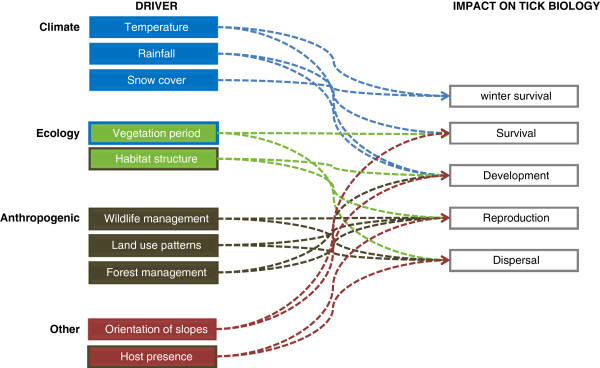
Many factors are involved in determining the latitudinal and altitudinal spread of the important tick vector Ixodes ricinus (Acari: Ixodidae) in Europe, as well as in changes in the distribution within its prior endemic zones. This paper builds on published literature and unpublished expert opinion from the VBORNET network with the aim of reviewing the evidence for these changes in Europe and discusses the many climatic, ecological, landscape and anthropogenic drivers. These can be divided into those directly related to climatic change, contributing to an expansion in the tick's geographic range at extremes of altitude in central Europe, and at extremes of latitude in Scandinavia; those related to changes in the distribution of tick hosts, particularly roe deer and other cervids; other ecological changes such as habitat connectivity and changes in land management; and finally, anthropogenically induced changes. These factors are strongly interlinked and often not well quantified. Although a change in climate plays an important role in certain geographic regions, for much of Europe it is non-climatic factors that are becoming increasingly important. How we manage habitats on a landscape scale, and the changes in the distribution and abundance of tick hosts are important considerations during our assessment and management of the public health risks associated with ticks and tick-borne disease issues in 21(st) century Europe. Better understanding and mapping of the spread of I. ricinus (and changes in its abundance) is, however, essential to assess the risk of the spread of infections transmitted by this vector species. Enhanced tick surveillance with harmonized approaches for comparison of data enabling the follow-up of trends at EU level will improve the messages on risk related to tick-borne diseases to policy makers, other stake holders and to the general public.
Overview
The claims and statistics of this paper haven’t been checked yet.
Run the check — free, no account needed. It reads the open-access text and checks the sources it cites.
Integrity signals
Registry
Cites
Statistics
Figures
Verification
Claims the paper makes
The claims and statistics of this paper haven’t been checked yet.
Run the check — free, no account needed. It reads the open-access text and checks the sources it cites.
Claims other papers make about this one
Each is checked against this paper’s own text: does it say what the citing paper says it does?
In the citing paper
“This could explain the result of five positive dogs (6%) that were microfilariae-positive and antigen-negative [35–37].”
From Prevalence of canine heartworm ( Dirofilaria immitis ) disease in dogs of central Portugal (2014) · cites this paper as [35]
Self-check
Percentages, sums and reported differences re-computed from the paper’s own numbers.
The self-check needs the paper’s full text.
Citations
Cites
Lindgren, E., Tälleklint, L., & Polfeldt, T. (2000) · Environmental Health Perspectives · doi:10.1289/ehp.00108119 · Cited by 558
Randolph, S. (2004) · Parasitology · doi:10.1017/s0031182004004925 · Cited by 509
Self-citationRizzoli, A. P., Hauffe, H. C., Carpi, G., Vourc’h, G., Neteler, M., & Rosà, R. (2011) · Eurosurveillance · doi:10.2807/ese.16.27.19906-en · Cited by 501
Self-citationJaenson, T. G. T., Jaenson, D. G. E., Eisen, L., Petersson, E., & Lindgren, E. (2012) · Parasites & Vectors · doi:10.1186/1756-3305-5-8 · Cited by 442
Self-citationAn empirical quantitative framework for the seasonal population dynamics of the tick Ixodes ricinus
Randolph, S., Green, R. M., Hoodless, A. N., & Peacey, M. (2002) · International Journal for Parasitology · doi:10.1016/s0020-7519(02)00030-9 · Cited by 332
Self-citationPerret, J.-L., Guigoz, E., Rais, O., & Gern, L. (2000) · Parasitology Research · doi:10.1007/s004360000209 · Cited by 301
Tick-borne bacterial diseases emerging in Europe
Parola, P., & Raoult, D. (2001) · Clinical Microbiology and Infection · doi:10.1046/j.1469-0691.2001.00200.x · Cited by 270
Cagnacci, F., Focardi, S., Heurich, M., Stache, A., Hewison, A. J. M., Morellet, N., Kjellander, P., Linnell, J. D. C., Mysterud, A., Neteler, M., et al. (2011) · Oikos · doi:10.1111/j.1600-0706.2011.19441.x · Cited by 250
Lindgren, E., & Jaenson, T. G. T. (2006) · Cited by 248
Self-citationGilbert, L. (2009) · Oecologia · doi:10.1007/s00442-009-1430-x · Cited by 247
Prevalence of Borrelia burgdorferi sensu lato-infected ticks on migrating birds
Olsen, B. R., Jaenson, T. G. T., & Bergström, S. (1995) · Applied and Environmental Microbiology · doi:10.1128/aem.61.8.3082-3087.1995 · Cited by 244
Self-citationEpidemiology of Lyme Borreliosis
lek, Z. H. A. (2009) · Current problems in dermatology · doi:10.1159/000213069 · Cited by 235
Jaenson, T. G. T., Tälleklint, L., Lundqvist, L., Olsén, B., Chirico, J., & Mejlon, H. (1994) · Journal of Medical Entomology · doi:10.1093/jmedent/31.2.240 · Cited by 227
Self-citationTick-borne Encephalitis from Eating Goat Cheese in a Mountain Region of Austria
Holzmann, H., Aberle, S. W., Stiasny, K., Werner, P., Mischak, A., Zainer, B., Netzer, M., Koppi, S., Bechter, E., & Heinz, F. X. (2009) · Emerging infectious diseases · doi:10.3201/eid1510.090743 · Cited by 217
Jore, S., Viljugrein, H., Hofshagen, M., Brun‐Hansen, H., Kristoffersen, A. B., Nygård, K. M., Brun, E., Ottesen, P., Sævik, B. K., & Ytrehus, B. (2011) · Parasites & Vectors · doi:10.1186/1756-3305-4-84 · Cited by 198
Climate change and adaptation strategies for human health
Menne, B., Geneva . Regional Office for Europe eng Who, & Ebi, K. L. (2006) · Medical Entomology and Zoology · Cited by 196
An Avian Reservoir (Turdus merula) of the Lyme Borreliosis Spirochetes
Humair, P., Postic, D., Wallich, R., & Gern, L. (1998) · Zentralblatt für Bakteriologie · doi:10.1016/s0934-8840(98)80194-1 · Cited by 174
Jaenson, T. G. T., & Lindgren, E. (2010) · Ticks and Tick-borne Diseases · doi:10.1016/j.ttbdis.2010.10.006 · Cited by 173
Self-citationStudies on the Ecology of Lyme Disease in a Deer Forest in County Galway, Ireland
Gray, J., Kahl, O., Janetzki, C., & Stein, J. (1992) · Journal of Medical Entomology · doi:10.1093/jmedent/29.6.915 · Cited by 170
Shift of the Tick Ixodes ricinus and Tick-Borne Encephalitis to Higher Altitudes in Central Europe
Dániel, M., Danielová, V., Kriz, B., Jirsa, A., & Nožička, J. (2003) · European Journal of Clinical Microbiology & Infectious Diseases · doi:10.1007/s10096-003-0918-2 · Cited by 169
Climate Change Cannot Explain the Upsurge of Tick-Borne Encephalitis in the Baltics
Šumilo, D., Ašoklienė, L., Bormane, A., Vasilenko, V., Golovljova, I., & Randolph, S. (2007) · PLoS ONE · doi:10.1371/journal.pone.0000500 · Cited by 165
Self-citationForest Structure and Roe Deer Abundance Predict Tick-Borne Encephalitis Risk in Italy
Rizzoli, A. P., Hauffe, H. C., Tagliapietra, V., Neteler, M., & Rosà, R. (2009) · PLoS ONE · doi:10.1371/journal.pone.0004336 · Cited by 160
Self-citationPerret, J., Guérin, P. M., Diehl, P. A., Vlimant, M., & Gern, L. (2003) · Journal of Experimental Biology · doi:10.1242/jeb.00345 · Cited by 157
Šumilo, D., Bormane, A., Ašoklienė, L., Vasilenko, V., Golovljova, I., Avšič‐Županc, T., Hubálek, Z., & Randolph, S. (2008) · Reviews in Medical Virology · doi:10.1002/rmv.566 · Cited by 157
Self-citationJouda, F., Perret, J., & Gern, L. (2004) · Journal of Medical Entomology · doi:10.1603/0022-2585-41.2.162 · Cited by 147
Tälleklint, L., & Jaenson, T. G. T. (1994) · Journal of Medical Entomology · doi:10.1093/jmedent/31.6.880 · Cited by 144
Self-citationTälleklint, L., & Jaenson, T. G. T. (1998) · Journal of Medical Entomology · doi:10.1093/jmedent/35.4.521 · Cited by 135
Self-citationSantos‐Silva, M. M., Béati, L., Santos, A. S., de Sousa, R., Núncio, M. S., Melo, P., Santos‐Reis, M., Fonseca, C. M. D., Formosinho, P., Vilela, C., et al. (2011) · Experimental and Applied Acarology · doi:10.1007/s10493-011-9440-x · Cited by 135
Self-citationThe ecology of the sheep tick,Ixodes ricinusL.
Milne, A. J. M. (1950) · Parasitology · doi:10.1017/s0031182000017820 · Cited by 134
Trends in ixodid tick abundance and distribution in Great Britain
Scharlemann, J. P. W., Johnson, P. J., Smith, A. A., Macdonald, D. W., & Randolph, S. (2008) · Medical and Veterinary Entomology · doi:10.1111/j.1365-2915.2008.00734.x · Cited by 134
Self-citationDobson, A. D. M., Taylor, J. L., & Randolph, S. (2011) · Ticks and Tick-borne Diseases · doi:10.1016/j.ttbdis.2011.03.002 · Cited by 128
Self-citationTick Surveillance in Great Britain
Jameson, L., & Medlock, J. M. (2010) · Vector-Borne and Zoonotic Diseases · doi:10.1089/vbz.2010.0079 · Cited by 128
Self-citationEstrada‐Peña, A., Farkas, R., Jaenson, T. G. T., Koenen, F., Madder, M., Pascucci, I., Salman, Μ. D., Tarrès‐Call, J., & Jongejan, F. (2012) · Experimental and Applied Acarology · doi:10.1007/s10493-012-9600-7 · Cited by 124
Self-citationEstrada‐Peña, A. (2003) · Ecography · doi:10.1034/j.1600-0587.2003.03530.x · Cited by 109
Self-citationRisk indicators for the tick Ixodes ricinus and Borrelia burgdorferi sensu lato in Sweden
Jaenson, T. G. T., Eisen, L., Comstedt, P., Mejlon, H., Lindgren, E., Bergström, S., & Olsén, B. (2009) · Medical and Veterinary Entomology · doi:10.1111/j.1365-2915.2009.00813.x · Cited by 107
Self-citationThe comparison of sheep‐tick populations ( Ixodes ricinus L.)
Milne, A. (1943) · Annals of Applied Biology · doi:10.1111/j.1744-7348.1943.tb06195.x · Cited by 107
Noureddine, R., Chauvin, A., & Plantard, O. (2010) · International Journal for Parasitology · doi:10.1016/j.ijpara.2010.08.010 · Cited by 105
Self-citationDanielová, V., Rudenko, N., Daniel, M., Holubová, J., Materna, J., Golovchenko, M., & Schwarzová, L. (2006) · International Journal of Medical Microbiology · doi:10.1016/j.ijmm.2006.02.007 · Cited by 101
SEX-BIASED GENETIC STRUCTURE IN THE VECTOR OF LYME DISEASE, IXODES RICINUS
Meeûs, T. D., Béati, L., Delaye, C., Aeschlimann, A., & François Renaud, A. (2002) · Evolution · doi:10.1111/j.0014-3820.2002.tb00194.x · Cited by 95
Jouda, F., Perret, J., & Gern, L. (2004) · Vector-Borne and Zoonotic Diseases · doi:10.1089/153036604773082960 · Cited by 94
Schwarz, A., Maier, W. A., III, Kistemann, T., & Kampen, H. (2008) · International Journal of Hygiene and Environmental Health · doi:10.1016/j.ijheh.2007.12.001 · Cited by 94
Spatial distribution of Dermacentor reticulatus and Ixodes ricinus in Hungary: evidence for change?
Sréter, T., Széll, Z., & Varga, I. (2005) · Veterinary Parasitology · doi:10.1016/j.vetpar.2004.11.025 · Cited by 93
Forecasting habitat suitability for ticks and prevention of tick-borne diseases
Estrada‐Peña, A. (2001) · Veterinary Parasitology · doi:10.1016/s0304-4017(01)00426-5 · Cited by 89
Self-citationDobson, A. D. M., & Randolph, S. (2011) · Journal of Applied Ecology · doi:10.1111/j.1365-2664.2011.02004.x · Cited by 87
Self-citationLandscape Predictors of Tick-Borne Encephalitis in Latvia: Land Cover, Land Use, and Land Ownership
Vanwambeke, S., Šumilo, D., Bormane, A., Lambin, É. F., & Randolph, S. (2009) · Vector-Borne and Zoonotic Diseases · doi:10.1089/vbz.2009.0116 · Cited by 86
Self-citationCraine, N., Randolph, S., & Nuttall, P. A. (1995) · PubMed · Cited by 85
Self-citationIxodes ricinus immatures on birds in a focus of Lyme borreliosis.
Humair, P., Turrian, N., Aeschlimann, A., & Gern, L. (1993) · PubMed · Cited by 84
Zeman, P., & Beneš, Č. (2004) · International Journal of Medical Microbiology Supplements · doi:10.1016/s1433-1128(04)80008-1 · Cited by 84
Danielová, V., Daniel, M., Schwarzová, L., Materna, J., Rudenko, N., Golovchenko, M., Holubová, J., Grubhoffer, L., & Kilián, P. (2009) · Vector-Borne and Zoonotic Diseases · doi:10.1089/vbz.2009.0020 · Cited by 84
Randolph, S., Ašoklienė, L., Avšič‐Županc, T., Bormane, A., Burri, C., Gern, L., Golovljova, I., Hubálek, Z., Knap, N., Kondrusik, M., et al. (2008) · Parasites & Vectors · doi:10.1186/1756-3305-1-44 · Cited by 82
Self-citationMaterna, J., Daniel, M., Metelka, L., & Harčarik, J. (2008) · International Journal of Medical Microbiology · doi:10.1016/j.ijmm.2008.05.004 · Cited by 81
Burri, C., Cadenas, F. M., Douet, V., Moret, J., & Gern, L. (2007) · Vector-Borne and Zoonotic Diseases · doi:10.1089/vbz.2006.0569 · Cited by 81
Rizzoli, A. P., Merler, S., Furlanello, C., & Genchi, C. (2002) · Journal of Medical Entomology · doi:10.1603/0022-2585-39.3.485 · Cited by 81
Self-citationSpatial Risk Assessment for Lyme Borreliosis in Denmark
Jensen, P. (2000) · Scandinavian Journal of Infectious Diseases · doi:10.1080/003655400458857 · Cited by 79
Self-citationMaterna, J., Dániel, M., & Danielová, V. (2005) · PubMed · Cited by 79
Borrelia burgdorferi in a focus of Lyme borreliosis: epizootiologic contribution of small mammals.
Humair, P., Turrian, N., Aeschilimann, A., & Gern, L. (1993) · PubMed · Cited by 78
Hofhuis, A., van der Giessen, J. W. B., Borgsteede, F. H. M., Wielinga, P. R., Notermans, D. W., & van Pelt, W. (2006) · Weekly releases (1997–2007) · doi:10.2807/esw.11.25.02978-en · Cited by 72
Medlock, J. M., Pietzsch, M. E., Rice, N., Jones, L. D., Kerrod, E., Avenell, D., Los, S. O., Ratcliffe, N. A., Leach, S., & Butt, T. M. (2008) · Journal of Medical Entomology · doi:10.1603/0022-2585(2008)45[314:ioeaed]2.0.co;2 · Cited by 71
Self-citationFernandez, M. I., & Sansonetti, P. J. (2003) · International Journal of Medical Microbiology · doi:10.1078/1438-4221-00244 · Cited by 68
Cadenas, F. M., Rais, O., Jouda, F., Douet, V., Humair, P., Moret, J., & Gern, L. (2007) · Journal of Medical Entomology · doi:10.1603/0022-2585(2007)44[683:poirai]2.0.co;2 · Cited by 68
Casati, S., Bernasconi, M. V., Gern, L., & Piffaretti, J.-C. (2007) · Infection Genetics and Evolution · doi:10.1016/j.meegid.2007.11.007 · Cited by 66
Tersago, K., Verhagen, R., Vapalahti, O. P., Heyman, P., Ducoffre, G., & Leirs, H. (2010) · Epidemiology and Infection · doi:10.1017/s0950268810000956 · Cited by 65
Széll, Z., Sréter-Lancz, Z., Màrialigeti, K., & Sréter, T. (2006) · Veterinary Parasitology · doi:10.1016/j.vetpar.2006.06.008 · Cited by 64
Gern, L., Morán Cadenas, F., & Burri, C. (2008) · International Journal of Medical Microbiology · doi:10.1016/j.ijmm.2008.01.005 · Cited by 64
Host races in Ixodes ricinus, the European vector of Lyme borreliosis
Kempf, F., Meeûs, T. D., Vaumourin, E., Noel, V., Tarageľová, V. R., Plantard, O., Heylen, D., Éraud, C., Chevillon, C., & McCoy, K. D. (2011) · Infection Genetics and Evolution · doi:10.1016/j.meegid.2011.09.016 · Cited by 63
Self-citationGassner, F., van Vliet, A. J. H., Burgers, S. L. G. E., Jacobs, F. H. H., Verbaarschot, P., Hovius, E. K. E., Mulder, S., Verhulst, N. O., van Overbeek, L. S., & Takken, W. (2010) · Vector-Borne and Zoonotic Diseases · doi:10.1089/vbz.2010.0026 · Cited by 63
Daniel, M., Danielová, V., Kriz, B., & Kott, I. (2004) · International Journal of Medical Microbiology Supplements · doi:10.1016/s1433-1128(04)80009-3 · Cited by 61
Prevalence of tick‐borne encephalitis virus in Ixodes ricinus ticks in Finland
Han, X., Aho, M., Vene, S., Peltomaa, M., Vaheri, A., & Vapalahti, O. P. (2001) · Journal of Medical Virology · doi:10.1002/jmv.1012 · Cited by 59
Milne, A. J. M. (1949) · Parasitology · doi:10.1017/s0031182000083736 · Cited by 55
Delaye, C., Béati, L., Aeschlimann, A., François Renaud, A., & Meeûs, T. D. (1997) · International Journal for Parasitology · doi:10.1016/s0020-7519(97)00040-4 · Cited by 54
Tick-borne encephalitis virus expansion to higher altitudes correlated with climate warming
Danielová, V., Schwarzová, L., Materna, J., Daniel, M., Metelka, L., Holubová, J., & Kriz, B. (2008) · International Journal of Medical Microbiology · doi:10.1016/j.ijmm.2008.02.005 · Cited by 53
Cadenas, F. M., Rais, O., Jouda, F., Douet, V., Humair, P., Moret, J., & Gern, L. (2007) · Journal of Medical Entomology · doi:10.1093/jmedent/44.4.683 · Cited by 47
Understanding the Relationships between Landscape Connectivity and Abundance of Ixodes ricinus Ticks
Estrada‐Peña, A. (2002) · Experimental and Applied Acarology · doi:10.1023/a:1025362903620 · Cited by 46
Self-citationJaenson, T. G. T., & Tälleklint, L. (1996) · Journal of Medical Entomology · doi:10.1093/jmedent/33.3.339 · Cited by 44
Self-citationKjelland, V., Stuen, S., Skarpaas, T., & Slettan, A. (2010) · Acta veterinaria Scandinavica · doi:10.1186/1751-0147-52-59 · Cited by 44
Ixodid ticks in Bosnia and Herzegovina
Omeragić, J. (2010) · Experimental and Applied Acarology · doi:10.1007/s10493-010-9402-8 · Cited by 42
Hubálek, Z., Anderson, J. F., Halouzka, J., & HaJek, V. (1996) · Journal of Medical Entomology · doi:10.1093/jmedent/33.5.766 · Cited by 41
Sudden increase in tick-borne encephalitis cases in the Czech Republic, 2006
Daniel, M., Kriz, B., Danielová, V., & Beneš, Č. (2008) · International Journal of Medical Microbiology · doi:10.1016/j.ijmm.2008.02.006 · Cited by 41
Danielová, V., Kliegrová, S., Daniel, M., & Beneš, Č. (2008) · Central European Journal of Public Health · doi:10.21101/cejph.a3460 · Cited by 41
Medlock, J. M., Shuttleworth, H., Copley, V., Hansford, K. M., & Leach, S. (2012) · Journal of Vector Ecology · doi:10.1111/j.1948-7134.2012.00232.x · Cited by 40
Self-citationUnderstanding the relationships between landscape connectivity and abundance of Ixodes ricinus ticks
Estrada‐Peña, A. (2003) · Springer eBooks · doi:10.1007/978-94-017-3526-1_24 · Cited by 38
Self-citationFive decades of tick–man interaction in Denmark – an analysis
Jensen, P., & Jespersen, J. B. (2005) · Experimental and Applied Acarology · doi:10.1007/s10493-004-1991-7 · Cited by 36
Self-citationEstrada-Pe�a, A., Gray, J., & Kahl, O. (1996) · Experimental and Applied Acarology · doi:10.1007/bf00053309 · Cited by 34
Self-citationTicks Parasitizing Humans in Greece
Papa, A., Chaligiannis, Ι., Xanthopoulou, K., Papaioakim, M., Papanastasiou, S., & Sotiraki, S. (2010) · Vector-Borne and Zoonotic Diseases · doi:10.1089/vbz.2010.0036 · Cited by 34
Self-citationCampbell, J. A. (1948) · ERA · Cited by 26
Ixodes ricinus Strains in Europe
Estrada‐Peña, A., Dániel, M., Frandsen, F., Gern, L., Gettinby, G., Gray, J., Jaenson, T. G. T., Jongejan, F., Kahl, O., Коренберг, Э. И., et al. (1998) · Zentralblatt für Bakteriologie · doi:10.1016/s0934-8840(98)80119-9 · Cited by 25
Self-citationGreek Goat Encephalitis Virus Strain Isolated fromIxodes ricinus,Greece
Papa, A., Pavlidou, V., & Ántoniadis, A. (2008) · Emerging infectious diseases · doi:10.3201/eid1402.070889 · Cited by 20
Self-citationRecords of ticks (Acari, Ixodidae) from the Faroe Islands
Jaenson, T. G. T., & Jensen, J. (2007) · Norwegian journal of entomology · Cited by 16
Self-citationFourie, L. J., Belozerov, V. N., & Needham, G. R. (2001) · Medical and Veterinary Entomology · doi:10.1046/j.0269-283x.2001.00313.x · Cited by 16
Hoodless, A. N., Kurtenbach, K., Peacey, M., Patrícia, A., & Randolph, S. (1998) · Cited by 8
Self-citation[Tick-borne diseases and changes in the ecosystem in Lorraine].
George, J., & Chastel, C. (2002) · PubMed · Cited by 7
Self-citationMaladies vectorielles à tiques et modifications de l'écosystème en Lorraine.
George, J., & Chastel, C. (2002) · Bulletin de la Société de pathologie exotique · Cited by 7
Self-citationLawson, A. B. (2008) · Encyclopedia of Quantitative Risk Analysis and Assessment · doi:10.1002/9780470061596.risk0323 · Cited by 4
Trakya İllerinde İnsanları Tutan Kenelerin Değerlendirilmesi
Gargılı, A., Cerit, Ç., Sırrı, K. A. R., Yılmazer, N., Sönmez, G., ŞAHİN, F., GÜNSELİ, H., & Vatansever, Z. (2009) · Kafkas Universitesi Veteriner Fakultesi Dergisi · doi:10.9775/kvfd.2009.2555 · Cited by 2
Research works printed but not linked: 3
- Bullová M, Lukáň B, Peťko : Zmeny rozšírenia kliešťa obyčajného Ixodes ricinus v Západných Karpatoch Slovenska pod vplyvom klimatických zmien. Ecology and Veterinary medicine VII. 7th International Scientific Conference. 2008, Univerzita veterinarskeho lekarstva v Košiciach, 82-88.
- Hrkľová G, Nováková M, Chytra M, Kostova C, Petko B: Monitoring the distribution and abundance of Ixodes ricinus ticks in relevance of climate change and prevalence of Borrelia burgdorferi sensu lato in Northern Slovakia (Liptovska valley). Folia Veterinaria. 2008, 52 (2): 62-63.
- Santos-Silva MM, De Sousa R, Lopes De Carvalho I, Santos A, Nuncio S: Revive: A Portuguese networking program for the surveillance of ticks and tick-borne diseases. International Conference on Ticks and Tick-borne diseases, TTP 8. 2011b, Poster presentation, CD, Zaragoza, Spain
Cited by
Sorted by citations
Global expansion and redistribution of Aedes-borne virus transmission risk with climate change
Ryan, S. J., Carlson, C. J., Mordecai, E. A., & Johnson, L. R. (2019) · PLoS neglected tropical diseases · doi:10.1371/journal.pntd.0007213 · Cited by 1,123
Impact of recent and future climate change on vector‐borne diseases
Caminade, C., McIntyre, K. M., & Jones, A. (2018) · Annals of the New York Academy of Sciences · doi:10.1111/nyas.13950 · Cited by 958
Climate Change, Human Rights, and Social Justice
Levy, B. S., & Patz, J. A. (2015) · Annals of Global Health · doi:10.1016/j.aogh.2015.08.008 · Cited by 585
Rizzoli, A. P., Silaghi, C., Obiegala, A., Rudolf, I., Hubálek, Z., Földvári, G., Plantard, O., Vayssier‐Taussat, M., Bonnet, S. I., pitalská, E. Å., et al. (2014) · Frontiers in Public Health · doi:10.3389/fpubh.2014.00251 · Cited by 545
Self-citationSonenshine, D. (2018) · International Journal of Environmental Research and Public Health · doi:10.3390/ijerph15030478 · Cited by 510
Metadata
- Authors
- Medlock, J. M., Hansford, K. M., Bormane, A., Derdakova, M., Estrada-Peña, A., George, J.-C., Golovljova, I., Jaenson, T. G. T., Jensen, J.-K., Jensen, P. M., Kazimirova, M., Oteo, J. A., Papa, A., Pfister, K., Plantard, O., Randolph, S. E., Rizzoli, A., Santos-Silva, M. M., Sprong, H., Vial, L., Hendrickx, G., Zeller, H., & Van Bortel, W.
- Affiliations
- Health Protection Agency (GB)
- National Institute for Health Development (EE)
- Uppsala University (SE)
- University of Copenhagen (DK)
- Hospital San Pedro (ES)
- Aristotle University of Thessaloniki (GR)
- Ludwig-Maximilians-Universität München (DE)
- Oniris (FR)
- University of Oxford (GB)
- Fondazione Edmund Mach (IT)
- National Institute for Public Health and the Environment (NL)
- Centre de Coopération Internationale en Recherche Agronomique pour le Développement (FR)
- Avia-GIS (Belgium) (BE)
- European Centre for Disease Prevention and Control (SE)
- Corresponding author
- Medlock, Jolyon M
- ORCID
- Venue
- Parasites & Vectors
- Published
- 2013-01-02
- Volume
- 6
- Issue
- 1
- Pages
- 1-1
- ISSN
- 1756-3305 (ISSN-L)
- PMC
- PMC3549795
- OpenAlex
- W2145987003
- Cited by
- 1,215
- References
- 94
- Citations by year
- 2026: 60 · 2025: 74 · 2024: 84 · 2023: 83 · 2022: 94 · 2021: 170 · 2020: 109 · 2019: 96 · 2018: 86 · 2017: 107 · 2016: 80 · 2015: 75 · 2014: 62 · 2013: 35
- FWCI
- 10.52
- Type
- journal article
- Language
- en
- Open access
- gold
- doi.org
- Licence
- Locations
- Parasites & Vectors (publishedVersion, cc-by)
- Europe PMC (PubMed Central) (publishedVersion, cc-by)
- PubMed Central (publishedVersion, cc-by)
- PubMed (publishedVersion)
- Research at the University of Copenhagen (University of Copenhagen) (publishedVersion, cc-by)
- CINECA IRIS Institutional Research Information System (Fondazione Edmund Mach) (submittedVersion, cc-by-nc-nd)
- Uppsala University Publications (Uppsala University) (submittedVersion, other-oa)
- HAL (submittedVersion, cc-by)
- Agritrop (Cirad) (submittedVersion)
- DOAJ (DOAJ: Directory of Open Access Journals) (submittedVersion)
- Open access LMU (Ludwid Maxmilian's Universitat Munchen) (submittedVersion)
- Portuguese National Funding Agency for Science, Research and Technology (RCAAP Project by FCT) (submittedVersion, other-oa)
- Rivm (National Institute for Public Health and the Environment) (submittedVersion)
- Funders
- European Commission (261504)
- European Centre for Disease Prevention and Control
- Topics
- Life Sciences › Immunology and Microbiology › Parasitology › Vector-borne infectious diseases
- Health Sciences › Medicine › Infectious Diseases › Viral Infections and Vectors
- Life Sciences › Agricultural and Biological Sciences › Ecology, Evolution, Behavior and Systematics › Study of Mite Species
- Keywords
- Ixodes ricinus, tick-borne diseases, climate change, roe deer, deer, habitat connectivity, land management, anthropogenic factors, tick surveillance, public health risk
- MeSH terms
- Animals, Europe, Ruminants, Ecosystem, Ixodes, Climate Change, Phylogeography
About these checks
Registry, retraction, Cites and statistics results are computed, not judged, with one exception: a printed reference that no index lists is read once by a model before it counts as a citation error. Claims are extracted by a model and kept only when their quote appears verbatim in the text; each cited source is then checked, with a model’s help, for whether it says what the claim relies on. Those verdicts can be wrong — read the claim’s quote and the cited source before relying on one.
Statistics and arithmetic are recomputed, not judged.
Confidence bands are shown only for fields calibrated on our annotated test set. None is calibrated yet, so no band is shown.
What counts as a claim ›How we measure confidence ›How we check this ›
Are you an author, or do you see a problem with this page? Request a review
