

Measurement tools for the diagnosis of nasal septal deviation: A systematic review
Open accessThe DOI matches its Crossref record; 41 of the 41 references it cites were found in a registry or an index.
Abstract
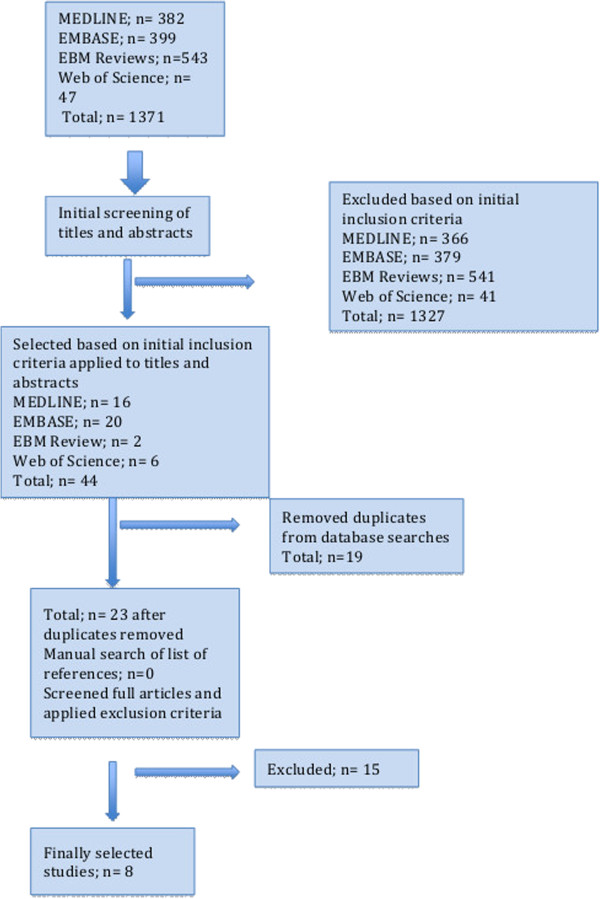
Objective: To perform a systematic review of measurement tools utilized for the diagnosis of nasal septal deviation (NSD). Methods: Electronic database searches were performed using MEDLINE (from 1966 to second week of August 2013), EMBASE (from 1966 to second week of August 2013), Web of Science (from 1945 to second week of August 2013) and all Evidence Based Medicine Reviews Files (EBMR); Cochrane Database of Systematic Review (CDSR), Cochrane Central Register of Controlled Trials (CCTR), Cochrane Methodology Register (CMR), Database of Abstracts of Reviews of Effects (DARE), American College of Physicians Journal Club (ACP Journal Club), Health Technology Assessments (HTA), NHS Economic Evaluation Database (NHSEED) till the second quarter of 2013. The search terms used in database searches were ‘nasal septum’, ‘deviation’, ‘diagnosis’, ‘nose deformities’ and ‘nose malformation’. The studies were reviewed using the updated Quality Assessment of Diagnostic Accuracy Studies (QUADAS-2) tool. Results: Online searches resulted in 23 abstracts after removal of duplicates that resulted from overlap of studies between the electronic databases. An additional 15 abstracts were excluded due to lack of relevance. A total of 8 studies were systematically reviewed. Conclusions: Diagnostic modalities such as acoustic rhinometry, rhinomanometry and nasal spectral sound analysis may be useful in identifying NSD in anterior region of the nasal cavity, but these tests in isolation are of limited utility. Compared to anterior rhinoscopy, nasal endoscopy, and imaging the above mentioned index tests lack sensitivity and specificity in identifying the presence, location, and severity of NSD.
Overview
The claims and statistics of this paper haven’t been checked yet.
Free: it reads the open-access text and checks the first 5 claims that cite a source we can check. Create a free account to check every claim.
Integrity signals
Registry
Cites
Statistics
Figures
Verification
Claims the paper makes
The claims and statistics of this paper haven’t been checked yet.
Free: it reads the open-access text and checks the first 5 claims that cite a source we can check. Create a free account to check every claim.
Claims other papers make about this one
Each is checked against this paper’s own text: does it say what the citing paper says it does?
The cited source says what the claim attributes to it.
In the citing paper
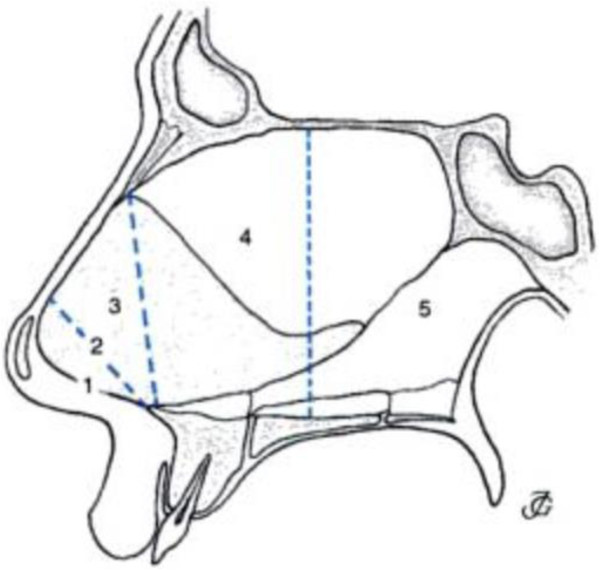
“AcR. This objective method for exploring the geometry of the nasal cavity enables us to analyze the acoustic reflection of a sound wave that travels along the nasal cavity and to measure areas and volumes at different points in the nasal fossa (Figure 3 A, B, and D) [46-48].”
From Position Paper on Nasal Obstruction: Evaluation and Treatment (2018) · cites this paper as [47]
Self-check
Percentages, sums and reported differences re-computed from the paper’s own numbers.
The self-check needs the paper’s full text.
Citations
Cites
QUADAS-2: a revised tool for the quality assessment of diagnostic accuracy studies
Whiting, P. F., Rutjes, A. W. S., Westwood, M. E., Mallett, S., Deeks, J. J., Reitsma, J. B., Leeflang, M. M. G., Sterne, J. A. C., Bossuyt, P. M. M., & the QUADAS-2 Group* (2011) · Annals of Internal Medicine · doi:10.7326/0003-4819-155-8-201110180-00009 · Cited by 14,199
Committee report on standardization of rhinomanometry.
Kern, E. B. (1981) · PubMed · Cited by 411
Marfan Syndrome: Long-term Survival and Complications After Aortic Aneurysm Repair
Finkbohner, R., Johnston, D., Crawford, E. S., Coselli, J., & Milewicz, D. M. (1995) · Circulation · doi:10.1161/01.cir.91.3.728 · Cited by 309
Deviated Nasal Septum Incidence and Etiology
Gray, L. P. (1978) · Annals of Otology, Rhinology & Laryngology · doi:10.1177/00034894780873s201 · Cited by 272
Otolaryngology head & neck surgery
Cummings, C. W. (2005) · Cited by 270
Committee report on standardization of rhinomanometry.
Clement, P. A. (1984) · PubMed · Cited by 244
Otolaryngology-Head & Neck Surgery: SILENT SINUS SYNDROME
Hayes, D. K., & Dickerson, E. E. (1997) · Southern Medical Journal · doi:10.1097/00007611-199710001-00374 · Cited by 191
Craniofacial growth in children with nasal septum deviation: A cephalometric comparative study
D’Ascanio, L., Lancione, C., Pompa, G., Rebuffini, E., Mansi, N., & Manzini, M. (2010) · International Journal of Pediatric Otorhinolaryngology · doi:10.1016/j.ijporl.2010.07.010 · Cited by 182
Kahveci, O. K., Miman, M. C., Yucel, A., Yucedag, F., Okur, E., & Altuntas, A. (2012) · Auris Nasus Larynx · doi:10.1016/j.anl.2011.08.006 · Cited by 162
Nasal, Septal, and Turbinate Anatomy and Embryology
Neskey, D. M., Eloy, J. A., & Casiano, R. R. (2009) · Otolaryngologic Clinics of North America · doi:10.1016/j.otc.2009.01.008 · Cited by 162
Garcia, G. J. M., Rhee, J. S., Senior, B. A., & Kimbell, J. S. (2010) · American Journal of Rhinology and Allergy · doi:10.2500/ajra.2010.24.3428 · Cited by 158
Assessment of septal deviation effects on nasal air flow: A computational fluid dynamics model
Chen, X. B., Lee, H. P., Hin Chong, V. F., & Wang, D. Y. (2009) · The Laryngoscope · doi:10.1002/lary.20585 · Cited by 138
Diagnosis of Nasal Airway Obstruction
Chandra, R. K., Patadia, M. O., & Raviv, J. (2009) · Otolaryngologic Clinics of North America · doi:10.1016/j.otc.2009.01.004 · Cited by 113
Moore, M., & Eccles, R. (2011) · Clinical Otolaryngology · doi:10.1111/j.1749-4486.2011.02279.x · Cited by 103
The Obstructive Nasal Septum: Effect of Simulated Deviations on Nasal Airflow Resistance
Cole, P., Chaban, R., Naito, K., & Oprysk, D. (1988) · Archives of Otolaryngology - Head and Neck Surgery · doi:10.1001/archotol.1988.01860160054020 · Cited by 102
Szücs, E., & Clement, P. A. R. (1998) · American Journal of Rhinology · doi:10.2500/105065898780182507 · Cited by 79
Incidence and Etiology: Shifting Patterns
Josen, K., Siegel, R. M., & Kamp, D. W. (2002) · Humana Press eBooks · doi:10.1007/978-1-59259-093-3_1 · Cited by 73
Mamikoglu, B., Houser, S., Akbar, I., Ng, B., & Corey, J. P. (2000) · Otolaryngology–Head and Neck Surgery · doi:10.1067/mhn.2000.105255 · Cited by 73
Growth of the Deviated Septum and Its Influence on Midfacial Development
Pirsig, W. (1992) · Facial Plastic Surgery · doi:10.1055/s-2008-1064654 · Cited by 72
How septum deformations in newborns occur
Kawalski, H., & Śpiewak, P. (1998) · International Journal of Pediatric Otorhinolaryngology · doi:10.1016/s0165-5876(98)00036-6 · Cited by 71
Jeppesen, F., & Windfeld, I. (1972) · Acta Obstetricia Et Gynecologica Scandinavica · doi:10.3109/00016347209154962 · Cited by 63
Nasal septal deviation: Effective intervention and long term follow-up
Sooknundun, M., Kacker, S. K., Bhatia, R., & Deka, R. C. (1986) · International Journal of Pediatric Otorhinolaryngology · doi:10.1016/s0165-5876(86)80059-3 · Cited by 55
Filho, D. I., Raveli, D. B., Raveli, R. B., Monteiro, L. D. C. L., & Gandin, L. G. (2001) · American Journal of Orthodontics and Dentofacial Orthopedics · doi:10.1067/mod.2001.116824 · Cited by 54
Liu, T., Han, D., Wang, J., Tan, J., Zang, H., Wang, T., Li, Y., & Cui, S. (2011) · Acta Oto-Laryngologica · doi:10.3109/00016489.2011.637233 · Cited by 51
Acoustic Rhinometry and Rhinomanometry in the Preoperative Screening of Septal Surgery Patients
Pirilä, T., & Tikanto, J. (2009) · American Journal of Rhinology & Allergy · doi:10.2500/ajra.2009.23.3372 · Cited by 43
Septal deviation in newborn infants
Alpini, D. C., Corti, A., Brusa, E., & Bini, A. (1986) · International Journal of Pediatric Otorhinolaryngology · doi:10.1016/s0165-5876(86)80004-0 · Cited by 42
Clinical assessment is an accurate predictor of which patients will need septoplasty
Sedaghat, A. R., Busaba, N. Y., Cunningham, M. J., & Kieff, D. A. (2012) · The Laryngoscope · doi:10.1002/lary.23683 · Cited by 38
Prevalence of septal deviations in school-aged children.
Haapaniemi, J. J., Jt, S., Aj, S., & Tuominen, J. (1995) · PubMed · Cited by 37
Nasal Endoscopy: Its Role in Office Diagnosis
Benninger, M. S. (1997) · American Journal of Rhinology · doi:10.2500/105065897782537205 · Cited by 30
Evaluation of Nasal Cavity by Acoustic Rhinometry in Chinese, Malay and Indian Ethnic Groups
Huang, D.-Y. W. Z.-L., Wang, D., & Zhang, P.-C. (2001) · Acta Oto-Laryngologica · doi:10.1080/00016480152602311 · Cited by 30
Cuddihy, P. J., & Eccles, R. (2003) · Clinical Otolaryngology · doi:10.1046/j.1365-2273.2003.00714.x · Cited by 28
Role of the Sphenoidal Process of the Septal Cartilage in the Development of Septal Deviation
Kim, J.-H., Kim, S. W., Kim, S. W., Cho, J. H., & Park, Y. J. (2011) · Otolaryngology · doi:10.1177/0194599811425000 · Cited by 26
Cho, G. S., Kim, J. H., & Jang, Y. J. (2012) · Annals of Otology Rhinology & Laryngology · doi:10.1177/000348941212100409 · Cited by 26
Hanif, J., Jawad, S., & Eccles, R. (2003) · PubMed · Cited by 17
Rhinomanometric detection rate of rhinoscopically-assessed septal deviations.
Pl, H., Klaassen, A. B., Tj, D. L., & Rt, W. (1992) · PubMed · Cited by 17
Gogniashvili, G., Steinmeier, E., Mlynski, G. H., & Beule, A. G. (2011) · Rhinology Journal · doi:10.4193/rhino10.089 · Cited by 16
Choi, H. S., Park, I., Geun, H., & Lee, H.-M. (2011) · American Journal of Rhinology and Allergy · doi:10.2500/ajra.2011.25.3602 · Cited by 14
Tahamiler, R., Canakcioglu, S., Yilmaz, S., & Dırıcan, A. (2007) · The Journal of Laryngology & Otology · doi:10.1017/s0022215107009437 · Cited by 13
Comparison of Odiosoft-Rhino and rhinomanometry in evaluation of nasal patency
Tahamiler, R., Alimoğlu, Y., & Çanakçıoğlu, S. (2011) · Rhinology Journal · doi:10.4193/rhino08.111 · Cited by 12
The validity of peak nasal inspiratory flow as a screening tool for nasal obstruction.
Rujanavej, V., Snidvongs, K., Chusakul, S., & Aeumjaturapat, S. (2012) · PubMed · Cited by 7
Role of spirometry in detection of nasal obstruction
Farhadi, M. R., Ghanbari, H., Izadi, F., Amintehran, E., Eikani, M. S., & Ghavami, Y. (2013) · The Journal of Laryngology & Otology · doi:10.1017/s0022215112003283 · Cited by 4
Research works printed but not linked: 1
- Cole PC Chaban R Naito K Oprysk D The obstructive nasal septum Arch Otolaryngol Head Neck Surg 1988 114 410 412 2450553 · DOI
Cited by
Nasal Septal Deviation: A Comprehensive Narrative Review
Alghamdi, F. S., Albogami, D. B., Alsurayhi, A. S., Alshibely, A. Y., Alkaabi, T. H., Alqurashi, L. M., Alahdal, A. A., Saber, A. A., & Almansouri, O. S. (2022) · Cureus · doi:10.7759/cureus.31317 · Cited by 138
Clinical Consensus Statement: Septoplasty with or without Inferior Turbinate Reduction
Han, J. K., Stringer, S. P., Rosenfeld, R. M., Archer, S. M., Baker, D. P., Brown, S. M., Edelstein, D. R., Gray, S. T., Lian, T., Ross, E. J., et al. (2015) · Otolaryngology · doi:10.1177/0194599815606435 · Cited by 95
Ta, N. H., Gao, J., & Philpott, C. M. (2021) · International Forum of Allergy & Rhinology · doi:10.1002/alr.22744 · Cited by 95
Position Paper on Nasal Obstruction: Evaluation and Treatment
SEAIC Rhinoconjunctivitis Committee & SEORL Rhinology, A., Valero, A., Navarro, A., del Cuvillo, A., Alobid, I., Benito, Jr., Colás, C., de los Santos, G., Fernández Liesa, R., García-Lliberós, A., et al. (2018) · Journal of Investigational Allergology and Clinical Immunology · doi:10.18176/jiaci.0232 · Cited by 76
Mohan, S., Fuller, J. C., Ford, S. F., & Lindsay, R. W. (2018) · JAMA Facial Plastic Surgery · doi:10.1001/jamafacial.2018.0279 · Cited by 47
Metadata
- Authors
- Aziz, T., Biron, V. L., Ansari, K., & Flores-Mir, C.
- Affiliations
- University of Alberta (CA)
- University of Alberta, Faculty of Medicine and Dentistry, School of Dentistry, Edmonton, Alberta, Canada
- ORCID
- Biron, Vincent L
- Venue
- Journal of Otolaryngology - Head & Neck Surgery
- Publisher
- SAGE Publications
- Published
- 2014-01
- Volume
- 43
- Issue
- 1
- Pages
- 11-11
- ISSN
- 1916-0208 (ISSN-L)
- 1916-0216
- PMC
- PMC4042609
- OpenAlex
- W2123684598
- Cited by
- 85
- References
- 41
- Citations by year
- 2026: 2 · 2025: 7 · 2024: 10 · 2023: 8 · 2022: 10 · 2021: 10 · 2020: 9 · 2019: 5 · 2018: 5 · 2017: 7 · 2016: 6 · 2015: 5 · 2014: 1
- FWCI
- 1.19
- Type
- journal article
- Language
- en
- Open access
- gold
- doi.org
- Licence
- Locations
- Journal of Otolaryngology - Head and Neck Surgery (publishedVersion, cc-by)
- Europe PMC (PubMed Central) (publishedVersion, cc-by)
- PubMed Central (publishedVersion, cc-by)
- PubMed (publishedVersion)
- Topics
- Health Sciences › Medicine › Surgery › Nasal Surgery and Airway Studies
- Health Sciences › Medicine › Otorhinolaryngology › Sinusitis and nasal conditions
- Health Sciences › Dentistry › Oral Surgery › Cleft Lip and Palate Research
- Keywords
- septal deviation, measurement instruments, diagnostic accuracy, acoustic rhinometry, rhinomanometry, anterior rhinoscopy, nasal endoscopy, nasal deformity
- MeSH terms
- Adult, Endoscopy, Female, Humans, Male, Middle Aged, Nasal Septum, Predictive Value of Tests, Rhinoplasty, Sound Spectrography, Nasal Obstruction, Rhinometry, Acoustic, Rhinomanometry, Young Adult
About these checks
Registry, retraction, Cites and statistics results are computed, not judged, with one exception: a printed reference that no index lists is read once by a model before it counts as a citation error. Claims are extracted by a model and kept only when their quote appears verbatim in the text; each cited source is then checked, with a model’s help, for whether it says what the claim relies on. Those verdicts can be wrong — read the claim’s quote and the cited source before relying on one.
Statistics and arithmetic are recomputed, not judged.
Confidence bands are shown only for fields calibrated on our annotated test set. None is calibrated yet, so no band is shown.
What counts as a claim ›How we measure confidence ›How we check this ›
Are you an author, or do you see a problem with this page? Request a review
Data sources
Bibliographic data: Semantic Scholar, OpenAlex, Crossref.
Contains information from the Semantic Scholar Academic Graph Datasets, made available under the ODC Attribution License (ODC-BY 1.0).
Semantic Scholar’s data is described in: Kinney, R., et al. (2023). The Semantic Scholar Open Data Platform. arXiv:2301.10140.
