

The homeodomain complement of the ctenophore Mnemiopsis leidyi suggests that Ctenophora and Porifera diverged prior to the ParaHoxozoa
Open accessThe DOI matches its Crossref record; 66 of the 66 references it cites were found in a registry or an index.
Abstract
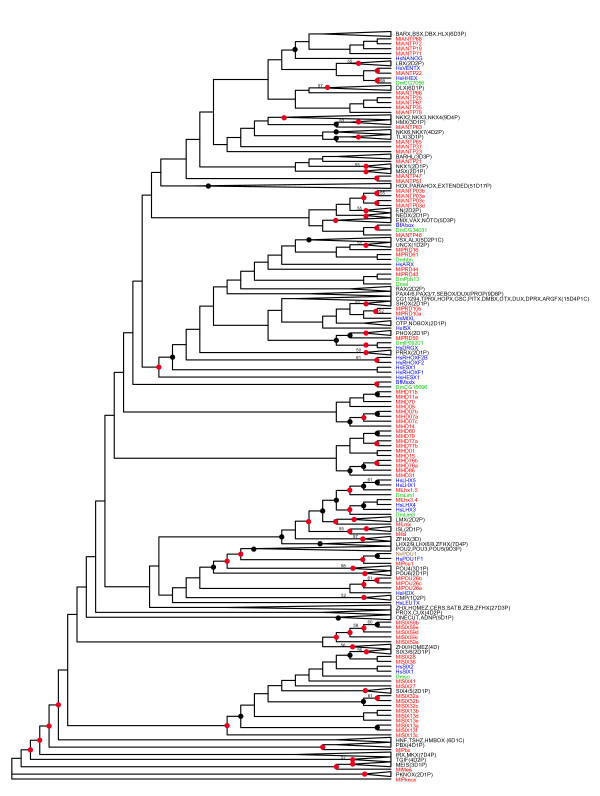
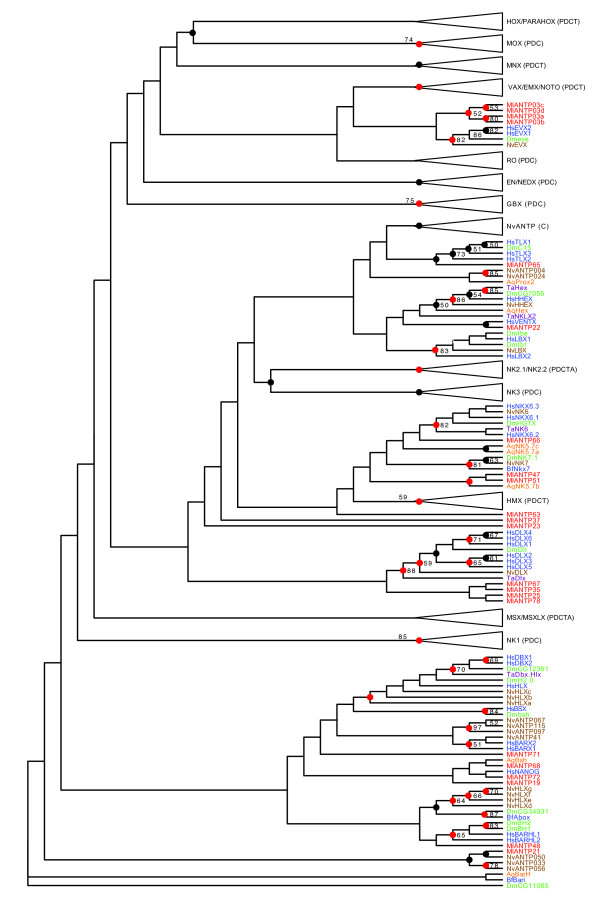
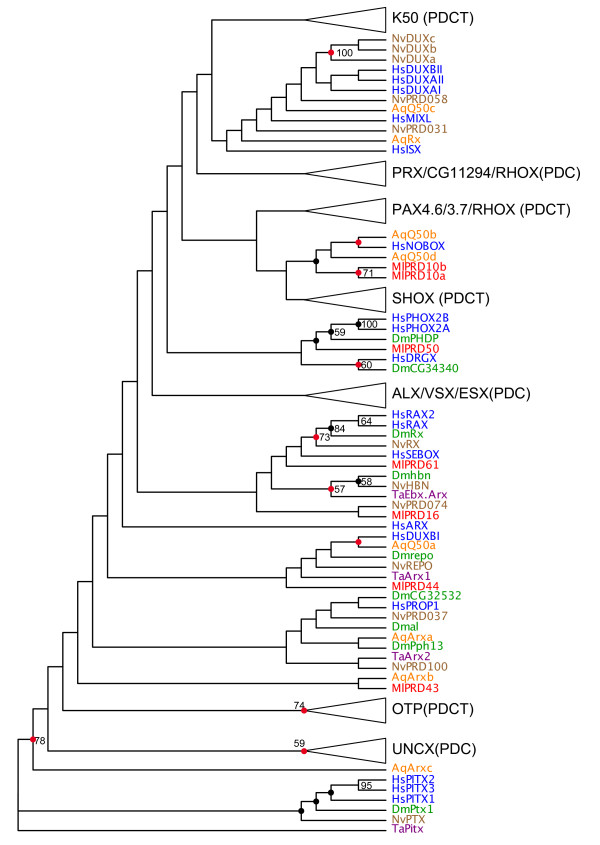
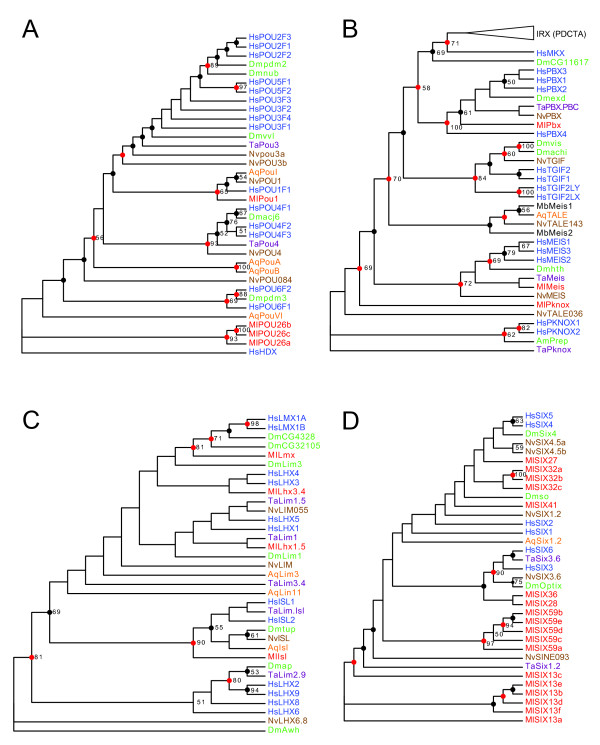
Background: The much-debated phylogenetic relationships of the five early branching metazoan lineages (Bilateria, Cnidaria, Ctenophora, Placozoa and Porifera) are of fundamental importance in piecing together events that occurred early in animal evolution. Comparisons of gene content between organismal lineages have been identified as a potentially useful methodology for phylogenetic reconstruction. However, these comparisons require complete genomes that, until now, did not exist for the ctenophore lineage. The homeobox superfamily of genes is particularly suited for these kinds of gene content comparisons, since it is large, diverse, and features a highly conserved domain. Results: We have used a next-generation sequencing approach to generate a high-quality rough draft of the genome of the ctenophore Mnemiopsis leidyi and subsequently identified a set of 76 homeobox-containing genes from this draft. We phylogenetically categorized this set into established gene families and classes and then compared this set to the homeodomain repertoire of species from the other four early branching metazoan lineages. We have identified several important classes and subclasses of homeodomains that appear to be absent from Mnemiopsis and from the poriferan Amphimedon queenslandica . We have also determined that, based on lineage-specific paralog retention and average branch lengths, it is unlikely that these missing classes and subclasses are due to extensive gene loss or unusually high rates of evolution in Mnemiopsis . Conclusions: This paper provides a first glimpse of the first sequenced ctenophore genome. We have characterized the full complement of Mnemiopsis homeodomains from this species and have compared them to species from other early branching lineages. Our results suggest that Porifera and Ctenophora were the first two extant lineages to diverge from the rest of animals. Based on this analysis, we also propose a new name - ParaHoxozoa - for the remaining group that includes Placozoa, Cnidaria and Bilateria.
Overview
The claims and statistics of this paper haven’t been checked yet.
Free: it reads the open-access text and checks the first 5 claims that cite a source we can check. Create a free account to check every claim.
Integrity signals
Registry
Cites
Statistics
Figures
Verification
Claims the paper makes
The claims and statistics of this paper haven’t been checked yet.
Free: it reads the open-access text and checks the first 5 claims that cite a source we can check. Create a free account to check every claim.
Claims other papers make about this one
Each is checked against this paper’s own text: does it say what the citing paper says it does?
The cited source doesn’t support the claim as written.
In the citing paper
“we have chosen to use the tree of Pick et al. (2010) as our framework (Fig. 1), i.e. with a monophyletic basal Porifera, and Ctenophora as sister group to Cnidaria + Bilateria, which we believe is the best-supported current topology (see Ryan et al. , 2010).”
From The origin of the animals and a ‘Savannah’ hypothesis for early bilaterian evolution: Early evolution of the animals (2017) · cites this paper as Ryan et al. , 2010
Checked by a reasoning model — may be wrong.
Experimental — accuracy not yet measuredThe source backs part of the claim, not all of it — or backs it for a different population, condition or comparison.
In the citing paper
“HOX genes involved in anterio-posterior patterning of body axesandpresentinallmetazoansareabsentinctenophoresandsponges 18 (Supplementary Tables 17 and 18).”
From The ctenophore genome and the evolutionary origins of neural systems (2014) · cites this paper as [18]
Experimental — accuracy not yet measuredThe source backs part of the claim, not all of it — or backs it for a different population, condition or comparison.
In the citing paper
“Although morphological and phylogenomic studies consistently unite bilaterians, cnidarians, and placozoans into a monophyletic clade (Parahoxozoa) that excludes sponges and ctenophores8,10,14 the relationship between sponges, ctenophores and Parahoxozoa remains controversial.”
From Ancient gene linkages support ctenophores as sister to other animals (2023) · cites this paper as [14]
Experimental — accuracy not yet measuredThe source backs part of the claim, not all of it — or backs it for a different population, condition or comparison.
In the citing paper
“The pattern of presence and absence of gene families and signaling pathway components seen in previous studies is consistent with these results (32–36).”
From The Genome of the Ctenophore Mnemiopsis leidyi and Its Implications for Cell Type Evolution (2013) · cites this paper as [36]
Experimental — accuracy not yet measuredThe cited source says what the claim attributes to it.
In the citing paper
“A clade grouping bilaterians, placozoans and cnidarians to the exclusion of sponges and ctenophores54 has been recovered in multiple phylogenetic studies8,10 and is now called Parahoxozoa on the basis of the shared presence of Hox/ParaHox-class genes14.”
From Ancient gene linkages support ctenophores as sister to other animals (2023) · cites this paper as [14]
1 more claim about this paper
Create a free account to see every claim other papers make about this one.
Self-check
Percentages, sums and reported differences re-computed from the paper’s own numbers.
The self-check needs the paper’s full text.
Citations
Cites
MrBayes 3: Bayesian phylogenetic inference under mixed models
Ronquist, F., & Huelsenbeck, J. P. (2003) · Bioinformatics · doi:10.1093/bioinformatics/btg180 · Cited by 29,077 · cited 1×
“2 [65] were conducted with the following execution block (prset aamodelpr = fixed(RTREV); lset rates = gamma; mcmcp mcmcdiagn = no nruns = 1 ngen = 5000000 printfreq = 5000 samplefreq = 500 nchains = 5 savebrlens = yes; mcmc; sumt filename = tale_w_insert.”
MethodPHYLIP-Phylogeny inference package (Version 3.2)
Felsenstein, J. (1989) · Cladistics · Cited by 18,906
A Simple, Fast, and Accurate Algorithm to Estimate Large Phylogenies by Maximum Likelihood
Guindon, S., & Gascuel, O. (2003) · Systematic Biology · doi:10.1080/10635150390235520 · Cited by 16,806 · cited 2×
“For example, in the case of ML, we used RaxML [37] and PhyML [38]).”
BackgroundMethodRAxML-VI-HPC: maximum likelihood-based phylogenetic analyses with thousands of taxa and mixed models
Stamatakis, A. (2006) · Bioinformatics · doi:10.1093/bioinformatics/btl446 · Cited by 15,582
PHYLIP ( PHYLogeny Inference Package)
Cummings, M. P. (2004) · Dictionary of Bioinformatics and Computational Biology · doi:10.1002/9780471650126.dob0534.pub2 · Cited by 3,127
Broad phylogenomic sampling improves resolution of the animal tree of life
Dunn, C. W., Hejnol, A., Matus, D. Q., Pang, K., Browne, W. E., Smith, S. A., Seaver, E., Rouse, G. W., Obst, M., Edgecombe, G. D., et al. (2008) · Nature · doi:10.1038/nature06614 · Cited by 1,921
Self-citationDistinguishing Homologous from Analogous Proteins
Fitch, W. M. (1970) · Systematic Zoology · doi:10.2307/2412448 · Cited by 1,503 · cited 1×
“These numbers give us an approximation of the number of lineage-specific homeodomain duplications that have been preserved in a specific lineage since it split from its closest relative in the analysis [51].”
BackgroundPhylogenomics and the reconstruction of the tree of life
Delsuc, F., Brinkmann, H., & Philippe, H. (2005) · Nature Reviews Genetics · doi:10.1038/nrg1603 · Cited by 1,236 · cited 2×
“Methods based on whole-genome content rather than large concatenated data matrices can provide an independent assessment of current phylogenetic hypotheses and, due to the rarity of events measured, may arguably be more appropriate in this context [14,16].”
BackgroundThe genome of the choanoflagellate Monosiga brevicollis and the origin of metazoans
King, N., Westbrook, M. J., Young, S. L., Kuo, A., Abedin, M., Chapman, J., Fairclough, S., Hellsten, U., Isogai, Y., Letunic, I., et al. (2008) · Nature · doi:10.1038/nature06617 · Cited by 1,139 · cited 2×
“We added 32 homeodomains from the demosponge Amphimedon queenslandica [30], 37 homeodomains from the placozoan Trichoplax adhaerens [27], 127 homedomains from the cnidarian Nematostella vectensis [26] and two homeodomains from the choanoflagellate Monosiga brevis [39].”
MethodA conserved DNA sequence in homoeotic genes of the Drosophila Antennapedia and bithorax complexes
McGinnis, W., Levine, M. S., Hafen, E., Kuroiwa, A., & Gehring, W. J. (1984) · Nature · doi:10.1038/308428a0 · Cited by 1,081 · cited 1×
“Homeobox genes encode transcription factor proteins characterized by the presence of a helix-loop-helix DNA-binding domain called the homeodomain [20].”
Background
Research works printed but not linked: 2
- Bürglin TR Meyers RA Homeodomain Proteins Encyclopedia or Molecular Cell Biology and Molecular Medicine 2005 2 Weinheim: Wiley-VCH Verlag16307171
- Rambaut A ed FigTree Book FigTree 2006 Edinburgh: Institute of Evolutionary Biology, University of Edinburgh
Cited by
Items 101–160 of 160
Martindale, M. Q., & Lee, P. N. (2013) · Biological Theory · doi:10.1007/s13752-013-0117-z · Cited by 14
Self-citationThe Mysterious Evolutionary Origin for the GNE Gene and the Root of Bilateria
de Mendoza, A., & Ruiz‐Trillo, I. (2011) · Molecular Biology and Evolution · doi:10.1093/molbev/msr142 · Cited by 17
“Examples of such molecular synapomorphies include the presence of Hox/ParaHox genes in the ParaHoxozoa (Placozoa, Cnidaria and Bilateria) (Ryan et al. 2010), an indel in the gene elongation-factor 1-alpha as a character of opisthokonts (Steenkamp, Wright and Baldauf 2006) or the the NAD5 mithocondrial gene that is exc…”
BackgroundInfluentialStone, M. C., Kothe, G. O., Rolls, M. M., & Jegla, T. J. (2020) · Journal of Experimental Biology · doi:10.1242/jeb.233197 · Cited by 14
Evolution of sodium channels and the new view of early nervous system evolution
Liebeskind, B. J. (2011) · Communicative & Integrative Biology · doi:10.4161/cib.17069 · Cited by 12
Xiang, X., Gomez, A. A. V., Blomberg, S. P., Yuan, H., Degnan, B. M., & Degnan, S. M. (2023) · Frontiers in Neural Circuits · doi:10.3389/fncir.2023.1250694 · Cited by 14
“There are three ancient lineages of extant animals that appeared to have diverged over 700 million years ago, before the Cryogenian (Snowball Earth): the ctenophores; sponges; and parahoxozoans (bilaterians, cnidarians and placozoans) (Ryan et al., 2010; Simion et al., 2017; Erwin, 2020; Schultz et al., 2023).”
BackgroundSalinas‐Saavedra, M., Salinas‐Saavedra, M., & Martindale, M. Q. (2018) · Protocol Exchange · doi:10.1038/protex.2018.092 · Cited by 11
Self-citationThe Caudal ParaHox gene is required for hindgut development in the mollusc Tritia (a.k.a. Ilyanassa)
Johnson, A. B., & Lambert, J. D. (2020) · Developmental Biology · doi:10.1016/j.ydbio.2020.10.010 · Cited by 10
Functional analysis of ctenophore Shaker K+ channels: N-type inactivation in the animal roots
Simonson, B. T., Jegla, M., Ryan, J. F., & Jegla, T. J. (2024) · Biophysical Journal · doi:10.1016/j.bpj.2024.01.027 · Cited by 9
Self-citationVargas, A. M., DeBiasse, M. B., Dykes, L. L., Edgar, A., Hayes, T. D., Groso, D., Babonis, L. S., Martindale, M. Q., & Ryan, J. F. (2024) · NAR Genomics and Bioinformatics · doi:10.1093/nargab/lqae072 · Cited by 11
“Upon sequencing of the M. leidyi genome more than a decade ago, a number of evolutionary studies of gene families that incorporated these new data were published ( 69–71 ,92 ).”
Self-citationDavidson, P. L., Koch, B. J., Schnitzler, C. E., Henry, J. J., Martindale, M. Q., Baxevanis, A. D., & Browne, W. E. (2017) · Molecular Reproduction and Development · doi:10.1002/mrd.22926 · Cited by 10
“…also detected differential activation at the eight-cell stage of three divergent, unclassified homeodomain genes—Mlehd07c (contig14607, contig14733), Mlehd11a (contig25571), Mlehd11b (contig23590)—and a single ANTP (Antennapedia) class HOXL-related gene—Mleantp03c (contig23663) (Ryan et al., 2010).”
BackgroundInfluentialSelf-citationFritzsch, B., & Glover, J. C. (2024) · Frontiers in Cell and Developmental Biology · doi:10.3389/fcell.2024.1340157 · Cited by 9
MODEL ORGANISMS USED IN MOLECULAR BIOLOGY OR MEDICAL RESEARCH
Pandey, G. (2011) · International Research Journal of Pharmacy · Cited by 11
Schulreich, S. M., Salamanca-Díaz, D. A., Zieger, E., Calcino, A., & Wanninger, A. (2022) · Organisms Diversity & Evolution · doi:10.1007/s13127-022-00569-5 · Cited by 7
Piezo proteins, mechano reception and behaviour in Hydra
Alzugaray, M. E., Gavazzi, M. V., Griffo, L., & Ronderos, J. R. (2025) · Scientific Reports · doi:10.1038/s41598-025-91048-2 · Cited by 10
“Regarding Metazoa, both analyses show Porifera in the same clade of ParaHoxozoa, which includes Placozoa, Cnidaria and Bilateria 37 , appearing Ctenophora as the sister group of this clade (Fig.”
InfluentialHejnol, A. (2014) · Nature · doi:10.1038/nature13340 · Cited by 6
Symbiogeny and the Evolution of Tissues: The Hypothesis
Shostak, S. (2015) · Biological Systems Open Access · doi:10.4172/2329-6577.1000127 · Cited by 6
“the homeodomain repertoire of species from the other four early branching metazoan lineages” [46].”
BackgroundNon-specificity of transcription factor function in Drosophila melanogaster
Percival‐Smith, A. (2016) · Development Genes and Evolution · doi:10.1007/s00427-016-0566-z · Cited by 6
Pandey, A., & Braun, E. L. (2021) · Biophysica · doi:10.3390/biophysica1020008 · Cited by 6
“The idea that basal metazoan lineages have experienced horizontal gene transfers from divergent lineages is strongly corroborated [99–101], hence the notion that there might have been gene transfers among the stem ctenophores, sponges, and Parahoxozoa (and other related lineages, such as choanoflagellates and Filaster…”
BackgroundInfluentialFerraioli, A., Digel, L., Sturm, D., Colgren, J. J., Goff, C. L., Jan, A., Soto-Angel, J. J., Naumann, B. T., Kittelmann, M., & Burkhardt, P. (2026) · Science Advances · doi:10.1126/sciadv.aea8399 · Cited by 13
“S9) ( 36 ).”
Phenotypic Nonspecificity as the Result of Limited Specificity of Transcription Factor Function
Percival‐Smith, A. (2018) · Genetics Research International · doi:10.1155/2018/7089109 · Cited by 4
“A significant proportion of the genes required for determination of the body plan encodes TFs, and hypotheses have proposed that the increase in complexity is associated with the increase in the number of TFs and families of TFs [57].”
BackgroundHox, Parahox, Ehgbox, and NK Genes in Bivalve Molluscs: Evolutionary Implications
Pérez‐Parallé, M. L., Pazos, A. J., Mesías-Gansbiller, C., & Sánchez, J. L. (2016) · Journal of Shellfish Research · doi:10.2983/035.035.0119 · Cited by 6
Martindale, M. Q. (2022) · Current topics in developmental biology/Current Topics in Developmental Biology · doi:10.1016/bs.ctdb.2022.02.002 · Cited by 4
Self-citationSalinas‐Saavedra, M., & Vargas, A. O. (2011) · EvoDevo · doi:10.1186/2041-9139-2-23 · Cited by 6
“The phylogenetic relationships of Ctenophora to other metazoa are currently controversial [56,96-102].”
Background[Early history of the Metazoa--a palaeontologist's viewpoint].
Zhuravlev, A. Y. (2014) · PubMed · Cited by 7
Ligrone, R. (2019) · Springer eBooks · doi:10.1007/978-3-030-16057-9_10 · Cited by 3
Evolution of Neuropeptide Signaling: From a Single Cell to Mammals
Krabichler, Q., & Grinevich, V. (2025) · Masterclass in neuroendocrinology · doi:10.1007/978-3-031-80209-6_1 · Cited by 5
The larva problem: homology, evolvability, terminology
Minelli, A. (2025) · Invertzool · doi:10.15298/invertzool.22.1.07 · Cited by 3
Feiner, N., & Wood, N. J. (2019) · Evolution & Development · doi:10.1111/ede.12300 · Cited by 6
“The deployment of Hox genes as positional markers is almost as old as the animal kingdom (only sponges, ctenophores, and placozoans lack Hox genes; Mendivil Ramos, Barker, & Ferrier, 2012; Moroz et al., 2014; Ryan et al., 2010).”
Shostak, S. (2015) · Cell & Developmental Biology · doi:10.4172/2168-9296.1000155 · Cited by 3
“Chen et al’s fossils [49] might not, after all, be too far off the trajectory of animal evolution predicted by the notion of bilateral cnidarians with “ParaHoxozoa” [33], “Urmetazoa” [50] or “Planulozoa” [51] as a clade of Placozoa, Cnidaria and Bilateria with Ctenophora its sister group [52].”
BackgroundGenome reveals comb jellies' ancient origin
Maxmen, A. (2013) · Nature · doi:10.1038/nature.2013.12176 · Cited by 3
Origin of Metazoan Patterning Systems and the Role of ANTP ‐Class Homeobox Genes
Thomas‐Chollier, M., & Martínez, P. (2016) · Wiley eBooks · doi:10.1002/9780470015902.a0022852.pub2 · Cited by 3
Liu, P., Chiu, W.-C., Lim, S. L., Chen, H., Chen, Y., Wang, H.-I., Yang, C., Chen, C., Nozawa, Y., Yamashiro, H., et al. (2025) · BMC Genomics · doi:10.1186/s12864-025-11962-7 · Cited by 2
“The absence of Hox genes and the presence of NK-related genes in T. hoshinota suggest an essential function for NK genes in early metazoan evolution, supporting the hypothesis that ProtoHox genes originated from an NK-like ancestor [39, 86].”
The Hox-TALE has been wagging for a long time
Ferrier, D. E. K. (2014) · eLife · doi:10.7554/elife.02515 · Cited by 2
Evolutionary Developmental Biology: Hox Gene Evolution
Nolte, C., Ahn, Y., & Krumlauf, R. K. (2012) · Wiley eBooks · doi:10.1002/9780470015902.a0001063.pub3 · Cited by 2
Pandey, A., & Braun, E. L. (2018) · bioRxiv (Cold Spring Harbor Laboratory) · doi:10.1101/400465 · Cited by 2
“All trees shown include a clade named Parahoxozoa (P) (Ryan et al. 2010).”
BackgroundThe ancestry of Antennapedia-like homeobox genesPreprint
Copley, R. R. (2023) · bioRxiv (Cold Spring Harbor Laboratory) · doi:10.1101/2023.03.14.532566 · Cited by 2
“[27,54,55], and notably, both classes share proteins with an EH1 motif N-terminal to a homeodomain.”
BackgroundIrreducible Complexity of Hox Gene: Path to the Canonical Function of the Hox Cluster
Kulakova, M. A., Maslakov, G. P., & Poliushkevich, L. O. (2024) · Biochemistry (Moscow) · doi:10.1134/s0006297924060014 · Cited by 2
Fenner, J., Wang, B., Ka, C., Gautam, S., & Range, R. (2025) · Journal of Developmental Biology · doi:10.3390/jdb13040036 · Cited by 1
McInerney, J. O., & O’Connell, M. J. (2014) · Nature · doi:10.1038/514570a · Cited by 1
The Fugs, the Lower East Side, and the Slum Aesthetic in 1960s Rock
Burke, P. (2014) · Journal of the Society for American Music · doi:10.1017/s175219631400039x · Cited by 1
Ancient sea jelly makes tree of life wobble
Maxmen, A. (2011) · Nature · doi:10.1038/news.2011.520
Insights from Sponge Transcriptomes & Physiology about the Early Evolution of Nervous Systems
Farrar, N. R. (2014) · ERA: Education and Research Archive (University of Alberta) · doi:10.7939/r3183485q · Cited by 1
Krämer-Eis, A., Ferretti, L., Schiffer, P. H., Heger, P., & Wiehe, T. (2016) · bioRxiv (Cold Spring Harbor Laboratory) · doi:10.1101/041806
“This result is in agreement with earlier studies that failed to detect homeodomain proteins of the PROS (prospero) class in cnidarians and ctenophores [75,76].”
ResultGermer, J. (2017) · eDiss (Georg-August-Universität Göttingen) · doi:10.53846/goediss-6604
Krämer-Eis, A., Ferretti, L., Schiffer, P. H., Heger, P., & Wiehe, T. (2016) · Cited by 2
From skin to brain: modelling a whole-body coordination scenario of nervous system origin
de Wiljes, O. (2020) · University of Groningen research database (University of Groningen / Centre for Information Technology) · doi:10.33612/diss.123420732 · Cited by 1
Nicotine Stimulates Peristalsis in N. Vectensis: From Behavior to Nicotinic Receptor GenesPreprint
Figueiredo, J., Rest, J. S., Adamo, S., Grella, R., & Dilger, J. P. (2021) · Research Square · doi:10.21203/rs.3.rs-195699/v1
Nishiya, N., & Yonezawa, H. (2021) · The Journal of Antibiotics · doi:10.1038/s41429-021-00461-y
Um panorama atual sobre a filogenia de Metazoa: conflitos e concordâncias
Andrade, M. P., Ferreira, F. D. S., de França, T. C., Sampronha, S., Santos, D., Silva, P. K. R., Carrijo, T. F., Nunes, F. R. C., & de Oliveira, O. M. P. (2021) · Revista da Biologia · doi:10.11606/revbio.21.07.10.2021
Um panorama atual sobre a filogenia de Metazoa: conflitos e concordâncias
Andrade, M. P., Ferreira, F. D. S., de França, T. C., Sampronha, S., Santos, D., Silva, P. K. R., Carrijo, T. F., Nunes, F. R. C., & de Oliveira, O. M. P. (2021) · Revista da Biologia · doi:10.11606/issn.1984-5154.v21p1-13
The seabed—Where life began and still evolves
Lopez, J. V. (2024) · Elsevier eBooks · doi:10.1016/b978-0-12-824112-7.00002-9
Irreducible Complexity of Hox Gene: A Path to the Canonical Function of the Hox Cluster (Review)
Kulakova, M. A., Maslakov, G. P., & Polyushkevich, L. O. (2024) · Biochemistry (Moscow) · doi:10.31857/s0320972524060012
NOCTOGENESIS: A Non-Classical Account of Evolutionary InnovationPreprint
Merriam, L. A. (2025) · OSF Preprints (OSF Preprints) · doi:10.31219/osf.io/5apvx_v5 · Cited by 1
Zhou, Y., & Lee, C. E. (2025) · bioRxiv (Cold Spring Harbor Laboratory) · doi:10.1101/2025.09.22.677836
“This ancient origin would suggest that the 3 distinct α CA clades are likely at least as ancient as the Hox/ParaHox homeodomain genes (Dunn et al., 2014; Ryan et al., 2010).”
ParaHox Genes Revisited: From Gut Patterning to Integrated Axial and Neural Organization in Rotifera
Fröbius, A. C., Welch, D. B. M., & Herlyn, H. (2026) · Journal of Experimental Zoology Part B Molecular and Developmental Evolution · doi:10.1002/jez.b.70019
“In support of this view, ParaHox and Hox genes are lacking in Ctenophora (Ryan et al. 2010).”
Étude du rôle des facteurs de transcription pou3f au cours du développement rénal
Cosse-Etchepare, C. (2017) · theses.fr (ABES) · doi:10.70675/258b85b3z0c5dz4075zb642zd36687fb2f70
Aït-Ali, N. (2018) · theses.fr (ABES) · doi:10.70675/bcbadff0z237cz407fz8ce6zfdc46fff23d1 · Cited by 1
Evolutionary principles underlying neuron subtype encoding and diversification in animalsPreprint
Hehmeyer, J., Harris, D., Lowe, C. J., & Marlow, H. (2026) · bioRxiv (Cold Spring Harbor Laboratory) · doi:10.64898/2026.04.13.718258 · Cited by 1
Zhou, Y., & Lee, C. E. (2026) · Genome Biology and Evolution · doi:10.1093/gbe/evag156 · Cited by 1
A morphological phylogenetic approach to the evolution of symmetry in animals
McDermott, J., Dunn, F. S., Marlétaz, F., & Rahman, I. A. (2026) · Proceedings of the Royal Society B Biological Sciences · doi:10.1098/rspb.2026.1111
Metadata
- Authors
- Ryan, J. F., Pang, K., Program, N. C. S., Mullikin, J. C., Martindale, M. Q., & Baxevanis, A. D.
- Affiliations
- National Institutes of Health (US)
- University of Hawaiʻi at Mānoa (US)
- Corresponding author
- Baxevanis, Andreas D
- Venue
- EvoDevo
- Published
- 2010-10-04
- Volume
- 1
- Issue
- 1
- Pages
- 9-9
- ISSN
- 2041-9139 (ISSN-L)
- PMC
- PMC2959044
- OpenAlex
- W2165478882
- Semantic Scholar
- a7b4020d5c8b0ad9b78770b1871969ed820b387d
- Cited by
- 160
- References
- 66
- Citations by year
- 2026: 5 · 2025: 7 · 2024: 7 · 2023: 6 · 2022: 3 · 2021: 10 · 2020: 5 · 2019: 9 · 2018: 9 · 2017: 8 · 2016: 14 · 2015: 24 · 2014: 18 · 2013: 8 · 2012: 14
- FWCI
- 7.90
- Type
- journal article
- Language
- en
- Open access
- gold
- doi.org
- Licence
- cc-by
- Locations
- EvoDevo (publishedVersion, cc-by)
- PubMed Central (publishedVersion, cc-by)
- PubMed (publishedVersion)
- DOAJ (DOAJ: Directory of Open Access Journals) (submittedVersion, cc-by-sa)
- Funders
- National Science Foundation
- National Aeronautics and Space Administration
- National Institutes of Health
- National Human Genome Research Institute
- Topics
- Life Sciences › Agricultural and Biological Sciences › Animal Science and Zoology › Marine Invertebrate Physiology and Ecology
- Life Sciences › Biochemistry, Genetics and Molecular Biology › Molecular Biology › Developmental Biology and Gene Regulation
- Life Sciences › Biochemistry, Genetics and Molecular Biology › Molecular Biology › Genomics and Phylogenetic Studies
- Keywords
- Mnemiopsis leidyi, ctenophores, homeobox genes, sponges, Ctenophora, metazoan phylogeny, gene content comparison, Amphimedon queenslandica, gene loss, Placozoa, Cnidaria, Bilateria
About these checks
Registry, retraction, Cites and statistics results are computed, not judged, with one exception: a printed reference that no index lists is read once by a model before it counts as a citation error. Claims are extracted by a model and kept only when their quote appears verbatim in the text; each cited source is then checked, with a model’s help, for whether it says what the claim relies on. Those verdicts can be wrong — read the claim’s quote and the cited source before relying on one.
Statistics and arithmetic are recomputed, not judged.
Confidence bands are shown only for fields calibrated on our annotated test set. None is calibrated yet, so no band is shown.
What counts as a claim ›How we measure confidence ›How we check this ›
Are you an author, or do you see a problem with this page? Request a review
Data sources
Bibliographic data: Semantic Scholar, OpenAlex, Crossref.
Contains information from the Semantic Scholar Academic Graph Datasets, made available under the ODC Attribution License (ODC-BY 1.0).
Semantic Scholar’s data is described in: Kinney, R., et al. (2023). The Semantic Scholar Open Data Platform. arXiv:2301.10140.
