

Area-dependent time courses of brain activation during video-induced symptom provocation in social anxiety disorder
Open accessThe DOI matches its Crossref record; 83 of the 83 references it cites were found in a registry or an index.
Abstract
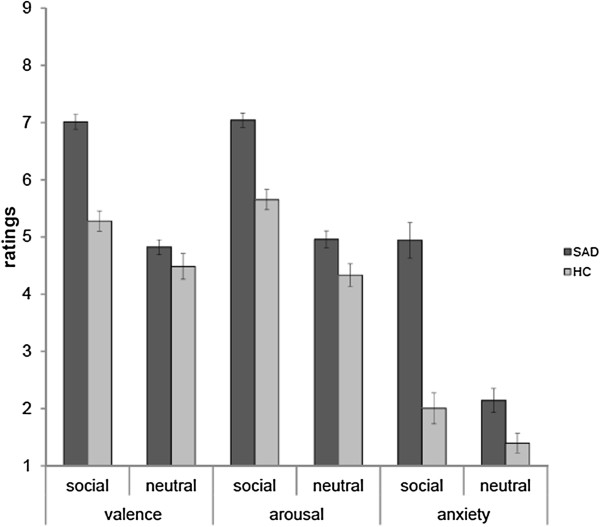
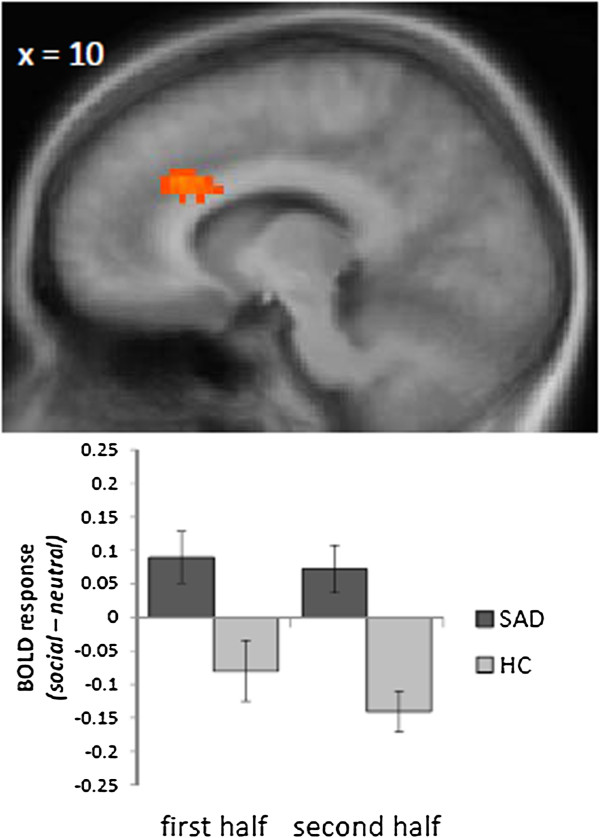
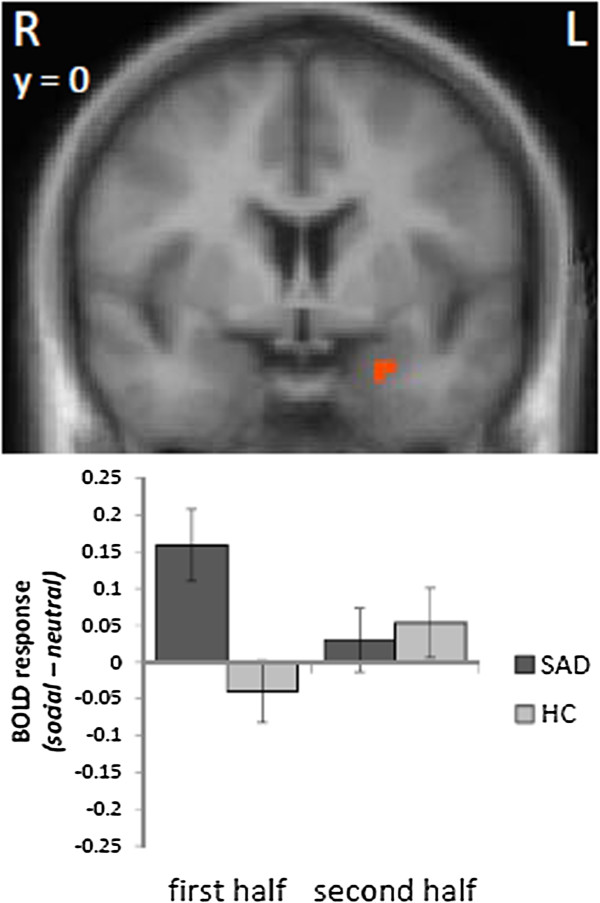
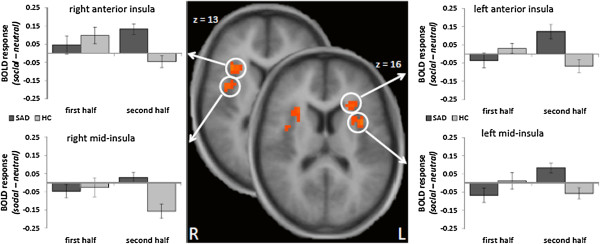
BACKGROUND: Previous functional imaging studies using symptom provocation in patients with social anxiety disorder (SAD) reported inconsistent findings, which might be at least partially related to different time-dependent activation profiles in different brain areas. In the present functional magnetic resonance imaging study, we used a novel video-based symptom provocation design in order to investigate the magnitude and time course of activation in different brain areas in 20 SAD patients and 20 healthy controls. RESULTS: The disorder-related videos induced increased anxiety in patients with SAD as compared to healthy controls. Analyses of brain activation to disorder-related versus neutral video clips revealed amygdala activation during the first but not during the second half of the clips in patients as compared to controls. In contrast, the activation in the insula showed a reversed pattern with increased activation during the second but not during the first half of the video clips. Furthermore, a cluster in the anterior dorsal anterior cingulate cortex showed a sustained response for the entire duration of the videos. CONCLUSIONS: The present findings suggest that different regions of the fear network show differential temporal response patterns during video-induced symptom provocation in SAD. While the amygdala is involved during initial threat processing, the insula seems to be more involved during subsequent anxiety responses. In accordance with cognitive models of SAD, a medial prefrontal region engaged in emotional-cognitive interactions is generally hyperactivated.
Overview
The claims and statistics of this paper haven’t been checked yet.
Free: it reads the open-access text and checks the first 5 claims that cite a source we can check. Create a free account to check every claim.
Integrity signals
Registry
Cites
Statistics
Figures
Verification
Claims the paper makes
The claims and statistics of this paper haven’t been checked yet.
Free: it reads the open-access text and checks the first 5 claims that cite a source we can check. Create a free account to check every claim.
Claims other papers make about this one
Each is checked against this paper’s own text: does it say what the citing paper says it does?
The cited source says what the claim attributes to it.
In the citing paper
“there has been a growing emphasis on other types of stimuli with putatively greater ecological validity such as imagining feared social situations (Blair et al., 2010; Boehme et al., 2014; Nakao et al., 2011), anticipation of public speaking (Boehme et al., 2013; Cremers et al., 2015), performance evaluation (Gimenez et al., 2012; Koric et al., 2012; Pujol et al., 2013), and exposure to social cr”
From Neural responses to social threat and predictors of cognitive behavioral therapy and acceptance and commitment therapy in social anxiety disorder (2017) · cites this paper as Boehme et al., 2014
Self-check
Percentages, sums and reported differences re-computed from the paper’s own numbers.
The self-check needs the paper’s full text.
Citations
Cites
Tzourio-Mazoyer, N., Landeau, B., Papathanassiou, D., Crivello, F., Etard, O., Delcroix, N., Mazoyer, B., & Joliot, M. (2002) · NeuroImage · doi:10.1006/nimg.2001.0978 · Cited by 16,319 · cited 1×
“ROIs for the bilateral insula (32,822 mm(3)), ACC (23,963 mm(3)), and dmPFC (medial division of the superior frontal cortex; 44,945 mm(3)) were extracted from the AAL atlas included in WFU PickAtlas software [55-57].”
MethodLeDoux, J. E. (2000) · Annual Review of Neuroscience · doi:10.1146/annurev.neuro.23.1.155 · Cited by 8,444
How do you feel — now? The anterior insula and human awareness
(Bud) Craig, A. D. (2009) · Nature Reviews Neuroscience · doi:10.1038/nrn2555 · Cited by 6,657 · cited 1×
“Especially the anterior insula has been shown to play an important role in the processing of visceral and autonomic responses to emotional stimuli (for example, [30,74]) and the integration of affective arousal responses with the perception of current physiological states [75].”
BackgroundHow do you feel? Interoception: The sense of the physiological condition of the body
Craig, A. D. (2002) · Nature Reviews Neuroscience · doi:10.1038/nrn894 · Cited by 6,006 · cited 1×
“The insula seems to be involved in interoception and representation of bodily states [27-29] and might support aversive feelings by evaluating arousal responses [28,30,31].”
BackgroundMaldjian, J. A., Laurienti, P. J., Kraft, R. A., & Burdette, J. H. (2003) · NeuroImage · doi:10.1016/s1053-8119(03)00169-1 · Cited by 5,085
Talairach, J., Tournoux, P., & Rayport, M. (1988) · Thieme eBooks · Cited by 5,058
Diagnostic and Statistical Manual of Mental Disorders ( DSM ‐ IV ‐ TR )
Segal, D. L. (2010) · The Corsini Encyclopedia of Psychology · doi:10.1002/9780470479216.corpsy0271 · Cited by 4,666
A new SPM toolbox for combining probabilistic cytoarchitectonic maps and functional imaging data
Eickhoff, S. B., Stephan, K. E., Mohlberg, H., Grefkes, C., Fink, G. R., Amunts, K., & Zilles, K. (2005) · NeuroImage · doi:10.1016/j.neuroimage.2004.12.034 · Cited by 4,033 · cited 1×
“[53], we extracted the amygdala ROI consisting of three bilateral amygdala maximum probability maps (laterobasal, centromedial, and superficial; 9,077 mm(3) in total) of the anatomy toolbox [54].”
MethodFunctional neuroanatomy of emotion: A meta-analysis of emotion activation studies in PET and fMRI
Phan, K. L., Wager, T., Taylor, S. F., & Liberzon, I. (2002) · NeuroImage · doi:10.1006/nimg.2002.1087 · Cited by 3,502 · cited 2×
“This may reflect the special characteristics of the video stimuli used in the present study, but it might in part also indicate greater self-referential and self-regulative processes [23-25] in SAD patients.”
BackgroundNeural systems supporting interoceptive awareness
Critchley, H. D., Wiens, S., Rotshtein, P., Öhman, A., & Dolan, R. J. (2004) · Nature Neuroscience · doi:10.1038/nn1176 · Cited by 3,406 · cited 1×
“The insula seems to be involved in interoception and representation of bodily states [27-29] and might support aversive feelings by evaluating arousal responses [28,30,31].”
Background
Cited by
Puglia, M. H., Lillard, T. S., Morris, J. P., & Connelly, J. J. (2015) · Proceedings of the National Academy of Sciences · doi:10.1073/pnas.1422096112 · Cited by 216
Herrmann, M. J., Boehme, S., Becker, M. P. I., Tupak, S. V., Guhn, A., Schmidt, B., Brinkmann, L., & Straube, T. (2016) · Human Brain Mapping · doi:10.1002/hbm.23088 · Cited by 79
Self-citationVoxel-based morphometry multi-center mega-analysis of brain structure in social anxiety disorder
Bas-Hoogendam, J. M., van Steenbergen, H., Nienke Pannekoek, J., Fouche, J.-P., Lochner, C., Hattingh, C. J., Cremers, H. R., Furmark, T., Månsson, K. N. T., Frick, A., et al. (2017) · NeuroImage: Clinical · doi:10.1016/j.nicl.2017.08.001 · Cited by 75
Self-citationHeitmann, C. Y., Feldker, K., Neumeister, P., Zepp, B. M., Peterburs, J., Zwitserlood, P., & Straube, T. (2016) · Human Brain Mapping · doi:10.1002/hbm.23120 · Cited by 60
“, 2008], or video clips showing social interaction situations [Boehme et al., 2014].”
BackgroundMethodSelf-citationBas‐Hoogendam, J. M., Groenewold, N. A., Aghajani, M., Freitag, G. F., Harrewijn, A., Hilbert, K., Jahanshad, N., Thomopoulos, S. I., Thompson, P. M., Veltman, D. J., et al. (2020) · Human Brain Mapping · doi:10.1002/hbm.25100 · Cited by 59
Burklund, L. J., Torre, J. B., Lieberman, M. D., Taylor, S. E., & Craske, M. G. (2017) · Psychiatry Research - Neuroimaging · doi:10.1016/j.pscychresns.2016.12.012 · Cited by 38
Moerkerke, M., Bonte, M.-L., Daniëls, N., Chubar, V., Alaerts, K., Steyaert, J. G., & Boets, B. (2021) · Research in Autism · doi:10.1016/j.rasd.2021.101785 · Cited by 40
Heitmann, C. Y., Feldker, K., Neumeister, P., Brinkmann, L., Schrammen, E., Zwitserlood, P., & Straube, T. (2017) · NeuroImage Clinical · doi:10.1016/j.nicl.2017.01.020 · Cited by 38
“Whole-brain analysis revealed additional activations in temporal lobe (BA13) and parahippocampal gyrus.”
BackgroundSelf-citationBecker, M. P. I., Simon, D., Miltner, W. H. R., & Straube, T. (2017) · Psychological Medicine · doi:10.1017/s0033291717001076 · Cited by 37
“Recently, reduced activation of VS in SAD patients during anticipation of a public speech has been reported (Boehme et al. 2014b), suggesting that, in SAD patients, alterations of the brain system for positive motivational signals contribute to anticipatory anxiety in performancerelated situations.”
BackgroundResultSelf-citation1H-magnetic resonance spectroscopy in social anxiety disorder
Howells, F. M., Hattingh, C. J., Syal, S., Breet, E., Stein, D. J., & Löchner, C. (2014) · Progress in Neuro-Psychopharmacology and Biological Psychiatry · doi:10.1016/j.pnpbp.2014.12.008 · Cited by 24
“Functional imaging studies in SAD have shown decreased activation of the putamen during a task that induced anticipatory anxiety (Boehme et al., 2014a), and sustained activation of the dorsal cingulate cortex during video-induced symptom provocation (Boehme et al., 2014b).”
BackgroundCognitive Neural Mechanism of Social Anxiety Disorder: A Meta-Analysis Based on fMRI Studies
Yu, X., Ruan, Y., Yawen, Z., Wang, J., Liu, Y., Zhang, J., & Zhang, L. (2021) · International Journal of Environmental Research and Public Health · doi:10.3390/ijerph18115556 · Cited by 21
“1 [13] 2002 15/15 8 0 Talairach Emotional face 2 [14] 2005 11/11 40 0 Talairach Emotional face 3 [15] 2006 10/10 8 0 Talairach Emotional face 4 [16] 2008 11/11 10 2 MNI Emotional face 5 [17] 2009 8/7 2 0 Talairach Emotional face 6 [18] 2010 12/12 12 1 MNI Emotional face 7 [19] 2010 8/7 11 4 Talairach Emotional face 8…”
Peterburs, J., Sandrock, C., Miltner, W. H. R., & Straube, T. (2016) · NeuroImage · doi:10.1016/j.neuroimage.2016.03.036 · Cited by 16
Self-citationMcDermott, T. J., Kirlić, N., & Aupperle, R. L. (2018) · Neurobiology of Stress · doi:10.1016/j.ynstr.2018.05.001 · Cited by 16
“, 2007], social evaluation for social anxiety [Boehme et al., 2014]) reminders such as pictures or script-driven imagery to uncover neuronal responses.”
BackgroundGlassman, L. H., Kuster, A. T., Tronieri, J. S., Forman, E. M., İzzetoğlu, M., Matteucci, A. J., & Herbert, J. D. (2016) · Brain Imaging and Behavior · doi:10.1007/s11682-016-9554-1 · Cited by 13
“our understanding of the biological underpinnings of the disorder is limited (Boehme et al. 2014; Tillfors et al. 2014).”
BackgroundThe neural correlates of perceived social support and its relationship to psychological well-being
Lu, H., Song, Y., Wang, X., & Liu, J. (2024) · Frontiers in Behavioral Neuroscience · doi:10.3389/fnbeh.2023.1295668 · Cited by 18
“…the statistical analysis of tens of thousands of brain voxels, we carried out a cluster-size threshold adjustment with a Monte Carlo simulation which was widely used in neuroimaging literature for multiple comparisons correction (Goldin et al., 2005; Moses-Kolko et al., 2010; Boehme et al., 2014).”
MethodZrenner, B., Zrenner, C., Balderston, N. L., Blumberger, D. M., Kloiber, S. M., Laposa, J. M., Tadayonnejad, R., Trevizol, A. P., Zai, G. C., & Feusner, J. D. (2023) · Frontiers in Neural Circuits · doi:10.3389/fncir.2023.1208930 · Cited by 8
“Videobased symptom provocation can also induce anxiety in laboratory settings (Miskovic and Schmidt, 2012; Boehme et al., 2014).”
BackgroundEffects of Psychotherapy on Brain Activation Patterns in Anxiety Disorders
Straube, T. (2016) · Zeitschrift für Psychologie · doi:10.1027/2151-2604/a000240 · Cited by 6
Self-citationBecker, M. P. I., Voegler, R., Peterburs, J., Hofmann, D., Bellebaum, C., & Straube, T. (2019) · bioRxiv (Cold Spring Harbor Laboratory) · doi:10.1101/821512 · Cited by 5
“Recent studies have shown differences between SAD and HC in VS activation to different feedbacks implying that these differences might indicate blunted signaling of positive Pes (Boehme et al., 2014, Becker et al., 2017).”
BackgroundSelf-citationHjärnan formas av psykologisk behandling
Månsson, K. N. T. (2016) · Linköping studies in behavioural science · doi:10.3384/diss.diva-132637 · Cited by 1
Introduction à une approche biologique de la peur
Devau, G. (2016) · Gérontologie et société · doi:10.3917/gs1.150.0017 · Cited by 28
Imaging Studies of Anxiety Disorders
Mann, J. J., & Yin, H. (2015) · Elsevier eBooks · doi:10.1016/b978-0-12-397025-1.00120-2 · Cited by 1
Triggered minds: key considerations for symptom provocation research in anxiety-related disorders
Serifova, X., Boets, B., & Luyten, L. (2026) · Trends in Neurosciences · doi:10.1016/j.tins.2026.02.006
Li, Y., Deng, M., Yang, Z., & Zou, Z. (2026) · Journal of Psychiatric Research · doi:10.1016/j.jpsychires.2026.10.046
Metadata
- Authors
- Boehme, S., Mohr, A., Becker, M. P., Miltner, W. H., & Straube, T.
- Affiliations
- Friedrich Schiller University Jena (DE)
- University of Münster (DE)
- Corresponding author
- Boehme, Stephanie
- Straube, Thomas
- Venue
- Biology of Mood & Anxiety Disorders
- Published
- 2014
- Volume
- 4
- Issue
- 1
- Pages
- 6
- ISSN
- 2045-5380 (ISSN-L)
- PMC
- PMC4052290
- OpenAlex
- W2151788468
- Cited by
- 23
- References
- 81
- Citations by year
- 2026: 2 · 2024: 1 · 2023: 1 · 2021: 2 · 2020: 1 · 2019: 1 · 2018: 1 · 2017: 3 · 2016: 7 · 2015: 3 · 2014: 1
- FWCI
- 6.47
- Type
- journal article
- Language
- en
- Open access
- hybrid
- doi.org
- Licence
- cc-by
- Locations
- Biology of Mood & Anxiety Disorders (publishedVersion, cc-by)
- PubMed Central (publishedVersion, cc-by)
- PubMed (publishedVersion)
- Funders
- Deutsche Forschungsgemeinschaft (TRR‐58, C06, C07, SFB/ TRR 58: C06, C07)
- Topics
- Social Sciences › Psychology › Experimental and Cognitive Psychology › Anxiety, Depression, Psychometrics, Treatment, Cognitive Processes
- Life Sciences › Neuroscience › Cognitive Neuroscience › Neural and Behavioral Psychology Studies
- Life Sciences › Neuroscience › Cognitive Neuroscience › Memory and Neural Mechanisms
- Keywords
- social anxiety disorder, symptom provocation, amygdala activation, insula, fear network, threat processing, medial prefrontal cortex
About these checks
Registry, retraction, Cites and statistics results are computed, not judged, with one exception: a printed reference that no index lists is read once by a model before it counts as a citation error. Claims are extracted by a model and kept only when their quote appears verbatim in the text; each cited source is then checked, with a model’s help, for whether it says what the claim relies on. Those verdicts can be wrong — read the claim’s quote and the cited source before relying on one.
Statistics and arithmetic are recomputed, not judged.
Confidence bands are shown only for fields calibrated on our annotated test set. None is calibrated yet, so no band is shown.
What counts as a claim ›How we measure confidence ›How we check this ›
Are you an author, or do you see a problem with this page? Request a review
Data sources
Bibliographic data: Semantic Scholar, OpenAlex, Crossref.
Contains information from the Semantic Scholar Academic Graph Datasets, made available under the ODC Attribution License (ODC-BY 1.0).
Semantic Scholar’s data is described in: Kinney, R., et al. (2023). The Semantic Scholar Open Data Platform. arXiv:2301.10140.
