

The DOI matches its Crossref record; 20 of the 20 references it cites were found in a registry or an index.
Assessing and presenting summaries of evidence in Cochrane Reviews
Open accessAbstract
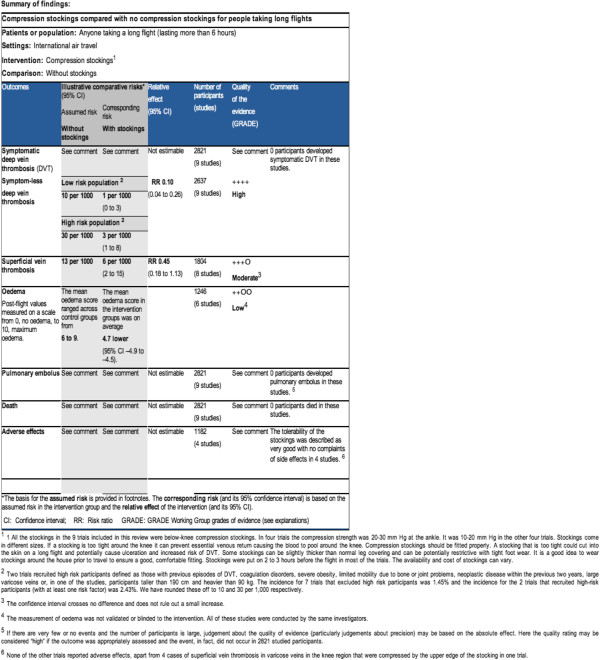
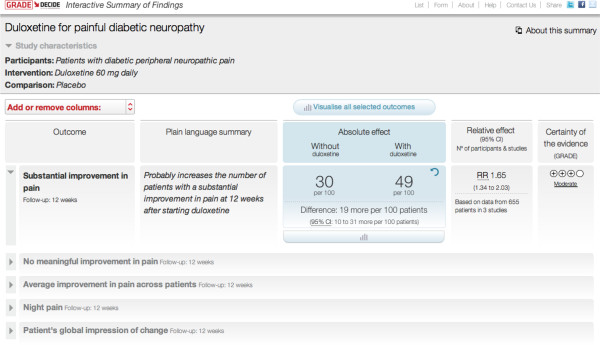
Cochrane Reviews are intended to help providers, practitioners and patients make informed decisions about health care. The goal of the Cochrane Applicability and Recommendation Methods Group (ARMG) is to develop approaches, strategies and guidance that facilitate the uptake of information from Cochrane Reviews and their use by a wide audience with specific focus on developers of recommendations and on healthcare decision makers. This paper is part of a series highlighting developments in systematic review methodology in the 20 years since the establishment of The Cochrane Collaboration, and its aim is to present current work and highlight future developments in assessing and presenting summaries of evidence, with special focus on Summary of Findings (SoF) tables and Plain Language Summaries.A SoF table provides a concise and transparent summary of the key findings of a review in a tabular format. Several studies have shown that SoF tables improve accessibility and understanding of Cochrane Reviews.The ARMG and GRADE Working Group are working on further development of the SoF tables, for example by evaluating the degree of acceptable flexibility beyond standard presentation of SoF tables, developing SoF tables for diagnostic test accuracy reviews and interactive SoF tables (iSoF).The plain language summary (PLS) is the other main building block for dissemination of review results to end-users. The PLS aims to summarize the results of a review in such a way that health care consumers can readily understand them. Current efforts include the development of a standardized language to describe statistical results, based on effect size and quality of supporting evidence.Producing high quality PLS and SoF tables and making them compatible and linked would make it easier to produce dissemination products targeting different audiences (for example, providers, health policy makers, guideline developers).Current issues of debate include optimal presentation formats of SoF tables, the training required to produce SoF tables, and the extent to which the authors of Cochrane Reviews should provide explicit guidance to target audiences of patients, clinicians and policy-makers.
Overview
The claims and statistics of this paper haven’t been checked yet.
Run the check — free, no account needed. It reads the open-access text and checks the sources it cites.
Integrity signals
Registry
Cites
Statistics
Figures
Verification
Claims the paper makes
The claims and statistics of this paper haven’t been checked yet.
Run the check — free, no account needed. It reads the open-access text and checks the sources it cites.
Claims other papers make about this one
Each is checked against this paper’s own text: does it say what the citing paper says it does?
In the citing paper
“We assessed the quality of evidence per association by applying the GRADE criteria (Grading of Recommendations, Assessment, Development, and Evaluations) in five domains, including (1) risk of bias in the individual studies, (2) inconsistency, (3) indirectness, (4) imprecision, and (5) publication bias [31].”
From Effects of ketogenic diet on health outcomes: an umbrella review of meta-analyses of randomized clinical trials (2023) · cites this paper as [31]
Self-check
Percentages, sums and reported differences re-computed from the paper’s own numbers.
The self-check needs the paper’s full text.
Citations
Cites
Cochrane Handbook for Systematic Reviews of Interventions: Cochrane Book Series
(2008) · doi:10.1002/9780470712184 · Cited by 25,048
GRADE guidelines: 1. Introduction—GRADE evidence profiles and summary of findings tables
Guyatt, G., Oxman, A. D., Akl, E. A., Kunz, R., Vist, G., Brozek, J., Norris, S., Falck-Ytter, Y., Glasziou, P., & deBeer, H. (2011) · Journal of Clinical Epidemiology · doi:10.1016/j.jclinepi.2010.04.026 · Cited by 10,681
Self-citationGrading quality of evidence and strength of recommendations
(2004) · BMJ · doi:10.1136/bmj.328.7454.1490 · Cited by 8,477
Self-citationWhat is ‘quality of evidence’ and why is it important to clinicians?
Guyatt, G. H., Oxman, A. D., Kunz, R., Vist, G. E., Falck-Ytter, Y., & Schünemann, H. J. (2008) · BMJ · doi:10.1136/bmj.39490.551019.be · Cited by 3,250
Self-citationChapter 12: Interpreting results and drawing conclusions
Schünemann, H. J., Oxman, A. D., Jonathan, J., & Glasziou, P. (2011) · Cited by 873
Self-citationGRADE guidelines: 12. Preparing Summary of Findings tables—binary outcomes
Guyatt, G. H., Oxman, A. D., Santesso, N., Helfand, M., Vist, G., Kunz, R., Brozek, J., Norris, S., Meerpohl, J., Djulbegovic, B., et al. (2013) · Journal of Clinical Epidemiology · doi:10.1016/j.jclinepi.2012.01.012 · Cited by 836
Self-citationSimple tools for understanding risks: from innumeracy to insight
Gigerenzer, G., & Edwards, A. (2003) · BMJ · doi:10.1136/bmj.327.7417.741 · Cited by 776
GRADE guidelines: 13. Preparing Summary of Findings tables and evidence profiles—continuous outcomes
Guyatt, G. H., Thorlund, K., Oxman, A. D., Walter, S. D., Patrick, D., Furukawa, T. A., Johnston, B. C., Karanicolas, P., Akl, E. A., Vist, G., et al. (2013) · Journal of Clinical Epidemiology · doi:10.1016/j.jclinepi.2012.08.001 · Cited by 772
Self-citationAn evidence based approach to individualising treatment
Glasziou, P., & Irwig, L. (1995) · BMJ · doi:10.1136/bmj.311.7016.1356 · Cited by 389
Self-citationHow to use the evidence: assessment and application of scientific evidence
Glasziou, P., Irwig, L., Bain, C., & Colditz, G. A. (2000) · Cited by 378
Self-citationCarter, T. (2003) · Scandinavian Journal of Work Environment & Health · doi:10.5271/sjweh.1021 · Cited by 343
Rosenbaum, S., Glenton, C., & Oxman, A. D. (2010) · Journal of Clinical Epidemiology · doi:10.1016/j.jclinepi.2009.12.014 · Cited by 161
Compression stockings for preventing deep vein thrombosis in airline passengers
Clarke, M. J., Broderick, C. A., Hopewell, S., Juszczak, E., & Eisinga, A. (2016) · Cochrane Database of Systematic Reviews · doi:10.1002/14651858.cd004002.pub3 · Cited by 133
Presenting the Results of Cochrane Systematic Reviews to a Consumer Audience: A Qualitative Study
Glenton, C., Santesso, N. A., Rosenbaum, S., Nilsen, E. S., Rader, T., Ciapponi, A., & Dilkes, H. (2010) · Medical Decision Making · doi:10.1177/0272989x10375853 · Cited by 125
Rosenbaum, S., Glenton, C., Nylund, H. K., & Oxman, A. D. (2010) · Journal of Clinical Epidemiology · doi:10.1016/j.jclinepi.2009.12.013 · Cited by 125
Evidence summaries tailored to health policy-makers in low- and middle-income countries
Rosenbaum, S., Glenton, C., Wiysonge, C. S., Abalos, E. J., Mignini, L. E., Young, T., Althabe, F., Ciapponi, A., Martí, S. G., Meng, Q., et al. (2010) · Bulletin of the World Health Organization · doi:10.2471/blt.10.075481 · Cited by 113
Compression stockings for preventing deep vein thrombosis in airline passengers
Clarke, M. J., Hopewell, S., Juszczak, E., Eisinga, A., & Kjeldstrøm, M. (2006) · Cochrane Database of Systematic Reviews · doi:10.1002/14651858.cd004002.pub2 · Cited by 73
Vandvik, P. O., Santesso, N. A., Akl, E. A., You, J. J., Mulla, S. M., Spencer, F. A., Johnston, B. C., Brożek, J., Kreis, J., Brandt, L., et al. (2012) · Journal of Clinical Epidemiology · doi:10.1016/j.jclinepi.2011.11.013 · Cited by 50
Self-citationRoutine Heparin for Patients with Cancer? One Answer, More Questions
Akl, E. A., & Schünemann, H. J. (2012) · New England Journal of Medicine · doi:10.1056/nejme1113672 · Cited by 43
Self-citationO’Connell, D. A., Glasziou, P., & Hill, S. E. (1999) · Cited by 35
Self-citation
Research works printed but not linked: 2
- Santesso N, Glenton C, Rader T, Strømme-Nilsen E, Moja L, Pardo JP, Ciapponi A, Schünemann H: A New Format for Plain Language Summaries: Does It Improve Understanding, and is It Useful and Preferable? A Randomized Trial. 2009, Singapore: Cochrane Colloquium, 17
- Schünemann HJ, Oxman AD, Higgins JP, Vist GE, Glasziou P, Guyatt GH, on behalf of the Cochrane Applicability and Recommendations Methods Group and the Cochrane Statistical Methods Group: Chapter 11: Presenting results and ‘summary of findings’ tables. Cochrane Handbook for Systematic Reviews of Interventions. Version 5.1.0. Edited by: Higgins JPT, Green S. 2011, The Cochrane Collaboration, Available from http://www.cochrane-handbook.org
Cited by
Sorted by citations
Establishing confidence in the output of qualitative research synthesis: the ConQual approach.
Munn, Z., Porritt, K., Lockwood, C., Aromataris, E., & Pearson, A. (2014) · BMC Medical Research Methodology · doi:10.1186/1471-2288-14-108 · Cited by 803
Mid-urethral sling operations for stress urinary incontinence in women
Ford, A. A., Rogerson, L., Cody, J. D., Aluko, P., & Ogah, J. A. (2017) · Cochrane Database of Systematic Reviews · doi:10.1002/14651858.cd006375.pub4 · Cited by 710
Selenium for preventing cancer
Vinceti, M., Filippini, T., Del Giovane, C., Dennert, G., Zwahlen, M., Brinkman, M., Zeegers, M. P., Horneber, M., D'Amico, R., & Crespi, C. M. (2018) · Cochrane Database of Systematic Reviews · doi:10.1002/14651858.cd005195.pub4 · Cited by 649
Daily oral iron supplementation during pregnancy
Peña‐Rosas, J. P., De‐Regil, L. M., Dowswell, T., & Viteri, F. E. (2012) · Cochrane Database of Systematic Reviews · doi:10.1002/14651858.cd004736.pub4 · Cited by 614
Daily oral iron supplementation during pregnancy
Peña-Rosas, J. P., De-Regil, L. M., Garcia-Casal, M. N., & Dowswell, T. (2015) · Cochrane Database of Systematic Reviews · doi:10.1002/14651858.cd004736.pub5 · Cited by 565
Metadata
- Authors
- Langendam, M. W., Akl, E. A., Dahm, P., Glasziou, P., Guyatt, G., & Schünemann, H. J.
- Affiliations
- Amsterdam UMC Location University of Amsterdam (NL)
- American University of Beirut (LB)
- University of Florida Health (US)
- Bond University (AU)
- McMaster University (CA)
- Corresponding author
- Langendam, Miranda W
- Venue
- Systematic Reviews
- Published
- 2013-09-23
- Volume
- 2
- Issue
- 1
- Pages
- 81-81
- ISSN
- 2046-4053 (ISSN-L)
- PMC
- PMC3849859
- OpenAlex
- W2122450633
- Cited by
- 282
- References
- 19
- Citations by year
- 2026: 4 · 2025: 14 · 2024: 21 · 2023: 31 · 2022: 23 · 2021: 30 · 2020: 22 · 2019: 25 · 2018: 26 · 2017: 23 · 2016: 27 · 2015: 21 · 2014: 6 · 2013: 4
- FWCI
- 21.33
- Type
- journal article
- Language
- en
- Open access
- gold
- doi.org
- Licence
- Locations
- Systematic Reviews (publishedVersion, cc-by)
- Europe PMC (PubMed Central) (publishedVersion, cc-by)
- PubMed Central (publishedVersion, cc-by)
- PubMed (publishedVersion)
- Pure Amsterdam UMC (publishedVersion)
- e-publications@bond (Bond University) (submittedVersion)
- Bond University Research Portal (Bond University) (submittedVersion, cc-by)
- Data Archiving and Networked Services (DANS) (submittedVersion)
- Topics
- Social Sciences › Decision Sciences › Statistics, Probability and Uncertainty › Meta-analysis and systematic reviews
- Health Sciences › Medicine › Public Health, Environmental and Occupational Health › Clinical practice guidelines implementation
- Health Sciences › Health Professions › General Health Professions › Health Sciences Research and Education
- Keywords
- summary of findings tables, plain language summaries, evidence summaries, effect size reporting, quality of evidence, guideline development, healthcare decision-making
- MeSH terms
- Humans, Information Services, Review Literature as Topic, Technology Transfer, Evidence-Based Medicine, Information Dissemination, Research Report
About these checks
Registry, retraction, Cites and statistics results are computed, not judged, with one exception: a printed reference that no index lists is read once by a model before it counts as a citation error. Claims are extracted by a model and kept only when their quote appears verbatim in the text; each cited source is then checked, with a model’s help, for whether it says what the claim relies on. Those verdicts can be wrong — read the claim’s quote and the cited source before relying on one.
Statistics and arithmetic are recomputed, not judged.
Confidence bands are shown only for fields calibrated on our annotated test set. None is calibrated yet, so no band is shown.
What counts as a claim ›How we measure confidence ›How we check this ›
Are you an author, or do you see a problem with this page? Request a review
