

What are the socio-economic impacts of genetically modified crops worldwide? A systematic map protocol
The DOI matches its Crossref record; 55 of the 55 references it cites were found in a registry or an index.
Abstract
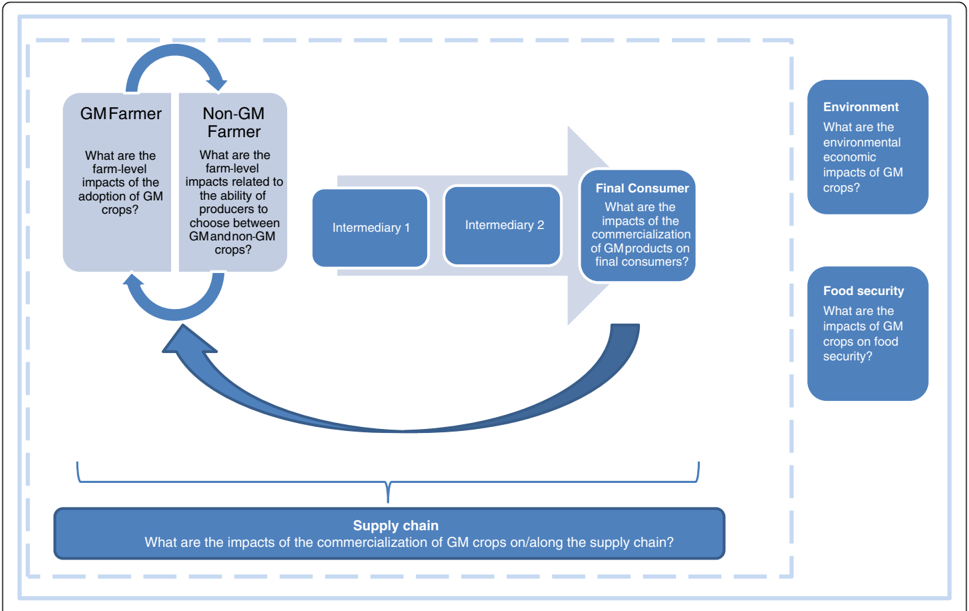
Genetically modified (GM) crops have generated a great deal of controversy. Since commercially introduced to farmers in 1996, the global area cultivated with GM crops has increased 94-fold. The rapid adoption of GM technology has had substantial socio-economic impacts which a vast amount of technical and non-technical literature has addressed in the last two decades. However, contradictory results between individual studies abound. Extensive and transparent reviews concerning this contentious and complex issue could help promote evidence-based dialogue among the diverse parties involved. This protocol specifies the methodology for identifying, evaluating, and mapping evidence related to the main review question: what are the socio-economic impacts of genetically modified crops worldwide? This question has been subdivided into the following topics: (a) farm-level impacts; (b) impacts of coexistence regulations; (c) impacts along the supply chain; (d) consumer-level impacts; (e) impacts on food security; and (f) environmental economic impacts. The search strategy includes the identification of primary studies from general scientific databases; global, regional, and national specialist databases; an on-line search engine; institutional websites; journal websites; subject experts/researchers; and serendipity. Searches will be conducted in six languages (Chinese, English, French, German, Portuguese, and Spanish). Identified studies will be screened for inclusion/exclusion criteria by a group of multi-language reviewers. Finally, pre-defined data from the studies will be extracted, mapped, and presented in a report. Potential research gaps will be identified and discussed, and the review process will be documented in an open-access database (i.e. CADIMA, http://www.cadima.info/ ).
Overview
The claims and statistics of this paper haven’t been checked yet.
Free: it reads the open-access text and checks the first 5 claims that cite a source we can check. Create a free account to check every claim.
Integrity signals
Registry
Cites
Statistics
Figures
Verification
Claims the paper makes
The claims and statistics of this paper haven’t been checked yet.
Free: it reads the open-access text and checks the first 5 claims that cite a source we can check. Create a free account to check every claim.
Claims other papers make about this one
Each is checked against this paper’s own text: does it say what the citing paper says it does?
The cited source says what the claim attributes to it.
In the citing paper
“Systematic reviews typically screen the first 50 to 100 search records within Google Scholar e.g. [18,19,20], sometimes restricting searches to title rather than full-text searches e.g. [21].”
From The role of google scholar in evidence reviews and its applicability to grey literature searching (2015) · cites this paper as [21]
Self-check
Percentages, sums and reported differences re-computed from the paper’s own numbers.
The self-check needs the paper’s full text.
Citations
Cites
The State of Food Insecurity in the World
WFP, W. (2015) · Cited by 2,947
McGuire, S. (2015) · Advances in Nutrition · doi:10.3945/an.115.009936 · Cited by 1,094
Carletto, C., Zezza, A., & Banerjee, R. (2013) · Global Food Security · doi:10.1016/j.gfs.2012.11.006 · Cited by 425
GM crops: global socio-economic and environmental impacts 1996- 2006
Brookes, G., & Barfoot, P. (2008) · Cited by 380
Searching for studies: a guide to information retrieval for Campbell systematic reviews
Kugley, S., Wade, A., Thomas, J., Mahood, Q., Jørgensen, A. K., Hammerstrøm, K., & Sathe, N. (2017) · Campbell Systematic Reviews · doi:10.4073/cmg.2016.1 · Cited by 371
Is the coverage of google scholar enough to be used alone for systematic reviews
Gehanno, J.-F., Rollin, L., & Darmoni, S. (2013) · BMC Medical Informatics and Decision Making · doi:10.1186/1472-6947-13-7 · Cited by 357 · cited 2×
“[53], one of the advantages of using Google scholar is that it identifies more types of literature compared to a general scientific database.”
BackgroundThe Global Evidence Mapping Initiative: Scoping research in broad topic areas
Bragge, P., Clavisi, O., Turner, T., Tavender, E., Collie, A., & Gruen, R. L. (2011) · BMC Medical Research Methodology · doi:10.1186/1471-2288-11-92 · Cited by 310 · cited 1×
“The breadth of the evidence captured in a systematic map helps to clearly identify potential research gaps and guide future research efforts [5].”
BackgroundEvaluation of exposure-specific risks from two independent samples: A simulation study
Reichmann, W. M., Gagnon, D., Horsburgh, C. R., & Losina, E. (2011) · BMC Medical Research Methodology · doi:10.1186/1471-2288-11-1 · Cited by 310
Transgenic varieties and productivity of smallholder cotton farmers in China
Huang, J., Hu, R., Rozelle, S., Qiao, F., & Pray, C. E. (2002) · Australian Journal of Agricultural and Resource Economics · doi:10.1111/1467-8489.00184 · Cited by 201
Genetically Engineered Plants and Foods: A Scientist's Analysis of the Issues (Part II)
Lemaux, P. G. (2009) · Annual Review of Plant Biology · doi:10.1146/annurev.arplant.043008.092013 · Cited by 189
López‐Cózar, E. D., & Repiso, R. (2013) · Comunicar · doi:10.3916/c41-2013-04 · Cited by 187
Google Scholar is not enough to be used alone for systematic reviews
Giustini, D., & Kamel Boulos, M. N. (2013) · Online Journal of Public Health Informatics · doi:10.5210/ojphi.v5i2.4623 · Cited by 187 · cited 1×
“On the negative side, Google scholar is “constantly-changing content, algorithms and database structure” and Google does not provide details about Google scholar’s database coverage [54].”
BackgroundImpact of unlinked deaths and coding changes on mortality trends in the Swiss National Cohort
Schmidlin, K., Clough-Gorr, K. M., Spoerri, A., Egger, M., Zwahlen, M., & Cohort, F. T. S. N. (2013) · BMC Medical Informatics and Decision Making · doi:10.1186/1472-6947-13-1 · Cited by 128
Birol, E., Villalba, E. R., & Smale, M. (2008) · Environment and Development Economics · doi:10.1017/s1355770x08004944 · Cited by 125
Bt cotton and sustainability of pesticide reductions in India
Krishna, V. V., & Qaim, M. (2012) · Agricultural Systems · doi:10.1016/j.agsy.2011.11.005 · Cited by 118
A latent class approach to investigating demand for genetically modified banana in Uganda
Kikulwe, E., Birol, E., Wesseler, J., & Falck‐Zepeda, J. B. (2011) · Agricultural Economics · doi:10.1111/j.1574-0862.2010.00529.x · Cited by 113
Self-citationRuane, J., & Sonnino, A. (2011) · Journal of Biotechnology · doi:10.1016/j.jbiotec.2011.06.013 · Cited by 111
Framing GM crops as a food security solution
Dibden, J., Gibbs, D. C., & Cocklin, C. (2011) · Journal of Rural Studies · doi:10.1016/j.jrurstud.2011.11.001 · Cited by 102
Bennett, R. M., Morse, S., & Ismael, Y. (2006) · The Journal of Development Studies · doi:10.1080/00220380600682215 · Cited by 78
Promise and issues of genetically modified crops
Chen, H., & Lin, Y. (2013) · Current Opinion in Plant Biology · doi:10.1016/j.pbi.2013.03.007 · Cited by 71
Lipton, M. (2007) · The Journal of Development Studies · doi:10.1080/00220380601055510 · Cited by 67
Genetically Modified Rice Adoption: Implications for Welfare and Poverty Alleviation
Anderson, K., Jackson, L. A., & Nielsen, C. P. (2005) · Journal of Economic Integration · doi:10.11130/jei.2005.20.4.771 · Cited by 64
Growth and development: from genes to networks and a mechanistic understanding of plant development
Scanlon, M. J., & Timmermans, M. C. P. (2013) · Current Opinion in Plant Biology · doi:10.1016/j.pbi.2013.01.002 · Cited by 62
Consumer welfare effects of introducing and labeling genetically modified food
Lusk, J. L., House, L., Valli, C., Jaeger, S. R., MOORE, M. L., Morrow, B., & Traill, B. W. (2005) · Economics Letters · doi:10.1016/j.econlet.2005.03.009 · Cited by 59
Competitors co-operating: establishing a supply chain to manage genetically modified canola
Smyth, S. J. (2001) · The International Food and Agribusiness Management Review · doi:10.1016/s1096-7508(01)00070-2 · Cited by 57
Aerni, P., Scholderer, J., & Ermen, D. (2011) · Food Policy · doi:10.1016/j.foodpol.2011.08.002 · Cited by 51
Mannion, A. M., & Morse, S. (2012) · Progress in Physical Geography Earth and Environment · doi:10.1177/0309133312457109 · Cited by 49
Beyer, F. R., & Wright, K. (2013) · Health Information & Libraries Journal · doi:10.1111/hir.12009 · Cited by 47 · cited 1×
“Little evidence exists to guide prioritization of databases for reviewers [51].”
BackgroundGlobal Identity Preservation Costs in Agricultural Supply Chains
Kalaitzandonakes, N., Maltsbarger, R., & Barnes, J. N. (2001) · Canadian Journal of Agricultural Economics/Revue canadienne d agroeconomie · doi:10.1111/j.1744-7976.2001.tb00330.x · Cited by 43
Costs and Risks of Testing and Segregating Genetically Modified Wheat
Wilson, W. W., & Dahl, B. L. (2005) · Review of Agricultural Economics · doi:10.1111/j.1467-9353.2005.00222.x · Cited by 42
Smale, M., Zambrano, P., Falck‐Zepeda, J. B., & Gruère, G. (2006) · AgEcon Search (University of Minnesota, USA) · doi:10.22004/ag.econ.55412 · Cited by 36
Does the use of transgenic plants diminish or promote biodiversity?
Raven, P. H. (2010) · New Biotechnology · doi:10.1016/j.nbt.2010.07.018 · Cited by 34
Coléno, F., Angevin, F., & Lecroart, B. (2009) · Agricultural Systems · doi:10.1016/j.agsy.2009.03.002 · Cited by 28
Zepeda, J. F. (2006) · American Journal of Agricultural Economics · doi:10.1111/j.1467-8276.2006.00933.x · Cited by 27
Impact Assessment of Bt Corn Adoption in the Philippines
Mutuc, M. E. M., Rejesus, R. M., Pan, S., & Yorobe, J. M. (2012) · Journal of Agricultural and Applied Economics · doi:10.1017/s1074070800000201 · Cited by 25
Dominos in the dairy: An analysis of transgenic maize in Dutch dairy farming
Groeneveld, R. A., Wesseler, J., & Berentsen, P. B. M. (2012) · Ecological Economics · doi:10.1016/j.ecolecon.2012.11.011 · Cited by 20
Self-citationMurphy, J., & Yanacopulos, H. (2005) · Geoforum · doi:10.1016/j.geoforum.2004.10.001 · Cited by 19
Zambrano, P., Maldonado, J. H., Mendoza, S. L. H., Ruíz, L., Fonseca, L. A., & Cardona, I. (2011) · RePEc: Research Papers in Economics · Cited by 17
To bt or not to bt? Risk and uncertainty considerations in technology assessmentPreprint
Gaurav, S., & Mishra, S. (2012) · RePEc: Research Papers in Economics · Cited by 16
Environmental Costs and Benefits of Genetically Modified Crops
Ando, A. W., & Khanna, M. (2000) · American Behavioral Scientist · doi:10.1177/00027640021956279 · Cited by 15
The Environmental Impacts of Genetically Modified Plants: Challenges to Decision Making
Batie, S. S. (2003) · American Journal of Agricultural Economics · doi:10.1111/j.0092-5853.2003.00516.x · Cited by 12
Net Effect of Education on Technology Adoption by U.S. FarmersPreprint
Uematsu, H., Mishra, A. K., Uematsu, H., & Mishra, A. K. (2010) · RePEc: Research Papers in Economics · doi:10.22004/ag.econ.56450 · Cited by 10
Coexistence of GM and non-GM crops with endogenously determined separation
Gray, E., Ancev, T., & Drynan, R. G. (2011) · Ecological Economics · doi:10.1016/j.ecolecon.2011.08.005 · Cited by 9
What have been the farm -level economic impacts of the global cultivation of GM crops?
Hall, C., Knight, B., Ringrose, S., & Knox, O. (2013) · Cited by 7
BOARD ON AGRICULTURE AND NATURAL RESOURCES
Manhattan, K. A.-D. F. I., Board on Agriculture, & Earth, D. O. (2012) · Cited by 7
Dying in the USA and Japan: selected legal and ethical issues
Davis, A. J., & Mitoh, T. (1999) · International Nursing Review · doi:10.1046/j.1466-7657.46.no.5issue347.10.x · Cited by 6
Tripney, J., Newman, M., Bird, K., Thomas, J., Kalra, N., Bangpan, M., & Vigurs, C. (2010) · UCL Discovery (University College London) · Cited by 5
The brave new world: imperfect information, segregation costs, and genetically modified organisms
Moss, C. B., Schmitz, T. G., & Schmitz, A. (2004) · German Journal of Agricultural Economics · doi:10.52825/gjae.v53i8.1604 · Cited by 5
Knox, O. G. G., Hall, C., McVittie, A., Walker, R. L., & Knight, B. (2013) · Food and Nutrition Sciences · doi:10.4236/fns.2013.46a004 · Cited by 4
Identifying driving factors for the establishment of cooperative GMO-free zones in GermanyPreprint
Consmüller, N., Beckmann, V., & Petrick, M. (2012) · RePEc: Research Papers in Economics · doi:10.22004/ag.econ.126531 · Cited by 3
Individual and Social Learning in Bio-technology Adoption: The Case of GM Corn in the U.S.Preprint
Yoo, D., & Yoo, D.-I. (2012) · RePEc: Research Papers in Economics · doi:10.22004/ag.econ.124975 · Cited by 3
Jaramillo, P. E., Useche, P., Barham, B. L., Foltz, J. D., Jaramillo, P. E., Useche, P., Barham, B. L., & Foltz, J. D. (2010) · RePEc: Research Papers in Economics · doi:10.22004/ag.econ.61860 · Cited by 2
Quasi-option values for enhanced information regarding genetically modified foodsPreprint
Donaghy, P., Rolfe, J. C., Bennett, J. W., Donaghy, P., Rolfe, J., & Bennett, J. W. (2004) · RePEc: Research Papers in Economics · doi:10.22004/ag.econ.58403 · Cited by 2
Costa‐Font, M., Tranter, R., Gil, J. M., Jones, P., & Gylling, M. (2010) · RePEc: Research Papers in Economics · doi:10.22004/ag.econ.91750 · Cited by 1
Agricultural Economics and Rural Policy
Gardebroek, C. (2013) · Socio-Environmental Systems Modeling · Cited by 1
Research works printed but not linked: 2
- Smale M, Zambrano P, Gruere G, Falck-Zepeda J, Matuschke I, Horna D, Nagarajan L, Yerramareddy I, Jones H: Measuring the Economic Impacts of Transgenic Crops in Developing Agriculture during the First Decade. Approaches, Findings and Future Directions. Washington: USA: Food Policy Review 10. IFPRI; 2009.
- GRACE: GRACE Stakeholder Consultation on Good Review Practice in GMO Impact Assessment. Part 2: Stakeholder priorities for review questions-Review questions on socioeconomic impacts; 2013.
Cited by
The role of google scholar in evidence reviews and its applicability to grey literature searching
Haddaway, N. R., Collins, A. M., Coughlin, D., & Kirk, S. (2015) · PLOS ONE · doi:10.1371/journal.pone.0138237 · Cited by 2,387
Kohl, C., McIntosh, E. J., Unger, S., Haddaway, N. R., Kecke, S., Schiemann, J., & Wilhelm, R. (2018) · Environmental Evidence · doi:10.1186/s13750-018-0115-5 · Cited by 471
“…and traceability of information on potential risks and benefits associated with the deliberate release of genetically modified crops [10–17]; and, (2) the development of an open access online tool (CADIMA) to facilitate the conduct of systematic reviews and maps on agricultural and…”
MethodSpök, A., Racovita, M., Karner, S., Adduci, G., Smets, G., Rüdelsheim, P., Kohl, C., Wilhelm, R., & Schiemann, J. (2018) · Environmental Evidence · doi:10.1186/s13750-017-0113-z · Cited by 45
“Socio-economic What are the socio-economic impacts of genetically modified crops worldwide? SM [31]”
Background
Metadata
- Authors
- Garcia-Yi, J., Lapikanonth, T., Vionita, H., Vu, H., Yang, S., Zhong, Y., Li, Y., Nagelschneider, V., Schlindwein, B., & Wesseler, J.
- Venue
- Environmental Evidence
- Published
- 2014
- Volume
- 3
- Issue
- 1
- Pages
- 24
- ISSN
- 2047-2382
- Cited by
- 26
- References
- 55
- Language
- en
About these checks
Registry, retraction, Cites and statistics results are computed, not judged, with one exception: a printed reference that no index lists is read once by a model before it counts as a citation error. Claims are extracted by a model and kept only when their quote appears verbatim in the text; each cited source is then checked, with a model’s help, for whether it says what the claim relies on. Those verdicts can be wrong — read the claim’s quote and the cited source before relying on one.
Statistics and arithmetic are recomputed, not judged.
Confidence bands are shown only for fields calibrated on our annotated test set. None is calibrated yet, so no band is shown.
What counts as a claim ›How we measure confidence ›How we check this ›
Are you an author, or do you see a problem with this page? Request a review
Data sources
Bibliographic data: Semantic Scholar, OpenAlex, Crossref.
Contains information from the Semantic Scholar Academic Graph Datasets, made available under the ODC Attribution License (ODC-BY 1.0).
Semantic Scholar’s data is described in: Kinney, R., et al. (2023). The Semantic Scholar Open Data Platform. arXiv:2301.10140.
