

Drug screening targeting TREM2-TYROBP transmembrane binding
Open accessPublished version of a preprint
The DOI matches its Crossref record; 25 of the 25 references it cites were found in a registry or an index; none of the 17 sources its claims cite is checked for support yet.
Abstract
TREM2 encodes a microglial membrane receptor involved in the disease-associated microglia (DAM) phenotype whose activation requires the transmembrane interaction with TYROBP. Mutations in TREM2 represent a high-impact risk factor for Alzheimer’s disease (AD) which turned TREM2 into a significant drug target. We present a bacterial two-hybrid (B2H) system designed for high-throughput screening of modulators for the TREM2-TYROBP transmembrane interaction. In a pilot study, 315 FDA-approved drugs were analyzed to identify potential binding modifiers. Our pipeline includes multiple filtering steps to ensure candidate specificity. The screening suggested two potential candidates that were finally assayed in the human microglial cell line HMC3. Upon stimulation with anti-TREM2 mAb, pSYK/SYK ratios were calculated in the presence of the candidates. As a result, we found that varenicline, a smoking cessation medication, can be considered as a transmembrane agonist of the TREM2-TYROBP interaction.
Overview
CoChat Summary
TL;DR
The paper develops a bacterial two-hybrid screening platform for modulators of the TREM2-TYROBP transmembrane interaction and pilots it against 315 FDA-approved drugs. It identifies varenicline as a candidate transmembrane agonist that increases the p-SYK/SYK ratio in HMC3 microglial cells and binds TREM2/TYROBP α-helices in docking.
Key findings
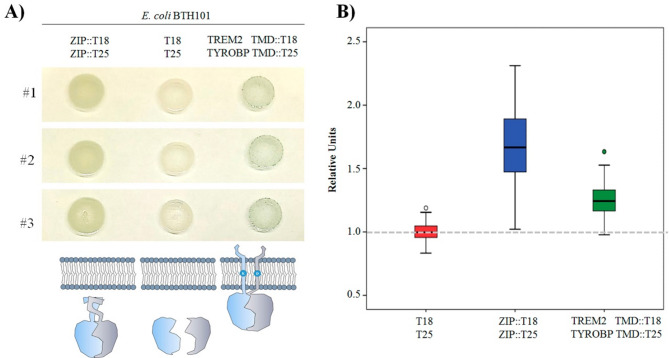
- The TREM2 and TYROBP transmembrane domains bound in the bacterial membrane in the B2H drop assay (mean 1.4 vs. 1.01, p < 0.01, Mann Whitney test).
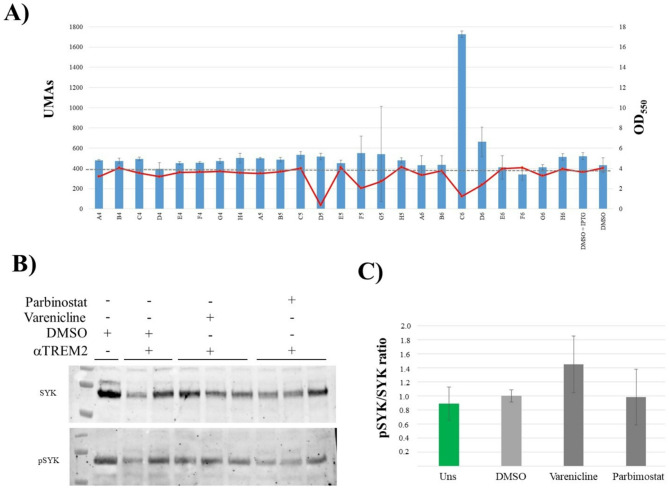
- Screening 315 FDA-approved drugs in triplicate yielded 38 promising candidates: 25 potential activators (8%) and 13 repressors (4%); 13 were independently validated (10 activators, 3 inhibitors), with a significant bias toward activators (3.2% vs. 1%, p = 0.049, χ2 test) and validated candidates significant overall (p = 0.014, Mann Whitney test).
- Specificity testing found 3 of 13 selected modulators were specific — dexamethasone, parbimostat, and varenicline — all activators; no inhibitors were specific. In HMC3 cells, parbimostat showed no effect and was considered a false positive, whereas varenicline increased the p-SYK/SYK ratio ≈ 40%.
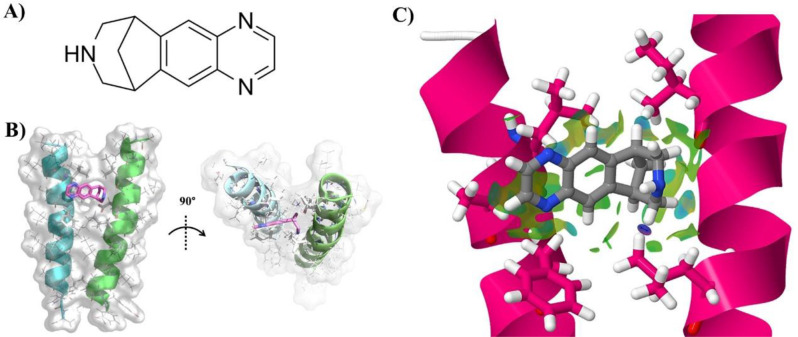
- Docking showed varenicline’s best binding mode interacting with both α-helices with an affinity of −5.6 kcal/mol, with attractive interactions at ILE-6 and LEU-13 of TYROBP’s TMD and LEU-6, ALA-7, and PHE-10 of TREM2’s TMD.
Methods
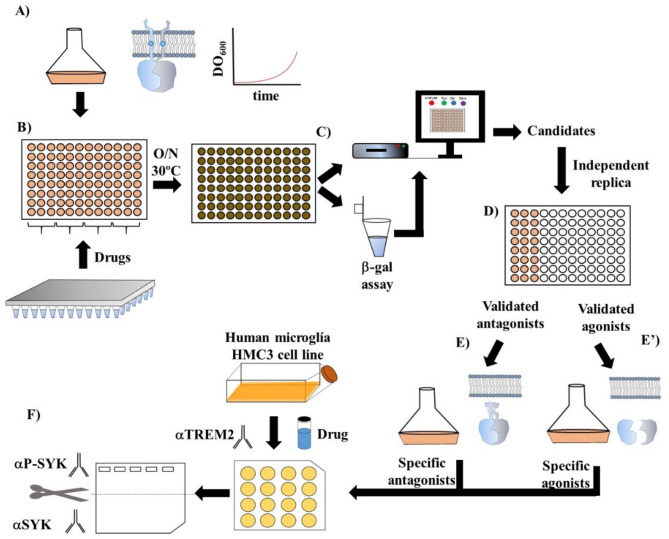
- A bacterial two-hybrid system based on adenylate cyclase reconstitution in E. coli BTH101 was used, with TREM2 and TYROBP transmembrane domains fused to T18 and T25 and β-galactosidase readout; drugs from an FDA-approved library were assayed at 150 µM in triplicates, followed by specificity assays using empty plasmids or ZIP controls.
- HMC3 human microglial cells were stimulated with 1 µg/ml anti-TREM2 for 5 min at 37°C in the presence of 1% DMSO alone or candidate drug, then pSYK/SYK ratios were measured by Western blot and independently by colorimetric Cell-Based ELISA with AL002 stimulation.
- Molecular docking used AutoDock Vina with varenicline from DrugBank and TREM2/TYROBP α-helices from a previous molecular dynamics simulation; non-covalent interactions were analyzed with NCIPLOT4.
Limitations
- The paper states that hepatic and gastric metabolism may alter the TREM2-TYROBP binding capacity observed in vitro; native TYROBP exists as dimers in microglia whereas the assays examined monomeric interactions, potentially affecting in vivo relevance; and promoting the interaction does not necessarily translate to intracellular upregulation, as it may merely extend complex stability or reduce the Km between the two domains.
- Evident from the text: this was a pilot screen of 315 FDA-approved drugs, no specific inhibitors were found, and the varenicline effect was not confirmed in vivo.
- Evident from the text: validation relied on the HMC3 cell line and a bacterial B2H system, which may not fully replicate native microglial membrane conditions.
Model-written summary. Check it against the paper before relying on it.
Integrity signals
Registry
Cites
Statistics
Figures
Verification
Claims the paper makes
0 Valid · 0 Not valid · 11 Not checked · 21 Own results and interpretations
A result the paper reports from its own data — it cites no other source for it, so there is none to check. The quote shows it is in the paper.
In the paper
“Drop assays of E. coli BTH101 strain harboring different plasmid configurations showed that both human TMDs effectively bind in the bacterial membrane (Mean of 1.4 vs. 1.01, p-value < 0.01, Mann Whitney test)”
§ Drug screening targeting TREM2-TYROBP transmembrane binding > Results
plainstates an associationn = 57- Asserted: passes — The authors put it forward as true.
- Checkable: passes — It can be checked against evidence.
- Load-bearing: passes — The paper’s conclusions depend on it.
- Based: passes — The paper gives a reason why it holds.
- Rests on an assumption not shown here.
A result the paper reports from its own data — it cites no other source for it, so there is none to check. The quote shows it is in the paper.
In the paper
“The screening suggested two potential candidates that were finally assayed in the human microglial cell line HMC3.”
§ Drug screening targeting TREM2-TYROBP transmembrane binding > Abstract
plain- Asserted: passes — The authors put it forward as true.
- Checkable: passes — It can be checked against evidence.
- Load-bearing: passes — The paper’s conclusions depend on it.
- Based: passes — The paper gives a reason why it holds.
A result the paper states — it cites no source for it, so there is none to check. The quote shows it is in the paper.
In the paper
“However, the dynamic range of this beta-galactosidase assay was lower than expected.”
§ Drug screening targeting TREM2-TYROBP transmembrane binding > Results
plain- Asserted: passes — The authors put it forward as true.
- Checkable: passes — It can be checked against evidence.
- Load-bearing: passes — The paper’s conclusions depend on it.
- Based: passes — The paper gives a reason why it holds.
A result the paper reports from its own data — it cites no other source for it, so there is none to check. The quote shows it is in the paper.
In the paper
“The non-covalent interactions (NCI) analysis shows that the varenicline ligand is establishing attractive interactions with the ILE-6 and LEU-13 residues from TYROBP’s TMD (right) and with the LEU-6, ALA-7 and PHE-10 residues in chain TREM2’s TMD (left)”
§ Drug screening targeting TREM2-TYROBP transmembrane binding > Results
plainstates an association- Asserted: passes — The authors put it forward as true.
- Checkable: passes — It can be checked against evidence.
- Load-bearing: passes — The paper’s conclusions depend on it.
- Based: passes — The paper gives a reason why it holds.
A result the paper reports from its own data — it cites no other source for it, so there is none to check. The quote shows it is in the paper.
In the paper
“Thus, we tested 315 FDA-approved drugs which were assayed in triplicate and compared with the negative control (Fig. 2A).”
§ Drug screening targeting TREM2-TYROBP transmembrane binding > Results
plain- Asserted: passes — The authors put it forward as true.
- Checkable: passes — It can be checked against evidence.
- Load-bearing: passes — The paper’s conclusions depend on it.
- Based: passes — The paper gives a reason why it holds.
12 more claims
Create a free account to see all 32 claims and to verify the 16 references still open.
- It may state two separate claims as one. 10
- Probably not a substantial claim. 9
Citations
Cites
Trott, O., & Olson, A. J. (2010) · Journal of Computational Chemistry · doi:10.1002/jcc.21334 · Cited by 38,412
AutoDock4 and AutoDockTools4: Automated docking with selective receptor flexibility
Morris, G. M., Huey, R., Lindstrom, W., Sanner, M. F., Belew, R. K., Goodsell, D. S., & Olson, A. J. (2009) · Journal of Computational Chemistry · doi:10.1002/jcc.21256 · Cited by 25,486
AutoDock Vina 1.2.0: New Docking Methods, Expanded Force Field, and Python Bindings
Eberhardt, J., Santos-Martins, D., Tillack, A. F., & Forli, S. (2021) · Journal of Chemical Information and Modeling · doi:10.1021/acs.jcim.1c00203 · Cited by 7,546
Alzheimer Disease: An Update on Pathobiology and Treatment Strategies
Long, J. M., & Holtzman, D. M. (2019) · Cell · doi:10.1016/j.cell.2019.09.001 · Cited by 3,204
Neuroinflammation and microglial activation in Alzheimer disease: where do we go from here?
Leng, F., & Edison, P. (2021) · Nature Reviews Neurology · doi:10.1038/s41582-020-00435-y · Cited by 3,179
Drug Transport across the Blood–Brain Barrier
Pardridge, W. M. (2012) · Journal of Cerebral Blood Flow & Metabolism · doi:10.1038/jcbfm.2012.126 · Cited by 1,994
DrugBank 6.0: the DrugBank Knowledgebase for 2024
Knox, C., Wilson, M., Klinger, C. M., Franklin, M., Oler, E., Wilson, A., Pon, A., Cox, J., Chin, N. E. (., Strawbridge, S. A., et al. (2024) · Nucleic Acids Research · doi:10.1093/nar/gkad976 · Cited by 1,727
Integrated Systems Approach Identifies Genetic Nodes and Networks in Late-Onset Alzheimer’s Disease
Zhang, B., Gaiteri, C., Bodea, L.-G., Wang, Z., McElwee, J., Podtelezhnikov, A. A., Zhang, C., Xie, T., Tran, L., Dobrin, R., et al. (2013) · Cell · doi:10.1016/j.cell.2013.03.030 · Cited by 1,657
TREM2 regulates microglial cholesterol metabolism upon chronic phagocytic challenge
Nugent, A. A., Lin, K., van Lengerich, B., Lianoglou, S., Przybyla, L., Davis, S. S., Llapashtica, C., Wang, J., Kim, D. J., Xia, D., et al. (2020) · Neuron · doi:10.1016/j.neuron.2019.12.007 · Cited by 798
Wang, S., Mustafa, M., Yuede, C. M., Salazar, S. V., Kong, P., Long, H., Ward, M., Siddiqui, O., Paul, R., Gilfillan, S., et al. (2020) · Journal of Experimental Medicine · doi:10.1084/jem.20200785 · Cited by 549 · cited 1×
“Under this scenario, AL002c was launched, consisting in a mouse IgG1 anti-hTREM2 monoclonal antibody (mAb) generated using the recombinant hTREM2 extracellular domain as an immunogen in a hybridoma approach, followed by humanization and affinity maturation by yeast display (Wang et al. 2020).”
Research works printed but not linked: 2
- Alector Presents Baseline Characteristics for INVOKE-2 Phase 2 Clinical Trial of AL002 at the Alzheimer’s Association International Conference® 2024 (AAIC®). News release. Alector. July 28, 2024. Accessed November 26. 2024. https://alector.gcs-web.com/news-releases/news-release-details/alector-presents-baseline-characteristics-invoke-2-phase-2
- Wang S, Sudan R, Peng V, et al. TREM2 drives microglia response to amyloid-β via SYK-dependent and -independent pathways. Cell. 2022b;185(22):4153–e416919. 36306735 PMC9625082 · DOI · Paper page
Cited by
Roles of TREM2 in Alzheimer’s disease
Qi, X., Zhu, K., Ke, W., Wang, J., Mao, S., & Chen, G. (2025) · Translational Neurodegeneration · doi:10.1186/s40035-025-00515-3 · Cited by 43
HMC3 revealed: how much do these “Microglia” really tell us?
Buccarello, L., Privitera, A., Partsinevelos, K., Serwa, K., Carota, G., Pietro, L. D., Cardaci, V., Mangione, R., Sibbitts, J., Lazzarino, G., et al. (2026) · Frontiers in Immunology · doi:10.3389/fimmu.2026.1778798 · Cited by 3
Fouché, B. R., Khumalo, S. G., Koopman, W. J. H., & Venter, M. (2026) · Cellular and Molecular Neurobiology · doi:10.1007/s10571-026-01681-2 · Cited by 3
Lietzke, E. E., Saeb, D., Aldrich, E. C., de Menezes, R. F., Bruce, K. D., & Sprenger, K. G. (2026) · Progress in Biophysics and Molecular Biology · doi:10.1016/j.pbiomolbio.2026.06.002 · Cited by 1
Zhu, S., Yang, T., Sheng, L., & Shi, L. (2026) · Frontiers in Ophthalmology · doi:10.3389/fopht.2026.1804578 · Cited by 1
Copper Ion-induced Protein Precipitation for Drug Target Discovery by Proteomics
Gao, Y., Zhang, Y., Ye, M., & Hu, L. (2025) · Chemical Research in Chinese Universities · doi:10.1007/s40242-025-5215-5 · Cited by 1
Metadata
- Authors
- Cobas-Carreño, M., Esteban-Martos, A., Tomas-Gallardo, L., Iribarren, I., Gonzalez-Palma, L., Rivera-Ramos, A., Elena-Guerra, J., Alarcon-Martin, E., Ruiz, R., Bravo, M. J., Venero, J. L., Morató, X., Ruiz, A., & Royo, J. L.
- Affiliations
- Universidad de Málaga (ES)
- Instituto de Biomedicina de Sevilla (ES)
- Universitat Internacional de Catalunya (ES)
- The University of Texas at San Antonio Health Science Center (US)
- Corresponding author
- Royo, J. L.
- Venue
- Molecular Medicine
- Published
- 2025-05-05
- Volume
- 31
- Issue
- 1
- Pages
- 171-171
- ISSN
- 1076-1551 (ISSN-L)
- 1528-3658
- PMC
- PMC12054299
- OpenAlex
- W4410085787
- Semantic Scholar
- edb9d72829a00aa11181384c51bda1143b6e7968
- Cited by
- 6
- References
- 24
- Citations by year
- 2026: 4 · 2025: 2
- FWCI
- 1.69
- Type
- journal article
- Language
- en
- Open access
- gold
- doi.org
- Licence
- cc-by
- creativecommons.org/licenses/by/4.0 (tdm)
- creativecommons.org/licenses/by/4.0 (vor)
- Locations
- Molecular Medicine (publishedVersion, cc-by)
- bioRxiv (Cold Spring Harbor Laboratory) (submittedVersion, cc-by)
- Repositorio Institucional de la Universidad de Málaga (University of Málaga) (publishedVersion, cc-by)
- Europe PMC (PubMed Central) (publishedVersion, cc-by)
- PubMed Central (publishedVersion, cc-by)
- PubMed (publishedVersion)
- DIGITAL.CSIC (Spanish National Research Council (CSIC)) (publishedVersion, other-oa)
- DOAJ (DOAJ: Directory of Open Access Journals) (submittedVersion)
- Topics
- Life Sciences › Neuroscience › Neurology › Neuroinflammation and Neurodegeneration Mechanisms
- Life Sciences › Neuroscience › Cellular and Molecular Neuroscience › Alzheimer's disease research and treatments
- Life Sciences › Immunology and Microbiology › Immunology › Inflammation biomarkers and pathways
- Keywords
- TREM2, TYROBP, disease-associated microglia, Alzheimer's disease, drug repurposing, varenicline, Syk phosphorylation, microglial activation, HMC3 cells
- MeSH terms
- Cell Line, Drug Evaluation, Preclinical, Humans, Membrane Glycoproteins, Membrane Proteins, Protein Binding, Receptors, Immunologic, Microglia, Adaptor Proteins, Signal Transducing, High-Throughput Screening Assays
About these checks
Registry, retraction, Cites and statistics results are computed, not judged, with one exception: a printed reference that no index lists is read once by a model before it counts as a citation error. Claims are extracted by a model and kept only when their quote appears verbatim in the text; each cited source is then checked, with a model’s help, for whether it says what the claim relies on. Those verdicts can be wrong — read the claim’s quote and the cited source before relying on one.
A language model drew the claims from the paper on 2026-11-27, under version 3 of the claim definition (model deepseek-v4.1-flash, prompt extract-v3).
A second model labelled each claim on 2026-11-27 (model jev-1.13-20260917, definition revision gold-guideline-v0.2).
Statistics and arithmetic are recomputed, not judged.
Confidence bands are shown only for fields calibrated on our annotated test set. None is calibrated yet, so no band is shown.
What counts as a claim ›How we measure confidence ›How we check this ›
Are you an author, or do you see a problem with this page? Request a review
Data sources
Bibliographic data: Semantic Scholar, OpenAlex, Crossref.
Contains information from the Semantic Scholar Academic Graph Datasets, made available under the ODC Attribution License (ODC-BY 1.0).
Semantic Scholar’s data is described in: Kinney, R., et al. (2023). The Semantic Scholar Open Data Platform. arXiv:2301.10140.
