

The DOI matches its Crossref record; the references it cites are not checked yet.
Physical activity monitors to enhance amount of physical activity in older adults: a systematic review and meta-analysis
Open accessAbstract
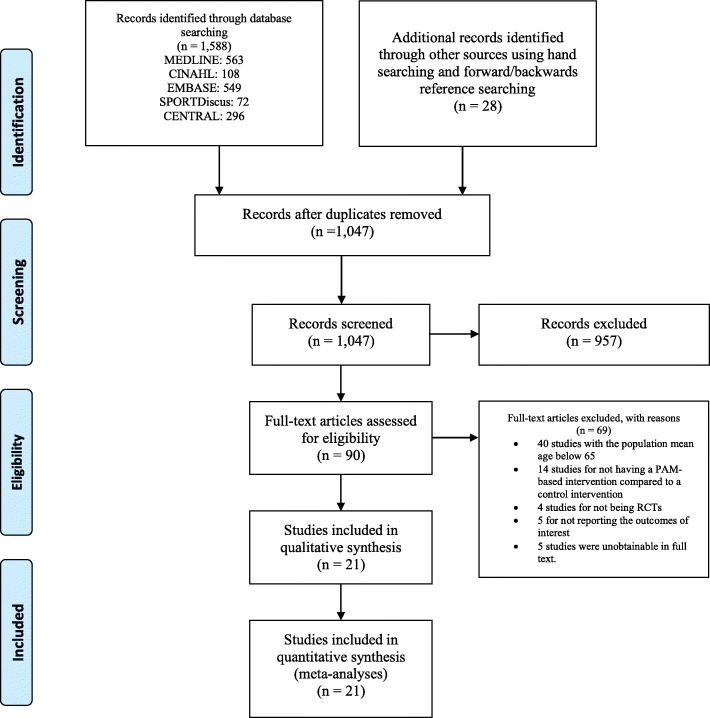
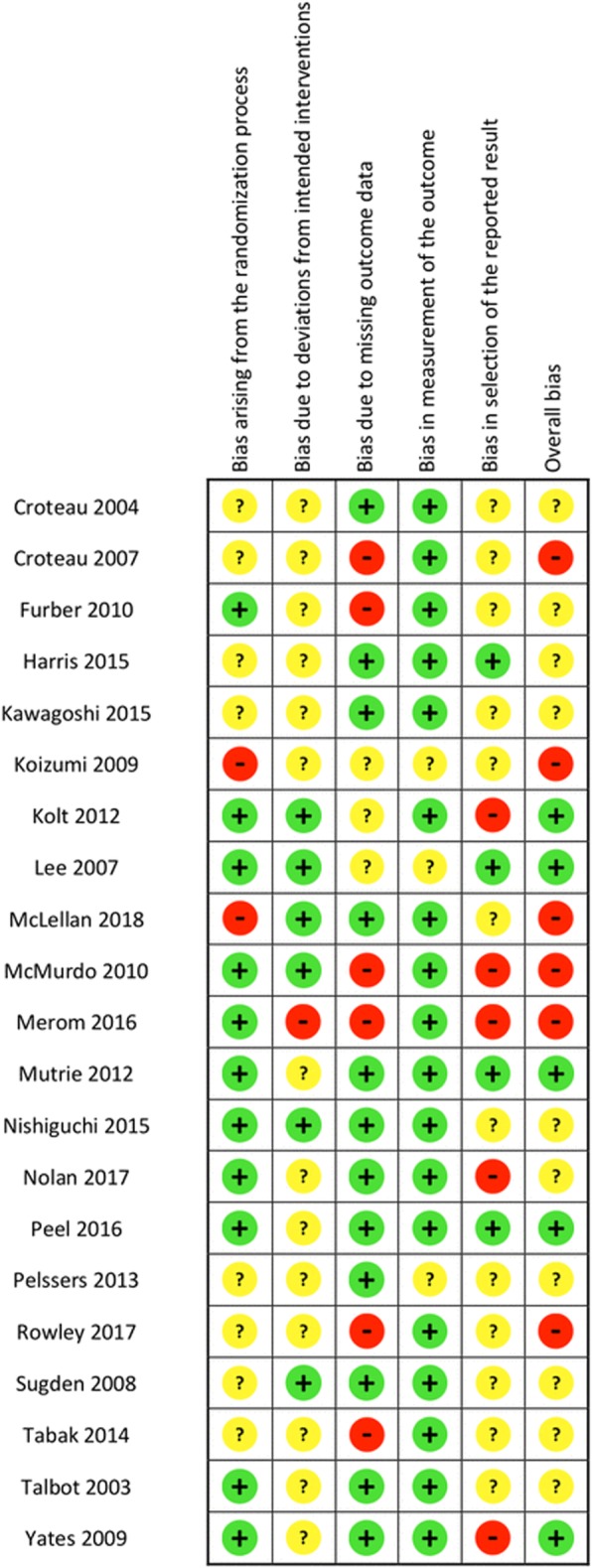
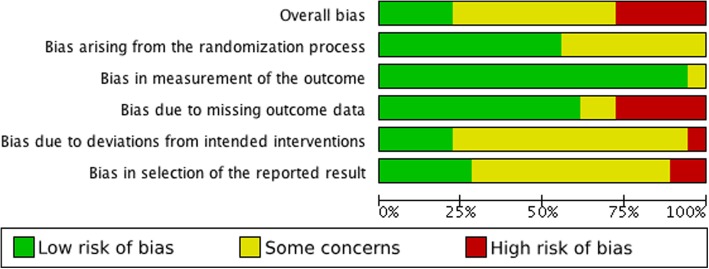
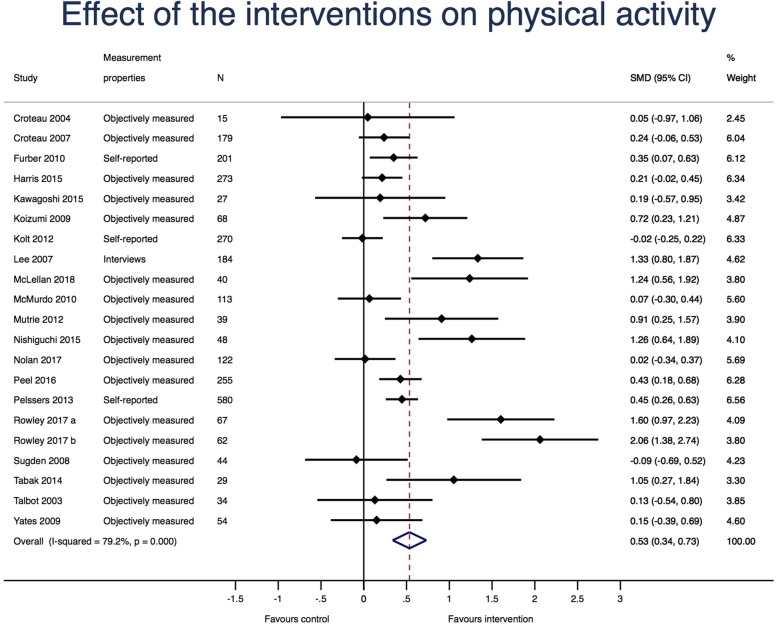
BACKGROUND: The body of evidence related to the effect of physical activity monitor-based interventions has grown over the recent years. However, the effect of physical activity monitor-based interventions in older adults remains unclear and should be systematically reviewed. OBJECTIVE: The objective of this systematic review was to estimate the effect of physical activity monitor-based interventions on physical activity behavior in participants aged 65 and above. Subsequently we explored the effect on body mass index, physical capacity, and health-related quality of life and finally the impact of patient- and intervention characteristics. METHODS: Searches in MEDLINE, EMBASE, SPORTDiscus, CINAHL, and CENTRAL were performed on April 26, 2018. No publication date filters were applied. References of eligible studies were scrutinized and relevant journals were hand-searched. Randomized controlled trials and randomized cross-over trials investigating the effect of a physical activity monitor-based intervention on physical activity were included. Studies were included if the mean age of the participants was above 65 years, and participants could walk independently with or without walking aids. The Cochrane handbook was used as a template for extracting data and the RoB 2.0 tool was used to assess risk of bias. Random-effects meta-analysis using Hedges g, were used to pool the study results. The main outcome of this study was physical activity. RESULTS: Twenty-one studies with 2783 participants were included. The median participant age in the studies was 70.5 years, the median percentage of male participants was 42%, and the median baseline daily step count was 5268. Physical activity monitor-based interventions had a moderate effect (SMD = 0.54, 95% CI: 0.34 to 0.73) compared to control interventions, corresponding to an average increase of 1297 steps per day in the intervention groups. No impact of patient and intervention characteristics on the effect estimates were found. SHORT CONCLUSION: Low quality of evidence was found for a moderate effect of physical activity monitor-based interventions on physical activity compared with control interventions. More studies with higher research methodology standards are required. PROSPERO REGISTRATION: CRD42018083648.
Overview
The claims and statistics of this paper haven’t been checked yet.
Run the check — free, no account needed. It reads the open-access text and checks the sources it cites.
Integrity signals
Registry
Cites
Statistics
Figures
Verification
Claims the paper makes
The claims and statistics of this paper haven’t been checked yet.
Run the check — free, no account needed. It reads the open-access text and checks the sources it cites.
Claims other papers make about this one
Each is checked against this paper’s own text: does it say what the citing paper says it does?
The source backs part of the claim, not all of it — or backs it for a different population, condition or comparison.
In the citing paper
“For physical activity, Larsen and colleagues 51 reported an effect size of 0•54 (95% CI 0•34-0•73; p<0•0001) and Freak-Poli and colleagues 43 reported a ratio of means of 1•37 (95% CI 1•11-1•71; p=0•004; appendix p 30), which is similar to, or marginally larger, than the effect sizes reported in other reviews (centred around an SMD of 0•4; figure 1).”
From Effectiveness of wearable activity trackers to increase physical activity and improve health: a systematic review of systematic reviews and meta-analyses. (2022) · cites this paper as [51]
Experimental — accuracy not yet measuredThe source backs part of the claim, not all of it — or backs it for a different population, condition or comparison.
In the citing paper
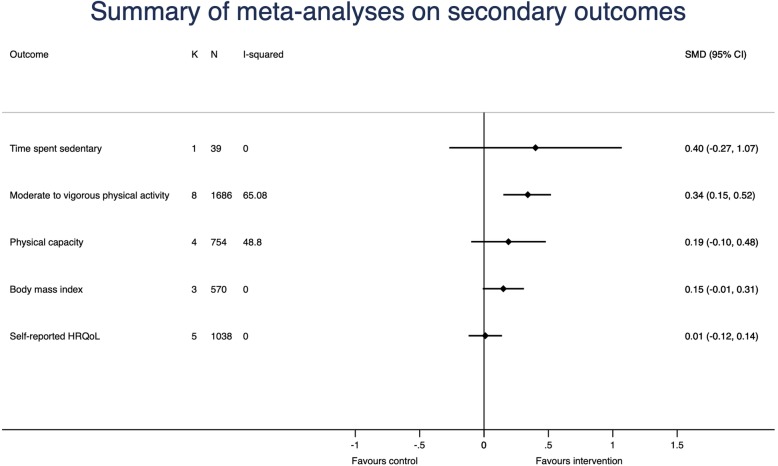
“For example, for MVPA, the meta-analysis by Larsen and colleagues 51 found an effect size of 0•34 (95% CI 0•20-0•52; p=0•005; figure 1), and the effect sizes for all other systematic reviews also centred around approximately 0•3”
From Effectiveness of wearable activity trackers to increase physical activity and improve health: a systematic review of systematic reviews and meta-analyses. (2022) · cites this paper as [51]
Experimental — accuracy not yet measured
Self-check
Percentages, sums and reported differences re-computed from the paper’s own numbers.
The self-check needs the paper’s full text.
Citations
The citation lists haven’t been fetched yet
References 54 · Cited by 77
Research works printed but not linked: 4
- Larsen RT, Christensen J, Juhl CB, Andersen HB, Langberg H. Physical activity monitors to enhance the daily amount of physical activity in elderly—a protocol for a systematic review and meta-analysis. Syst Rev. 2018;7:69. · DOI
- Higgins G. Cochrane Handbook for Systematic Reviews of Interventions, 16.5.4 How to include multiple groups from one study. In: Cochrane Handbook for Systematic Reviews of Interventions; 2011.
- World Health Organization. Global recommendations on physical activity for health. 2010. http://www.ncbi.nlm.nih.gov/books/NBK305057/ . Accessed 26 Jun 2017.
- Higgins JPT, Green S. Cochrane Handbook for Systematic Reviews of Interventions, 10.2 Types of reporting bias and the supporting evidence. In: Cochrane Handbook for Systematic Reviews of Interventions; 2011.
Metadata
- Authors
- Larsen, R. T., Christensen, J., Juhl, C. B., Andersen, H. B., & Langberg, H.
- Affiliations
- University of Copenhagen (DK)
- University of Southern Denmark (DK)
- Technical University of Denmark (DK)
- Corresponding author
- Larsen, Rasmus Tolstrup
- ORCID
- Venue
- European Review of Aging and Physical Activity
- Published
- 2019-05-04
- Volume
- 16
- Issue
- 1
- Pages
- 7-7
- ISSN
- 1813-7253 (ISSN-L)
- 1861-6909
- PMC
- PMC6500067
- OpenAlex
- W2943839570
- Cited by
- 77
- References
- 54
- Citations by year
- 2026: 7 · 2025: 9 · 2024: 16 · 2023: 10 · 2022: 14 · 2021: 11 · 2020: 10
- FWCI
- 1.03
- Type
- journal article
- Language
- en
- Open access
- gold
- doi.org
- Licence
- Locations
- European Review of Aging and Physical Activity (publishedVersion, cc-by)
- PubMed Central (publishedVersion, cc-by)
- PubMed (publishedVersion)
- Research at the University of Copenhagen (University of Copenhagen) (publishedVersion, cc-by)
- University of Southern Denmark Research Portal (University of Southern Denmark) (acceptedVersion, cc-by)
- Technical University of Denmark, DTU Orbit (Technical University of Denmark, DTU) (submittedVersion, other-oa)
- Funders
- Horizon 2020 (690425)
- Topics
- Health Sciences › Medicine › Public Health, Environmental and Occupational Health › Physical Activity and Health
- Physical Sciences › Computer Science › Computer Vision and Pattern Recognition › Context-Aware Activity Recognition Systems
- Health Sciences › Health Professions › Physical Therapy, Sports Therapy and Rehabilitation › Balance, Gait, and Falls Prevention
- Keywords
- wearable activity trackers, accelerometer, older adults, physical activity behavior, step count, body mass index, physical capacity, health-related quality of life, physical activity interventions, walking aids
About these checks
Registry, retraction, Cites and statistics results are computed, not judged, with one exception: a printed reference that no index lists is read once by a model before it counts as a citation error. Claims are extracted by a model and kept only when their quote appears verbatim in the text; each cited source is then checked, with a model’s help, for whether it says what the claim relies on. Those verdicts can be wrong — read the claim’s quote and the cited source before relying on one.
Statistics and arithmetic are recomputed, not judged.
Confidence bands are shown only for fields calibrated on our annotated test set. None is calibrated yet, so no band is shown.
What counts as a claim ›How we measure confidence ›How we check this ›
Are you an author, or do you see a problem with this page? Request a review
How to cite
Cite CoChat for the checks on this page, and the paper for its own findings.
- This page
- CoChat. (2026). Citation check: Physical activity monitors to enhance amount of physical activity in older adults: a systematic review and meta-analysis. https://app.cochat.ai/papers/10.1186/s11556-019-0213-6
- The paper
- Larsen, R. T., Christensen, J., Juhl, C. B., Andersen, H. B., & Langberg, H. (2019). Physical activity monitors to enhance amount of physical activity in older adults: a systematic review and meta-analysis. European Review of Aging and Physical Activity. https://doi.org/10.1186/s11556-019-0213-6
