

Enhancement in Ct-DNA binding affinity and antimicrobial activity of ZnO nanoparticles via Ag-doping
Open accessThe DOI matches its Crossref record; 35 of the 35 references it cites were found in a registry or an index; none of the 34 sources its claims cite is checked for support yet.
Abstract
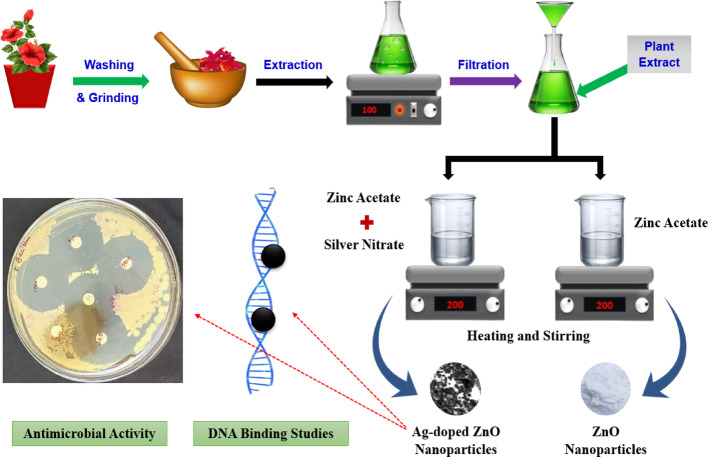
Developing multifunctional nanomaterials with improved antibacterial properties and reliable biocompatibility is an essential issue in biomedical research to address the increasing concern of antibiotic resistance. Ag-doped zinc oxide nanoparticles (ZnO NPs) were synthesized using a green and eco-friendly route using hibiscus flower extract as a reducing and stabilizing agent. The nanoparticles were synthesized successfully and characterized through FT-IR, TEM, EDX, and UV-Vis analysis. The bactericidal action potential was tested against E. coli, S. aureus, B. subtilis, Lactobacillus, and C. albicans pathogens using the Kirby-Bauer disk diffusion method. Ag-doped ZnO NPs were observed to have superior inhibition action against E. coli compared to pristine ZnO NPs. The interactions of ZnO and Ag-ZnO NPs towards calf thymus DNA (ct-DNA) were examined spectroscopically using absorption and fluorescence studies. It was observed that Ag-doped ZnO NPs showed a greater interaction with ct-DNA than pristine ZnO NPs. Thus, we conclude that biosynthesized Ag-ZnO NPs are multifunctional nanomaterials with good antibacterial action, an improved ability to bind to DNA, and better biocompatibility for future biomedical applications.
Overview
CoChat Summary
TL;DR
Green-synthesized ZnO and Ag-doped ZnO nanoparticles using hibiscus flower extract showed that Ag doping enhanced ct-DNA binding affinity and antimicrobial activity. Ag-doped ZnO had higher DNA binding constants and stronger inhibition against E. coli and B. subtilis than pristine ZnO.
Key findings
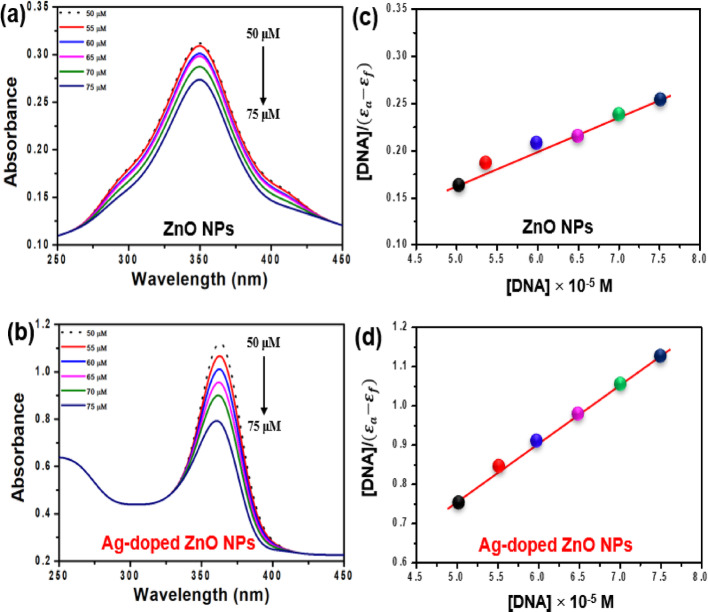
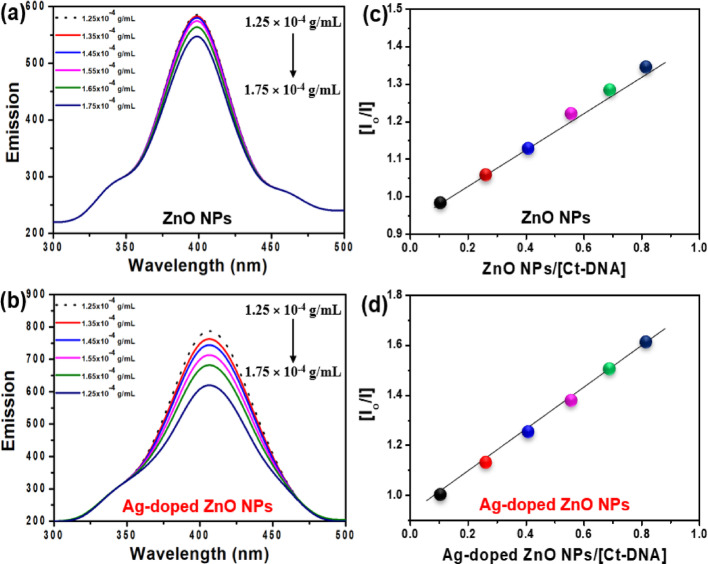
- Ag-doped ZnO NPs bound ct-DNA more strongly than pristine ZnO: intrinsic binding constant \(K_b\) was \(3.03 \times 10^2\ \text{M}^{-1}\) for Ag-doped ZnO vs \(2.81 \times 10^2\ \text{M}^{-1}\) for ZnO; Stern–Volmer quenching constant \(k_{SV}\) was \(1.79 \times 10^5\ \text{M}^{-1}\) vs \(1.44 \times 10^5\ \text{M}^{-1}\).
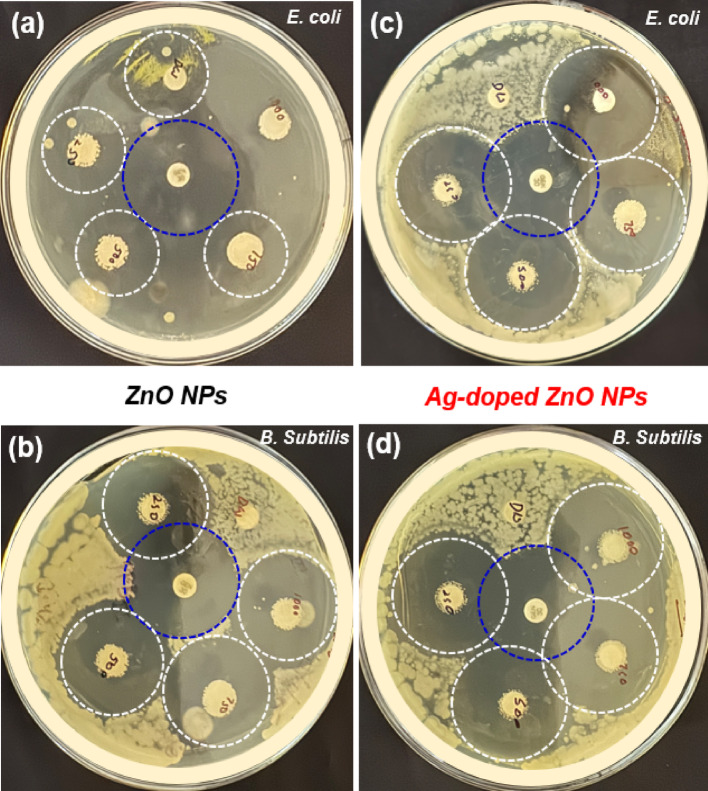
- Antimicrobial testing showed Ag-doped ZnO NPs were more active than pure ZnO against E. coli and B. subtilis; at 1000 µg mL⁻¹, maximum growth suppression reached 85.2% for B. subtilis and 76.4% for E. coli, with inhibition zones of \(25.3 \pm 1\) mm for E. coli and \(25.3 \pm 3\) mm for B. subtilis. MIC values ranged from 25 to 250 µg mL⁻¹, and all tested bacteria had an MBC/MIC ratio of 2 or below.
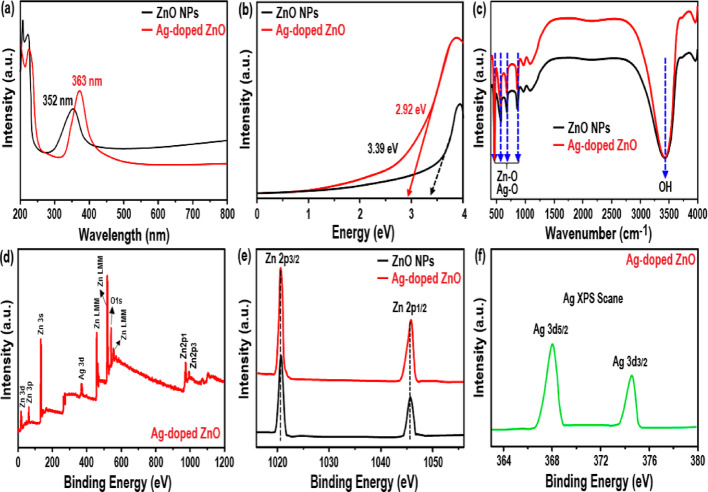
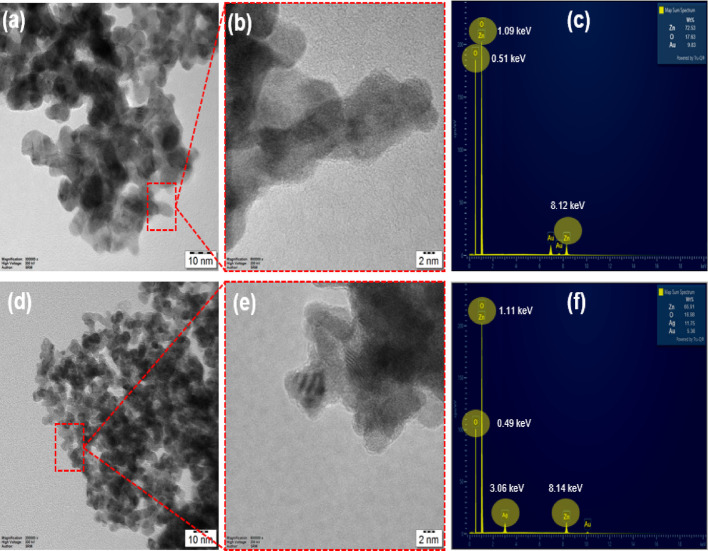
- Characterization: XRD crystallite sizes were 42 nm for ZnO and 34 nm for Ag-doped ZnO; TEM showed diameters of 5–8 nm with average Ag-doped ZnO size about 7 nm; optical band gaps were 3.39 eV for ZnO and 2.92 eV for Ag-doped ZnO; EDX indicated about 12% actual Ag content in Ag-doped ZnO.
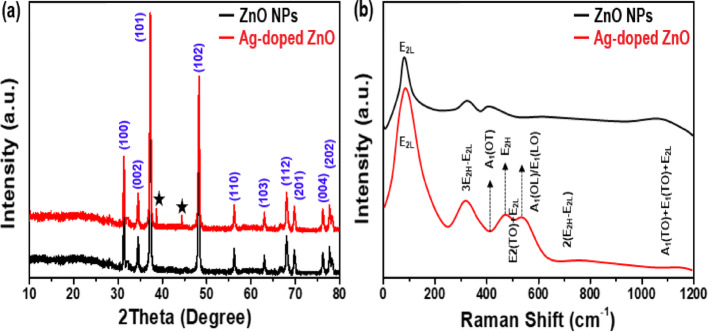
- XRD showed additional Ag peaks at 38.44° and 44.60° for Ag-doped ZnO, confirming Ag incorporation into the ZnO structure.
Methods
- ZnO and Ag-doped ZnO NPs were synthesized by a green route using hibiscus flower extract as reducing/stabilizing agent; ZnO was prepared from zinc acetate and extract and calcined at 650 °C, while Ag-doped ZnO used 1% 0.1 M AgNO₃ and was calcined at 650 °C for 3 h.
- Characterization used XRD, Raman, UV-Vis, FT-IR, XPS, TEM, and EDX.
- Antimicrobial activity was tested by Kirby–Bauer disk diffusion against E. coli, S. aureus, B. subtilis, Lactobacillus, and C. albicans at 250, 500, 750, and 1000 µg mL⁻¹, with MIC by broth microdilution and MBC assays; all antimicrobial assessments were done in triplicate with one-way ANOVA and Tukey’s post hoc test (\(p < 0.05\)). ct-DNA binding was studied by UV-visible and fluorescence spectroscopy with ethidium bromide displacement, using fixed ct-DNA concentrations and nanoparticle concentrations varied from \(1.25 \times 10^{-4}\) to \(1.75 \times 10^{-4}\) g mL⁻¹.
Limitations
- The paper states that the exact ct-DNA binding mechanism is still to be determined.
- Evident from the text: crystallite size reporting is inconsistent—XRD gives 42 nm for ZnO and 34 nm for Ag-doped ZnO, while the conclusion states average crystallite sizes of 5 nm for ZnO and 7 nm for Ag-doped ZnO, and TEM reports 5–8 nm diameters.
- Evident from the text: the crystallinity statement says it “increased from 61% for pure ZnO to 55% for Ag-doped ZnO,” which is a decrease, not an increase; quantitative antimicrobial data are largely placed in supplementary Tables S1 and S2 rather than fully in the main text, and no in vivo or clinical data are reported.
Model-written summary. Check it against the paper before relying on it.
Integrity signals
Registry
Cites
Statistics
Figures
Verification
Claims the paper makes
0 Valid · 0 Not valid · 26 Not checked · 67 Own results and interpretations
A result the paper reports from its own data — it cites no other source for it, so there is none to check. The quote shows it is in the paper.
In the paper
“Ag-doped ZnO NPs were observed to have superior inhibition action against E. coli compared to pristine ZnO NPs.”
§ Enhancement in Ct-DNA binding affinity and antimicrobial activity of ZnO nanoparticles via Ag-doping > Abstract
plainstates a cause- Asserted: passes — The authors put it forward as true.
- Checkable: passes — It can be checked against evidence.
- Load-bearing: passes — The paper’s conclusions depend on it.
- Based: passes — The paper gives a reason why it holds.
A result the paper reports from its own data — it cites no other source for it, so there is none to check. The quote shows it is in the paper.
In the paper
“Ag-doped zinc oxide nanoparticles (ZnO NPs) were synthesized using a green and eco-friendly route using hibiscus flower extract as a reducing and stabilizing agent.”
- Also stated in: § Introduction · plain
“Keeping the above considerations in mind, in the present study, green synthesis of ZnO and Ag-doped ZnO NPs was conducted using hibiscus flower extract.”
§ Enhancement in Ct-DNA binding affinity and antimicrobial activity of ZnO nanoparticles via Ag-doping > Abstract
plain- Asserted: passes — The authors put it forward as true.
- Checkable: passes — It can be checked against evidence.
- Load-bearing: passes — The paper’s conclusions depend on it.
- Based: passes — The paper gives a reason why it holds.
- Also stated in: § Introduction · plain
A result the paper reports from its own data — it cites no other source for it, so there is none to check. The quote shows it is in the paper.
In the paper
“It was observed that Ag-doped ZnO NPs showed a greater interaction with ct-DNA than pristine ZnO NPs.”
§ Enhancement in Ct-DNA binding affinity and antimicrobial activity of ZnO nanoparticles via Ag-doping > Abstract
plainstates an association- Asserted: passes — The authors put it forward as true.
- Checkable: passes — It can be checked against evidence.
- Load-bearing: passes — The paper’s conclusions depend on it.
- Based: passes — The paper gives a reason why it holds.
A result the paper reports from its own data — it cites no other source for it, so there is none to check. The quote shows it is in the paper.
In the paper
“Furthermore, the EDX results validated the successful integration of an actual Ag content of around 12% in the Ag-doped ZnO NPs.”
§ Enhancement in Ct-DNA binding affinity and antimicrobial activity of ZnO nanoparticles via Ag-doping > Results and discussion > Structural and morphological characterization of the prepared nanoparticles
plainstates a cause- Asserted: passes — The authors put it forward as true.
- Checkable: passes — It can be checked against evidence.
- Load-bearing: unclear — It is unclear whether the paper’s conclusions depend on it.
- Based: passes — The paper gives a reason why it holds.
In the paper
“The Raman spectrum of pristine ZnO NPs (Fig. 2b) exhibits the primary phonon modes E2L, A1(TO), E2H, and A1(LO)/E1(LO) at 100, 380, 441, and 586 cm− 1, respectively [5].”
§ Enhancement in Ct-DNA binding affinity and antimicrobial activity of ZnO nanoparticles via Ag-doping > Results and discussion > Structural and morphological characterization of the prepared nanoparticles
What the sources say
- Not checked yetcites [5] Raza A, Sayeed K, Naaz A, Muaz M, Islam SN, Rahaman S, Sama F, Pandey K, Ahmad A. Green synthesis of ZnO nanoparticles and Ag-doped ZnO nanocomposite utilizing Sansevieria trifasciata for high-performance asymmetric supercapacitors. ACS Omega. 2024;9:32444–54. 39100365 PMC11292842 source
plain- Asserted: passes — The authors put it forward as true.
- Checkable: passes — It can be checked against evidence.
- Load-bearing: unclear — It is unclear whether the paper’s conclusions depend on it.
- Based: passes — The paper gives a reason why it holds.
46 more claims
Create a free account to see all 93 claims and to verify the 34 references still open.
- It may state two separate claims as one. 33
- Probably not a substantial claim. 15
Self-check
Percentages, sums and reported differences re-computed from the paper’s own numbers.
Each contradiction between two passages listed here was confirmed by an independent check.
Rated major: it would touch a result — a value a result rests on, reported and recomputed p-values on opposite sides of the significance level, two passages that conflict with no sign which is right, or a cited work retracted before this paper was published.
In the paper
§ Enhancement in Ct-DNA binding affinity and antimicrobial activity of ZnO nanoparticles via Ag-doping > Conclusions
“Average crystallite sizes were determined to be 5 nm for ZnO NPs and 7 nm for Ag-doped ZnO NPs”
§ Enhancement in Ct-DNA binding affinity and antimicrobial activity of ZnO nanoparticles via Ag-doping > Results and discussion > Structural and morphological characterization of the prepared nanoparticles
“The crystallite size of ZnO NPs was found to be 42 nm when the Debye–Scherrer equation was used to quantify it. However, after Ag doping, the size of the crystallites decreased to 34 nm.”
Rated minor: it would not touch a result — a value no result rests on, a p-value that stays on the same side of the significance level, or a conflict that is clerical, resolved elsewhere in the paper, or outside its own findings.
In the paper
§ Enhancement in Ct-DNA binding affinity and antimicrobial activity of ZnO nanoparticles via Ag-doping > Results and discussion > Structural and morphological characterization of the prepared nanoparticles
“The amount of crystallinity was found to increase”
§ Enhancement in Ct-DNA binding affinity and antimicrobial activity of ZnO nanoparticles via Ag-doping > Results and discussion > Structural and morphological characterization of the prepared nanoparticles
“from 61% for pure ZnO to 55% for Ag-doped ZnO NPs”
Citations
Cites
ZnO nanostructured materials and their potential applications: progress, challenges and perspectives
Raha, S., & Ahmaruzzaman, M. (2022) · Nanoscale Advances · doi:10.1039/d1na00880c · Cited by 1,107 · cited 1×
“…of reactive oxygen species (ROS), enzyme inhibition, cell membrane integrity disruption due to loss of phospholipid bilayer integrity, and leakage of intracellular components leading to cell death, capable of inactivating a broad spectrum of bacteria with light exposure or ambient moisture [9].”
Nanomaterials: An overview of synthesis, classification, characterization, and applications
Mekuye, B., & Abera, B. (2023) · Nano Select · doi:10.1002/nano.202300038 · Cited by 751 · cited 1×
“Nanomaterials possess unique physicochemical properties compared to bulk materials [1].”
Exploring the Journey of Zinc Oxide Nanoparticles (ZnO-NPs) toward Biomedical Applications
Islam, F., Shohag, S., Uddin, M. J., Islam, M. R., Nafady, M. H., Akter, A., Mitra, S., Roy, A., Emran, T. B., & Cavalu, S. (2022) · Materials · doi:10.3390/ma15062160 · Cited by 403 · cited 1×
“Several reports revealed Pt/ZnO and Au/ZnO to have high photocatalytic activity compared to pristine ZnO NPs, but their high cost limits their practical application [10].”
Huang, H., Feng, W., & Chen, Y. (2021) · Chemical Society Reviews · doi:10.1039/d0cs01138j · Cited by 285 · cited 1×
“Owing to their tunable properties, nanomaterials have earned importance in disciplines like chemistry, biology, medicine, and medicine, and physics, as well as engineering [2, 3].”
Kawsar, M., Hossain, M. S., Bahadur, N. M., & Ahmed, S. (2024) · Heliyon · doi:10.1016/j.heliyon.2024.e25347 · Cited by 214 · cited 2×
“Lattice distortion caused by the addition of Ag was further supported by the fact that the interplanar spacing (d) values, which were determined for large reflections, exhibited slight changes towards higher or lower 2θ values [22].”
InfluentialZnO-based antimicrobial coatings for biomedical applications
Puspasari, V., Ridhova, A., Hermawan, A., Amal, M. I., & Khan, M. M. (2022) · Bioprocess and Biosystems Engineering · doi:10.1007/s00449-022-02733-9 · Cited by 188 · cited 1×
“Therefore, Ag can be effectively incorporated into ZnO NPs to modify its surface features and electronic state, which ultimately enhances the antibacterial potential of this material [11].”
Bechambi, O., Chalbi, M., Najjar, W., & Sayadi, S. (2015) · Applied Surface Science · doi:10.1016/j.apsusc.2015.03.049 · Cited by 176 · cited 1×
“Recently, Bachambi et al. synthesized Ag-doped ZnO nanostructures following the hydrothermal process and investigated their antibacterial activity [14].”
InfluentialWagh, S. S., Kadam, V. S., Jagtap, C. V., Salunkhe, D. B., Patil, R. S., Pathan, H. M., & Patole, S. P. (2023) · ACS Omega · doi:10.1021/acsomega.2c07499 · Cited by 167
Emerging Trends for ZnO Nanoparticles and Their Applications in Food Packaging
Zare, M., Namratha, K., Ilyas, S., Sultana, A., Hezam, A., L, S., Surmeneva, M. A., Surmenev, R. A., Nayan, M. B., Ramakrishna, S., et al. (2022) · ACS Food Science & Technology · doi:10.1021/acsfoodscitech.2c00043 · Cited by 149
Sagadevan, S., Pal, K., Chowdhury, Z. Z., & Hoque, M. E. (2017) · Journal of Sol-Gel Science and Technology · doi:10.1007/s10971-017-4418-8 · Cited by 126 · cited 1×
“The XRD patterns of Ag-doped ZnO NPs exhibit two additional peaks at 38.44° and 44.60°, corresponding to the (111) and (200) reflections of Ag, respectively, so proving the successful incorporation of Ag into the ZnO structure [21].”
Influential
Research works printed but not linked: 1
- Kumar R, Krishnan K, Burle G, Samathoti P, Kumar JP, Bagade O, Reddy KK, Jahnavi P. Biochemical Engineering of Green Nanomaterials for Targeted Drug Delivery and Therapeutic Applications. J Chem Reviews. 2025;7:191–215.
Cited by
Jawad, M. H., Alesary, H. F., & Al‐Yasari, A. (2026) · Plasmonics · doi:10.1007/s11468-026-03425-w · Cited by 4
Metadata
- Authors
- Almadhhi, S. S., Kumar, A., Ubaidullah, M., & Al-Enizi, A. M.
- Affiliations
- King Saud University (SA)
- GLA University (IN)
- Corresponding author
- Kumar, Anuj
- Venue
- Discover Nano
- Published
- 2026-05-19
- Volume
- 21
- Issue
- 1
- Pages
- 202
- ISSN
- 2731-9229 (ISSN-L)
- PMC
- PMC13187099
- OpenAlex
- W7161631538
- Cited by
- 1
- References
- 34
- Citations by year
- 2026: 1
- FWCI
- 0.82
- Type
- journal article
- Language
- en
- Open access
- gold
- doi.org
- Licence
- cc-by-nc-nd
- creativecommons.org/licenses/by-nc-nd/4.0 (tdm)
- creativecommons.org/licenses/by-nc-nd/4.0 (vor)
- Locations
- Discover Nano (publishedVersion, cc-by-nc-nd)
- PubMed Central (publishedVersion, cc-by-nc-nd)
- PubMed (publishedVersion)
- DOAJ (DOAJ: Directory of Open Access Journals) (submittedVersion)
- Funders
- King Saud University
- Topics
- Physical Sciences › Materials Science › Materials Chemistry › Nanoparticles: synthesis and applications
- Physical Sciences › Materials Science › Materials Chemistry › ZnO doping and properties
- Health Sciences › Medicine › Oncology › Metal complexes synthesis and properties
- Keywords
- Ag/ZnO nanoparticles, green synthesis, hibiscus flower extract, antibacterial activity, DNA binding, calf thymus DNA, Escherichia coli, Staphylococcus aureus, Bacillus subtilis, Lactobacillus, Candida albicans, antibiotic resistance, biocompatibility
About these checks
Registry, retraction, Cites and statistics results are computed, not judged, with one exception: a printed reference that no index lists is read once by a model before it counts as a citation error. Claims are extracted by a model and kept only when their quote appears verbatim in the text; each cited source is then checked, with a model’s help, for whether it says what the claim relies on. Those verdicts can be wrong — read the claim’s quote and the cited source before relying on one.
A language model drew the claims from the paper on 2026-11-27, under version 3 of the claim definition (model deepseek-v4.1-flash, prompt extract-v3).
A second model labelled each claim on 2026-11-27 (model jev-1.13-20260917, definition revision gold-guideline-v0.2).
Statistics and arithmetic are recomputed, not judged.
Confidence bands are shown only for fields calibrated on our annotated test set. None is calibrated yet, so no band is shown.
What counts as a claim ›How we measure confidence ›How we check this ›
Are you an author, or do you see a problem with this page? Request a review
Data sources
Bibliographic data: Semantic Scholar, OpenAlex, Crossref.
Contains information from the Semantic Scholar Academic Graph Datasets, made available under the ODC Attribution License (ODC-BY 1.0).
Semantic Scholar’s data is described in: Kinney, R., et al. (2023). The Semantic Scholar Open Data Platform. arXiv:2301.10140.
