

The DOI matches its Crossref record; 26 of the 26 references it cites were found in a registry or an index.
Simple spectrophotometric assay for measuring catalase activity in biological tissues
Open accessAbstract
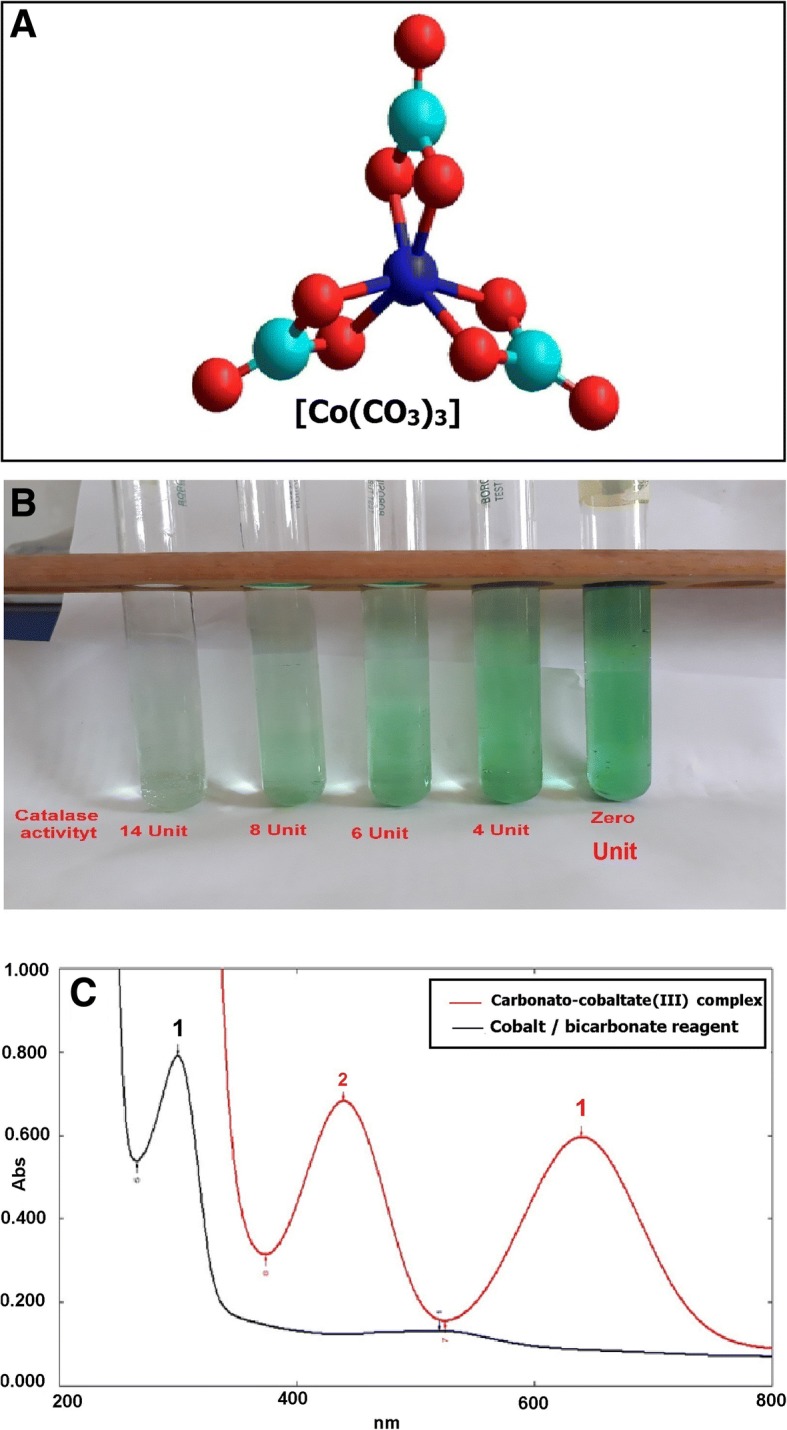
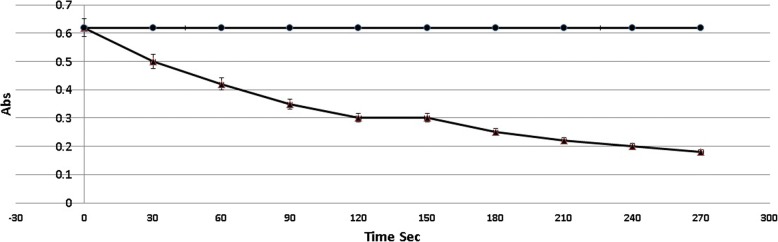
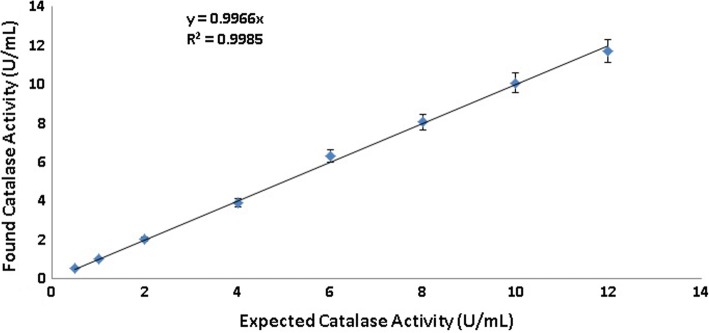
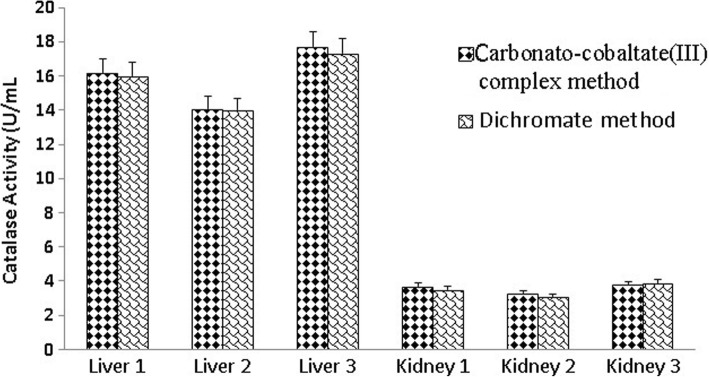
The details of a precise, accurate, and sensitive spectrophotometric method for measuring catalase activity are presented here. The assay was established for biological samples and depends on the rapid formation of a stable and colored carbonato-cobaltate (III) complex. Samples exhibiting catalase activity are incubated with hydrogen peroxide solution for 2 min prior to rapid mixing of the incubation enzymatic reaction mixture with cobalt-bicarbonate reagent, which assesses non-reacting hydrogen peroxide. Catalase activity is always directly proportional to the rate of dissociation of hydrogen peroxide. Hydrogen peroxide acts to oxidize cobalt (II) to cobalt (III) in the presence of bicarbonate ions; this process ends with the production of a carbonato-cobaltate (III) complex ([Co (CO 3 ) 3 ]Co). The formed end product has two maximum absorbance peaks: 440 nm and 640 nm. The 440-nm peak has been utilized for assessing catalase activity. The catalase activity results of the current method for erythrocyte lysate homogenates were computationally identical to those of the dichromate method ( r = 0.9950). The coefficient of variation was calculated to determine the imprecision of the current assay. The within-run and between-run results were 2.96 and 3.83%, respectively. This method is appropriate for analyzing bacteria, red blood cells and liver and kidney tissue homogenates.
Overview
The claims and statistics of this paper haven’t been checked yet.
Run the check — free, no account needed. It reads the open-access text and checks the sources it cites.
Integrity signals
Registry
Cites
Statistics
Figures
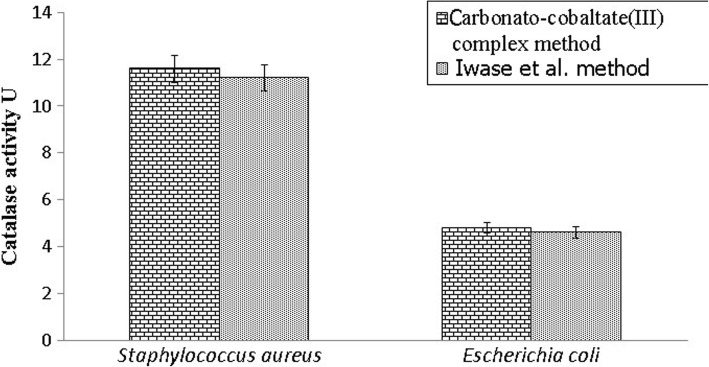
Verification
Claims the paper makes
The claims and statistics of this paper haven’t been checked yet.
Run the check — free, no account needed. It reads the open-access text and checks the sources it cites.
Claims other papers make about this one
Each is checked against this paper’s own text: does it say what the citing paper says it does?
In the citing paper
“Thus, the catalase activity in the studied system is conversely proportional to the obtained signal (Hadwan 2018).”
From Reactive Oxygen Species, Toxicity, Oxidative Stress, and Antioxidants: Chronic Diseases and Aging (2023) · cites this paper as Hadwan 2018
Self-check
Percentages, sums and reported differences re-computed from the paper’s own numbers.
The self-check needs the paper’s full text.
Citations
Cites
Aebi, H. (1984) · Methods in Enzymology · doi:10.1016/s0076-6879(84)05016-3 · Cited by 25,696
Colorimetric assay of catalase
Sinha, A. K. (1972) · Analytical Biochemistry · doi:10.1016/0003-2697(72)90132-7 · Cited by 5,574
[136] Assay of catalases and peroxidases
Chance, B., & Maehly, A. C. (1955) · Methods in enzymology on CD-ROM/Methods in enzymology · doi:10.1016/s0076-6879(55)02300-8 · Cited by 4,937
The Assay of Catalases and Peroxidases
Maehly, A. C. (1954) · Methods of biochemical analysis · doi:10.1002/9780470110171.ch14 · Cited by 3,306
Measurement of catalase activity in tissue extracts
Cohen, G., Dembiec, D., & Marcus, J. (1970) · Analytical Biochemistry · doi:10.1016/0003-2697(70)90083-7 · Cited by 1,211
A spectrophotometric method for determination of catalase activity in small tissue samples
Johansson, L. H., & Borg, L. (1988) · Analytical Biochemistry · doi:10.1016/0003-2697(88)90554-4 · Cited by 1,097
ASSAY OF CATALASES AND PEROXIDASES, IN METHODS IN ENZYMOLOGY
Chance, B., & Maehly, A. C. (1995) · Cited by 641
Wheeler, C. R., Salzman, J. A., Elsayed, N. M., Omaye, S. T., & Korte, D. W. (1990) · Analytical Biochemistry · doi:10.1016/0003-2697(90)90668-y · Cited by 548
Data supporting the spectrophotometric method for the estimation of catalase activity
Hadwan, M. H., & Abed, H. N. (2015) · Data in Brief · doi:10.1016/j.dib.2015.12.012 · Cited by 438
Self-citationDiversity of properties among catalases
Switala, J., & Loewen, P. C. (2002) · Archives of Biochemistry and Biophysics · doi:10.1016/s0003-9861(02)00049-8 · Cited by 389
Research works printed but not linked: 2
- Euler HV, Josephson K. Über katalase. I European J Org Chem. 1927;452:158–81.
- Masschelein W, Denis M, Ledent R. Spectrophotometric determination of residual hydrogen peroxide. Water Sewage Works. 1977;8:69–72.
Cited by
Sorted by citations
Reactive Oxygen Species, Toxicity, Oxidative Stress, and Antioxidants: Chronic Diseases and Aging
Jomova, K., Raptova, R., Alomar, S. Y., Alwasel, S. H., Nepovimova, E., Kuca, K., & Valko, M. (2023) · Archives of Toxicology · doi:10.1007/s00204-023-03562-9 · Cited by 2,638
Biomarkers in Stress Related Diseases/Disorders: Diagnostic, Prognostic, and Therapeutic Values
Dhama, K., Latheef, S. K., Dadar, M., Samad, H. A., Munjal, A. K., Khandia, R., Karthik, K., Tiwari, R., Yatoo, M. I., Bhatt, P., et al. (2019) · Frontiers in Molecular Biosciences · doi:10.3389/fmolb.2019.00091 · Cited by 354
Natural Antioxidant Evaluation: A Review of Detection Methods
Mendonça, J. D. S., Guimarães, R. D. C. A., Zorgetto-Pinheiro, V. A., Fernandes, C. D. P., Marcelino, G., Bogo, D., Freitas, K. D. C., Hiane, P. A., Melo, E. S. D. P., Vilela, M. L. B., et al. (2022) · Molecules · doi:10.3390/molecules27113563 · Cited by 164
An improved method for measuring catalase activity in biological samples
Hadwan, M. H., Hussein, M. J., Mohammed, R. M., Hadwan, A. M., Al‐Kawaz, H. S., Al-Obaidy, S. S. M., & Talebi, Z. A. A. (2024) · Biology Methods and Protocols · doi:10.1093/biomethods/bpae015 · Cited by 110
Self-citationKim, M., Shin, B., Lee, J., Park, H. Y., & Park, W. (2019) · Scientific Reports · doi:10.1038/s41598-019-56882-1 · Cited by 103
Metadata
- Authors
- Hadwan, M. H.
- Affiliations
- University of Babylon (IQ)
- Corresponding author
- Hadwan, Mahmoud Hussein
- Venue
- BMC Biochemistry
- Published
- 2018-08-03
- Volume
- 19
- Issue
- 1
- Pages
- 7-7
- ISSN
- 1471-2091 (ISSN-L)
- PMC
- PMC6091033
- OpenAlex
- W2885891351
- Cited by
- 377
- References
- 26
- Citations by year
- 2026: 43 · 2025: 77 · 2024: 60 · 2023: 63 · 2022: 51 · 2021: 43 · 2020: 30 · 2019: 9
- FWCI
- 7.29
- Type
- journal article
- Language
- en
- Open access
- hybrid
- doi.org
- Licence
- Locations
- BMC Biochemistry (publishedVersion, cc-by)
- Europe PMC (PubMed Central) (publishedVersion, other-oa)
- PubMed Central (publishedVersion, cc-by)
- PubMed (publishedVersion)
- DOAJ (DOAJ: Directory of Open Access Journals) (submittedVersion)
- Topics
- Life Sciences › Biochemistry, Genetics and Molecular Biology › Molecular Biology › Redox biology and oxidative stress
- Life Sciences › Biochemistry, Genetics and Molecular Biology › Molecular Biology › Cancer and biochemical research
- Health Sciences › Medicine › Biochemistry (medical) › Antioxidant Activity and Oxidative Stress
- Keywords
- catalase activity, spectrophotometric assay, hydrogen peroxide decomposition, erythrocyte lysate, tissue homogenates, erythrocytes, liver tissue, kidney tissue, bacterial catalase
- MeSH terms
- Bacteria, Catalase, Cobalt, Erythrocytes, Humans, Hydrogen Peroxide, Kidney, Liver, Spectrophotometry, Ultraviolet, Reproducibility of Results, Artifacts, Enzyme Assays
About these checks
Registry, retraction, Cites and statistics results are computed, not judged, with one exception: a printed reference that no index lists is read once by a model before it counts as a citation error. Claims are extracted by a model and kept only when their quote appears verbatim in the text; each cited source is then checked, with a model’s help, for whether it says what the claim relies on. Those verdicts can be wrong — read the claim’s quote and the cited source before relying on one.
Statistics and arithmetic are recomputed, not judged.
Confidence bands are shown only for fields calibrated on our annotated test set. None is calibrated yet, so no band is shown.
What counts as a claim ›How we measure confidence ›How we check this ›
Are you an author, or do you see a problem with this page? Request a review
