

The DOI matches its Crossref record; 43 of the 44 references it cites were found in a registry or an index.
COMBINE archive and OMEX format: one file to share all information to reproduce a modeling project
Open accessAbstract
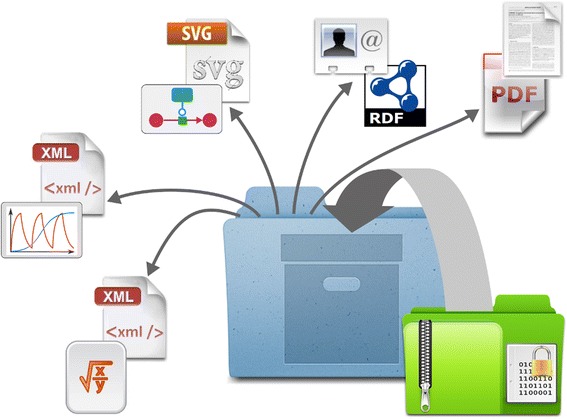
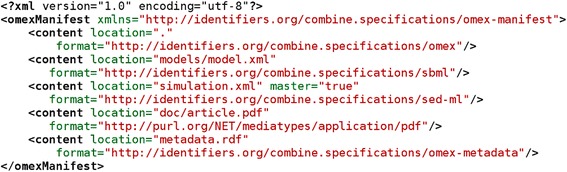
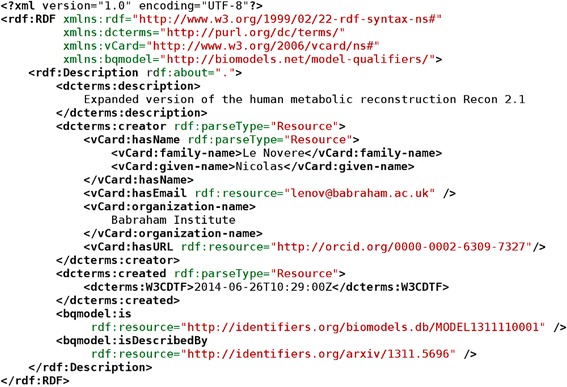
BACKGROUND: With the ever increasing use of computational models in the biosciences, the need to share models and reproduce the results of published studies efficiently and easily is becoming more important. To this end, various standards have been proposed that can be used to describe models, simulations, data or other essential information in a consistent fashion. These constitute various separate components required to reproduce a given published scientific result. RESULTS: We describe the Open Modeling EXchange format (OMEX). Together with the use of other standard formats from the Computational Modeling in Biology Network (COMBINE), OMEX is the basis of the COMBINE Archive, a single file that supports the exchange of all the information necessary for a modeling and simulation experiment in biology. An OMEX file is a ZIP container that includes a manifest file, listing the content of the archive, an optional metadata file adding information about the archive and its content, and the files describing the model. The content of a COMBINE Archive consists of files encoded in COMBINE standards whenever possible, but may include additional files defined by an Internet Media Type. Several tools that support the COMBINE Archive are available, either as independent libraries or embedded in modeling software. CONCLUSIONS: The COMBINE Archive facilitates the reproduction of modeling and simulation experiments in biology by embedding all the relevant information in one file. Having all the information stored and exchanged at once also helps in building activity logs and audit trails. We anticipate that the COMBINE Archive will become a significant help for modellers, as the domain moves to larger, more complex experiments such as multi-scale models of organs, digital organisms, and bioengineering.
Overview
The claims and statistics of this paper haven’t been checked yet.
Run the check — free, no account needed. It reads the open-access text and checks the sources it cites.
Integrity signals
Registry
Cites
Statistics
Figures
Verification
Claims the paper makes
The claims and statistics of this paper haven’t been checked yet.
Run the check — free, no account needed. It reads the open-access text and checks the sources it cites.
Claims other papers make about this one
Each is checked against this paper’s own text: does it say what the citing paper says it does?
The source backs part of the claim, not all of it — or backs it for a different population, condition or comparison.
In the citing paper
“Each entity and activity has already been mentioned for provenance, modeling or documentation purposes, or experiment design of simulation studies [1, 3–5, 8, 20, 21, 60–63], but they have not all been used together.”
From Relating simulation studies by provenance—Developing a family of Wnt signaling models (2021) · cites this paper as [61]
Experimental — accuracy not yet measuredThe cited source says what the claim attributes to it.
In the citing paper
“The inclusion of all necessary protocols and data needed to implement a model enables distribution of models via a single file encouraging reuse and improving reproducibility [55].”
From Adapting modeling and simulation credibility standards to computational systems biology (2023) · cites this paper as [55]
Self-check
Percentages, sums and reported differences re-computed from the paper’s own numbers.
The self-check needs the paper’s full text.
Citations
Cites
Hucka, M., Finney, A., Sauro, H. M., Bolouri, H., Doyle, J. C., Kitano, H., Arkin, A. P., Bornstein, B. J., Bray, D., Cornish-Bowden, A., et al. (2003) · Bioinformatics · doi:10.1093/bioinformatics/btg015 · Cited by 3,060
Self-citationA standard protocol for describing individual-based and agent-based models
Grimm, V., Berger, U., Bastiansen, F., Eliassen, S., Ginot, V., Giske, J., GOSS‐CUSTARD, J. D., Grand, T. C., Heinz, S. K., Huse, G., et al. (2006) · Ecological Modelling · doi:10.1016/j.ecolmodel.2006.04.023 · Cited by 2,988
Uniform Resource Identifiers (URI): Generic Syntax
Berners‐Lee, T., Fielding, R. T., & Masinter, L. M. (1998) · doi:10.17487/rfc2396 · Cited by 1,757
A Whole-Cell Computational Model Predicts Phenotype from Genotype
Karr, J. R., Sanghvi, J. C., Macklin, D. N., Gutschow, M. V., Jacobs, J. M., Bolival, B., Assad-Garcia, N., Glass, J. I., & Covert, M. W. (2012) · Cell · doi:10.1016/j.cell.2012.05.044 · Cited by 1,300
A community-driven global reconstruction of human metabolism
Thiele, I., Swainston, N., Fleming, R. M. T., Hoppe, A., Sahoo, S., Aurich, M. K., Haraldsdottir, H., Mo, M. L., Rolfsson, O., Stobbe, M. D., et al. (2013) · Nature Biotechnology · doi:10.1038/nbt.2488 · Cited by 1,019
Self-citationUniform Resource Identifier (URI): Generic Syntax
Berners‐Lee, T., Fielding, R. T., & Masinter, L. M. (2005) · doi:10.17487/rfc3986 · Cited by 928
The systems biology graphical notation.
Novère, N. L., Hucka, M., Mi, H., Moodie, S., Schreiber, F., Sorokin, A., Demir, E., Wegner, K., Aladjem, M. I., Wimalaratne, S. M., et al. (2009) · Nature Biotechnology · doi:10.1038/nbt.1558 · Cited by 903
Self-citationTen Simple Rules for Reproducible Computational Research
Sandve, G. K., Nekrutenko, A., Taylor, J., & Hovig, E. (2013) · PLoS Computational Biology · doi:10.1371/journal.pcbi.1003285 · Cited by 880
Minimum information requested in the annotation of biochemical models (MIRIAM)
Novère, N. L., Finney, A., Hucka, M., Bhalla, U. S., Campagne, F., Collado-Vides, J., Crampin, E. J., Halstead, M., Klipp, E., Mendes, P., et al. (2005) · Nature Biotechnology · doi:10.1038/nbt1156 · Cited by 622
Self-citationLi, C., Donizelli, M., Rodríguez, N., Dharuri, H. K., Endler, L., Chelliah, V., Li, L., He, E., Henry, A., Stefan, M. I., et al. (2010) · BMC Systems Biology · doi:10.1186/1752-0509-4-92 · Cited by 561
Self-citation
Cited by
Sorted by citations
Items 101–174 of 174
Metabolic Modeling Elucidates Phenformin and Atpenin A5 as Broad-Spectrum Antiviral DrugsPreprint
Renz, A., Hohner, M., Breitenbach, M., Josephs‐Spaulding, J., Dürrwald, J., Best, L., Jami, R., Μαρίνος, Γ., Cabreiro, F., Dräger, A., et al. (2022) · Preprints.org · doi:10.20944/preprints202210.0223.v1 · Cited by 4
The NeuroML ecosystem for standardized multi-scale modeling in neurosciencePreprint
Sinha, A., Gleeson, P., Marin, B., Durá-Bernal, S., Panagiotou, S., Crook, S. M., Cantarelli, M., Cannon, R. C., Davison, A. P., Gurnani, H., et al. (2024) · eLife · doi:10.7554/elife.95135 · Cited by 10
A Practical Guide to Reproducible Modeling for Biochemical Networks
Porubsky, V. L., & Sauro, H. M. (2023) · Methods in molecular biology · doi:10.1007/978-1-0716-3008-2_5 · Cited by 4
Self-citationThe NeuroML ecosystem for standardized multi-scale modeling in neuroscience
Sinha, A., Gleeson, P., Marin, B., Durá-Bernal, S., Panagiotou, S., Crook, S. M., Cantarelli, M., Cannon, R. C., Davison, A. P., Gurnani, H., et al. (2025) · eLife · doi:10.1101/2023.12.07.570537 · Cited by 4
Genome-scale metabolic model of Staphylococcus epidermidis ATCC 12228 matches in vitro conditions
Leonidou, N., Renz, A., Winnerling, B., Grekova, A., Grein, F., & Dräger, A. (2025) · mSystems · doi:10.1128/msystems.00418-25 · Cited by 4
Chen, L., Wu, Q.-L., & Xie, X. (2019) · IOP Conference Series Earth and Environmental Science · doi:10.1088/1755-1315/267/5/052059 · Cited by 4
Kutumova, E. O., Akberdin, I. R., Kiselev, I. N., Sharipov, R., & Kolpakov, F. (2022) · Mathematics · doi:10.3390/math10071176 · Cited by 4
FAIR and scalable management of small-angle X-ray scattering data
Giess, T., Itzigehl, S., Range, J., Schömig, R., Bruckner, J. R., & Pleiss, J. (2023) · Journal of Applied Crystallography · doi:10.1107/s1600576723001577 · Cited by 4
Reproducibility and FAIR principles: the case of a segment polarity network model
Mendes, P. (2023) · Frontiers in Cell and Developmental Biology · doi:10.3389/fcell.2023.1201673 · Cited by 5
Simulation studies of social systems: telling the story based on provenance patterns
Wilsdorf, P., Reinhardt, O., Prike, T., Hinsch, M., Bijak, J., & Uhrmacher, A. M. (2024) · Royal Society Open Science · doi:10.1098/rsos.240258 · Cited by 4
Tools for time-course simulation in systems biology: a brief overview
Musilová, J., & Sedlář, K. (2020) · Briefings in Bioinformatics · doi:10.1093/bib/bbaa392 · Cited by 5
Extracting reproducible simulation studies from model repositories using the combinearchive toolkitPreprint
Scharm, M., & Waltemath, D. (2015) · Datenbanksysteme für Business, Technologie und Web · doi:10.7287/peerj.preprints.792v1 · Cited by 6
Self-citationData Formats for Systems Biology and Quantitative Modeling
Golebiewski, M. (2018) · Elsevier eBooks · doi:10.1016/b978-0-12-809633-8.20471-8 · Cited by 4
Self-citationSimulation Studies of Social Systems – Telling the Story Based on Provenance PatternsPreprint
Reinhardt, O., Prike, T., Hinsch, M., Bijak, J., Wilsdorf, P., & Uhrmacher, A. M. (2022) · doi:10.36227/techrxiv.20209844 · Cited by 3
FAIR Sharing of Reproducible Models of Epidemic and Pandemic Forecast (preprint)Preprint
Ramachandran, K., König, M., Scharm, M., Nguyen, T. V. N., Hermjakob, H., Waltemath, D., & Sheriff, R. S. M. (2022) · Preprints.org · doi:10.20944/preprints202206.0137.v1 · Cited by 2
Self-citationThe NeuroML ecosystem for standardized multi-scale modeling in neurosciencePreprint
Sinha, A., Gleeson, P., Marin, B., Durá-Bernal, S., Panagiotou, S., Crook, S. M., Cantarelli, M., Cannon, R. C., Davison, A. P., Gurnani, H., et al. (2024) · eLife · doi:10.7554/elife.95135.1 · Cited by 4
MCC: automated mass and charge curation at the genome scale applied to C. tuberculostearicum
Mostolizadeh, R., Mier, F., & Dräger, A. (2025) · Microbiology Spectrum · doi:10.1128/spectrum.03200-24 · Cited by 3
BMSS2: A Unified Database-Driven Modeling Tool for Systematic Biomodel Selection
Ngo, R. K. J., Yeoh, J. W., Fan, G. H. W., Loh, W. K. S., & Poh, C. L. (2022) · ACS Synthetic Biology · doi:10.1021/acssynbio.2c00123 · Cited by 3
Renz, A., Hohner, M., Jami, R., Breitenbach, M., Josephs‐Spaulding, J., Dürrwald, J., Best, L., Dulière, V., Mialon, C., Bader, S. M., et al. (2025) · Communications Biology · doi:10.1038/s42003-025-08148-y · Cited by 4
Overview: Standards for Modeling in Systems Medicine
Dräger, A., & Waltemath, D. (2020) · Elsevier eBooks · doi:10.1016/b978-0-12-816077-0.00001-7 · Cited by 3
Self-citationThe Practice of Ensuring Repeatable and Reproducible Computational ModelsPreprint
Sauro, H. (2021) · arXiv (Cornell University) · doi:10.48550/arxiv.2107.05386 · Cited by 3
Self-citationSimulation Studies of Social Systems -- Telling the Story Based on Provenance PatternsPreprint
Reinhardt, O., Prike, T., Hinsch, M., Bijak, J., Uhrmacher, A. M., & Wilsdorf, P. (2023) · doi:10.36227/techrxiv.20209844.v2 · Cited by 2
Creating Aesthetically Pleasing SBGN Visualisations for Presentation and ExplorationPreprint
Czauderna, T., & Schreiber, F. (2023) · bioRxiv (Cold Spring Harbor Laboratory) · doi:10.1101/2023.12.23.573191 · Cited by 3
Nethathe, B., Phaswane, R. M., Abera, A. B., & Naidoo, V. (2021) · PLoS ONE · doi:10.1371/journal.pone.0250408 · Cited by 2
The Archive and Package (arcp) URI Scheme
Soiland‐Reyes, S., & Cáceres, M. (2018) · IEEE International Conference on eScience · doi:10.1109/escience.2018.00018 · Cited by 2
Self-citationIntegrative modeling of the cell
Zhong, X., Zhao, J., & Sun, L. (2022) · Acta Biochimica et Biophysica Sinica · doi:10.3724/abbs.2022115 · Cited by 2
Editorial Reproducibility of Computational Models
Erdemir, A., & Sauro, H. M. (2016) · IEEE Transactions on Biomedical Engineering · doi:10.1109/tbme.2016.2594702 · Cited by 2
Self-citationvan Kampen, A. H. C., Mahamune, U., Jongejan, A., van Schaik, B. D. C., Balashova, D., Lashgari, D., Pras‐Raves, M. L., Wever, E. J. M., Dane, A. D., García-Valiente, R., et al. (2023) · doi:10.31222/osf.io/m9yqz · Cited by 2
Metabolic Modeling Elucidates Phenformin and Atpenin A5 as Broad-Spectrum Antiviral DrugsPreprint
Renz, A., Hohner, M., Breitenbach, M., Josephs‐Spaulding, J., Dürrwald, J., Best, L., Jami, R., Μαρίνος, Γ., Cabreiro, F., Dräger, A., et al. (2023) · Preprints.org · doi:10.20944/preprints202210.0223.v2 · Cited by 1
The NeuroML ecosystem for standardized multi-scale modeling in neurosciencePreprint
Sinha, A., Gleeson, P., Marin, B., Durá-Bernal, S., Panagiotou, S., Crook, S. M., Cantarelli, M., Cannon, R. C., Davison, A. P., Gurnani, H., et al. (2024) · eLife · doi:10.7554/elife.95135.2 · Cited by 2
FAIRification of computational models in biologyPreprint
Balaur, I., Nickerson, D. P., Welter, D., Wodke, J. A. H., Ancien, F., Gebhardt, T., Grouès, V., Hermjakob, H., König, M., Radde, N. E., et al. (2025) · bioRxiv (Cold Spring Harbor Laboratory) · doi:10.1101/2025.03.21.644517 · Cited by 2
Self-citationThe Archive And Package (Arcp) Uri Scheme
Soiland‐Reyes, S., & Cáceres, M. (2018) · Research Explorer (The University of Manchester) · doi:10.5281/zenodo.1312581 · Cited by 1
Self-citationNoroozbabaee, L., Imtiaz, M. S., Helden, D. F. V., Du, P., & Nickerson, D. P. (2023) · Physiome · doi:10.36903/physiome.21708176.v1 · Cited by 1
Self-citationNBSIMGEN: Jupyter Notebook Extension for Generating Simulation Experiments
Wilsdorf, P., Kirchhübel, A. W., & Uhrmacher, A. M. (2023) · Winter Simulation Conference · doi:10.1109/wsc60868.2023.10408537 · Cited by 1
Finding patterns in biochemical reaction networksPreprint
Henkel, R., Lambusch, F., Wolkenhauer, O., Sandkuhl, K., Rosenke, C., & Waltemath, D. (2016) · PeerJ Preprints · doi:10.7287/peerj.preprints.1479v2 · Cited by 1
Self-citationIntroducing Data Primitives: Data Formats for the SKED FrameworkPreprint
Trippe, E. D., Aguilar, J. B., Yan, Y., Nural, M. V., Brady, J. A., & Gutiérrez, J. B. (2017) · arXiv (Cornell University) · doi:10.48550/arxiv.1706.08131 · Cited by 1
Guidelines for benchmarking of optimization approaches for fitting mathematical modelsPreprint
Kreutz, C. (2019) · arXiv (Cornell University) · doi:10.48550/arxiv.1907.03427 · Cited by 1
Modelling techniques for biomolecular networksPreprint
Mayer, G. (2020) · arXiv (Cornell University) · doi:10.48550/arxiv.2003.00327 · Cited by 2
Simulation Studies of Social Systems -- Telling the Story Based on ProvenancePreprint
Reinhardt, O., Prike, T., Hinsch, M., Bijak, J., Uhrmacher, A. M., & Wilsdorf, P. (2022) · doi:10.36227/techrxiv.20209844.v1 · Cited by 1
Metabolic Modeling Elucidates Phenformin and Atpenin A5 as Broad-Spectrum Antiviral DrugsPreprint
Renz, A., Hohner, M., Breitenbach, M., Josephs‐Spaulding, J., Dürrwald, J., Best, L., Dulière, V., Mialon, C., Bader, S. M., Jami, R., et al. (2024) · Preprints.org · doi:10.20944/preprints202210.0223.v3 · Cited by 1
Hall, A. D. (2015) · Montana State University ScholarWorks (Montana State University)
Genetic Circuit Design Principles
Yeoh, J. W., Gomez‐Carretero, S., Chee, W. K. D., Teh, A. Y., & Poh, C. L. (2019) · Springer eBooks · doi:10.1007/978-3-319-47405-2_171-1
Status and Challenges of Reproducibility in Computational Systems and Synthetic Biology
Choi, K., Karr, J. R., & Sauro, H. (2021) · Elsevier eBooks · doi:10.1016/b978-0-12-801238-3.11525-9
Self-citationAutomated Execution of Simulation Studies in Systems Medicine Using SED-ML and COMBINE Archive
Rampadarath, A., & Nickerson, D. P. (2020) · Elsevier eBooks · doi:10.1016/b978-0-12-801238-3.11688-5
Self-citationCellML Model Discovery with the Physiome Model Repository
Sarwar, D. M., & Nickerson, D. P. (2020) · Elsevier eBooks · doi:10.1016/b978-0-12-801238-3.11681-2
Self-citationSED-ML Validator: tool for debugging simulation experimentsPreprint
Shaikh, B., Freiburger, A., König, M., Bergmann, F., Nickerson, D. P., Sauro, H. M., Blinov, M. L., Smith, L. P., Moraru, I. I., & Karr, J. R. (2021) · arXiv (Cornell University) · doi:10.48550/arxiv.2106.00844
Self-citationGenetic Circuit Design Principles
Yeoh, J. W., Gomez‐Carretero, S., Chee, W. K. D., Teh, A. Y., & Poh, C. L. (2021) · Springer eBooks · doi:10.1007/978-3-030-23217-7_171
Noroozbabaee, L., Nickerson, D. P., & Du, P. (2023) · Physiome · doi:10.36903/physiome.21760691.v1
Self-citationNoroozbabaee, L., Nickerson, D. P., & Du, P. (2023) · Physiome · doi:10.36903/physiome.21760691
Self-citationNoroozbabaee, L., Imtiaz, M. S., Helden, D. F. V., Du, P., & Nickerson, D. P. (2023) · Physiome · doi:10.36903/physiome.21708176
Self-citationNoroozbabaee, L., Imtiaz, M. S., Helden, D. F. V., Du, P., & Nickerson, D. P. (2023) · Physiome · doi:10.36903/physiome.21708176.v2
Self-citationCreating PROV-DM Graphs from Model Databases
Wilsdorf, P., & Uhrmacher, A. M. (2022) · Winter Simulation Conference · doi:10.1109/wsc57314.2022.10015331
Data Formats for Systems Biology, Systems Medicine and Computational Modeling
Golebiewski, M., & Mayer, G. (2024) · Elsevier eBooks · doi:10.1016/b978-0-323-95502-7.00164-0
Self-citationDeep Kernel Inversion: Rapid and Accurate Molecular Interaction Prediction for Drug DesignPreprint
Myers, S. A., Miller, C., Lugo, K., Trinh, T., Lee, C., Arunachalam, N., Chen, H., Drygin, D., & Martineau, J. I. (2024) · bioRxiv (Cold Spring Harbor Laboratory) · doi:10.1101/2024.11.19.624391
Curating models from BioModels: Developing a workflow for creating OMEX files
Xu, J. H., & Smith, L. P. (2024) · PLoS ONE · doi:10.1371/journal.pone.0314875
de Abechuco, E. L., Mensching, Y., & Filter, M. (2025) · Methods and protocols in food science · doi:10.1007/978-1-0716-4112-5_9
Aryana-bs: context-aware alignment of bisulfite-sequencing reads
Nikaein, H., Sharifi‐Zarchi, A., Afzal, A., Ezzati, S., Rasti, F., Chitsaz, H., & Kunde‐Ramamoorthy, G. (2025) · BMC Bioinformatics · doi:10.1186/s12859-025-06182-5
Illuminating the Role of Asymmetric Mitochondrial Fission on Beta-Cell HealthPreprint
Henning, P., Schultz, J., Baltrusch, S., & Uhrmacher, A. M. (2025) · bioRxiv (Cold Spring Harbor Laboratory) · doi:10.1101/2025.11.25.690461
van Oossanen, S., Ferrer-Ledo, N., D’Adamo, S., dos Santos, V. A. P. M., Barbosa, M. J., & Diez, M. S. (2025) · bioRxiv (Cold Spring Harbor Laboratory) · doi:10.64898/2025.12.19.695437
Jost, P. J., Bergmann, F., Weindl, D., & Hasenauer, J. (2026) · Bioinformatics · doi:10.1093/bioinformatics/btag106
Self-citationHenning, P., Schultz, J., Baltrusch, S., & Uhrmacher, A. M. (2026) · npj Systems Biology and Applications · doi:10.1038/s41540-026-00732-0
Hajal, A. A., & Meslamani, A. Z. A. (2026) · Computational Toxicology · doi:10.1016/j.comtox.2026.100429
TabularQual: A spreadsheet-based format for annotating and curating logical models in SBML-qualPreprint
Li, L. X., Bleker, C., Soliman, S., Calzone, L., Hiroi, N. F., Helikar, T., König, M., Ladeira, L., Monteiro, P. T., Noël, V., et al. (2026) · bioRxiv (Cold Spring Harbor Laboratory) · doi:10.64898/2026.05.31.727710
First Genome-Scale Metabolic Model for Understanding HMPV-Host InteractionPreprint
Hussain, S. M., Beierle, L., Schmeck, B., & Mostolizadeh, R. (2026) · bioRxiv (Cold Spring Harbor Laboratory) · doi:10.64898/2026.06.10.731436
Proteus: an executable, statically-checked language for biological reaction modelsPreprint
Deprez, F. (2026) · SSRN Electronic Journal · doi:10.2139/ssrn.7324287
Vallverdú, J. (2026) · Frontiers in Systems Biology · doi:10.3389/fsysb.2026.1905585
FAIRsharing record for: BioModels
FAIRsharing Team (2015) · FAIRsharing.org · doi:10.25504/fairsharing.paz6mh
FAIRsharing record for: Open Modeling EXchange format
FAIRsharing Team, & McQuilton, P. (2018) · FAIRsharing.org · doi:10.25504/fairsharing.27tnee
FAIRsharing record for: COMODI
FAIRsharing Team (2018) · FAIRsharing.org · doi:10.25504/fairsharing.htq39f
Standards in systems and synthetic biology: status, developments, and tools in 2026
Schreiber, F., Golebiewski, M., Gleeson, P., Keating, S., König, M., Luna, A., May, E. E., Mısırlı, G., Myers, C. J., Nickerson, D. P., et al. (2026) · Berichte aus der medizinischen Informatik und Bioinformatik/Journal of integrative bioinformatics · doi:10.1515/jib-2026-0037
Self-citationA meta-modeler’s guide to the cellular interface and its composition patterns
Agmon, E. (2026) · Seminars in Cell and Developmental Biology · doi:10.1016/j.semcdb.2026.103705
RESSIST: a research object-basedrecommender system
Badenes-Olmedo, C. (2015)
Metadata
- Authors
- Bergmann, F. T., Adams, R., Moodie, S., Cooper, J., Glont, M., Golebiewski, M., Hucka, M., Laibe, C., Miller, A. K., Nickerson, D. P., Olivier, B. G., Rodriguez, N., Sauro, H. M., Scharm, M., Soiland-Reyes, S., Waltemath, D., Yvon, F., & Le Novère, N.
- Affiliations
- Heidelberg University (DE)
- Research Space (United Kingdom) (GB)
- European Bioinformatics Institute (GB)
- University of Oxford (GB)
- Heidelberg Institute for Theoretical Studies (DE)
- California Institute of Technology (US)
- University of Auckland (NZ)
- Vrije Universiteit Amsterdam (NL)
- University of Washington (US)
- University of Rostock (DE)
- ORCID
- Venue
- BMC Bioinformatics
- Published
- 2014-12
- Volume
- 15
- Issue
- 1
- Pages
- 369-369
- ISSN
- 1471-2105 (ISSN-L)
- PMC
- PMC4272562
- OpenAlex
- W2096951208
- Cited by
- 173
- References
- 44
- Citations by year
- 2026: 10 · 2025: 10 · 2024: 19 · 2023: 23 · 2022: 16 · 2021: 25 · 2020: 18 · 2019: 10 · 2018: 15 · 2017: 6 · 2016: 11 · 2015: 7 · 2014: 2
- FWCI
- 16.81
- Type
- journal article
- Language
- en
- Open access
- gold
- doi.org
- Locations
- BMC Bioinformatics (publishedVersion, cc-by)
- Europe PMC (PubMed Central) (publishedVersion, cc-by)
- PubMed Central (publishedVersion, cc-by)
- PubMed (publishedVersion)
- Research Explorer (The University of Manchester) (publishedVersion, cc-by)
- VU Research Portal (publishedVersion, other-oa)
- arXiv (Cornell University) (submittedVersion)
- CaltechAUTHORS (California Institute of Technology) (submittedVersion, cc-by)
- UCL Discovery (University College London) (submittedVersion)
- Data Archiving and Networked Services (DANS) (submittedVersion, other-oa)
- arXiv (Cornell University)
- Funders
- Microsoft Research
- European Commission (283359, 270192)
- ZonMw (40-41009-98-10038)
- Bundesministerium für Bildung und Forschung (FKZ 031, FKZ 0316194, 0316194)
- Innovative Medicines Initiative (115156)
- Maurice Wilkins Centre for Molecular Biodiscovery
- National Institutes of Health (NIH P50, GM094503)
- Engineering and Physical Sciences Research Council (EP/I017909, EP/I017909/1)
- Biotechnology and Biological Sciences Research Council (BB/M013189/1, BBS/E/B/000C0419)
- National Institute of General Medical Sciences (GM070923, R01GM070923, P50GM094503, R01GM081070)
- FP7 Information and Communication Technologies
- Topics
- Social Sciences › Decision Sciences › Information Systems and Management › Scientific Computing and Data Management
- Physical Sciences › Computer Science › Information Systems › Research Data Management Practices
- Life Sciences › Biochemistry, Genetics and Molecular Biology › Molecular Biology › Gene Regulatory Network Analysis
- Keywords
- model exchange, model reproducibility, model metadata, audit trail, multiscale modeling, digital organisms
- MeSH terms
- Archives, Computer Simulation, Humans, Software, Information Storage and Retrieval, Computational Biology, Internet, Databases, Nucleic Acid
About these checks
Registry, retraction, Cites and statistics results are computed, not judged, with one exception: a printed reference that no index lists is read once by a model before it counts as a citation error. Claims are extracted by a model and kept only when their quote appears verbatim in the text; each cited source is then checked, with a model’s help, for whether it says what the claim relies on. Those verdicts can be wrong — read the claim’s quote and the cited source before relying on one.
Statistics and arithmetic are recomputed, not judged.
Confidence bands are shown only for fields calibrated on our annotated test set. None is calibrated yet, so no band is shown.
What counts as a claim ›How we measure confidence ›How we check this ›
Are you an author, or do you see a problem with this page? Request a review
