

Relative performance of gene- and pathway-level methods as secondary analyses for genome-wide association studies
Open accessThe DOI matches its Crossref record; 28 of the 28 references it cites were found in a registry or an index.
Abstract
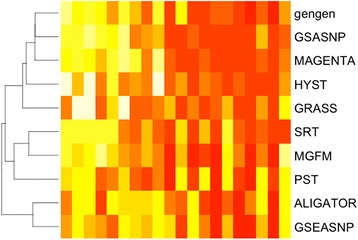
BACKGROUND: Despite the success of genome-wide association studies (GWAS), there still remains "missing heritability" for many traits. One contributing factor may be the result of examining one marker at a time as opposed to a group of markers that are biologically meaningful in aggregate. To address this problem, a variety of gene- and pathway-level methods have been developed to identify putative biologically relevant associations. A simulation was conducted to systematically assess the performance of these methods. Using genetic data from 4,500 individuals in the Wellcome Trust Case Control Consortium (WTCCC), case-control status was simulated based on an additive polygenic model. We evaluated gene-level methods based on their sensitivity, specificity, and proportion of false positives. Pathway-level methods were evaluated on the relationship between proportion of causal genes within the pathway and the strength of association. RESULTS: The gene-level methods had low sensitivity (20-63%), high specificity (89-100%), and low proportion of false positives (0.1-6%). The gene-level program VEGAS using only the top 10% of associated single nucleotide polymorphisms (SNPs) within the gene had the highest sensitivity (28.6%) with less than 1% false positives. The performance of the pathway-level methods depended on their reliance upon asymptotic distributions or if significance was estimated in a competitive manner. The pathway-level programs GenGen, GSA-SNP and MAGENTA had the best performance while accounting for potential confounders. CONCLUSIONS: Novel genes and pathways can be identified using the gene and pathway-level methods. These methods may provide valuable insight into the "missing heritability" of traits and provide biological interpretations to GWAS findings.
Overview
The claims and statistics of this paper haven’t been checked yet.
Free: it reads the open-access text and checks the first 5 claims that cite a source we can check. Create a free account to check every claim.
Integrity signals
Registry
Cites
Statistics
Figures
Verification
Claims the paper makes
The claims and statistics of this paper haven’t been checked yet.
Free: it reads the open-access text and checks the first 5 claims that cite a source we can check. Create a free account to check every claim.
Claims other papers make about this one
Each is checked against this paper’s own text: does it say what the citing paper says it does?
In the citing paper
“Analyses were limited to the top 10%, by P value, of SNPs per gene, an approach which has been shown to give rise to higher sensitivity and lower false positive rates compared to other gene-set methods [37].”
Self-check
Percentages, sums and reported differences re-computed from the paper’s own numbers.
The self-check needs the paper’s full text.
Citations
Cites
Subramanian, A., Tamayo, P., Mootha, V. K., Mukherjee, S., Ebert, B. L., Gillette, M. A., Paulovich, A., Pomeroy, S. L., Golub, T. R., Lander, E. S., et al. (2005) · Proceedings of the National Academy of Sciences · doi:10.1073/pnas.0506580102 · Cited by 53,625 · cited 2×
“We systematically evaluated the relative performance of gene- and pathway-level methods for a case–control GWAS through a simulation of over 17,000 genes and 20 pathways from the Gene Ontology Biological Processes.”
MethodPLINK: a tool set for whole-genome association and population-based linkage analyses.
Purcell, S., Neale, B., Todd-Brown, K., Thomas, L., Ferreira, M. A. R., Bender, D., Maller, J., Sklar, P., de Bakker, P. I. W., Daly, M. J., et al. (2007) · The American Journal of Human Genetics · doi:10.1086/519795 · Cited by 34,089 · cited 6×
“Pathway-level methods can be separated into two groups: competitive (ALIGATOR, GenGen, GSA-SNP, GSEA-SNP, MAGENTA, MGFM, SNP Ratio Test) and self-contained (GRASS, HYST, Plink Set Test).”
MethodInfluentialPrincipal components analysis corrects for stratification in genome-wide association studies
Price, A. L., Patterson, N. J., Plenge, R. M., Weinblatt, M. E., Shadick, N. A., & Reich, D. (2006) · Nature Genetics · doi:10.1038/ng1847 · Cited by 10,248 · cited 1×
“Principal components analysis (PCA) was conducted to ensure a homogenous sample without outliers using EIGENSTRAT [10].”
MethodGenome-wide association study of 14,000 cases of seven common diseases and 3,000 shared controls
The Wellcome Trust Case Control Consortium, Management Committee, Burton, P. R., Clayton, D. G., Cardon, L. R., Craddock, N., Deloukas, P., Duncanson, A., Kwiatkowski, D. P., McCarthy, M. I., et al. (2007) · Nature · doi:10.1038/nature05911 · Cited by 9,442 · cited 1×
“Funding for the project was provided by the Wellcome Trust under award 076113, 085475, and 090355 [9].”
MethodHindorff, L. A., Sethupathy, P., Junkins, H. A., Ramos, E. M., Mehta, J. P., Collins, F. S., & Manolio, T. A. (2009) · Proceedings of the National Academy of Sciences · doi:10.1073/pnas.0903103106 · Cited by 4,013 · cited 1×
“In less than one decade after their advent, genome-wide association studies (GWAS) have been remarkably successful and have elucidated many loci for diverse phenotypes [1].”
BackgroundGenome-wide association studies for complex traits: consensus, uncertainty and challenges
McCarthy, M. I., Abecasis, G. R., Cardon, L. R., Goldstein, D. B., Little, J., Ioannidis, J. P. A., & Hirschhorn, J. N. (2008) · Nature Reviews Genetics · doi:10.1038/nrg2344 · Cited by 2,891 · cited 1×
“5 million tests results in a p-value significance threshold of 5×10 [3], and biologically-relevant genetic associations may lie below this threshold, but are ignored in many traditional GWAS.”
BackgroundEfficiency and power in genetic association studies
de Bakker, P. I. W., Yelensky, R., Pe'er, I., Gabriel, S. B., Daly, M. J., & Altshuler, D. (2005) · Nature Genetics · doi:10.1038/ng1669 · Cited by 1,688 · cited 1×
“2) within the genic region and the 20 kilobase (kb) flanking regions using the program Tagger [13].”
MethodPathway-Based Approaches for Analysis of Genomewide Association Studies
Wang, K., Li, M., & Bucan, M. (2007) · The American Journal of Human Genetics · doi:10.1086/522374 · Cited by 858 · cited 8×
“Pathway-level methods can be separated into two groups: competitive (ALIGATOR, GenGen, GSA-SNP, GSEA-SNP, MAGENTA, MGFM, SNP Ratio Test) and self-contained (GRASS, HYST, Plink Set Test).”
MethodInfluentialA Versatile Gene-Based Test for Genome-wide Association Studies
Liu, J. Z., Mcrae, A. F., Nyholt, D. R., Medland, S. E., Wray, N. R., Brown, K. M., Hayward, N. K., Montgomery, G. W., Visscher, P. M., Martin, N. G., et al. (2010) · The American Journal of Human Genetics · doi:10.1016/j.ajhg.2010.06.009 · Cited by 791 · cited 1×
“For the Novel methods we evaluated VEGAS using all SNPs and using only the top 10% of associated SNPs [19].”
MethodCytoplasmic 5′-3′ exonuclease Xrn1p is also a genome-wide transcription factor in yeast
Medina, D. A., Jordán-Pla, A., Millán-Zambrano, G., Chávez, S., Choder, M., & Pérez-Ortín, J. E. (2014) · Frontiers in Genetics · doi:10.3389/fgene.2014.00001 · Cited by 757
Cited by
The Autism Spectrum Disorders Working Group of The Psychiatric Genomics Consortium (2017) · Molecular Autism · doi:10.1186/s13229-017-0137-9 · Cited by 587
Recombination Rate Variation, Hitchhiking, and Demographic History Shape Deleterious Load in Poplar
Zhang, M., Zhou, L., Bawa, R., Suren, H., & Holliday, J. A. (2016) · Molecular Biology and Evolution · doi:10.1093/molbev/msw169 · Cited by 68
“With linkage disequilibrium between genic SNPs, FDR correction allows correlation structure between SNPs and controls false positives at a similar level as other classical methods without losing power (Wojcik et al. 2015).”
BackgroundGermline Features Associated with Immune Infiltration in Solid Tumors
Shahamatdar, S., He, M. X., Reyna, M. A., Gusev, A., AlDubayan, S. H., Allen, E. M. V., & Ramachandran, S. (2020) · Cell Reports · doi:10.1016/j.celrep.2020.02.039 · Cited by 68
Gene and Network Analysis of Common Variants Reveals Novel Associations in Multiple Complex Diseases
Nakka, P., Raphael, B. J., & Ramachandran, S. (2016) · Genetics · doi:10.1534/genetics.116.188391 · Cited by 58
“To compare how well minSNP, SKAT, VEGAS, and PEGASUS can recover causal genes, we conducted a GWA study for a simulated complex phenotype with known genetic architecture based on the approach outlined in Wojcik et al. (2015) and applied these four methods to the simulated data (Figure S13).”
MethodMishra, A., & MacGregor, S. (2017) · Twin Research and Human Genetics · doi:10.1017/thg.2016.100 · Cited by 49
“Recently, Wojcik et al. (2015) compared 21 different methods for gene- and pathway-level analysis of GWAS data and reported that the VEGAS approach considering the top 10% of SNP association p values performs better in terms of both sensitivity and control of type 1 error rate.”
Campana, M. G., Parker, L. D., Hawkins, M. T. R., Young, H. S., Helgen, K. M., Gunther, M. S., Woodroffe, R., Maldonado, J. E., & Fleischer, R. C. (2016) · BMC Genomics · doi:10.1186/s12864-016-3368-9 · Cited by 39
Analysis of the Influence of microRNAs in Lithium Response in Bipolar Disorder
Reinbold, C. S., Forstner, A. J., Hecker, J., Fullerton, J. M., Hoffmann, P., Hou, L., Heilbronner, U., Degenhardt, F., Adli, M., Akiyama, K., et al. (2018) · Frontiers in Psychiatry · doi:10.3389/fpsyt.2018.00207 · Cited by 37
Gorlova, O. Y., Li, Y., Gorlov, I. P., Ying, B., Chen, W. V., Assassi, S., Reveille, J. D., Arnett, F. C., Zhou, X., Bossini‐Castillo, L., et al. (2018) · PLoS ONE · doi:10.1371/journal.pone.0189498 · Cited by 38
Bidwell, L. C., Gray, J. C., Weafer, J. J., Palmer, A. A., de Wit, H., & MacKillop, J. M. (2017) · American Journal of Medical Genetics Part B Neuropsychiatric Genetics · doi:10.1002/ajmg.b.32535 · Cited by 35
“Gene-based analyses used Versatile Gene-based Association Study 2 (VEGAS2) software (Mishra & Macgregor, 2015), employing the top 10% SNP test for optimal sensitivity and specificity of true positives (Wojcik et al., 2015).”
MethodLemopoulos, A., Uusi‐Heikkilä, S., Hyvärinen, P., Alioravainen, N., Prokkola, J. M., Elvidge, C. K., Vasemägi, A., & Vainikka, A. (2019) · G3 Genes Genomes Genetics · doi:10.1534/g3.119.400369 · Cited by 35
Jia, X., Yang, Y., Chen, Y., Xia, Z., Zhang, W., Feng, Y. Y., Li, Y., Tan, J., Xu, C., Zhang, Q., et al. (2018) · International Journal of Cardiology · doi:10.1016/j.ijcard.2018.10.102 · Cited by 23
Salnikova, L. E., Khadzhieva, M. B., & Kolobkov, D. S. (2016) · Human Genetics · doi:10.1007/s00439-016-1672-8 · Cited by 21
Jia, X., Yang, Y., Chen, Y., Cheng, Z., Du, Y., Xia, Z., Zhang, W., Xu, C., Zhang, Q., Xia, X., et al. (2018) · Journal of Affective Disorders · doi:10.1016/j.jad.2018.07.046 · Cited by 20
“This method calculates the correlation analysis of multiple SNPs in a gene region with one phenotype using GWAS summary statistics, which has previously shown higher sensitivity and lower false positive rates compared to other gene-based approaches (Autism Spectrum Disorders Working Group of The Psychiatric Genomics C…”
MethodBaillie, J. K., Bretherick, A. D., Haley, C., Clohisey, S., Gray, A., Neyton, L. P. A., Barrett, J. C., Stahl, E. A., Tenesa, A., Andersson, R., et al. (2018) · PLoS Computational Biology · doi:10.1371/journal.pcbi.1005934 · Cited by 20
Chen, Y., Xu, C., Zhang, J., Zeng, C., Wang, X.-F., Zhou, R. L., Xu, L., Ao, Z., Lu, J., Shen, J., et al. (2018) · PLoS ONE · doi:10.1371/journal.pone.0201173 · Cited by 17
Hariharan, P., & Dupuis, J. (2021) · Scientific Reports · doi:10.1038/s41598-021-95637-9 · Cited by 19
Iris Garcia-martinez, A., Sánchez‐Mora, C., Artigas, M. S., Rovira, P., Pagerols, M., Corrales, M., Calvo-Sánchez, E., Richarte, V., Bustamante, M., Sunyer, J., et al. (2017) · Scientific Reports · doi:10.1038/s41598-017-05514-7 · Cited by 18
Multi‐omics cannot replace sample size in genome‐wide association studies
Baranger, D. A. A., Hatoum, A. S., Polimanti, R. A., Gelernter, J. E., Edenberg, H. J., Bogdan, R., & Agrawal, A. (2023) · Genes Brain & Behavior · doi:10.1111/gbb.12846 · Cited by 18
“Similarly, prior work examining positional gene-based methods in a simulated trait with relatively few causal SNPs ( n = 602) observed a tradeoff between sensitivity and specificity, 56 which is also seen here.”
BackgroundMcGuirl, M. R., Smith, S. P., Sandstede, B., & Ramachandran, S. (2020) · Genetics · doi:10.1534/genetics.120.303096 · Cited by 17
“…2016; Boyle et al. 2017) and that effect sizes have reached diminishing returns (Zhang et al. 2018), gene-level association tests (Liu et al. 2010; Wu et al. 2011; Lamparter et al. 2016) can offer insight into gene sets and pathways that are enriched for mutations in cases of a phenotype of…”
BackgroundMethodInfluentialHierarchical investigation of genetic influences on response inhibition in healthy young adults.
Weafer, J. J., Gray, J. C., Hernandez, K. M., Palmer, A. A., MacKillop, J., & de Wit, H. (2017) · Experimental and Clinical Psychopharmacology · doi:10.1037/pha0000156 · Cited by 16
Jia, X., Shi, X., Xia, Z., Feng, Y., Li, Y., Tan, J., Xu, F., Wang, W., Sun, C., Deng, H., et al. (2020) · Frontiers in Immunology · doi:10.3389/fimmu.2020.00030 · Cited by 14
“This method has been widely applied in the genetics studies and has been shown to offer higher sensitivity and lower false positive rates compared to other genebased approaches (33).”
MethodLu, Q., Lao, X., Gan, J., Du, P., Zhou, Y., Nong, W., & Yang, Z. (2023) · Infectious Agents and Cancer · doi:10.1186/s13027-023-00529-4 · Cited by 13
Moore, A. L., Marks, J. A., Quach, B. C., Guo, Y., Bierut, L. J., Gaddis, N., Hancock, D. B., Page, G. P., & Johnson, E. O. (2023) · Communications Biology · doi:10.1038/s42003-023-05413-w · Cited by 14
“…silico functional follow-up are plentiful 21 – 25 and range from fi ne-mapping to determining the biological underpinnings of the variant-trait association; many of these in silico approaches to uncover the functional causes underpinning GWAS associations have been previously reviewed 20,26 – 30 .”
Bayesian Genome- and Epigenome-Wide Association Studies with Gene Level Dependence
Lock, E. F., & Dunson, D. B. (2017) · Biometrics · doi:10.1111/biom.12649 · Cited by 11
“These methods can substantially increase power, as many markers within a gene have a weak association that cannot be detected independently (Wojcik et al., 2015), and also reduce the number of overall tests for multiplicity correction.”
MethodBenny, P. A., Yamasato, K. S., Yunits, B., Zhu, X., Ching, T. H., Garmire, L. X., Berry, M. J., & Towner, D. (2019) · PLoS ONE · doi:10.1371/journal.pone.0222672 · Cited by 10
Husser, D., Buttner, P. G., Stübner, D., Ueberham, L., Platonov, P. G., Dinov, B., Arya, A., Hindricks, G., & Bollmann, A. (2017) · Frontiers in Genetics · doi:10.3389/fgene.2017.00224 · Cited by 10
“This is a more conservative test with a high specificity and very low proportion of false positives (Wojcik et al., 2015).”
BackgroundNakka, P., Archer, N. P., Xu, H. Y., Lupo, P. J., Raphael, B. J., Yang, J. J. J., & Ramachandran, S. (2017) · Cancer Epidemiology Biomarkers & Prevention · doi:10.1158/1055-9965.epi-17-0360 · Cited by 5
“We then tested for replication of the 42 resulting gene hits (p < 10 -3 , Bonferroni-corrected for the number of haplotype blocks in the genome (38)) using a replication dataset of gene-level p-values calculated from a second dataset of case-control GWA p-values (14) (Table 1 and Supplemental Table S3).”
MethodMoore, A. L., Marks, J. A., Quach, B. C., Guo, Y., Bierut, L. J., Gaddis, N., Hancock, D. B., Page, G. P., & Johnson, E. O. (2022) · bioRxiv (Cold Spring Harbor Laboratory) · doi:10.1101/2022.01.10.475153 · Cited by 3
Baranger, D. A. A., Hatoum, A. S., Polimanti, R. A., Gelernter, J. E., Edenberg, H. J., Bogdan, R., & Arpana Agrawal, A. (2022) · bioRxiv (Cold Spring Harbor Laboratory) · doi:10.1101/2022.04.13.487655 · Cited by 3
“Similarly, prior work examining positional gene-based methods in a simulated trait with relatively few causal SNPs (n=602) observed a tradeoff between sensitivity and specificity (49), which is also seen here.”
BackgroundWang, X., Wang, S., & Meng, X. (2018) · International Journal of Biomathematics · doi:10.1142/s1793524518500948 · Cited by 2
The impact of gene polymorphisms on the response of methotrexate-based treatments
Esperón, P., Vital, M., & Giletti, A. (2026) · European Journal of Clinical Pharmacology · doi:10.1007/s00228-026-04059-x · Cited by 1
Jia, X., Shi, N., Xia, Z., Feng, Y. Y., Li, Y., Tan, J., Xu, F., Wang, W., Sun, C., Deng, H., et al. (2019) · bioRxiv (Cold Spring Harbor Laboratory) · doi:10.1101/563973 · Cited by 1
Jia, X., Shi, N., Feng, Y., Zhu, H., Wang, Y., Jie, L., Yang, Y., & Shi, X. (2021) · Research Square · doi:10.21203/rs.3.rs-695526/v1
Metadata
- Authors
- Wojcik, G. L., Kao, W. L., & Duggal, P.
- Affiliations
- Johns Hopkins University (US)
- Corresponding author
- Wojcik, Genevieve L
- Venue
- BMC Genetics
- Published
- 2015-04-08
- Volume
- 16
- Issue
- 1
- Pages
- 34-34
- ISSN
- 1471-2156 (ISSN-L)
- PMC
- PMC4391470
- OpenAlex
- W2059283420
- Cited by
- 33
- References
- 28
- Citations by year
- 2026: 1 · 2023: 3 · 2022: 2 · 2021: 2 · 2020: 3 · 2019: 3 · 2018: 7 · 2017: 8 · 2016: 4
- FWCI
- 4.35
- Type
- journal article
- Language
- en
- Open access
- gold
- doi.org
- Locations
- BMC Genetics (publishedVersion, cc-by)
- PubMed Central (publishedVersion, cc-by)
- PubMed (publishedVersion)
- Funders
- Bill and Melinda Gates Foundation
- Wellcome Trust (085475, 090355, 076113)
- National Institutes of Health
- U.S. Public Health Service (EYE02-1531)
- Topics
- Life Sciences › Biochemistry, Genetics and Molecular Biology › Genetics › Genetic Associations and Epidemiology
- Life Sciences › Biochemistry, Genetics and Molecular Biology › Molecular Biology › Bioinformatics and Genomic Networks
- Life Sciences › Biochemistry, Genetics and Molecular Biology › Genetics › Genetic Mapping and Diversity in Plants and Animals
- Keywords
- missing heritability, Vega, magenta, sensitivity and specificity, false positives, polygenic model, Wellcome Trust Case Control Consortium, single nucleotide polymorphisms
- MeSH terms
- Genes, Humans, Sensitivity and Specificity, Reproducibility of Results, Signal Transduction, Case-Control Studies, Computational Biology, Polymorphism, Single Nucleotide, Genomics, Genome-Wide Association Study
About these checks
Registry, retraction, Cites and statistics results are computed, not judged, with one exception: a printed reference that no index lists is read once by a model before it counts as a citation error. Claims are extracted by a model and kept only when their quote appears verbatim in the text; each cited source is then checked, with a model’s help, for whether it says what the claim relies on. Those verdicts can be wrong — read the claim’s quote and the cited source before relying on one.
Statistics and arithmetic are recomputed, not judged.
Confidence bands are shown only for fields calibrated on our annotated test set. None is calibrated yet, so no band is shown.
What counts as a claim ›How we measure confidence ›How we check this ›
Are you an author, or do you see a problem with this page? Request a review
Data sources
Bibliographic data: Semantic Scholar, OpenAlex, Crossref.
Contains information from the Semantic Scholar Academic Graph Datasets, made available under the ODC Attribution License (ODC-BY 1.0).
Semantic Scholar’s data is described in: Kinney, R., et al. (2023). The Semantic Scholar Open Data Platform. arXiv:2301.10140.
