

The DOI matches its Crossref record; 2 of the 2 references it cites were found in a registry or an index.
Effects of Desflurane and Sevoflurane anesthesia on regulatory T cells in patients undergoing living donor kidney transplantation: a randomized intervention trial
Open accessPublished version of a preprint
Abstract
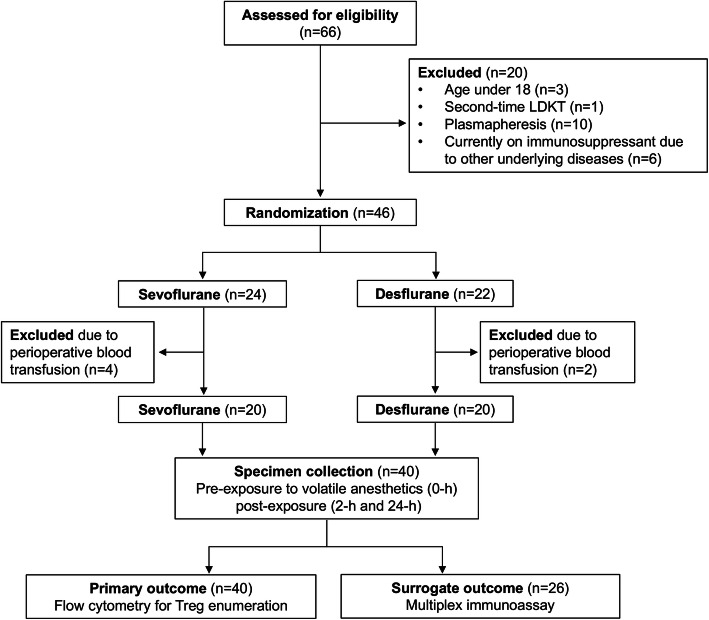
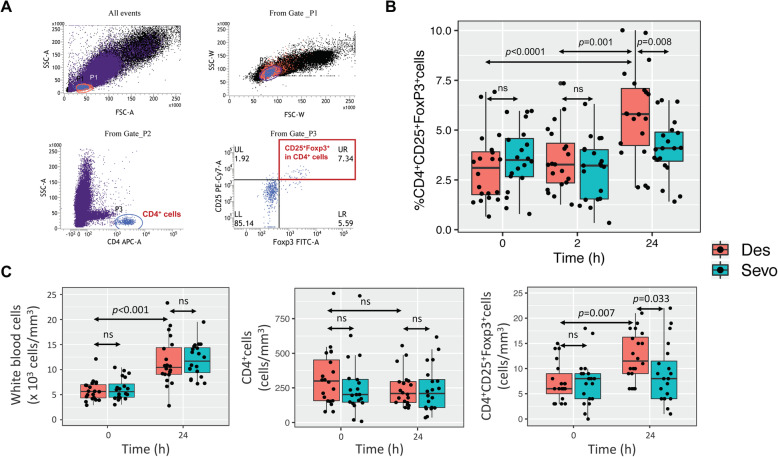
Background: Volatile anesthetic agents used during surgery have immunomodulatory effects which could affect postoperative outcomes. Recognizing that regulatory T cells (Tregs) plays crucial roles in transplant tolerance and high peripheral blood Tregs associated with stable kidney graft function, knowing which volatile anesthetic agents can induce peripheral blood Tregs increment would have clinical implications. This study aimed to compare effects of desflurane and sevoflurane anesthesia on peripheral blood Tregs induction in patients undergoing living donor kidney transplantation. Methods: A prospective, randomized, double-blind trial in living donor kidney transplant recipients was conducted at a single center, tertiary-care, academic university hospital in Thailand during August 2015 – June 2017. Sixty-six patients were assessed for eligibility and 40 patients who fulfilled the study requirement were equally randomized and allocated to desflurane versus sevoflurane anesthesia during transplant surgery. The primary outcome included absolute changes of peripheral blood CD4 + CD25 + FoxP3 + Tregs which measured by flow cytometry and expressed as the percentage of the total population of CD4 + T lymphocytes at pre-exposure (0-h) and post-exposure (2-h and 24-h) to anesthetic gas. P -value < 0.05 denoted statistical significance. Results: Demographic data were comparable between groups. No statistical difference of peripheral blood Tregs between desflurane and sevoflurane groups observed at the baseline pre-exposure (3.6 ± 0.4% vs. 3.1 ± 0.4%; p = 0.371) and 2-h post-exposure (3.0 ± 0.3% vs. 3.5 ± 0.4%; p = 0.319). At 24-h post-exposure, peripheral blood Tregs was significantly higher in desflurane group (5.8 ± 0.5% vs. 4.1 ± 0.3%; p = 0.008). Within group analysis showed patients receiving desflurane, but not sevoflurane, had 2.7% increase in peripheral blood Treg over 24-h period ( p < 0.001). Conclusion: This study provides the clinical trial-based evidence that desflurane induced peripheral blood Tregs increment after 24-h exposure, which could be beneficial in the context of kidney transplantation. Mechanisms of action and clinical advantages of desflurane anesthesia based on Treg immunomodulation should be investigated in the future. Trial registration: ClinicalTrials.gov, NCT02559297 . Registered 22 September 2015 - retrospectively registered
Overview
The claims and statistics of this paper haven’t been checked yet.
Run the check — free, no account needed. It reads the open-access text and checks the sources it cites.
Integrity signals
Registry
Cites
Statistics
Figures
Verification
Claims the paper makes
The claims and statistics of this paper haven’t been checked yet.
Run the check — free, no account needed. It reads the open-access text and checks the sources it cites.
Self-check
Percentages, sums and reported differences re-computed from the paper’s own numbers.
The self-check needs the paper’s full text.
Citations
Cites
CONSORT 2010 Statement: updated guidelines for reporting parallel group randomised trials
the CONSORT Group, Schulz, K. F., Altman, D. G., & Moher, D. (2010) · Trials · doi:10.1186/1745-6215-11-32 · Cited by 1,871
FOXP3+ regulatory T cells and their functional regulation
Li, Z., Li, D., Tsun, A., & Li, B. (2015) · Cellular & Molecular Immunology · doi:10.1038/cmi.2015.10 · Cited by 290
Research works printed but not linked: 30
- Josephson MA. Monitoring and managing graft health in the kidney transplant recipient. Clin J Am Soc Nephrol. 2011;6:1774–80. · DOI
- Goldberg RJ, Weng FL, Kandula P. Acute and chronic allograft dysfunction in kidney transplant recipients. Med Clin North Am. 2016;100:487–503. · DOI
- Hara S. Banff 2013 update: pearls and pitfalls in transplant renal pathology. Nephrology. 2015;20(Suppl 2):2–8. · DOI
- Halloran PF, Reeve JP, Pereira AB, Hidalgo LG, Famulski KS. Antibody-mediated rejection, T cell-mediated rejection, and the injury-repair response: new insights from the Genome Canada studies of kidney transplant biopsies. Kidney Int. 2014;85:258–64. · DOI
- Graca L, Cobbold SP, Waldmann H. Identification of regulatory T cells in tolerated allografts. J Exp Med. 2002;195:1641–6. · DOI
- Edozie FC, Nova-Lamperti EA, Povoleri GA, Scottà C, John S, Lombardi G, et al. Regulatory T-cell therapy in the induction of transplant tolerance: the issue of subpopulations. Transplantation. 2014;98:370–9. · DOI
- Hu M, Wang YM, Wang Y, Zhang GY, Zheng G, Yi S, et al. Regulatory T cells in kidney disease and transplantation. Kidney Int. 2016;90:502–14. · DOI
- Tang Q, Vincenti F. Transplant trials with Tregs: perils and promises. J Clin Invest. 2017;127:2505–12. · DOI
- de St Groth BF. Regulatory T-cell abnormalities and the global epidemic of immuno-inflammatory disease. Immunol Cell Biol. 2012;90:256–9. · DOI
- Stelmaszczyk-Emmel A, Zawadzka-Krajewska A, Szypowska A, Kulus M, Demkow U. Frequency and activation of CD4+CD25 FoxP3+ regulatory T cells in peripheral blood from children with atopic allergy. Int Arch Allergy Immunol. 2013;162:16–24. · DOI
- Srisala S, Pongsakul N, Sahakijpicharn T, Hongeng S, Chutipongtanate S, Apiwattanakul N. Capillary blood as an alternative specimen for enumeration of percentages of lymphocyte subsets. BMC Res Notes. 2019;12:633. https://doi.org/10.1186/s13104-019-4659-4. · DOI
- Shan J, Guo Y, Luo L, Lu J, Li C, Zhang C, et al. Do CD4+ Foxp3+ Treg cells correlate with transplant outcomes: a systematic review on recipients of solid organ transplantation. Cell Immunol. 2011;270:5–12. · DOI
- Karczewski M, Karczewski J, Kostrzewa A, Wiktorowicz K, Glyda M. The role of Foxp3+ regulatory T cells in kidney transplantation. Transplant Proc. 2009;41:1527–9. · DOI
- San Segundo D, Fernández-Fresnedo G, Rodrigo E, Ruiz JC, González M, Gómez-Alamillo C, et al. High regulatory T-cell levels at 1 year posttransplantation predict long-term graft survival among kidney transplant recipients. Transplant Proc. 2012;44:2538–41. · DOI
- Liu L, Deng S, Teng L, Fu Q, Wang C, He X. Absolute of CD4(+)CD25(+)FOXP3(+) regulatory T-cell count rather than its ratio in peripheral blood is related to long-term survival of renal allografts. Transplant Proc. 2012;44:284–6. · DOI
- Ma L, Zhang H, Hu K, Lv G, Fu Y, Ayana DA, et al. The imbalance between Tregs, Th17 cells and inflammatory cytokines among renal transplant recipients. BMC Immunol. 2015;16:56. https://doi.org/10.1186/s12865-015-0118-8. · DOI
- Carmona-Escamilla MA, Queipo G, García-Mosqueda LA, García-Covarrubias L, Fonseca-Sánchez MA, Villanueva-Ortega E, et al. Peripheral blood regulatory T cells are diminished in kidney transplant patients with chronic allograft nephropathy. Transplant Proc. 2018;50:444–8. · DOI
- Hutchinson JA, Geissler EK. Now or never? The case for cell-based immunosuppression in kidney transplantation. Kidney Int. 2015;87:1116–24. · DOI
- Zwang NA, Leventhal JR. Cell therapy in kidney transplantation: focus on regulatory T cells. J Am Soc Nephrol. 2017;28:1960–72. · DOI
- Schneemilch CE, Hachenberg T, Ansorge S, Ittenson A, Bank U. Effects of different anaesthetic agents on immune cell function in vitro. Eur J Anaesthesiol. 2005;22:616–23. · DOI
- Pirbudak Cocelli L, Ugur MG, Karadasli H. Comparison of effects of low-flow sevoflurane and desflurane anesthesia on neutrophil and T-cell populations. Curr Ther Res Clin Exp. 2012;73:41–51. · DOI
- Koksoy S, Sahin Z, Karsli B. Comparison of the effects of desflurane and bupivacaine on Th1 and Th2 responses. Clin Lab. 2013;59:1215–20. · DOI
- Zhang T, Fan Y, Liu K, Wang Y. Effects of different general anaesthetic techniques on immune responses in patients undergoing surgery for tongue cancer. Anaesth Intensive Care. 2014;42:220–7. · DOI
- Liu S, Gu X, Zhu L, et al. Effects of propofol and sevoflurane on perioperative immune response in patients undergoing laparoscopic radical hysterectomy for cervical cancer. Medicine. 2016;95:e5479. https://doi.org/10.1097/MD.0000000000005479. · DOI
- Stollings LM, Jia LJ, Tang P, Dou H, Lu B, Xu Y. Immune modulation by volatile anesthetics. Anesthesiology. 2016;125:399–411. · DOI
- Yuki K, Eckenhoff RG. Mechanisms of the immunological effects of volatile anesthetics: a review. Anesth Analg. 2016;123:326–35. · DOI
- Alberu J, Vargas-Rojas MI, Morales-Buenrostro LE, Crispin JC, Rodríguez-Romo R, Uribe-Uribe NO, et al. De novo donor-specific HLA antibody development and peripheral CD4(+)CD25(high) cells in kidney transplant recipients: a place for interaction? J Transp Secur. 2012;2012:302539. https://doi.org/10.1155/2012/302539. · DOI
- Vignali DA, Collison LW, Workman CJ. How regulatory T cells work. Nat Rev Immunol. 2008;8:523–32. · DOI · Paper page
- Gianchecchi E, Fierabracci A. Inhibitory receptors and pathways of lymphocytes: the role of PD-1 in Treg development and their involvement in autoimmunity onset and cancer progression. Front Immunol. 2018;9:2374. https://doi.org/10.3389/fimmu.2018.02374. · DOI
- Vanichapol T, Pongsakul N, Srisala S, Apiwattanakul N, Chutipongtanate S, Hongeng S. Suppressive characteristics of umbilical cord blood-derived regulatory T cells after ex vivo expansion on autologous and allogeneic T effectors and various lymphoblastic cells. J Immunother. 2019;42:110–8. · DOI
Metadata
- Authors
- Chutipongtanate, A., Prukviwat, S., Pongsakul, N., Srisala, S., Kamanee, N., Arpornsujaritkun, N., Gesprasert, G., Apiwattanakul, N., Hongeng, S., Ittichaikulthol, W., Sumethkul, V., & Chutipongtanate, S.
- Affiliations
- Mahidol University (TH)
- Corresponding author
- Chutipongtanate, Somchai
- ORCID
- Venue
- BMC Anesthesiology
- Published
- 2020-08-27
- Volume
- 20
- Issue
- 1
- Pages
- 215-215
- ISSN
- 1471-2253 (ISSN-L)
- PMC
- PMC7450591
- OpenAlex
- W3080813876
- Cited by
- 11
- References
- 2
- Citations by year
- 2026: 1 · 2025: 3 · 2024: 1 · 2023: 2 · 2022: 2 · 2021: 2
- FWCI
- 1.09
- Type
- journal article
- Language
- en
- Open access
- gold
- doi.org
- Locations
- BMC Anesthesiology (publishedVersion, cc-by)
- Research Square (acceptedVersion, cc-by)
- PubMed Central (publishedVersion, cc-by)
- PubMed (publishedVersion)
- DOAJ (DOAJ: Directory of Open Access Journals) (submittedVersion, cc-by-sa)
- Funders
- Talent Management Program of Mahidol University (TM:CP131)
- Topics
- Life Sciences › Biochemistry, Genetics and Molecular Biology › Cancer Research › Cancer, Stress, Anesthesia, and Immune Response
- Health Sciences › Medicine › Anesthesiology and Pain Medicine › Anesthesia and Sedative Agents
- Life Sciences › Neuroscience › Developmental Neuroscience › Anesthesia and Neurotoxicity Research
- Keywords
- sevoflurane, regulatory T cells, living donor kidney transplantation, volatile anesthetics, immunomodulation, transplantation tolerance, Foxp3, CD4+CD25+ T cells, kidney graft function, transplant rejection risk
- MeSH terms
- Sevoflurane, Desflurane, Adult, Double-Blind Method, Female, Humans, Male, Middle Aged, Prospective Studies, Kidney Transplantation, Anesthetics, Inhalation, Living Donors, T-Lymphocytes, Regulatory
About these checks
Registry, retraction, Cites and statistics results are computed, not judged, with one exception: a printed reference that no index lists is read once by a model before it counts as a citation error. Claims are extracted by a model and kept only when their quote appears verbatim in the text; each cited source is then checked, with a model’s help, for whether it says what the claim relies on. Those verdicts can be wrong — read the claim’s quote and the cited source before relying on one.
Statistics and arithmetic are recomputed, not judged.
Confidence bands are shown only for fields calibrated on our annotated test set. None is calibrated yet, so no band is shown.
What counts as a claim ›How we measure confidence ›How we check this ›
Are you an author, or do you see a problem with this page? Request a review
